
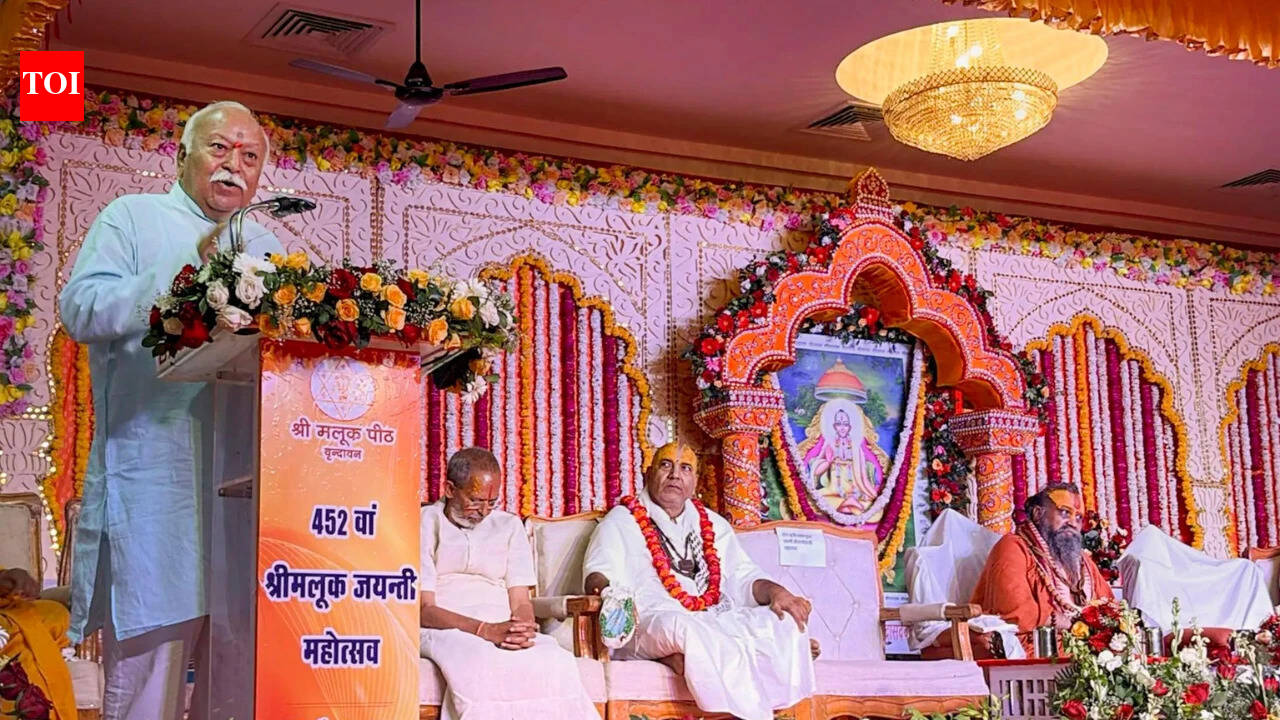

Mohan Bhagwat: Public awareness like Ram Temple is needed to stop cow slaughter: Mohan Bhagwat. india news
There is a need for public awareness like Ram temple to stop cow slaughter: Mohan Bhagwat
Mathura: RSS chairman Mohan Bhagwat Tuesday said public awareness could help end cow slaughter in India, and wished for a Ram Temple-style enthusiasm for the cause.“Make the society dedicated to cows, and cow slaughter will stop immediately. We have to make the public aware; The rest will follow,” Bhagwat said.He acknowledged the constraints of keeping cows in cities and suggested people support ‘gaushalas’ instead.The Rashtriya Swayamsevak Sangh (RSS) chief was speaking on the 452nd birth anniversary of Maluk Das Ji Maharaj at Maluk Peeth in Vrindavan.“If public sentiment exists, the system has to accept it,” he said.Bhagwat referred to the historic judgment of the Supreme Court which paved the way for the construction of Ram Janmabhoomi temple in Ayodhya.He said, “Ram temple did not come between 2014 and 2019. It came after 2019. Why? The Supreme Court, which said it had other very important matters, gave a unanimous verdict.”Bhagwat said the top court gave this decision due to the “sentiments” of the entire country. “Similarly, the same feeling should be shown for the cows also. You are also trying, we are also trying.” The decades-long struggle for the Ram temple in Ayodhya ended with the Supreme Court’s decision in 2019.A ‘Bhoomi Pujan’ ritual was conducted at the temple construction site in the presence of Prime Minister Narendra Modi in August 2020, followed by a ‘Pran Pratishtha’ ceremony in January 2024.According to a statement released by the organizers after the event, Bhagwat said he has no doubt that India will become a world leader.Bhagwat said, “India will provide a new direction to the world by taking inspiration from its saints and its spiritual values.”On unrest in West Asia, the RSS chief said the time has come for “India to emerge as a ‘Vishwa Guru’ and create a new, happy and beautiful world.” Bhagwat stressed the need for enlightenment for all and urged people to follow not only the words of the saints but also the feelings underlying them.He said that Maluk Peeth kept the tradition of Sant Maluk Das alive for 452 years. Everyone should learn the philosophy of life from this example.He said, “There cannot be (any) religion without truth and compassion. All must live in harmony. Compassion enters one’s life when the suffering of others feels like one’s own suffering.”Responding to Mahant Rajendra Das Maharaj’s demand for a complete ban on cow slaughter, Bhagwat said that make the society cow devotees, cow slaughter will automatically stop.He said, “Strengthen… This will be a bold step. Cow products will be made available to every single person. The Sangh will work in this direction.”

उत्तराखंड मौसम: बदला मौसम का मिजाज, अगले तीन दिनों तक बारिश और ओलावृष्टि की चेतावनी जारी – उत्तराखंड में अगले तीन दिनों तक बारिश और ओलावृष्टि की चेतावनी जारी
मौसम का मिजाज फिर बदल गया है। मौसम विज्ञान केंद्र देहरादून ने पिथौरागढ़, बागेश्वर समेत सभी जिलों में बिजली गिरने, ओलावृष्टि और तेज आंधी चलने की चेतावनी जारी की है। इस दौरान पर्वतीय जिलों के ऊंचाई वाले क्षेत्रों में कुछ स्थानों पर हल्की से मध्यम बारिश और बर्फबारी की संभावना है।


Why was Assamgold banned? Streamer breaks silence on Twitch suspension and calls out “double standard”

Twitch streamer AsmonGold is now at the forefront of another controversy, this one due to a week-long suspension that almost immediately spiraled out of control and sparked a widespread debate about how the platform enforced its rules and how consistently they appeared. The ban was mentioned suddenly on April 6, leaving viewers surprised when their channel went offline continuously. Within hours the trending creator himself responded to the issue, providing a clear clarification that further fueled the ongoing discussion.This was not only a personal defense but a more general attack on Twitch. Asmagold’s response went viral on social media and was met with backlash from fans and critics. The case has again shown how easily streamer scams can emerge, especially when they involve sensitive issues and platform policing.
AsmonGold calls out “double standards” after ban
Addressing X, Asmagold did not hold back from explaining the reason behind his suspension. He wrote: “Banned for an entire week because I said I don’t give a fuck about the opinions of illiterate third world people. Would someone be banned for saying they don’t care what an American’s opinion is on the Middle East? Of course that’s not blatant double standards, I didn’t break ToS.”There was an immediate backlash to his comments, with many users questioning both the language used and his claims of inappropriate behaviour. However, others sided with him and argued that enforcement on Twitch often appears inconsistent depending on the creator or context.The controversy did not emerge alone. Just a few weeks ago, Asmagold had already gone viral for comments about “parasitic immigrants”, where he said: “I will continue to say this – they are doing this deliberately. They’re doing it so they can continue to fund these parasitic immigrants into our country, and that’s why… And, by the way, for you guys in Europe who are watching this, the same thing is happening there. A huge problem in the West is that we have a transition, and we refuse to admit that there is a problem. Clearly there is a problem. Obviously there is pain. And, clearly, there is a solution.”That earlier clip had already divided audiences, and the latest ban has only intensified the scrutiny around its content and rhetoric. Despite the growing debate, Twitch has not yet released any official statement regarding the suspension.For now, this incident opens up a bigger question about moderation standards on streaming platforms. Where is the line between opinion and violation and who ultimately decides?

Sabarimala entry case: SC judge Nagarathna says can’t treat woman as ‘untouchable’ for 3 days | india news

New Delhi: A woman cannot be considered “untouchable” for three days in a month and then again on the fourth day. Supreme Court Judge BV Nagarathna made this comment on Tuesday during the hearing of other cases including Sabarimala issue.The remarks came when Solicitor General Tushar Mehta, representing the Centre, said he took strong objection to the 2018 Sabarimala verdict’s observation that barring women aged 10 to 50 years from entering the temple amounts to “untouchability” under Article 17 of the Constitution. “Article 17 in the context of Sabarimala, I don’t know how it can be argued. Speaking as a woman, there cannot be three days of untouchability every month, and on the fourth day, there is no untouchability,” Justice Nagarathna.The comment came in response to Mehta saying: “India is not as patriarchal or gender stereotypical as the West perceives it to be.”In the Sabarimala case, Justice DY Chandrachud said that barring women from entering the Sabarimala temple in Kerala, whether due to age or menstruation, amounts to “untouchability”, placing them in a “subordinate” position, reinforcing “patriarchy” and undermining their dignity.Mehta said the ban on women’s entry into the Sabarimala temple is not linked to menstruation, but has been imposed only on the basis of a specific age group.He said, “We must be clear. Sabarimala belongs only to a particular age group. There should be no confusion. Lord Ayyappa’s temples across the country and the world are open to women of all ages. This is the only temple which has this restriction. It is a normal matter.”The nine-judge bench was hearing petitions examining discrimination against women at religious places, including the Sabarimala temple in Kerala, and the extent and limits of religious freedom in different religions. The Constitution bench comprised Chief Justice Surya Kant and Justices BV Nagarathna, MM Sundaresh, Ahsanuddin Amanullah, Arvind Kumar, Augustine George Masih, Prasanna B Varale, R Mahadevan and Joymalya Bagchi.

Macaulay’s children are triggered because Pujarini Pradhan, from Medinipur, didn’t ask for permission to think, and speak English |

The controversy surrounding Pujarini Pradhan, better known as @Lifeofpuja on Instagram (with 751K followers), reminded me of a peculiar exchange in a cab about 18 years ago. The year was 2008. Author Salman Rushdie had won the ‘Best of Booker’ Prize, and newsrooms all over New Delhi, and the whole world, were abuzz. More than usual. This was the day after the news made headlines. After shifts got over, we were talking about the immense feat of the Indian-born British author (he hadn’t taken his American citizenship at the time) and waiting for Jha ji, the commander of the fleet of cabs that ferried journalists home at night.Jha ji was our favourite. He remembered all our names, and was a father figure for all of us who had come from different cities to make Delhi home, and quietly missed the elders we had left behind. He was in his mid-50s and we were mostly early-20-somethings. He had a baritone Bollywood would envy, and soft yet wise eyes that would smile but never tolerate any nonsense. He respected us, and took pride in ensuring every journalist — possibly his children’s age — reached home safely.Two minutes into the cab ride, we started discussing Rushdie’s feat, our headlines, our copies, the usual. Jha ji, as he sometimes did, joined the conversation. “Kaisi hai unki kitaab?” (How is his book?) he asked, referring to Midnight’s Children, which had won Rushdie his first Man Booker in 1981. A recent joinee, barely a few weeks into the job, turned to him and asked: “Aap jaante bhi ho Salman Rushdie kaun hai, Jha ji?” (Do you even know who Rushdie is?)Our driver was so stunned he actually slowed the car, looked back, and said quietly: “Haan, unko ‘Best of Booker’ mila hai. Akhbaar hum bhi padhte hain, waise. Hindi akhbaar. Usme bhi duniya ki khabar milti hai.” (Yes, he’s being awarded ‘Best of Booker’. I, too, read a newspaper. In Hindi. There’s world news covered in Hindi newspapers too)Pin-drop silence for the rest of the ride. But one thing was unmistakable: Jha ji was hurt. Hurt that a few kids he respected would think so little of him.Why did this person think less of Jha ji? Was it because he assumed knowledge and intellect were the exclusive preserve of the convent-educated, English-speaking middle class and above? Did it not occur to him that newspapers are published in every Indian language, and that the world arrives in people’s homes in many tongues? Was it foolishness, naivety, arrogance or some seamless, unreflective amalgam of all three?Which brings us to Pujarini. The controversy erupted while Pradhan was busy cutting vegetables, making videos, and talking about everything from menstrual leave to Stanley Kubrick, from why she wears a ghunghat while calling herself a feminist to Satyajit Ray. All in the same breath, with an ease and clarity of thought that is genuinely rare. And she does it in English. Not the impeccable, urban-approved, Macaulayan English that unlocks professional doors in Delhi or Mumbai, but English spoken with the unmistakable accent of someone who grew up in rural West Bengal and has absolutely no apology to offer for it. She is from Medinipur, to be precise. Urban India has a word for this kind of English: desi. Or ghati. The contempt is baked into the vocabulary itself.We may have reached the far side of the moon, Artemis 2, a first for humankind as evidence of just how far the human mind can stretch when it dares to dream. And yet that same brain remains perfectly capable of dragging others down simply to feel taller by comparison. Schadenfreude is as old as hunger. So is ignorance. We cannot always achieve something to feel superior, so we find the next best thing: diminishing someone else. Is she even real? How does she have access to international cinema? How can a rural woman edit her own content? As if curiosity has a postcode. As if Ray and Kubrick belong only to those with a metropolitan address and a particular vowel formation.This is not merely “influencer drama.” It is a sociological case study, a live demonstration of how urban Indians, conditioned by a colonial legacy that was never quite dismantled, continue to weaponise the English language to exclude and delegitimise voices that do not conform to metropolitan standards of aesthetics or articulation. It is the person in the cab, replicated across a thousand comment sections.When influencers like Niharika Jain and Aishwarya Subramanium accused Pujarini of being inauthentic, the accusation wasn’t really about authenticity. It was about register. About the unsettling dissonance they felt watching someone analyse Pather Panchali in an accent they had been trained—socially, culturally, almost genetically at this point—to associate with the domestic help rather than the film critic. The outrage wasn’t intellectual. It was hierarchical.To understand why Pradhan’s accent caused what some breathlessly called an “internet meltdown,” you have to go back to 1835 and Thomas Babington Macaulay’s infamous Minute on Education: a document that set out, with remarkable candour, to manufacture a class of Indians who were Indian in blood but English in taste, opinion, and intellect. Intermediaries. A buffer class that would administer an empire and, long after that empire crumbled, would continue to administer its values. What Macaulay built wasn’t just a school system. It was a self-replicating hierarchy of credibility, and nearly two centuries later, it runs on autopilot, maintained not by British colonisers but by their most devoted inheritors.
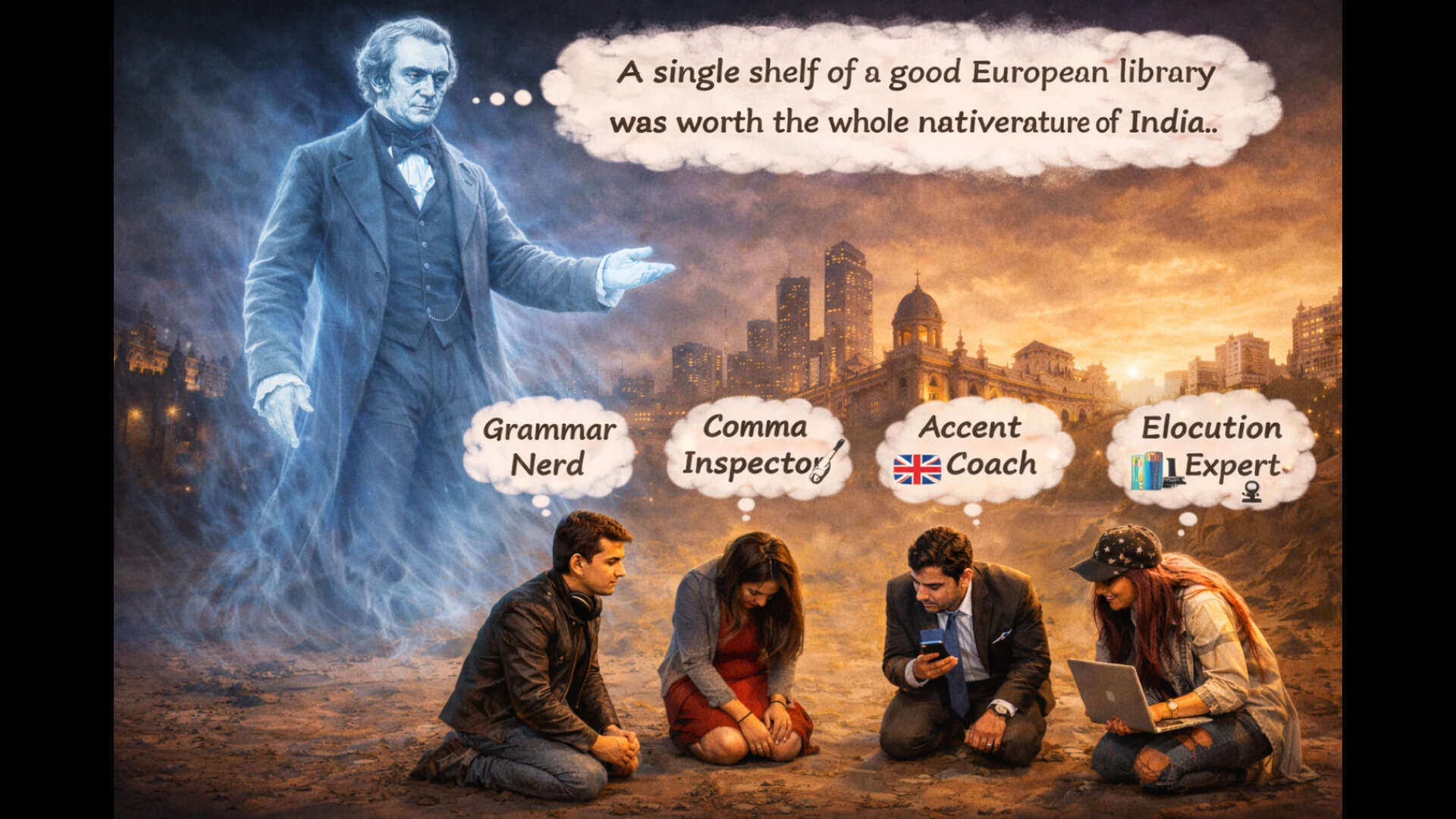
The ‘Macaulayan ghost’ haunts corporate offices and social media platforms with equal comfort. You’ll find it in the colleague who switches to English mid-meeting to subtly reassert authority, in the recruiter who mistakes fluency for intelligence, in the comment that says “at least learn to speak properly before having opinions”
The ‘Macaulayan ghost’ haunts corporate offices and social media platforms with equal comfort. You’ll find it in the colleague who switches to English mid-meeting to subtly reassert authority, in the recruiter who mistakes fluency for intelligence, in the comment that says “at least learn to speak properly before having opinions”. As if grammar were a prerequisite for thought. These are people who genuinely need a Prozac to recover from the Oxford Comma becoming history.
Community response to structural bias
What makes this more than a social media spat is that the bias Pujarini encountered isn’t just human — it’s infrastructural. Research into digital access in India reveals that over 53% of students from non-metro backgrounds believe their accent or mother tongue actively works against them when interacting with technology. They practise what researchers call “linguistic self-censorship”—consciously avoiding cultural references, flattening their speech, editing themselves before they even begin—to avoid being penalised by systems calibrated to a “standard” English that was never theirs to begin with. When urban influencers questioned Pujarini’s authenticity, they were doing the same thing, just without an algorithm. They became the algorithm, human proxies enforcing a standard that has no business being a standard, deciding who gets to be taken seriously and who needs to prove themselves first.What the accusers didn’t anticipate was the wall they ran into. The backlash against the backlash was swift, sharp, and surprisingly precise. Particularly from the Bengali community and from anti-caste voices who identified, almost immediately, what was really being said. People noted that the “savarna feminist” solidarity on display had a hidden clause: it extended only to those who cleared a certain socio-economic bar. “Bangali meye ra shob paare (Bengali girls can do anything)” became something of a rallying cry, less about regional pride than about collective refusal. What emerged wasn’t just defence of one creator; it was a reckoning with the particular cruelty of being told you don’t belong in a conversation you walked into on your own, with nothing but curiosity and years of quietly paying attention.There was one moment in all of this that cut through everything else. When critics pointed to the quality of her editing and colour grading as proof she couldn’t possibly be working alone, Pujarini’s response was three words: “Like it’s hard?”, a reference to Legally Blonde that was, in itself, a small act of cultural warfare. She wasn’t being dismissive. She was making a precise point: these are learnable skills, available to anyone with internet access and patience. The assumption of hidden expertise behind her work said far more about her critics than about her. They had tried to use her competence against her. She turned it around and made competence sound like the most ordinary thing in the world. Because for her generation, it is.
Pujarini is refusing to perform suffering
Perhaps the most revealing thread in the entire controversy is what Pujarini didn’t do. She didn’t display hardship. She didn’t frame her life as a struggle to be overcome or a condition to be pitied. Her videos are unhurried — moringa pakodas, a handcrafted toothbrush holder, opinions on Kubrick delivered while chopping vegetables. And this, it turns out, was the quiet provocation at the heart of everything. Urban audiences have been conditioned to receive rural India as a site of suffering, a moral project, a place that needs saving. A rural woman who is simply happy, articulate, financially independent, and entirely uninterested in your sympathy doesn’t fit that frame. She doesn’t give the elite the psychological foothold of feeling superior. As she put it herself: “They want me to see suffering in every video. They want me to see sad.” By refusing to perform poverty, she became, in their eyes, suspicious. Which tells you everything about whose comfort the narrative was always designed to protect.
What Pujarini actually represents and why that’s threatening…
The deeper discomfort isn’t that she speaks imperfect English. It’s that she speaks it anyway. Unselfconsciously, without the apologetic hedging that the hierarchy demands of those it considers outsiders. She hasn’t sought permission. She hasn’t code-switched to earn legitimacy. She picked up the language, the cinema, the discourse, and walked straight in through the front door and the gatekeepers are livid precisely because there was no gate to stop her.This is the thing about the internet that its early evangelists got right and its critics underestimated: it is, at its best, genuinely indifferent to your accent. A YouTube algorithm does not ask where you are from. A film doesn’t reveal its meaning only to those who watched it in a multiplex. Knowledge has always found ways around the walls built to contain it. Real, curious, hungry knowledge. Jha ji read the Hindi newspaper. Pujarini watched The Shining in Medinipur. The walls were never as tall as their builders believed.What we are witnessing, in the fury directed at her, is not a culture war about authenticity. It is the sound of a particular class realising, with mounting dread, that the thing they mistook for intelligence was always just access. And access, it turns out, is no longer entirely theirs to control.

Photo: @lifeofpujaa/ Instagram
What’s the Pujarini Pradhan controversy all about?
Influencer Niharika Jain and former fashion editor Aishwarya Subramanyam, also known as @otherwarya accused Pujarini Pradhan @lifeofpuja of being “inauthentic”, “manufactured” and siad she was possibly an “industry plant”. Actress Samantha Ruth Prabhu, who played the fiery Sri Lankan Tamil liberation rebel in ‘The Family Man’, liked the reel questioning Pradhan’s authenticity. Director Kiran Rao, known for ‘Laapata Ladies’, liked the reel by Otherwarya too. Given Rao’s public stance on inclusivity, it was disappointing. But it was also ironic because ‘Laapata Ladies’ is a story of rural women breaking barriers by using their wit while fighting social stigma. But the accusation backfired as more people on social media defended her, calling out the hypocrisy of urban creators and influencers. She also got support from director Vikramaditya Motwane, director Gunnet Monga, actor Archana Puran Singh and influencer Kusha Kapila, among others.
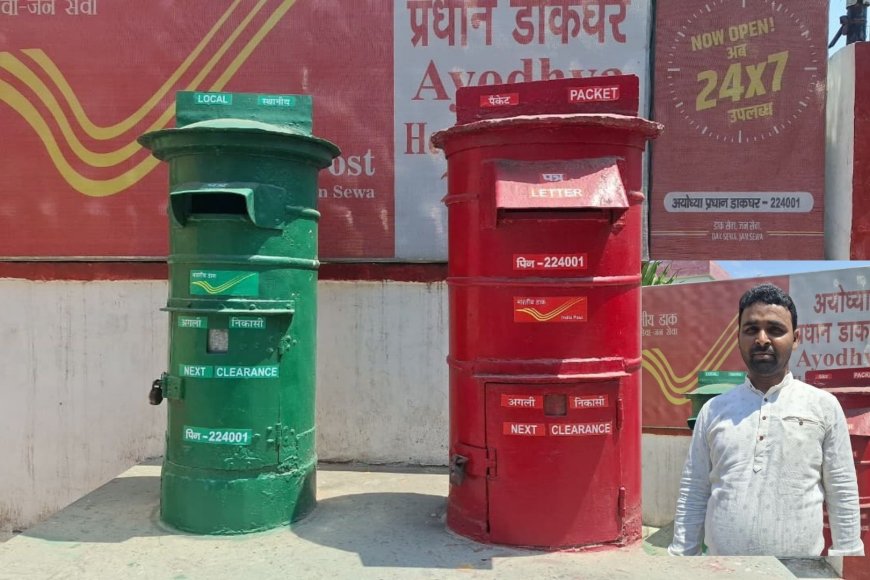
अयोध्या में 30 लाख रुपये के गबन का मामला, उप डाकपाल समेत तीन पर केस, पुलिस की जांच तेज
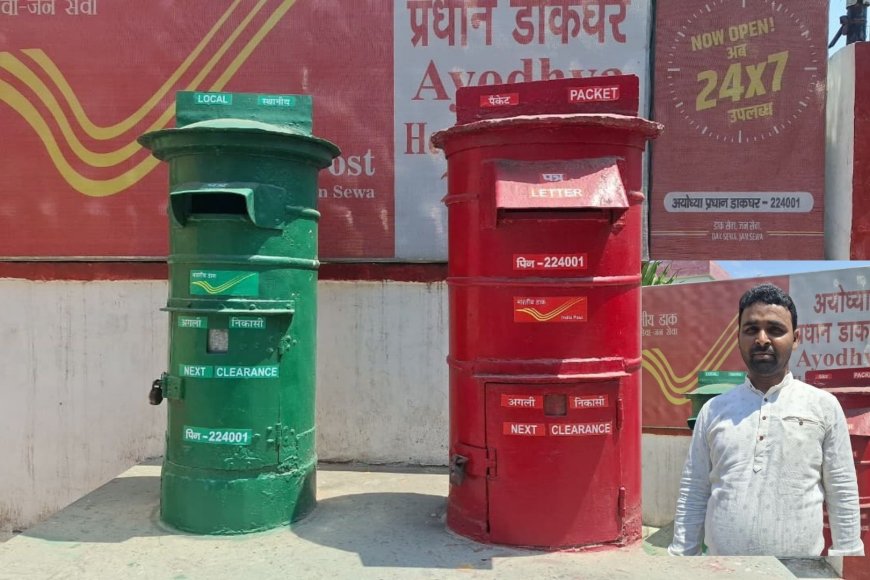
धार्मिक नगरी अयोध्या के महबूबगंज उपडाकघर में 30 लाख रुपये के गबन का गंभीर मामला सामने आया है, जिससे प्रशासन और आम लोगों के होश उड़ गए हैं. इस मामले में डिप्टी पोस्टमास्टर शिवांशु श्रीवास्तव, उनकी पत्नी आयुषी श्रीवास्तव और सिपाही अजय यादव के खिलाफ केस दर्ज किया गया है. आरोप है कि खाताधारकों को फर्जी तरीके से मृत दिखाकर उनकी जमा पूंजी हड़प ली गई। मामले की गंभीरता को देखते हुए पुलिस ने जांच शुरू कर दी है और संबंधित अधिकारियों के खिलाफ कार्रवाई भी की गई है.
कैसे हुआ 30 लाख रुपये का गबन?
जानकारी के मुताबिक, पीड़ित मोहम्मद सगीर खान, उनके बेटे शमशेर खान और पत्नी कैसर जहां ने 11 जनवरी 2025 को 30 लाख रुपये का किसान विकास पत्र खरीदा था. आरोप है कि उप डाकपाल शिवांशु श्रीवास्तव ने इन तीनों खातों को फर्जी तरीके से मृत दिखाकर बंद कर दिया. इसके बाद पूरी रकम नॉमिनी मुमताज जहां के खाते में ट्रांसफर कर दी गई.
यहां तक कि नॉमिनी को भी कोई जानकारी नहीं थी
सबसे चौंकाने वाली बात यह थी कि नॉमिनी मुमताज जहां को इस लेनदेन के बारे में कोई जानकारी नहीं थी. 13 मई को उनके खाते से 15 लाख रुपये निकाल लिए गए। बाद में जांच में पता चला कि उसी दिन यह रकम सिपाही अजय यादव के खाते में जमा की गई थी।
जांच में आपसी संबंधों का खुलासा हुआ
पुलिस जांच में यह भी पता चला कि अजय यादव और शिवांशु श्रीवास्तव के बीच करीबी रिश्ते थे. इसके अलावा कुछ रकम आयुषी श्रीवास्तव के खाते में भी ट्रांसफर की गई थी. इससे पूरे मामले में साजिश की आशंका को और बल मिल गया है.
लापरवाही पर कार्रवाई, जांच जारी
मामले में लापरवाही पाए जाने पर डॉ. गौरव ग्रोवर ने सख्त कार्रवाई करते हुए थाना प्रभारी शरदेंदु दुबे और सिपाही अजय यादव को निलंबित कर दिया. फिलहाल पुलिस पूरे मामले की गहराई से जांच कर रही है और यह पता लगाने की कोशिश कर रही है कि इसमें और कौन लोग शामिल हो सकते हैं.
लोगों में बढ़ी चिंता
इस घटना के बाद आम लोगों में अपने पैसों की सुरक्षा को लेकर चिंता बढ़ गई है. डाकघर जैसी भरोसेमंद संस्था में इस तरह का मामला सामने आने से लोगों के विश्वास पर असर पड़ा है.
(रिपोर्ट:अनूप कुमार अयोध्या)

Artemis II astronauts observe the Moon during flight; NASA shared the picture.

NASA’s Artemis II mission has taken a significant step forward in its flight program by taking astronauts to the closest point to the Moon, which was last done during the Apollo 17 mission. Although no landing occurred during this mission, the purpose of the mission was to test space systems and make observations during a seven-hour flight near the Moon.The mission has had several concrete achievements, such as setting a new record for the greatest distance traveled by astronauts. The far side of the Moon, solar eclipse and unique phenomena occurring on the Moon’s surface were also observed.
NASA’s Artemis II lunar flyby Reveals detailed views of the far side of the Moon
During their time in lunar orbit, the astronauts made intensive observations of the area. It was found that the far side of the moon contained a dense collection of craters, as well as solidified lava fields and geological cracks. Variation in brightness and texture has been observed, which may be useful for understanding variations in surface structure.The information collected is believed to be useful in future missions, especially in the search for suitable locations. In addition, the crew observed the Earthset and Earthrise events.
Artemis II lunar flyby captures solar eclipse and rare meteorite impact shine
A solar eclipse occurred during the observation window when the spacecraft, Moon, and Sun were aligned. The event lasted about an hour and allowed the crew to observe the solar corona in partially blocked sunlight conditions.Six flashes were observed on the Moon’s surface during the same period. These flashes are consistent with meteorite impacts, which occur when space debris hits the Moon at high velocity. While such effects are known, direct observations from crewed spacecraft are limited.The recorded flashes will be analyzed along with the imaging data to determine their exact time and location.

PC: NASA
NASA Artemis II live coverage shows crew interacting with Donald Trump
Following the completion of the lunar observation period, the crew participated in a live broadcast segment hosted by NASA. During this session, President Donald Trump spoke to the astronauts and praised the progress of the mission.The crew also chatted with Jared Isaacman, discussing aspects of the flyby and onboard observations. Questions submitted through social media were addressed during the broadcast, which was part of the mission’s public communication effort. The talks took place after communication links were fully restored.

PC: NASA
orion spacecraft 40 minutes of signal lost during lunar flyby mission
When Orion moved behind the Moon, communication with Mission Control was temporarily lost. This blackout lasted about 40 minutes and was caused by the Moon blocking direct radio signals between the spacecraft and Earth.During this phase, the spacecraft made its closest approach to the lunar surface at a distance of approximately 4,067 miles. At around 7:00 pm, Orion passed on the far side before continuing on its trajectory. All onboard systems operated as expected during the communications gap, and contact was restored when the spacecraft reappeared from behind the Moon.
NASA Artemis II flyby data sent to Earth to support future lunar landings
Data collected during the Artemis II flyby is currently being sent to Earth for detailed investigation. It includes images, recorded observations, and spacecraft telemetry. Scientific teams are expected to review the material to refine models related to lunar geology and mission operations.There are also plans to compare the observed impact brightness with independent observations from Earth-based viewers. This may help verify the timing and nature of events recorded during the mission.

Harry Maguire signs contract extension at Manchester United
Former Harry Maguire has signed a new one-year contract with Manchester United, with the option to extend for a further year. The 33-year-old central defender’s previous deal was due to expire at the end of the season.
Maguire joined United from Leicester City in 2019 for £80 million, which was a world-record fee for a defender at the time. Since then, he has made 266 appearances and played a role in the club’s League Cup victory in 2022–23, followed by FA Cup success the following season.
Maguire said, “Representing Manchester United is the highest honour. It’s a responsibility that makes me and my family proud every day.” “I am delighted to extend my journey at this incredible club to at least eight seasons and continue playing in front of our special supporters to create more amazing moments together.”
Maguire’s tenure at Old Trafford has not been without turmoil. Appointed captain by Ole Gunnar Solskjaer just five months after his arrival, he remained a regular despite criticism during the tenures of both Solskjaer and his successor, Ralf Rangnick.
In April 2022, Cheshire Police searched Maguire’s home After the bomb threat. His status at the club subsequently declined under Eric ten Hag, who stripped him of the captaincy in July 2023. Although a transfer to West Ham United was agreed soon afterwards, Maguire chose to remain at United.
Under Ruben Amorim, opportunities were limited, but the defender has since experienced a resurgence under interim manager Michael Carrick, starting all ten matches since Carrick’s appointment in mid-January.
Maguire said, “You can feel the ambition and potential of this exciting team. The determination throughout the club to fight for major trophies is clear to everyone, and I am confident that together our best moments lie ahead of us.”
Director of Football Jason Wilcox said: “Harry represents the mentality and resilience required to perform for Manchester United. He is the ultimate professional who brings invaluable experience and leadership to our young, ambitious squad.”
– ends

Rahul Gandhi accuses Modi government of excluding Dalit, tribal and OBC entrepreneurs from major public contracts. india news

‘Why have Bahujan entrepreneurs been kept out?’ Rahul Gandhi targets Center over contract data gap
New Delhi: Rahul Gandhi Asking the Modi government why no data is maintained on the share of public works contracts worth over Rs 16,500 crore awarded to Dalit, tribal and OBC-owned businesses, he has accused the Center of promoting a “deliberately constructed exclusionary system” after Parliament had told him no such record existed.In an unstarred question in the Lok Sabha, Gandhi sought details on public works and infrastructure contracts awarded under the Central Public Works Department (CPWD) and the Ministry of Housing and Urban Affairs in the last five years, specifically asking how many were secured by SC, ST and OBC-owned enterprises.
Government response
In a written reply, Minister of State for Housing and Urban Affairs Tokhan Sahu said that though the government can provide the total number and value of contracts awarded year-wise, “there is no existing mechanism to track contracts awarded to enterprises owned by persons belonging to Scheduled Castes (SC), Scheduled Tribes (ST) and Other Backward Classes (OBCs).”The government also clarified that all such contracts fall under construction contracts, and it is “not mandatory” for them to maintain caste-based data. On a question on extending the purchase mandate for SC/ST owned enterprises, the minister replied: “In view of the above, the question does not arise.”
‘Deliberate boycott’: Rahul Gandhi
Responding to the government’s response on social media, the opposition leader said the response was “deeply worrying”.“The government does not maintain any data in this regard,” Gandhi said. “The policy says 25% of public procurement should be sourced from MSMEs, of which 4% is earmarked for Dalit and tribal entrepreneurs. However, when it comes to the largest and most lucrative contracts, public works, the government says this requirement is not ‘mandatory’.”He argued that this is “not just an administrative lapse; it is a system of exclusion deliberately created through the policies of the Modi government, which undermines social and economic justice.”“The question is simple: Why are Bahujan entrepreneurs being kept out of the country’s biggest public contracts?” He added.Rahul Gandhi further explained in his post that the government’s public procurement policy for MSMEs states that 25 percent of procurement by central ministries and public sector undertakings will be from micro, small and medium enterprises, of which four percent is specifically earmarked for SC/ST-owned enterprises.However, the government has now clarified in Parliament that this provision is not mandatory for public works contracts, which are generally among the largest and most profitable government tenders. These contracts are awarded through open tender processes, and no centralized database is maintained on the social category of contractors.This exchange has taken place ahead of assembly elections in many states. Gandhi’s office said the absence of such data raises broader concerns about equal access and transparency in government spending.Gandhi said, “Modi government will have to answer this.”
ब्रिटेन: पंतनगर विश्वविद्यालय का 37वां दीक्षांत समारोह शुरू, 1395 छात्रों को मिलेगी डिग्री
गोविंद बल्लभ पंत कृषि एवं प्रौद्योगिकी विश्वविद्यालय, रुद्रपुर का दीक्षांत समारोह शुरू हो गया है। 37वें दीक्षांत समारोह के मुख्य अतिथि राज्यपाल और विश्वविद्यालय के कुलाधिपति सीनेटर लेफ्टिनेंट जनरल गुरुमीत सिंह और कृषि मंत्री गणेश जोशी कार्यक्रम स्थल पर पहुंच गये हैं.
अतिथि कुछ देर में 1395 विद्यार्थियों को डिग्री प्रदान करेंगे। समारोह में सर्वश्रेष्ठ स्नातकों को 13 स्वर्ण, 12 रजत और 10 कांस्य पदक प्रदान किये जायेंगे। यहां सांसद अजय भट्ट, कुलपति प्रो.मनमोहन सिंह चौहान आदि पहुंचे हैं।