
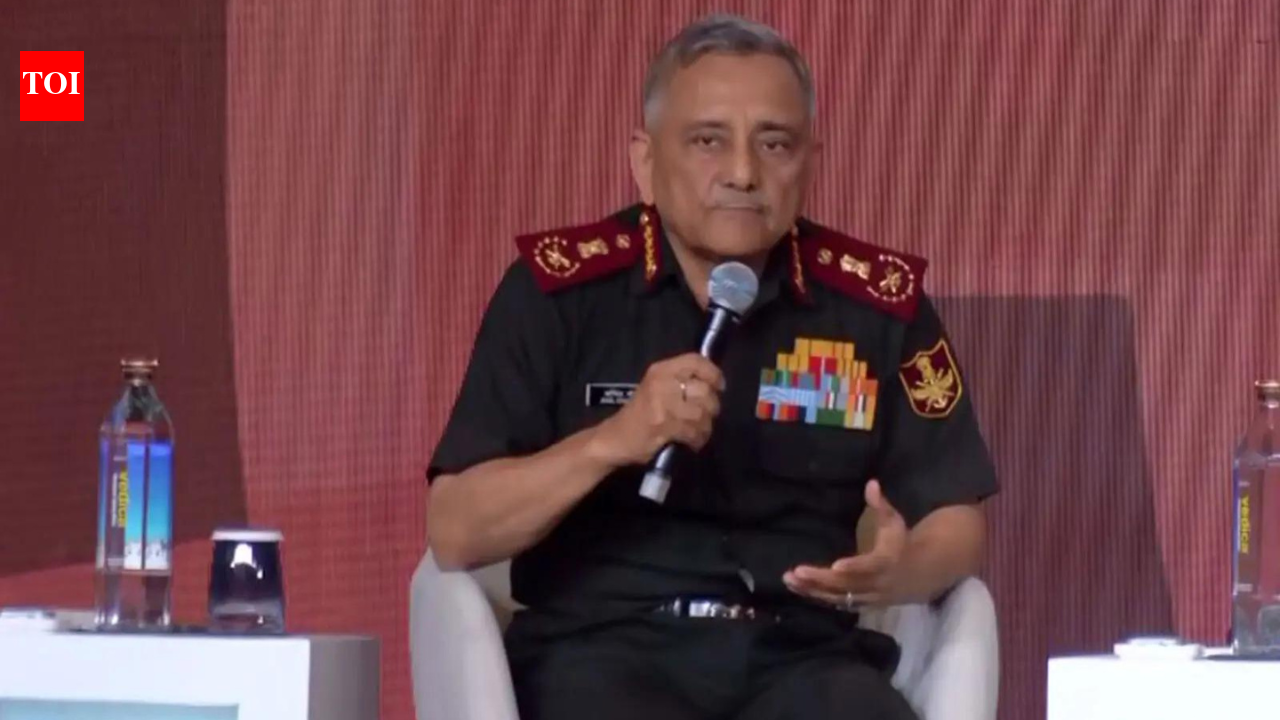

CDS signals consensus of services on theater commands, says structure still evolving
BENGALURU: Chief of Defense Staff General Anil Chauhan on Friday said India’s push towards a unified theater command has cleared its most significant hurdle – agreement in principle between the three services – but key questions on structure, sequencing and organization are still being worked out.Speaking to reporters on the sidelines of Ran Samvad 2026 in Bengaluru, Chouhan described the reform as “a big step”, noting that the Army, Navy and Air Force are united on the basic idea of separating force generation from force application. “There is complete agreement on the concept,” he said, adding that details such as command location, structure and sequencing “can be resolved during implementation” and are not cast in stone.Chouhan acknowledged that the reforms involved voluntarily reducing the traditional authority of the service chiefs, a concession he described as significant. Calling it a more meaningful development than structural details, he said, “The service chiefs are willing to do this for the larger good of India.”The new joint headquarters will integrate operations, intelligence and logistics under a single structure. The existing regional commands will continue to be under the theater command for operations while being attached to the service headquarters for administrative purposes. Chauhan clarified that the Army’s proposed Integrated Battle Groups (IBGs) are completely separate, aimed at making ground combat units more agile and are unrelated to the theater command structure.On the theme of RAN dialogue, on multi-domain operations, Chauhan offered a more detailed view than currently reflected in doctrine. He argued that warfare has moved beyond physical spheres into synthetic and cognitive spheres, where shaping public perception can achieve political objectives without firing a single shot – pointing to ongoing conflicts where battlefield dominance has not translated into clear political outcomes.He also presented an original reformulation of U.S. Air Force strategist Colonel John Boyd’s OODA (Observe, Orient, Decide, Act) loop, suggesting that advances in predictive AI and data analytics could reverse the traditional sequence, allowing forces to orient and decide before observing, thereby compressing the decision cycle more than Boyd had imagined.Chauhan characterized time as the emerging fourth dimension of warfare, noting that modern battlefields now host systems running at vastly different speeds simultaneously, from slow-moving underwater platforms to almost instantaneous cyber intrusions, demanding new frameworks for understanding and command.On capability options, he was deliberately non-committal on debates such as the future of aircraft carriers versus submarines or tanks, arguing that the war was evolving too rapidly for firm long-term answers. He denied any shift towards expeditionary ambitions, reaffirming that securing India’s borders remains the primary focus, with foreign roles limited to humanitarian aid and UN missions.Terming the Ran Samvad as a deliberate reversal of the tradition of centering serving officers rather than veterans or think tanks, Chauhan said the seminar also acted as a diagnostic tool, giving him a ground-level insight into how deeply the culture of jointness has actually penetrated the three services.