
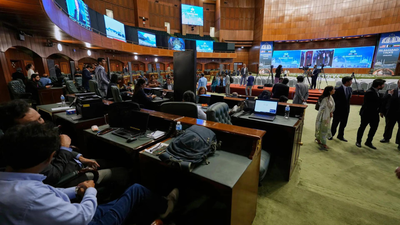

Amidst controversies and distrust, direct talks between America and Iran begin in Pakistan.
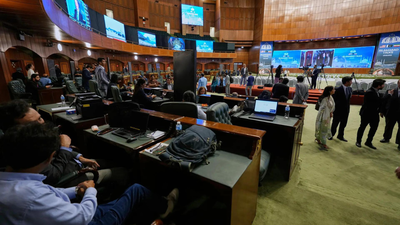
ISLAMABAD: The United States and Iran began face-to-face talks in Pakistan on Saturday, days after announcing a fragile, two-week ceasefire as the war that has killed thousands and roiled global markets enters its seventh week. The White House confirmed the direct nature of the talks, which are a rare example of high-level US government engagement with the Iranian government. Iran’s state news agency said three-party talks, including Pakistan, had begun after Iranian pre-conditions were met, including a reduction in Israeli attacks on southern Lebanon. “The formal round of direct talks between Iran and the US has officially started on Saturday evening after Pakistan Prime Minister Shehbaz Sharif held separate meetings with the US and Iranian delegations,” a senior Shehbaz administration official told PTI. The US delegation, led by Vice President J.D. Vance, and the Iranian delegation, led by Parliament Speaker Mohammad Bagher Qalibaf, were discussing how to advance a ceasefire already endangered by deep differences of opinion and Israel’s continued attacks against Hezbollah in Lebanon. Vance, accompanied by special envoy Steve Witkoff and President Trump’s son-in-law Jared Kushner, arrived in Islamabad hours after Qalibaf. Both delegations were welcomed by Pakistan’s Deputy PM Ishaq Dar and Army Chief Field Marshal Asim Munir at Rawalpindi’s Noor Khan airbase, which was damaged by Indian strikes during Operation Sindoor. Iranians wore black to mourn Ayatollah Khamenei and others killed in the war.
Chinese, Egyptian, Saudi and Qatari officials are in Islamabad to facilitate talks
Iranian Foreign Minister Abbas Araghchi was also part of the delegation. Since the Islamic Revolution in Iran in 1979, the most direct US contact occurred in September 2013 when President Barack Obama called newly elected President Hassan Rouhani to discuss Iran’s nuclear program. The highest-level meetings during talks on the program recently took place between Secretary of State John Kerry and his counterpart Mohammad Javad Zarif. Iran doubled down on parts of its earlier proposal, with its delegation telling Iranian state television that it had presented some of the plan’s ideas as “red lines” in meetings with Sharif. These included compensation for damage caused by the American-Israeli attacks that started the war on February 28. Reflecting the high stakes, officials in the region said Chinese, Egyptian, Saudi and Qatari officials were in Islamabad to indirectly facilitate the talks. He discussed the sensitive matter on condition of anonymity.