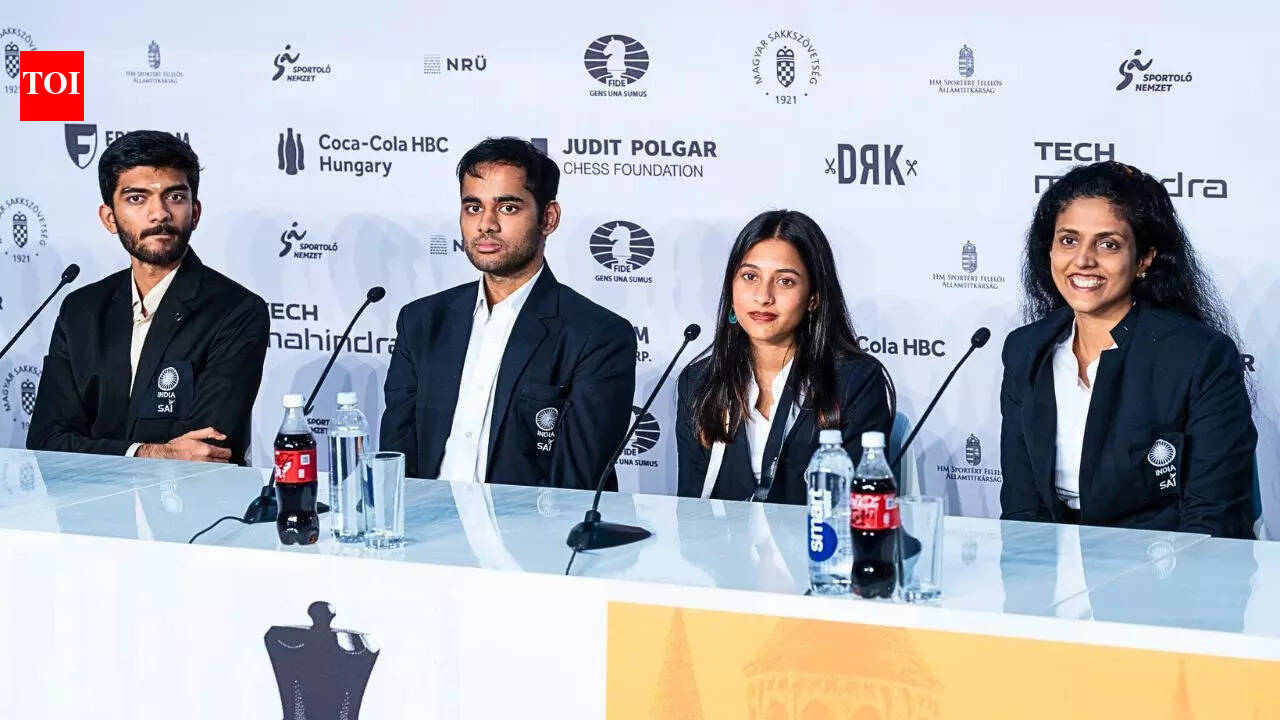
New Delhi: Last Sunday was International Women’s Day. Unless you’re on a full-on digital detox, your feed will probably be buried under a mountain of Instagram stories and WhatsApp statuses celebrating the day. You probably liked something, responded to some desires, and offered a vision of your values that aligned perfectly with the purpose.In view of the occasion, the FIDE Women’s Chess Commission (WOM) and the University of Queensland on Sunday published the 2026 Gender Equality in Chess Index (GECI). In this index, India has slipped one place in the global rankings to 25th since the inauguration of the 2023 edition.
From no laptop to Chess World Cup dreams: Exclusive interview with GM Pranesh M
In isolation, the decline of a spot may not seem worrisome. But in a country currently hailed as the fastest-growing chess powerhouse on the planet, this ranking points to a deeper structural imbalance. Although there are certainly poor performing countries in the list, questions may arise as to why India is not at the top.
What is the Gender Equality in Chess Index (GECI)?
The Gender Equality in Chess Index is essentially an attempt by the global chess body FIDE to measure the gender balance in federations around the world. The idea behind this is to measure where countries stand so that they can improve.“When we created the GECI in 2023, we wanted to give federations a clear, evidence-based picture of where they stand on gender equality. You can’t improve what you don’t measure,” said Grandmaster (GM) David Smerdon, Associate Professor at the University of Queensland and lead author of the report.
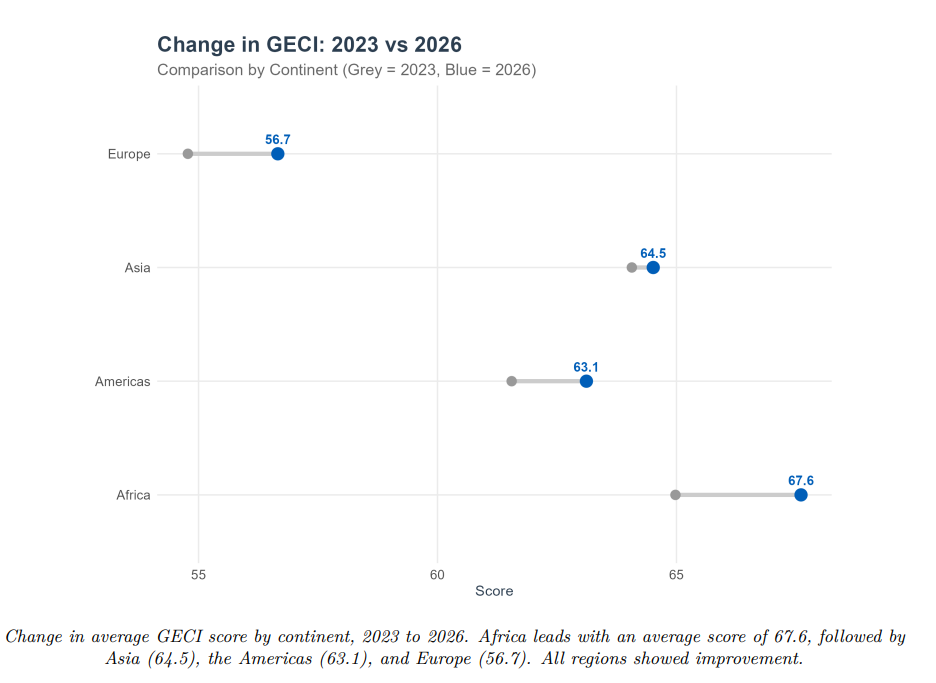
Change in average GECI score by continent (graphic from GECI Report 2026)
The report uses FIDE’s global ratings database and youth championship participation records to create an overall score that reflects women’s participation, performance and development pathways. According to the report, there are 1,446,605 active chess players worldwide, but only 238,716 are women, meaning overall female participation is only 16.5%.
How are rankings measured?
The GECI score is calculated using three key pillars:
- Participation – the share of women among active rated players in a federation. (The closer this figure is to 50%, the more balanced the ratio between male and female players.)
- Performance – The difference in strength between men and women based on average Elo rating.
- Progress – The proportion of girls representing a country at international youth championships.
In the 2026 release, India’s overall GECI score is 71.04, resulting in it falling one place to 25th globally. However, when you look deeper, the numbers tell a story of two different Indias.
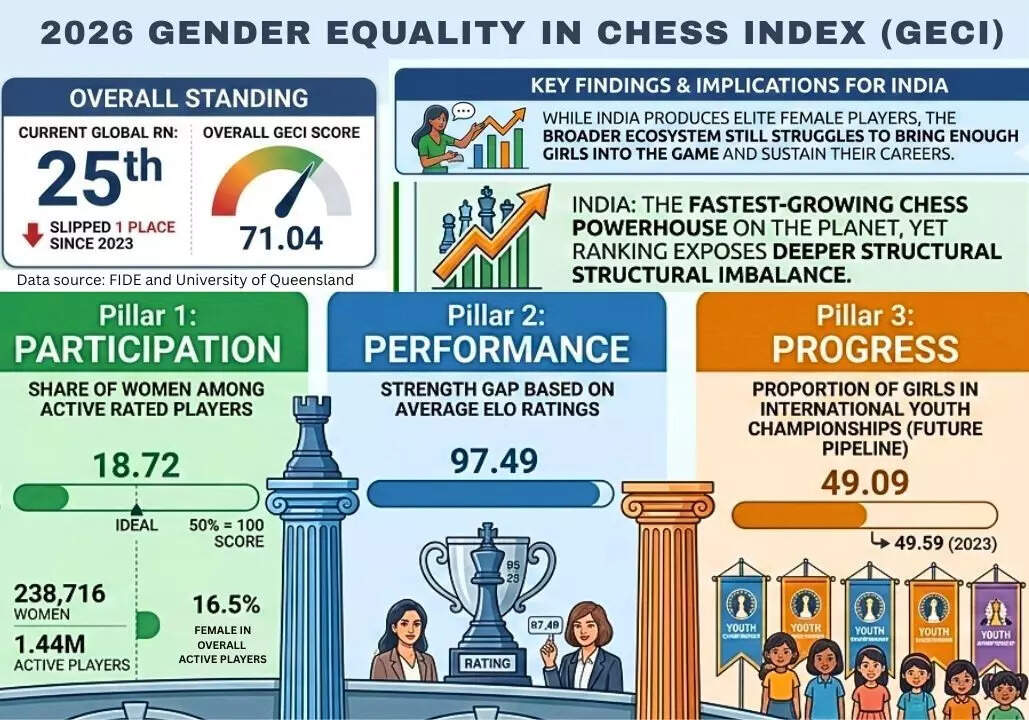
India’s numbers in 2026 GECI report
In performance, India stands at a staggering 97.49 (up from 88.31 in 2023), proving that our elite women are world class. Still, participation is down from 18.72, and progress, the metric for the next generation, saw a slight decline to 49.09.The metrics show that while India is phenomenal in producing top-rated female players, the broader ecosystem is still struggling to get girls on board and keep them there.
Where is the shortage in India?
From Vishwanathan Anand, who inspired a generation, to teenage talents dominating global tournaments, the country now has more than 90 grandmasters. Yet, in a country of over a billion people, only four women have reached chess’s highest titles and become GMs.As GM Harika Dronavalli explained, the issue starts long before players reach elite levels. “Girls aren’t driven to achieve ambitious goals like boys are. The talent is definitely there, but societal expectations often clip those wings early on.” he told timesofindia.com.The decline is particularly visible during adolescence. Coach GM Srinath Narayanan, who has worked with many of India’s top female players, says that many promising girls leave the sport between the ages of 13 and 15.“Girls in India often face greater pressure to prioritize academic or domestic responsibilities over sports. Chess demands sustained investment, time, travel and coaching, and families may be hesitant to support girls in such careers long-term,” she said.
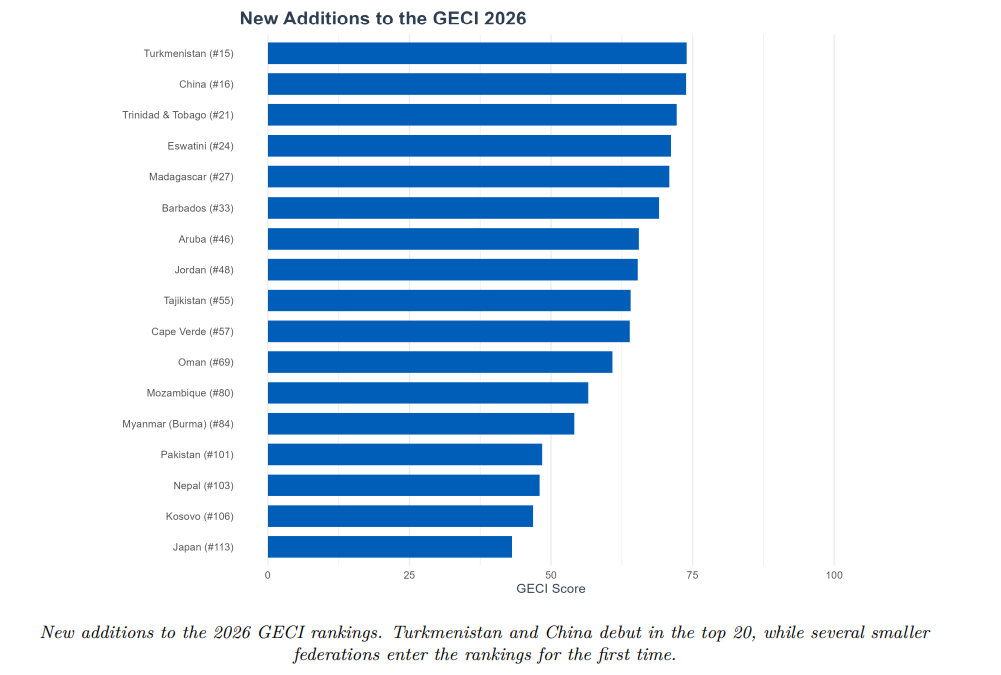
New additions to GECI 2026 report
Even those who remain in the system face structural challenges. International Master (IM) Vantika Aggarwal reiterated that competing at the international level is an important step towards achieving Grandmaster criteria, but it is much more difficult for female players.“Playing a lot of tournaments abroad is financially challenging,” he said. “Female players don’t get much opportunity to play with stronger players, which hinders their development. And our society is still male-dominated. Women don’t get equal opportunities and support.”Young girls often compete in women-only events rather than in stronger open sections, limiting their exposure to tough opposition during critical developmental years.
What can India do to improve and bridge this gap?
While talking to this website recentlyIndia’s veteran Grandmaster Praveen Thipsay breaks down the reality of ‘individualism’ within the Indian chess ecosystem.He elaborated, “There is no system in Indian chess that will produce champions. It is basically the efforts of the parents and the players. Players have spent a lot of time and energy, and parents have sacrificed their careers, only then some have emerged as champions.”“Just because three players are performing well, it doesn’t mean that five years down the line we will have three or five players doing the same. We cannot say that it is like the Soviet school where one champion leaves and another comes. Even in China, they have a steady stream of players, especially women. Whenever one generation is no longer strong, a different generation is already arriving. These are things that don’t happen here; What we have is the individual effort of one person.“Although some notable individuals have helped sow the seeds of chess culture in India, its growth has been limited to certain parts of the country rather than spreading across India. And this movement cannot reach its full potential without the direct intervention of the All India Chess Federation (AICF). But how do they achieve this?
There is no system in Indian chess that can produce champions. It is basically the efforts of the parents and the players.
GM Praveen Thipsay
The GECI framework itself provides clues about the solution.First of all, women’s participation should increase at the grassroots level. Even a modest increase in the percentage of girls playing chess would significantly strengthen the talent pipeline.Second, strong competitive experience is essential. Coaches argue that talented girls should be encouraged to play in open events early in their careers.Third, the ecosystem needs financial support ranging from travel grants and sponsorships to structured training programs specifically designed for promising female players.
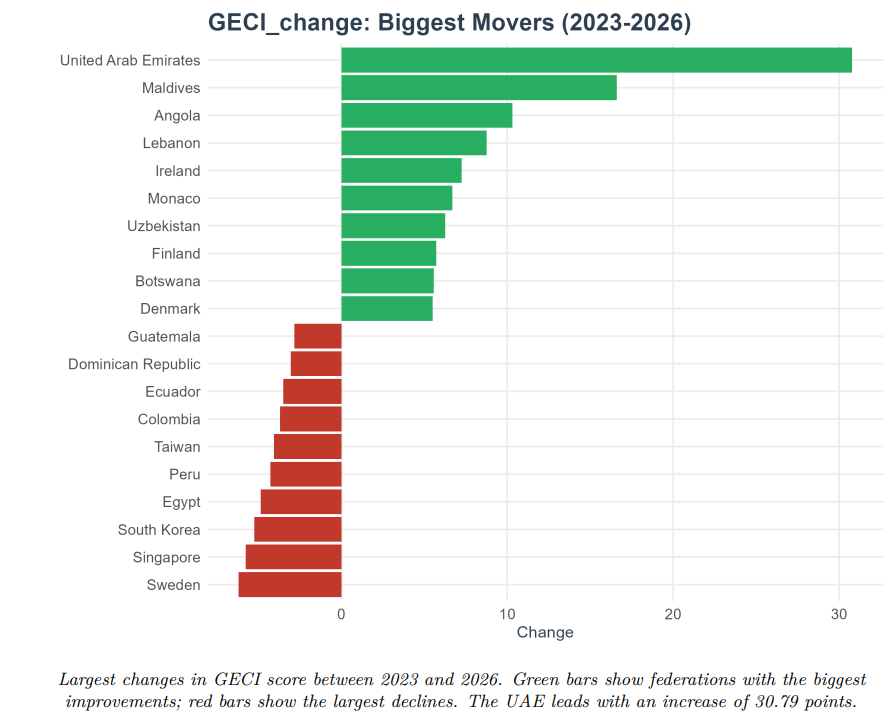
GECI report biggest step in 2026
Overall, the UAE blueprint outlined in the 2026 GECI report could prove to be highly effective.The UAE has climbed 73 places in the rankings, from 77th in the previous edition to now fourth, largely due to a dramatic increase in the number of girls sent to the youth championships. The country increased female participation in youth delegations from 12.5% to 43.75% in the “Progress” indicator, demonstrating how targeted policy decisions can rapidly change representation.With the support of its Sports Ministry and National Councils, the UAE has institutionalized women’s chess through an exclusive network of seven chess clubs with dedicated sections only for girls and two clubs for girls only. They have also made it mandatory to have female representation in their governing bodies.By providing logistical support to families and including women in leadership roles, such as Secretary General Dr. Maleeha Mahmoud Al Majmi, the federation has created a sustainable professional pipeline.Also read: India got its 93rd GM. Mother quit her job for chess – creation of Aarav Dengla, influenced by D Gukesh and Arjun ErigaysiFurthermore, the system is based on a year-round competitive calendar for girls, ranging from school level events to national championships for all age groups. Away from the board, the federation has also invested in the inclusion of female international and national referees.For India, the lesson is simple. As the data shows, the talent already exists in the country. What is needed now is a system that keeps girls in sports for a long time to create a sustainable model of development.



 Renault Concept Bridger