


Indian man arrested in New York state for $200,000 scam; Called people and told them ‘You are wanted on a warrant’

Tushar Sharma, a 23-year-old Indian man, was arrested in New York state on charges of a $200,000 scam, where he called individuals and told them they would be arrested if they did not pay.
Indian Tushar Sharma, 23, was arrested by New York State Police earlier this month after a $200,000 fraud investigation led police to Sharma, who was living in California. Police said the investigation began when a victim reported receiving a call from a man claiming to be a Department of Homeland Security officer. The caller told the victim that there was a warrant for his arrest for money laundering and drug trafficking. The victim was told he needed to withdraw cash and drop it off at a designated location in the Bainbridge area of New York State. The victim was asked to maintain confidentiality and handed over large sums of money on two separate occasions. On the third occasion, he was asked to give $100,000 to a man who claimed to be a law enforcement officer. After the victim handed over the cash, NY State troopers took the suspect into custody, the money was recovered and the man was identified as Tushar Sharma. Sharma was charged with grand theft, fraudulent scheme and conspiracy, was released on his personal recognizance, ordered to remain in New York State, and is scheduled to appear in Bainbridge Town Court on April 20, 2026.Citing the incident, the New York State Police reminded the public that law enforcement agencies will never contact individuals over the phone to demand money or threaten arrest. Deputies released Sharma’s photo because they believe there may be other victims of this scam. NY troopers also cautioned that if anyone receives such a call demanding money to avoid arrest, they should immediately hang up, not give them any information and not send any money, and contact the local police department.

Marjorie Taylor Greene, Ro Khanna, Schumer invoke 25th Amendment to remove Trump: ‘There is not a single bomb…’

Democrats and many conservative commentators called for invoking the 25th Amendment to remove Trump.
Democrats have called for the 25th Amendment to be invoked to remove President Donald Trump after his latest threat that “the entire civilization will die tonight, never to be brought back again”. Former Congresswoman Marjorie Taylor Greene posted, “Not a single bomb has fallen on America. We cannot kill an entire civilization. This is evil and madness.” “We need to invoke the 25th Amendment and remove Trump. Threatening war crimes is a flagrant violation of our Constitution and the Geneva Conventions,” the congressman said ro khanna He said that what the President is doing is a moral crime and if there is any life left in Congress, every member should demand Trump’s removal because Trump is disrespecting the entire population of Iran, Gaza, Cuba. “The 25th Amendment needs to be invoked. He is a genocidal maniac. Our Congress and military need to intervene. We are beyond insanity,” Candace Owens posted. Conservative commentator Alex Jones also invoked the 25th Amendment. Dem Senator Chuck Schumer posted, “This is an extremely sick man. Every Republican who refuses to join us in voting against this wanton war on choice, no matter what it takes, will face every consequence.” “Too bad. Donald Trump should be impeached. When will it be enough for my Republican colleagues to muster the courage and remove him from office?” Ilhan Omar wrote. “Tonight an entire civilization will die, never to be brought back again. I don’t want it to happen, but maybe it will. However, now that we have complete and total regime change, where different, smarter and less radical people prevail, maybe something revolutionary wonderful can happen…” Trump posted.
What is the 25th Amendment?
The 25th Amendment to the United States Constitution deals with what happens if the President or Vice President is unable to serve. It was ratified in 1967 after concerns grew over events such as the assassination of President Kennedy. If the President dies, resigns, or is removed, the Vice President becomes President.

Russia, China veto UN resolution to reopen Strait of Hormuz

Image used for representative purposes
Russia and China on Tuesday vetoed a UN Security Council resolution aimed at reopening the Strait of Hormuz, dealing a blow to Gulf-backed efforts to restore navigation through one of the world’s most vital oil routes.The motion tabled by Bahrain failed despite gaining 11 votes in favor, while Pakistan and Colombia abstained. The vote came just hours before a deadline set by US President Donald Trump for Iran to reopen the strait or face widespread attacks on its infrastructure.Bahrain’s Foreign Minister Abdullatif bin Rashid Al Zayani said, “Failing to adopt this resolution sends the wrong signal to the world, to the people of the world.” He warned that inaction risks harming efforts to protect global waterways.The proposal underwent several amendments in an attempt to avoid a veto. An earlier draft called for “all necessary means” to ensure safe passage, language that could authorize military action, but this was scaled back to “defensive means” and later stripped of any explicit Security Council mandate.In its final form, the resolution only encouraged countries dependent on the strait to coordinate defensive measures, including escorting commercial ships and preventing attempts to disrupt shipping.It also called on Iran to immediately stop attacks on merchant ships and stop interfering with navigation through the strait, through which about a fifth of the global oil supply typically passes.However, Russia and China opposed the move and blamed the United States and Israel for escalating the conflict. Their envoys argued that the priority should be an immediate cessation of hostilities rather than measures focused solely on maritime security.The standoff comes as Iran’s blockade of the strait continues to depress global energy markets and raise concerns among Gulf states, many of which rely heavily on the route for oil and gas exports. Bahrain, which hosts the US Fifth Fleet, is pushing for international intervention, calling the disruption an existential threat.Tensions have been further heightened by repeated warnings from Trump, who has demanded that Iran reopen the waterway. He warned that failure to comply could lead to a massive military response, and said the country could be “taken out overnight” if an agreement was not reached.

Katie Miller says Trump, Rubio working on revoking visas of 3000-4000 Iranian elite living in US

Hamideh Soleimani Afshar (left), 47, and her daughter Sarinsadat Hosseini, 25, relatives of the Iranian leader, were living a luxurious life in the US.
After the State Department revoked the green cards of Hamideh Suleimani Afshar, the niece and granddaughter of Islamic Revolutionary Guard Corps Maj. Gen. Qassem Soleimani, and her daughter Sarinsadat Hosseini, the administration is targeting other elite Iranians living in the US. Katie Miller, the podcaster wife of White House Deputy Chief of Staff Stephen Miller, appeared on Fox News and said she was aware that President Trump and Secretary of State Marco Rubio were working diligently to revoke the visas of approximately 3,000 to 4,000 Iranian elites living in the US. Miller also asked why so many elite people of the Iranian regime were given protection not only in the US but also in European countries. “The double standard, not only in their wardrobe, but the fact that they get to live here in the greatest country in the world in security and prosperity, you can’t get enough of that,” Miller said. After the outbreak of the war, Dr. Fatemeh Ardeshir-Larijani, whose late father was a top official in Tehran, was removed from Emory University, prompting a massive backlash asking why she was allowed to retain the prestigious position of assistant professor at Emory University’s Winship Cancer Institute in Atlanta.However, the most high-profile cases are the ICE arrests of the mother-daughter duo as their arrests revealed that they were living a luxurious life in Los Angeles. “While in the United States, he (Afshar) promoted Iranian regime propaganda, celebrated attacks against U.S. troops and military facilities in the Middle East, praised the new Iranian Supreme Leader, denounced the U.S. as the “Great Satan” and voiced his unwavering support for the Islamic Revolutionary Guard Corps, a designated terrorist organization. “Afshar Soleimani promoted this propaganda for Iran’s terrorist regime while enjoying a lavish lifestyle in Los Angeles, as evidenced by his frequent postings on his recently deleted Instagram account,” the State Department said. Afshar entered the US on a tourist visa in 2015 and was later granted asylum by an immigration judge in 2019. She became a lawful permanent resident in 2021. But in his 2025 naturalization application, officials say he disclosed multiple trips to Iran after receiving his green cardWhich is now grounds for disqualification. His daughter entered the United States on a student visa in July 2015. In 2019, a judge granted him asylum. She became a green card holder in 2023.

Don’t blame people of Frisco for H-1B takeover, blame Congress: Expert on hate against Indians in Texas

American influencers have taken to the streets of Texas to expose alleged H-1B abuse on camera.
As every other influencer in Texas is busting Indians allegedly abusing their visas by working in shops, immigration policy expert Rosemary Jenks said the blame is misplaced, as all the hate is being heaped on the people living there, while Congress should be blamed, which allowed H-1B visas to become a path to residence. Appearing on Steve Bannon’s show, Jenks said that the H-1B visa was a three-year visa for specialized workers, but Congress decided that H-1B visa holders should stay indefinitely and then bring their families if they found a company willing to sponsor them. “So these people have been here on H-1B visas for decades. This is ridiculous. A temporary visa is supposed to be temporary. They should be released after three years.” If we did that and if they couldn’t bring their families to America, they would be much less attractive to employers. Because employers have to train new H-1Bs every three years and then it’s much cheaper to hire Americans,” Jenks said, blaming this policy, along with the sheer number of H-1Bs, behind fraud in the program.She also explained how most H-1B and F-1 student visa holders in the US begin their journey and then enter the system through Optional Practical Training (OPT), STEM OPT extension and then the H-1B visa program. “Yes, we should eliminate the H-1B visa program altogether, but if the donor class won’t allow Congress to do that, the least we can do is make it a temporary visa again,” Jenks said.
Anti-H-1B influencers rise in Texas
Over the past few months, there has been a rise in anti-H-1B influencers in Texas making videos against the ‘Indian takeover’ of Texas and Frisco in particular. Journalist Sarah Gonzales claimed to have uncovered ‘ghost’ offices that were listed as H-1B employers, but found nothing there when she visited. She also visited a food truck and found that an H-1B visa holder was working there, although the man claimed he was helping his wife at the food truck after her office work. Now, YouTuber Tyler Oliveira made a detailed video on the ‘Indian Invasion of Texas’ where he interviewed Indians in Texas and convicted them of fraud. Oliveira interviewed diplomat Mahwas Siddiqui, who previously claimed to have witnessed first-hand H-1B fraud in India; He also interviewed lawyer Chand Parvataneni for his YouTube video.

‘Entire civilization will die tonight’: Trump threatens ‘revolutionary moments’ as Iran deadline approaches

Donald Trump (file photo)
US President Donald Trump on Tuesday issued a stern warning to Iran as part of his ultimatum to open the Strait of Hormuz, saying “the entire civilization will die tonight”.“Tonight an entire civilization will die, never to be brought back again. I don’t want that to happen, but it probably will. However, now that we have complete and total regime change, where different, smarter and less radical minds prevail, maybe something revolutionary wonderful can happen, who knows?” said the US President on Truth Social.
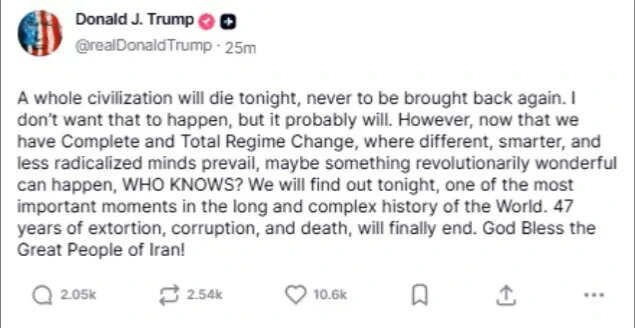
He added, “We are talking about a “historic moment” tonight, one of the most important moments in the world’s long and complex history. 47 years of extortion, corruption and death will finally end. God bless the great people of Iran!”This comes as the conflict between Iran, Israel and the United States continues to escalate. Separate attacks on Tuesday targeted a major railway bridge in Kashan and Iran’s primary oil export hub on Kharg island, according to reports. The Yahya Abad rail bridge in the central region was hit, while several attacks were reported on the island facility, which handles a large portion of Iran’s oil exports.Trump issued several warnings over the past few days that Iran’s power plants and bridges could be destroyed within hours if Tehran fails to meet his demands, including reopening the Strait of Hormuz. At a press conference on Monday, he said the country’s infrastructure could be “taken out overnight”, warning that there would be “no bridges, no power plants” if Tehran did not comply.Amid rising tensions, Iranian official Alireza Rahimi has urged citizens, especially youth, to gather around major power plants at a certain time in what appears to be a call to form human chains around critical infrastructure, describing them as “national assets” and appealing for unity beyond political boundaries.

Why was Assamgold banned? Streamer breaks silence on Twitch suspension and calls out “double standard”

Twitch streamer AsmonGold is now at the forefront of another controversy, this one due to a week-long suspension that almost immediately spiraled out of control and sparked a widespread debate about how the platform enforced its rules and how consistently they appeared. The ban was mentioned suddenly on April 6, leaving viewers surprised when their channel went offline continuously. Within hours the trending creator himself responded to the issue, providing a clear clarification that further fueled the ongoing discussion.This was not only a personal defense but a more general attack on Twitch. Asmagold’s response went viral on social media and was met with backlash from fans and critics. The case has again shown how easily streamer scams can emerge, especially when they involve sensitive issues and platform policing.
AsmonGold calls out “double standards” after ban
Addressing X, Asmagold did not hold back from explaining the reason behind his suspension. He wrote: “Banned for an entire week because I said I don’t give a fuck about the opinions of illiterate third world people. Would someone be banned for saying they don’t care what an American’s opinion is on the Middle East? Of course that’s not blatant double standards, I didn’t break ToS.”There was an immediate backlash to his comments, with many users questioning both the language used and his claims of inappropriate behaviour. However, others sided with him and argued that enforcement on Twitch often appears inconsistent depending on the creator or context.The controversy did not emerge alone. Just a few weeks ago, Asmagold had already gone viral for comments about “parasitic immigrants”, where he said: “I will continue to say this – they are doing this deliberately. They’re doing it so they can continue to fund these parasitic immigrants into our country, and that’s why… And, by the way, for you guys in Europe who are watching this, the same thing is happening there. A huge problem in the West is that we have a transition, and we refuse to admit that there is a problem. Clearly there is a problem. Obviously there is pain. And, clearly, there is a solution.”That earlier clip had already divided audiences, and the latest ban has only intensified the scrutiny around its content and rhetoric. Despite the growing debate, Twitch has not yet released any official statement regarding the suspension.For now, this incident opens up a bigger question about moderation standards on streaming platforms. Where is the line between opinion and violation and who ultimately decides?

Artemis II astronauts observe the Moon during flight; NASA shared the picture.

NASA’s Artemis II mission has taken a significant step forward in its flight program by taking astronauts to the closest point to the Moon, which was last done during the Apollo 17 mission. Although no landing occurred during this mission, the purpose of the mission was to test space systems and make observations during a seven-hour flight near the Moon.The mission has had several concrete achievements, such as setting a new record for the greatest distance traveled by astronauts. The far side of the Moon, solar eclipse and unique phenomena occurring on the Moon’s surface were also observed.
NASA’s Artemis II lunar flyby Reveals detailed views of the far side of the Moon
During their time in lunar orbit, the astronauts made intensive observations of the area. It was found that the far side of the moon contained a dense collection of craters, as well as solidified lava fields and geological cracks. Variation in brightness and texture has been observed, which may be useful for understanding variations in surface structure.The information collected is believed to be useful in future missions, especially in the search for suitable locations. In addition, the crew observed the Earthset and Earthrise events.
Artemis II lunar flyby captures solar eclipse and rare meteorite impact shine
A solar eclipse occurred during the observation window when the spacecraft, Moon, and Sun were aligned. The event lasted about an hour and allowed the crew to observe the solar corona in partially blocked sunlight conditions.Six flashes were observed on the Moon’s surface during the same period. These flashes are consistent with meteorite impacts, which occur when space debris hits the Moon at high velocity. While such effects are known, direct observations from crewed spacecraft are limited.The recorded flashes will be analyzed along with the imaging data to determine their exact time and location.

PC: NASA
NASA Artemis II live coverage shows crew interacting with Donald Trump
Following the completion of the lunar observation period, the crew participated in a live broadcast segment hosted by NASA. During this session, President Donald Trump spoke to the astronauts and praised the progress of the mission.The crew also chatted with Jared Isaacman, discussing aspects of the flyby and onboard observations. Questions submitted through social media were addressed during the broadcast, which was part of the mission’s public communication effort. The talks took place after communication links were fully restored.

PC: NASA
orion spacecraft 40 minutes of signal lost during lunar flyby mission
When Orion moved behind the Moon, communication with Mission Control was temporarily lost. This blackout lasted about 40 minutes and was caused by the Moon blocking direct radio signals between the spacecraft and Earth.During this phase, the spacecraft made its closest approach to the lunar surface at a distance of approximately 4,067 miles. At around 7:00 pm, Orion passed on the far side before continuing on its trajectory. All onboard systems operated as expected during the communications gap, and contact was restored when the spacecraft reappeared from behind the Moon.
NASA Artemis II flyby data sent to Earth to support future lunar landings
Data collected during the Artemis II flyby is currently being sent to Earth for detailed investigation. It includes images, recorded observations, and spacecraft telemetry. Scientific teams are expected to review the material to refine models related to lunar geology and mission operations.There are also plans to compare the observed impact brightness with independent observations from Earth-based viewers. This may help verify the timing and nature of events recorded during the mission.

‘One in 15.5 million’: Woman in Russia gives birth to four identical girls world News

A rare and medically significant birth has been reported in St. Petersburg, where a woman gave birth to four identical baby girls, the first such case officially recorded in Russia.The delivery, which took place at a maternity hospital in the city, has attracted attention because of its extreme rarity. Medical estimates suggest that monochorionic, or identical, quadruplets occur in approximately one in 15.5 million births. Globally, only 15 such cases have been recorded.All four babies were born in the 32nd week of pregnancy and their condition is said to be stable. His birth weight was between 1,360 g and 1,640 g, and his length was between 37 cm and 41 cm. Doctors have described these figures as strong for babies born at this stage.In a statement shared by the hospital on Russian social media platforms VKontakte“Four charming sisters were born at 32 weeks. According to estimates, monochorionic (identical) quadruplets occur once in 15.5 million births. Such a unique birth has not been reported in the country,” the team said.What makes matters especially complicated is that all four babies developed from the same fertilized egg and shared the same placenta, a condition known as a monochorionic pregnancy. In most multiple pregnancies, each baby has a separate placenta. Doctors say the risk is higher in such cases and constant monitoring is required.“For a pregnancy of 32 weeks, this is an excellent outcome, made possible due to proper management of the mother and expertise of the doctors in the antenatal department,” the hospital said.The delivery required the coordinated effort of a large medical team, including obstetricians, anesthesiologists, intensive care specialists, midwives, and neonatologists. Each baby was immediately attended to by neonatologists and specialized nurses to ensure proper care from the first moment after birth.According to the hospital, the process was led by the chief physician, Professor Anton Mikhailov, as well as a team of specialists from the antenatal department and the obstetric unit. The operation was described as highly complex, requiring complete precision and teamwork.Doctors explained that identical, or monozygotic, pregnancies occur when a single fertilized egg splits into multiple embryos, resulting in children with identical genetic makeup and the same sex. There is no known way to predict or prevent such events.The case is now seen as a milestone in Russian medical practice, highlighting both the rarity of the occurrence and the level of care required to successfully manage such a high-risk pregnancy.

Cambodia honors its most famous landmine-sniffing rat, Magava, with a statue World News

Cambodia has erected a statue to commemorate Magava, the African giant pouched rat famous for its remarkable olfactory skills and life-saving work. The memorial was unveiled in Siem Reap on April 3, 2026. During five years of dedicated service as HeroRAT, Magawa detected more than 100 landmines and unexploded ordnance and cleared more than 141,000 square meters of land. Their training allowed them to ignore the scrap metal and focus only on the faint smell of explosives, resulting in landmine clearance that was safer and quicker than traditional methods.By erecting a sandstone statue of Magwa in Siem Reap, Cambodia is honoring both animal intelligence and the human effort to remove landmines from the landscape. The story of this small rodent is testament to the innovative ways in which non-technical methods of mining have helped restore safe living conditions to communities affected by conflict and war.
The record-breaking career of Cambodia’s landmine-sniffing rat Magwa
Siem Reap has erected a permanent sandstone monument to the memory of Magwa, whose unique contribution to humanitarian devastation makes him a true hero in the eyes of the community. Trained as a HERORAT by APOPO, a permanent organization, Magawa was the most accomplished HERORAT in APOPO’s history, successfully identifying 71 landmines and 38 items of unexploded ordnance (UXO) during his tenure, while releasing land equivalent to 20 football fields back to the community.
Why might Magawa ignore scrap metal?
Magawa’s operational efficiency over time was unprecedented; It can clear an area the size of a tennis court in as little as 20 minutes (compared to a human using a metal detector who typically takes 4 days to complete the same task). Chrysetomys ansorgei (African giant pouched rat) was chosen to detect mines due to the presence of specific physiological and behavioral characteristics identified through veterinary research studies. Scientific studies confirm that these rats have a highly sensitive olfactory system capable of detecting minute concentrations of explosive vapor, allowing them to ignore scrap metal and simply detect the presence of TNT. Their low body mass enables them to safely cross pressure-activated landmines without triggering the pressure-sensitive detonators, allowing them to make straight land crossings that would kill either a human deminer or a large detection animal such as a dog.
Why is biological identification the fastest path to security?
Magawa’s work was a humanitarian effort that complied with an extensive list of rules from the International Mine Action Standards (IMAS) global safety protocol. IMAS integrates animal detection systems into technical surveys so that officials can return land to communities for agriculture and habitation with a high level of confidence.Because these rats are trained to smell explosives, they produce fewer false alarms than traditional sensors. This, in turn, accelerates the entire process of reclaiming land for families displaced by the conflict.
The first rat to receive this honor from PDSA
Magawa’s contributions were acknowledged worldwide in 2020, marking a watershed moment for animal detection systems in international security. He made history as the first rat in the 77-year existence of the People’s Dispensary for Sick Animals (PDSA) to be awarded a gold medal – an honor similar to the George Cross for animals.