

India’s third domestic N-sub commissioned; Rajnath also launches stealth frigate, large cavitation tunnel facility in Vizag India News
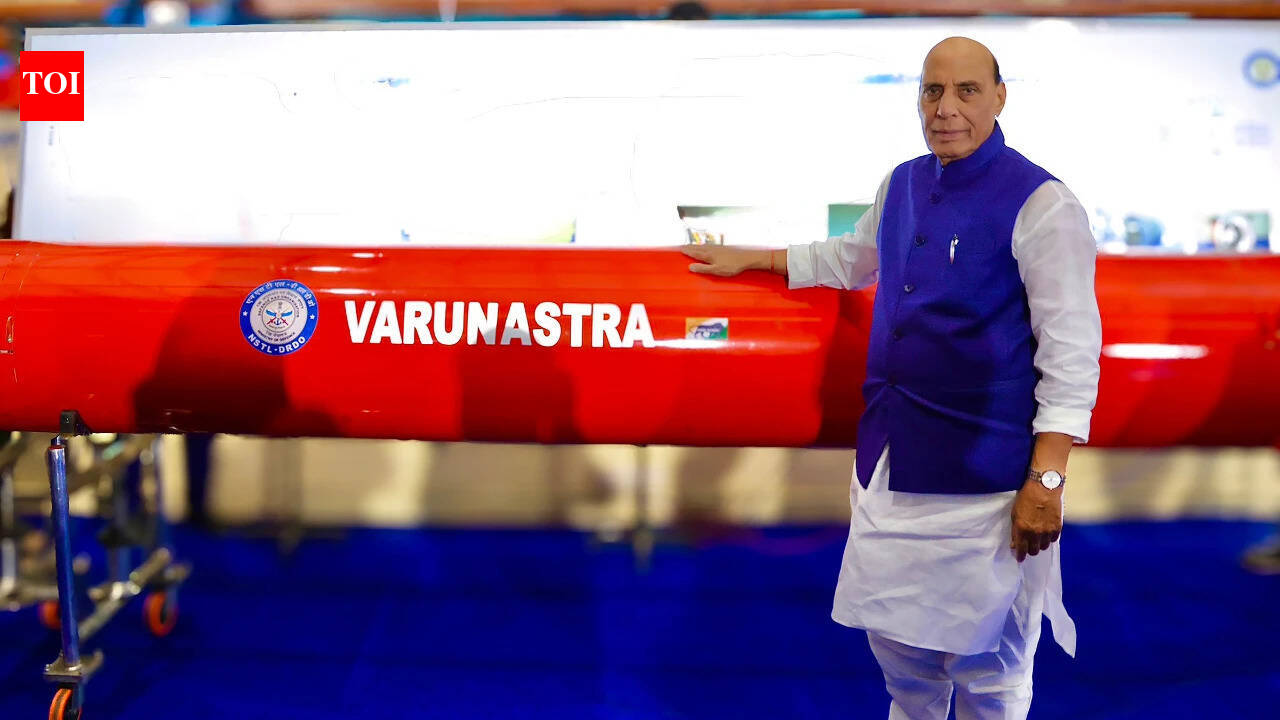
New Delhi: In a major boost to India’s “second-strike capability”, the country’s third indigenously developed nuclear-powered ballistic missile submarine, INS Aridhman, was commissioned into the Navy on Friday, an official source confirmed to TOI.Part of the classified Advanced Technology Vessels project, the commissioning of the nuclear-powered ballistic missile submarine (SSBN) was not announced. However, sources confirmed that INS Aridman was launched at an event in Visakhapatnam, where Defense Minister Rajnath Singh and Navy Chief Admiral Dinesh K Tripathi were present.A cryptic post by Rajnath on X on Friday morning was seen by many as confirmation of this. The minister posted, “It’s not words, it’s power, ‘Aridaman’! (It’s not words, it’s power, ‘Aridaman’!).”INS Aridman has a displacement of 7,000 tonnes (1,000 tonnes more than its predecessors) and is powered by an 83 MW compact light water reactor. The 130 meter long submarine is designed for superior stealth and will boost India’s nuclear triad. Equipped with eight Vertical Launch System tubes (compared to 4 in earlier models), INS Aridman is capable of carrying 24 K-15 Sagarika missiles (750 km range) or eight K-4 missiles (3,500 km range).India’s first indigenous nuclear submarine, INS Arihant, was launched in July 2009 and quietly commissioned in 2016, while SSBN INS Arighat was commissioned in August 2024.In Visakhapatnam, Rajnath also commissioned the indigenously developed 6,670-tonne stealth frigate INS Taragiri, the fourth warship of the Nilgiri class (Project 17A). Built by Mazagon Dock Shipbuilders, INS Taragiri represents a generational leap over earlier designs as it has a significantly reduced radar cross-section allowing it to operate with lethal stealth.Rajnath also laid the foundation stone of a Large Cavitation Tunnel (LCT) facility at DRDO’s Naval Science and Technology Laboratory in Visakhapatnam. This facility will significantly enhance India’s naval research and testing capabilities. “It will serve as a fundamental backbone for the design and development of submarines and ships, which will support future advancements in naval engineering and maritime defense systems,” the minister said.Rajnath said that “95% of our trade is through the sea route, energy security also depends on this route. Therefore, a strong navy is not an option but a basic requirement. The commissioning of INS Taragiri reflects India’s growing indigenous power and growing ‘self-reliance’ in the region. He said, “Be it the Persian Gulf or the Strait of Malacca, the Navy remains ready to provide all types of assistance even during humanitarian crises.““There are many sensitive points in the vast expanse of sea, where our Navy has maintained a constant active presence to ensure smooth flow of goods,” Rajnath said. “Whenever tension rises, Indian Navy Steps to guarantee the safety of commercial ships and oil tankers. It is not only protecting India’s national interests, but it is also ready to take every necessary measure to protect our citizens and trade routes around the world. It is this capability that firmly establishes India as a responsible and formidable maritime power,” he said.