


Macaulay’s children are triggered because Pujarini Pradhan, from Medinipur, didn’t ask for permission to think, and speak English |

The controversy surrounding Pujarini Pradhan, better known as @Lifeofpuja on Instagram (with 751K followers), reminded me of a peculiar exchange in a cab about 18 years ago. The year was 2008. Author Salman Rushdie had won the ‘Best of Booker’ Prize, and newsrooms all over New Delhi, and the whole world, were abuzz. More than usual. This was the day after the news made headlines. After shifts got over, we were talking about the immense feat of the Indian-born British author (he hadn’t taken his American citizenship at the time) and waiting for Jha ji, the commander of the fleet of cabs that ferried journalists home at night.Jha ji was our favourite. He remembered all our names, and was a father figure for all of us who had come from different cities to make Delhi home, and quietly missed the elders we had left behind. He was in his mid-50s and we were mostly early-20-somethings. He had a baritone Bollywood would envy, and soft yet wise eyes that would smile but never tolerate any nonsense. He respected us, and took pride in ensuring every journalist — possibly his children’s age — reached home safely.Two minutes into the cab ride, we started discussing Rushdie’s feat, our headlines, our copies, the usual. Jha ji, as he sometimes did, joined the conversation. “Kaisi hai unki kitaab?” (How is his book?) he asked, referring to Midnight’s Children, which had won Rushdie his first Man Booker in 1981. A recent joinee, barely a few weeks into the job, turned to him and asked: “Aap jaante bhi ho Salman Rushdie kaun hai, Jha ji?” (Do you even know who Rushdie is?)Our driver was so stunned he actually slowed the car, looked back, and said quietly: “Haan, unko ‘Best of Booker’ mila hai. Akhbaar hum bhi padhte hain, waise. Hindi akhbaar. Usme bhi duniya ki khabar milti hai.” (Yes, he’s being awarded ‘Best of Booker’. I, too, read a newspaper. In Hindi. There’s world news covered in Hindi newspapers too)Pin-drop silence for the rest of the ride. But one thing was unmistakable: Jha ji was hurt. Hurt that a few kids he respected would think so little of him.Why did this person think less of Jha ji? Was it because he assumed knowledge and intellect were the exclusive preserve of the convent-educated, English-speaking middle class and above? Did it not occur to him that newspapers are published in every Indian language, and that the world arrives in people’s homes in many tongues? Was it foolishness, naivety, arrogance or some seamless, unreflective amalgam of all three?Which brings us to Pujarini. The controversy erupted while Pradhan was busy cutting vegetables, making videos, and talking about everything from menstrual leave to Stanley Kubrick, from why she wears a ghunghat while calling herself a feminist to Satyajit Ray. All in the same breath, with an ease and clarity of thought that is genuinely rare. And she does it in English. Not the impeccable, urban-approved, Macaulayan English that unlocks professional doors in Delhi or Mumbai, but English spoken with the unmistakable accent of someone who grew up in rural West Bengal and has absolutely no apology to offer for it. She is from Medinipur, to be precise. Urban India has a word for this kind of English: desi. Or ghati. The contempt is baked into the vocabulary itself.We may have reached the far side of the moon, Artemis 2, a first for humankind as evidence of just how far the human mind can stretch when it dares to dream. And yet that same brain remains perfectly capable of dragging others down simply to feel taller by comparison. Schadenfreude is as old as hunger. So is ignorance. We cannot always achieve something to feel superior, so we find the next best thing: diminishing someone else. Is she even real? How does she have access to international cinema? How can a rural woman edit her own content? As if curiosity has a postcode. As if Ray and Kubrick belong only to those with a metropolitan address and a particular vowel formation.This is not merely “influencer drama.” It is a sociological case study, a live demonstration of how urban Indians, conditioned by a colonial legacy that was never quite dismantled, continue to weaponise the English language to exclude and delegitimise voices that do not conform to metropolitan standards of aesthetics or articulation. It is the person in the cab, replicated across a thousand comment sections.When influencers like Niharika Jain and Aishwarya Subramanium accused Pujarini of being inauthentic, the accusation wasn’t really about authenticity. It was about register. About the unsettling dissonance they felt watching someone analyse Pather Panchali in an accent they had been trained—socially, culturally, almost genetically at this point—to associate with the domestic help rather than the film critic. The outrage wasn’t intellectual. It was hierarchical.To understand why Pradhan’s accent caused what some breathlessly called an “internet meltdown,” you have to go back to 1835 and Thomas Babington Macaulay’s infamous Minute on Education: a document that set out, with remarkable candour, to manufacture a class of Indians who were Indian in blood but English in taste, opinion, and intellect. Intermediaries. A buffer class that would administer an empire and, long after that empire crumbled, would continue to administer its values. What Macaulay built wasn’t just a school system. It was a self-replicating hierarchy of credibility, and nearly two centuries later, it runs on autopilot, maintained not by British colonisers but by their most devoted inheritors.
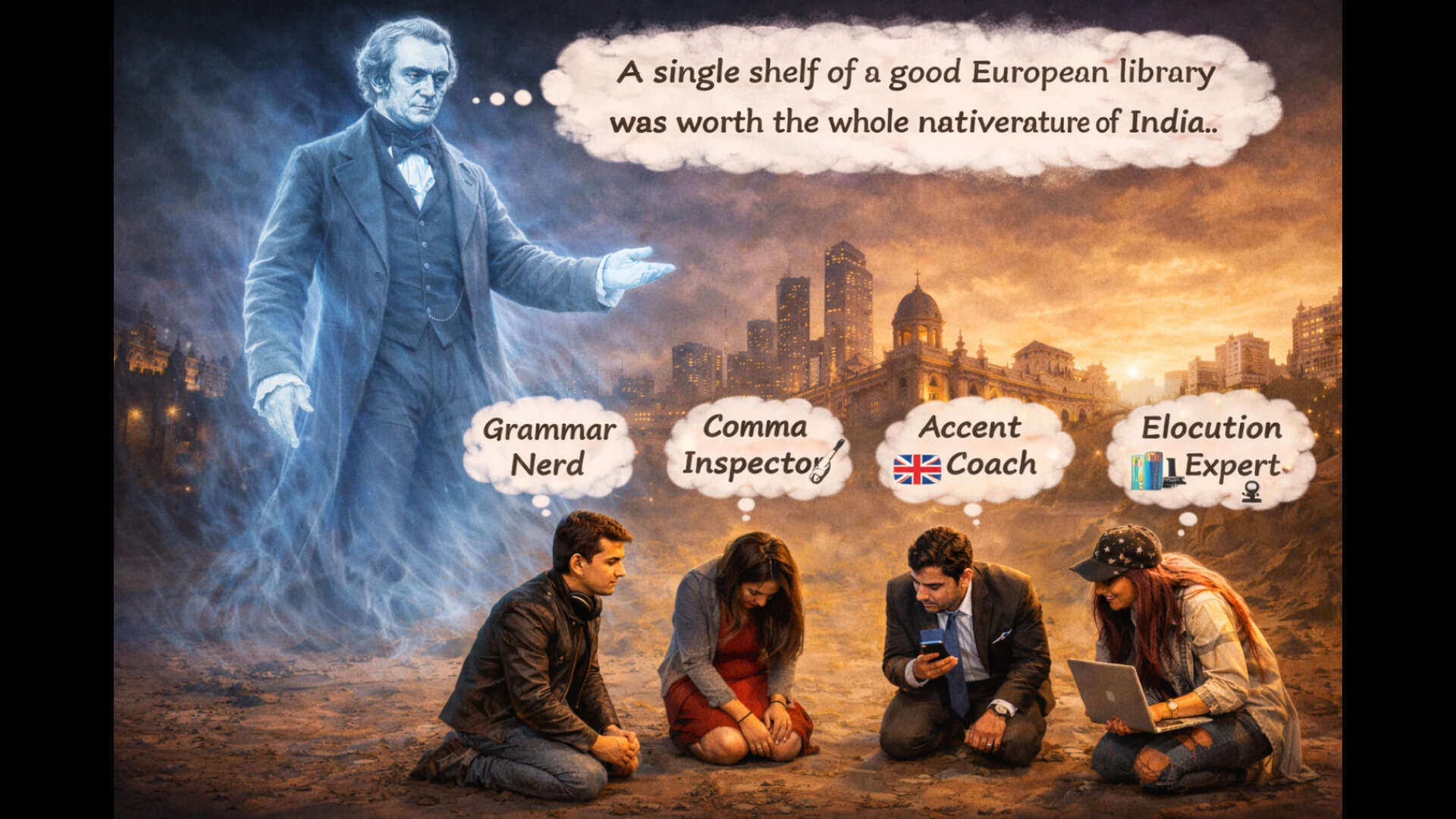
The ‘Macaulayan ghost’ haunts corporate offices and social media platforms with equal comfort. You’ll find it in the colleague who switches to English mid-meeting to subtly reassert authority, in the recruiter who mistakes fluency for intelligence, in the comment that says “at least learn to speak properly before having opinions”
The ‘Macaulayan ghost’ haunts corporate offices and social media platforms with equal comfort. You’ll find it in the colleague who switches to English mid-meeting to subtly reassert authority, in the recruiter who mistakes fluency for intelligence, in the comment that says “at least learn to speak properly before having opinions”. As if grammar were a prerequisite for thought. These are people who genuinely need a Prozac to recover from the Oxford Comma becoming history.
Community response to structural bias
What makes this more than a social media spat is that the bias Pujarini encountered isn’t just human — it’s infrastructural. Research into digital access in India reveals that over 53% of students from non-metro backgrounds believe their accent or mother tongue actively works against them when interacting with technology. They practise what researchers call “linguistic self-censorship”—consciously avoiding cultural references, flattening their speech, editing themselves before they even begin—to avoid being penalised by systems calibrated to a “standard” English that was never theirs to begin with. When urban influencers questioned Pujarini’s authenticity, they were doing the same thing, just without an algorithm. They became the algorithm, human proxies enforcing a standard that has no business being a standard, deciding who gets to be taken seriously and who needs to prove themselves first.What the accusers didn’t anticipate was the wall they ran into. The backlash against the backlash was swift, sharp, and surprisingly precise. Particularly from the Bengali community and from anti-caste voices who identified, almost immediately, what was really being said. People noted that the “savarna feminist” solidarity on display had a hidden clause: it extended only to those who cleared a certain socio-economic bar. “Bangali meye ra shob paare (Bengali girls can do anything)” became something of a rallying cry, less about regional pride than about collective refusal. What emerged wasn’t just defence of one creator; it was a reckoning with the particular cruelty of being told you don’t belong in a conversation you walked into on your own, with nothing but curiosity and years of quietly paying attention.There was one moment in all of this that cut through everything else. When critics pointed to the quality of her editing and colour grading as proof she couldn’t possibly be working alone, Pujarini’s response was three words: “Like it’s hard?”, a reference to Legally Blonde that was, in itself, a small act of cultural warfare. She wasn’t being dismissive. She was making a precise point: these are learnable skills, available to anyone with internet access and patience. The assumption of hidden expertise behind her work said far more about her critics than about her. They had tried to use her competence against her. She turned it around and made competence sound like the most ordinary thing in the world. Because for her generation, it is.
Pujarini is refusing to perform suffering
Perhaps the most revealing thread in the entire controversy is what Pujarini didn’t do. She didn’t display hardship. She didn’t frame her life as a struggle to be overcome or a condition to be pitied. Her videos are unhurried — moringa pakodas, a handcrafted toothbrush holder, opinions on Kubrick delivered while chopping vegetables. And this, it turns out, was the quiet provocation at the heart of everything. Urban audiences have been conditioned to receive rural India as a site of suffering, a moral project, a place that needs saving. A rural woman who is simply happy, articulate, financially independent, and entirely uninterested in your sympathy doesn’t fit that frame. She doesn’t give the elite the psychological foothold of feeling superior. As she put it herself: “They want me to see suffering in every video. They want me to see sad.” By refusing to perform poverty, she became, in their eyes, suspicious. Which tells you everything about whose comfort the narrative was always designed to protect.
What Pujarini actually represents and why that’s threatening…
The deeper discomfort isn’t that she speaks imperfect English. It’s that she speaks it anyway. Unselfconsciously, without the apologetic hedging that the hierarchy demands of those it considers outsiders. She hasn’t sought permission. She hasn’t code-switched to earn legitimacy. She picked up the language, the cinema, the discourse, and walked straight in through the front door and the gatekeepers are livid precisely because there was no gate to stop her.This is the thing about the internet that its early evangelists got right and its critics underestimated: it is, at its best, genuinely indifferent to your accent. A YouTube algorithm does not ask where you are from. A film doesn’t reveal its meaning only to those who watched it in a multiplex. Knowledge has always found ways around the walls built to contain it. Real, curious, hungry knowledge. Jha ji read the Hindi newspaper. Pujarini watched The Shining in Medinipur. The walls were never as tall as their builders believed.What we are witnessing, in the fury directed at her, is not a culture war about authenticity. It is the sound of a particular class realising, with mounting dread, that the thing they mistook for intelligence was always just access. And access, it turns out, is no longer entirely theirs to control.

Photo: @lifeofpujaa/ Instagram
What’s the Pujarini Pradhan controversy all about?
Influencer Niharika Jain and former fashion editor Aishwarya Subramanyam, also known as @otherwarya accused Pujarini Pradhan @lifeofpuja of being “inauthentic”, “manufactured” and siad she was possibly an “industry plant”. Actress Samantha Ruth Prabhu, who played the fiery Sri Lankan Tamil liberation rebel in ‘The Family Man’, liked the reel questioning Pradhan’s authenticity. Director Kiran Rao, known for ‘Laapata Ladies’, liked the reel by Otherwarya too. Given Rao’s public stance on inclusivity, it was disappointing. But it was also ironic because ‘Laapata Ladies’ is a story of rural women breaking barriers by using their wit while fighting social stigma. But the accusation backfired as more people on social media defended her, calling out the hypocrisy of urban creators and influencers. She also got support from director Vikramaditya Motwane, director Gunnet Monga, actor Archana Puran Singh and influencer Kusha Kapila, among others.