

The War That Tore apart Greece: How Athens and Sparta Destroyed Their Own World world News
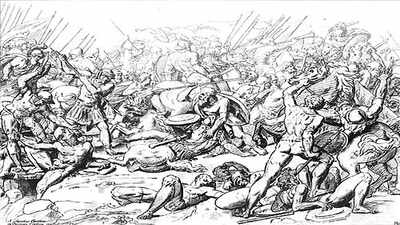
The Peloponnesian War, which lasted from 431 to 404 BC, is one of the most decisive conflicts in the history of the ancient Greeks. The war, in which Athens and Sparta, along with their respective allies, engaged in a long war not only redefined the Greek world but did so in ways that went far beyond the physical arena of warfare. While the war began as a struggle for power, it soon turned into a devastating conflict that destabilized societies, eroding the power of the Greek world and weakening the Greek world as a unifying power. The war ended in a Greece that was no longer the power it once was, but fragmented, weak, and vulnerable to attack from the outside world.
Peloponnesian War: A struggle for power and glory
according to Political economy of the original “Thucydides Trap” At its core, the Peloponnesian War was a conflict between two different forms of government, Athens being a naval democracy and Sparta being an oligarchy with a land-based army. Thucydides, the ancient historian and participant in the war, said, “It was the rise of Athens and the fear it inspired in Sparta that made war inevitable”.This quote shows how fear, desire for power, and competition have been part of this war. The war was fought for nearly three decades, with Athens using its powerful navy and Sparta using its powerful army. However, neither side was able to win this war quickly, causing Greece to suffer losses.
Economic ruin and social breakdown in ancient Greece
Cambridge University Press One of the major ways the Peloponnesian War has been said to have affected Ancient Greece was through economic destruction. The war was a major disruption to the economy and everyday life. Farmland was destroyed, especially in the region of Attica, where the Spartans invaded and forced people to move to the crowded city of Athens.The plague, described by Thucydides, was a major disruption to the economy and everyday life. This was responsible for “anarchy” and destroyed the social structure. It killed thousands of people, including the powerful leader Pericles, and destroyed the economy and social structure.The city-states that made up Ancient Greece suffered from a lack of resources and people. The economy was unstable and in a dilapidated condition.
Political instability and loss of Greek unity
The war also brought political instability. Democracies and oligarchies clashed, leading to coups and political instability in various city-states. Thucydides said that during this war, “words had to change their usual meaning,” reflecting the political instability of the time.The Greek city-states failed to cooperate and unite against external enemies. Instead, they started fighting among themselves. There were a series of alliances and trust between them was low. Peace was not achieved even after Sparta was victorious in 404 BC. Sparta was having trouble keeping the peace, leading to more conflicts such as the Corinthian War.This was the end of the “Golden Age” of Greece.
Long-term consequences: opening the door to Macedonian rule
However, perhaps its most lasting impact peloponnesian war This is the way it set the stage for conquest by outside forces. The divided Greek city-states were no match for the growing power of the Macedonians.In the mid-4th century BC, Philip II of Macedon took advantage of the divisions in the Greek world to gain control of Greece, marking the end of the independence of the classical Greek city-states.The historian Xenophon, continuing the writings of Thucydides, details the outcome of the battle, highlighting the instability caused by the decades-long conflict.
A battle that changed the course of Greek history
The Peloponnesian War, determining the winner between Athens and Sparta, also caused a sustained disaster in ancient Greece. Economic, social and political conditions created an unstable situation, as the once flourishing civilization now became weak and disorganized.From the descriptions given by historians Thucydides and Xenophon, we can clearly understand that war can have devastating effects on even the most powerful nations. War, ultimately, is an example of how divisions among themselves ultimately destroy a civilization, far more than an opposing force.