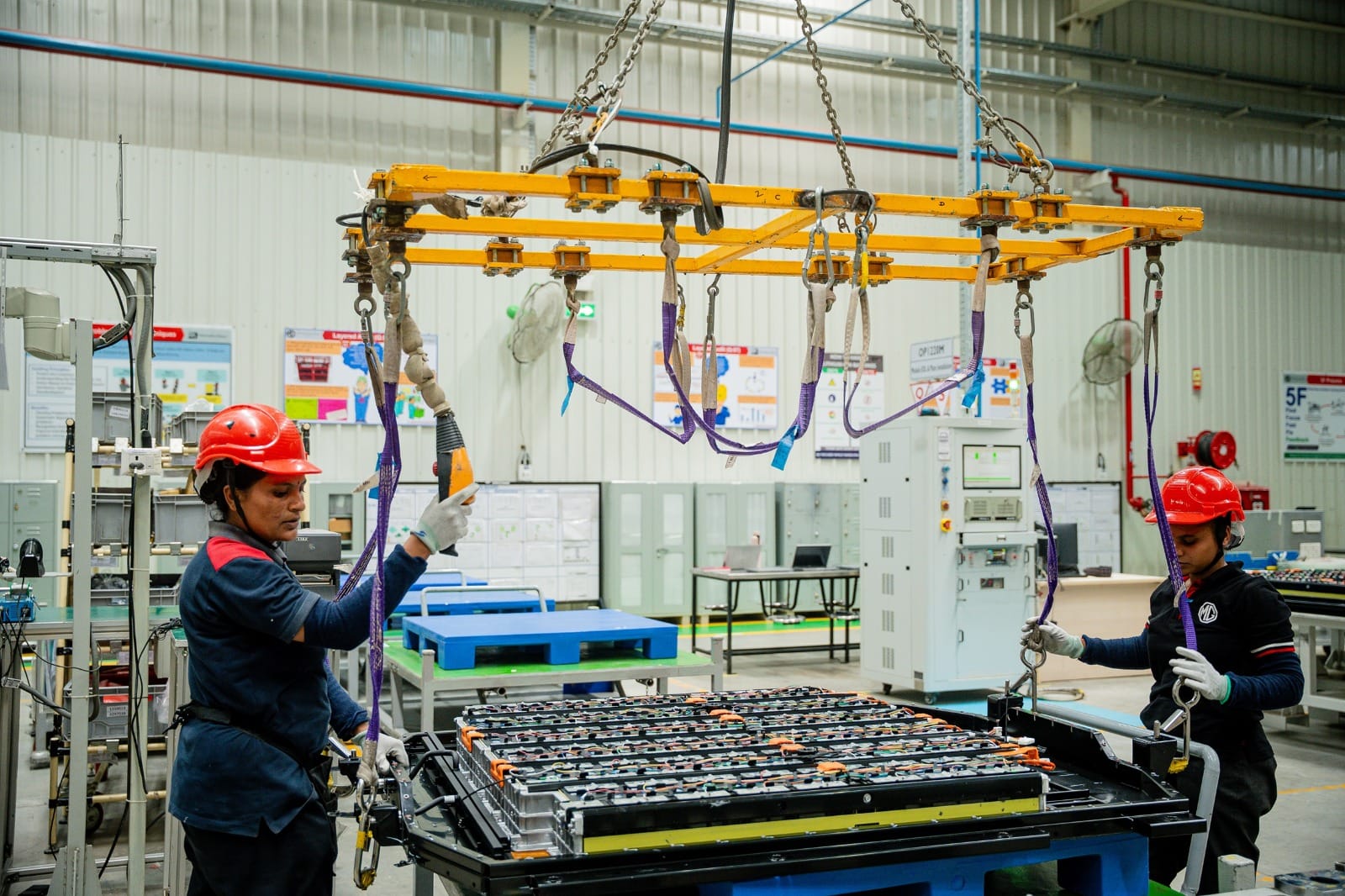
Walk into a battery assembly plant in India’s southern automotive belt today, and you’re likely to find something that would have been unusual on a car factory floor a decade ago: Most of the workers are women.
This is no coincidence, nor is it a CSR initiative. This is a result of the demand for electric vehicles.
Battery assembly, sensor calibration and electronics integration require fine motor control, constant concentration and precision. Where the internal combustion engine once valued physical strength, the EV prioritizes dexterity – and increasingly, working with robots to do what muscles once did. As automation takes over the lifting, pressing and torque-heavy tasks that previously defined the male-dominated factory floor, the work that remains is no longer gendered. Companies have followed this logic to its practical conclusion.
The results are tangible. According to estimates by TeamLease, one of India’s largest staffing firms, women constitute less than 20 percent of the workforce in heavy assembly. In component manufacturing—dashboards, instrument clusters and electronics—this share increases to between 30 and 40 percent. This gap aligns almost exactly where electrification and the automation that comes with it has advanced the most.
“Manufacturing is now moving towards precision-based quality robotics, which is really opening up a lot of opportunities for women to enter this field,” says Malvika Mathur, director of Deloitte India’s automotive practice. He argues that what the industry is experiencing is not a cultural shift but a structural one: first the nature of work changed, then the workforce.
business case
Balasubramaniam Ananth Narayanan, senior vice president of TeamLease, has spent years recruiting employees in the automotive aisles. He clearly describes the basic argument. Companies in these sectors found that women offered comparable skills, less attrition and longer tenure. He says the business case is simple.
Retention trends have a specific shape. Many women employed by firms are second-earners in their households. A small increase in a competitor’s salary is not worth risking their steady secondary income. Men, who are often the primary breadwinners, change jobs out of necessity for equal pay increases. Over time, this has resulted in female-dominated factory floors becoming more stable and cheaper to maintain.
Regulatory changes have further affected this calculation. Amendments to labor laws now allow women to work night shifts after 7 pm. “Even in your tier 3, tier 4 cities, where employers need to make adequate arrangements, that pressure is already applied,” says Mathur. Equal opportunity, combined with proper security and transportation infrastructure, provides access to labor supply that was previously unavailable in the second and third shifts.
The EV change changed this logic to an appointment template. Balasubramaniam cites battery manufacturing plants in the south as a clear example. He said factories set up to make EV batteries are predominantly or entirely run by women. This diversity is not the goal; This is a hiring decision based on productivity in a manufacturing sector that barely existed on a large scale five years ago.
a perception that the work has gone ahead
Malvika Mathur was associated with the automotive industry about fifteen years ago. “When I joined as a young intern, women were under-represented in the automotive sector,” she recalls. “Automotive is often considered a man’s field because of the physical nature of the work. Everyone thinks manufacturing involves heavy lifting.”
This perception is now fundamentally different from the current state of the industry.
Change matters because perception shapes the pipeline. For years, women avoided automotive manufacturing, not because they couldn’t do the work, but because the image of the work discouraged them. EV manufacturing is slowly changing that image from within. A factory floor focused on circuit boards and battery modules looks different from one focused on engine blocks and drivetrains – and it works differently.
Rajat Mahajan, partner and automotive sector leader, Deloitte India, identifies visibility as the key mechanism to bridge this gap. “Over time, because of women in senior roles, they move up in the hierarchy,” he explains. “They also come from the outside and challenge the status quo, inspiring other women to look to them as role models.”
The data behind the change
Comprehensive labor market data reflects the direction of this change. The government’s periodic labor force survey published in November 2025 put the overall female labor force participation rate at 35.1 percent, up from 32.0 percent in June of the same year. The rural female rate increased sharply from 35.2 percent to 39.7 percent. Female unemployment fell from 5.4 percent in October to 4.8 percent in November.
These numbers indicate an increase in the number of female job seekers; Industries are actively integrating women into the workforce. The rural female worker population ratio increased to 38.4 per cent in November 2025, showing that factory floors and industrial corridors are contributing more to women’s paid work than the office.
India’s automotive sector contributes 7.1 percent to GDP, accounts for about 49 percent of manufacturing output, directly employs about four million people, and supports an estimated 26 million jobs across its value chain. Even small changes in gender composition translate into large absolute numbers.
The GCC layer offers another perspective. According to Mahajan, India’s automotive global capability centers—engineering and technology centers set up by major manufacturers—are seeing strong female participation in engineering, product development and software. Mathur estimates that women comprise about 43 percent of STEM enrollment in India, while Mahajan says at least 30 percent of entry-level software engineers are women.
geography of change
The change is most visible where industrial density and infrastructure converge: Tamil Nadu’s Greater Chennai manufacturing belt, the Hosur corridor on the Karnataka border, and automotive clusters in Maharashtra and Gujarat. Balasubramaniam attributes this partly to the South’s historically high female literacy rates and comparatively low stigma against women in formal employment.
Retaining women in jobs requires investment that the industry has once ignored. “Many factories do not even have separate toilets for women, and even if they do, they are not kept clean,” explains Balasubramaniam. Companies are now offering discounted transportation, food and crèche facilities. Mixed-gender security teams are also being deployed so that female workers have someone they can contact if they feel unsafe.
what the programs reveal
Industry’s investment in developing this workforce is becoming measurable through CSR disclosure. Under the Companies Act 2013, eligible companies must allocate two percent of average net profit for CSR, including professional skill development.
CSR Activities of the Indian Automobile Industry 2026, published by the Society of Indian Automobile Manufacturers, reports on the disclosures of 17 member OEMs. What emerges is less a coordinated strategy and more a series of parallel efforts – all pointing in the same direction.
Hero MotoCorp’s Project Saksham has trained 4,113 women as two-wheeler technicians and sales professionals across 21 states. Of these, 3,555 have been certified and 1,660 have been placed in jobs. The nearly 40 percent placement rate highlights both the scale of the program and the gap between training and employment.
Mahindra & Mahindra’s Project Kaabil has reached over 1.1 million women from marginalized communities. Skoda Auto Volkswagen India has upgraded five all-women ITIs in Maharashtra, adding robotics, mechatronics and paint technologies to their curriculum.
JSW MG Motor India’s Wings to Fly initiative trained women to drive, linking mobility access to employment. Mercedes-Benz India’s Catalyst program supported 100 women engineering students with over 300 hours of training and industry internships.
middle interval
The challenge now is not of entry but of retention and progress.
Balasubramaniam says women are most accessible at a specific life stage – around 18 to 25 – after they enter the workforce, but after their circumstances change before marriage. Many people plan to work for four to six years, save money, and then leave the workforce.
This model largely fills entry-level roles but does not create a sustainable career pipeline. “There are a lot of fallbacks as we climb the ladder,” says Mathur. “One thing we need to focus on is how to get young women involved – and keep them there.”
There are some exceptions also. Balasubramaniam mentions a woman who started as a trainee at a major auto plant and within five years was supervising 250 people. But such cases remain rare.
The issue is structural. The industry has invested heavily in bringing women to the entry point, but the infrastructure for this – flexible return-to-work plans, mid-career re-entry after family breakdown, and clear pathways from the shop floor to supervisory roles – is not yet standard practice.
The EV transition has changed who the industry hires. Whether this will change how far women can advance remains to be seen.
which the statistics have not yet captured
India’s November 2025 PLFS data complicates a straightforwardly optimistic narrative. While rural female labor participation has increased, urban participation has remained stagnant at around 25.5 percent.
The expansion of global capability centers and white-collar automotive roles has not yet changed the urban headline numbers. Structural changes are often visible on the factory floor long before they appear in national statistics.
The factory floors of Hosur, Sanand and Aurangabad highlight something that is long overdue in a policy debate: employer demands that precede social mandates.
The companies themselves describe the change pragmatically.
“These things are not PR stunts,” says Balasubramaniam. “There is a real business case for this.”
The gap between goodwill and productivity has been quietly made possible by the EV transition. The industry did not plan to hire more women. It decided to make a different kind of car. The task force followed the task.














 The state estimates that these grassroots projects could create more than 80 lakh jobs. Projects worth Rs 10.11 lakh crore were launched during the Ground Breaking Ceremony (GBC) 4.0 in February 2024.The state has focused on investment commitments as well as project execution, while also emphasizing digital governance measures aimed at improving ease of doing business.Among the key initiatives listed was the state’s single-window clearance portal, Nivesh Mitra, which currently offers over 467 online services across 43 departments. The government also said that its Nivesh Sarathi platform is being used to monitor investment proposals from the MoU stage to operationalization. Additionally, 4,074 regulatory compliance or procedural burdens have been reduced.The state has also outlined the expansion of region-specific industrial infrastructure. These include a PM-Mitra Mega Integrated Textile Region and Apparel Park in Lucknow and Hardoi, a medical device park in Gautam Buddha Nagar, a plastics park in Gorakhpur and a leather park in Kanpur. It said approval has been given for 11 toy parks in places like Greater Noida, Aligarh and Jhansi.On the MSME front, the government said Uttar Pradesh has over 96 lakh units, making it the largest MSME base in the country.It also pointed towards the Chief Minister Youth Self-Employment Scheme, under which financial assistance up to Rs 25 lakh is given to young entrepreneurs.The state further said that foreign direct investment received between 2017 and 2023 was almost four times more than the inflows recorded during 2000-2017. It said the 2024 UP International Trade Show saw participation from over 100 countries and business inquiries worth Rs 10,000 crore.