

‘Surviving and protesting’: MP turns 100 in Janata rule. india news
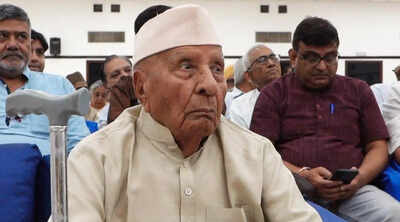
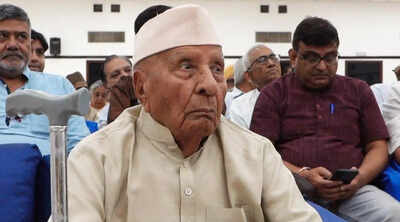
New Delhi: A month ago, Pandit Ramkishan sat on a dharna in Rajasthan demanding better quality water for his home district Bharatpur. One of India’s oldest former MPs (he was in Parliament in 1977) told TOI on Friday, a day before he turned 100, that he will always remain a socialist. “This is what I have learned from Ram Manohar Lohia.”Sitting in his Bharatpur home, the veteran, “Lohia’s oldest disciple”, as he likes to call himself, speaks with the authority of a man who has not only witnessed history, but shaped it. Until recently he was briefly hospitalized due to a fall, he was attending three meetings a week.What keeps him going is the unfinished business.He asserts, “The day I stop thinking about a better India is the day I stop living. I am alive now and my voice will be heard.” “The values we fought for – equality, integrity, dialogue – are under pressure. We need to speak out.” This is exactly what is said in his autobiography published last year – I am alive.
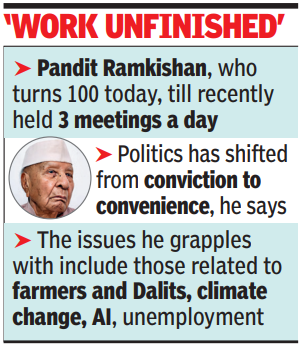
The first part of life was defined by ideology, the second part saw its erosion: PanditjiBut why continue this physically excruciating movement, sitting in the sun, sometimes without food and water, on knees and carrying the weight of a century behind you? “It comes natural to me,” says Pandit Ramkishan simply.a partner in Quit India Movement In 1942, “and shaped by Lohia and Jayprakash Narayan”, Panditji, as people fondly call him, went to jail during the Emergency, from where, they say, he came out sane.Not born into politics, he was the son of a farmer, for whom independence meant “freedom from fear, freedom from ‘lagaan’ and want, and freedom from a system that marginalized the common man”.He remembers searching for Mahatma Gandhi in his youth. As a student in Bharatpur, he traveled to Delhi by collecting some coins among friends in the hope of hearing Gandhiji one day. Panditji was not impressed. “We went looking for revolutionary ideas.”He believes that the very idea of freedom is untenable today. If the first half of his life was defined by ideology, he says the second half saw its erosion. He argues that politics has shifted from conviction to convenience.When the Samajwadi faction split, Panditji left the Congress – and never returned. He recalls that repeated attempts were made to bring him on board, including an offer to lead the state of Rajasthan. He refused. “It was difficult – but necessary… Opportunity or pressure should never outweigh principle.”So, what modern issues is he grappling with these days? “Quite a few,” he says. “From problems related to farmers and Dalits to climate change, unemployment and artificial intelligence.” However, what troubles him is “what politics has lost now”. He tells a story. “I was contesting against Union Minister Babu Raj Bahadur, who once stopped midway to help me during my campaign when my vehicle broke down. We were contesting elections, but there was no enmity.“Today, he says, the rival is treated not as a part of the regime but as the enemy. “Criticism is meant to strengthen democracy – not to invite hostility.”Is he hopeful?Panditji stopped. There is pessimism when he talks about communal polarization and political opportunism. But also a refusal to accept defeat. He said, “The solution will not come from political parties. It will be up to common people to understand what impacts the country’s progress, and in turn their own.”