


Puducherry Elections 2026: Top 3 factors that can decide the decision india news
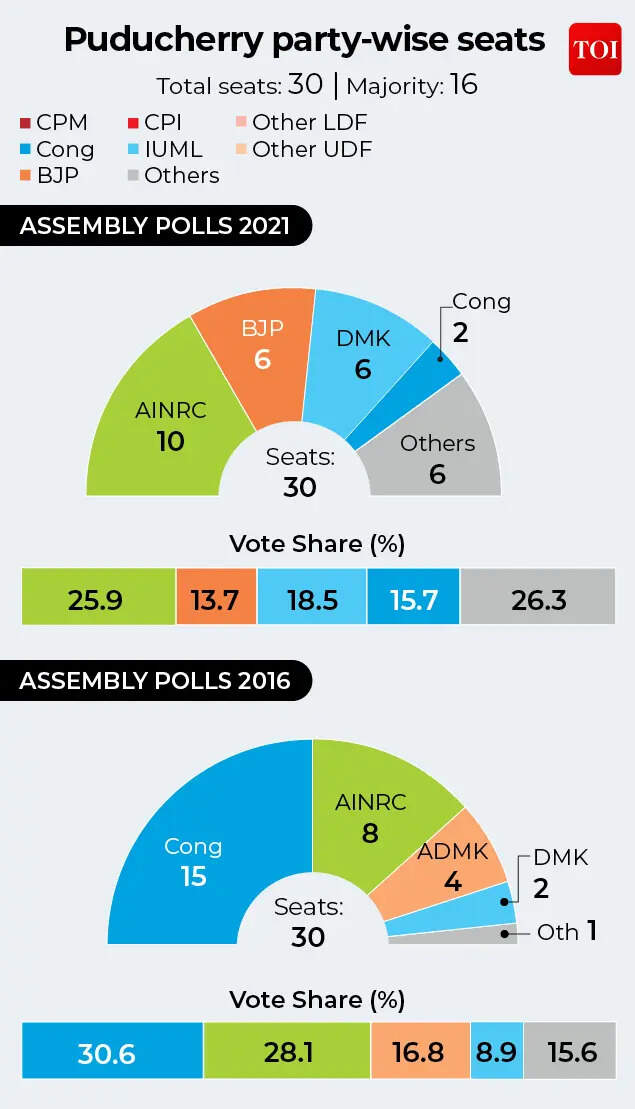
New Delhi: Puducherry is all set to vote on Thursday (April 9) and though the contest may be fought on just 30 seats, the stakes are anything but small. Nearly 9.5 lakh voters will decide the fate of 294 candidates, with even the slightest of margins capable of overturning the result.Here are the 3 key factors shaping this tightly contested election in Puducherry:See complete coverage of Assembly Elections 2026 1. state demandPuducherry’s long-standing demand for full statehood is once again at the center of political debate. while being Chief Minister N Rangasamy And while his All India NR Congress (AINRC), backed by the BJP-led National Democratic Alliance (NDA), argues that an alliance with the Center ensures smooth governance, the opposition says otherwise. The Congress-DMK faction is projecting this election as a referendum on “lost autonomy”, arguing that despite being part of the “double engine” setup, Puducherry has seen continued friction with the Lieutenant Governor and limited administrative independence.
2. Electricity, prices and welfareEconomic concerns are front and center right now. Protests have started against the proposed privatization of the electricity department and there is a possibility of increase in rates. At the same time, the ruling coalition is relying on welfare, including cash assistance schemes and subsidies, to maintain voter confidence. However, the opposition has focused on rising cost of living, unemployment and lack of quality jobs, which have forced many youth to migrate to cities like Chennai and Bengaluru.
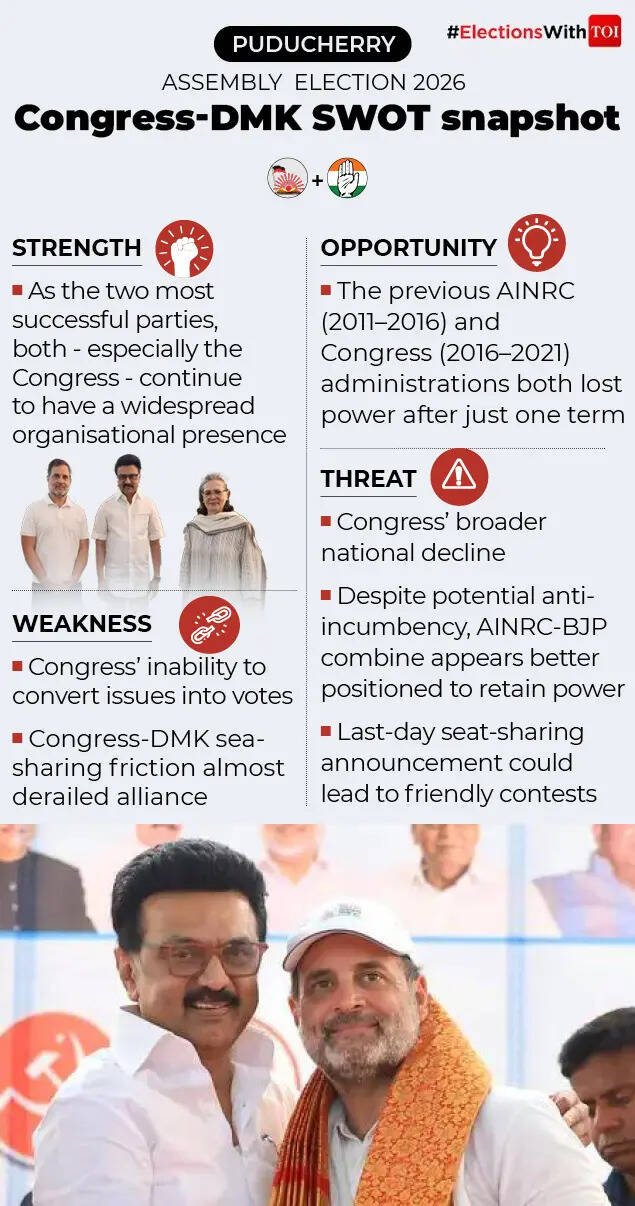
3. Fragmented Competition and Victory FactorIn a small assembly like Puducherry, even a few thousand votes can change the outcome, and this time, the contest is more crowded than usual. Apart from the NDA and the Congress-DMK alliance, actor-turned-politician Vijay’s Tamilaga Vetri Kazhagam (TVK) has entered the fray, adding a new layer of unpredictability.
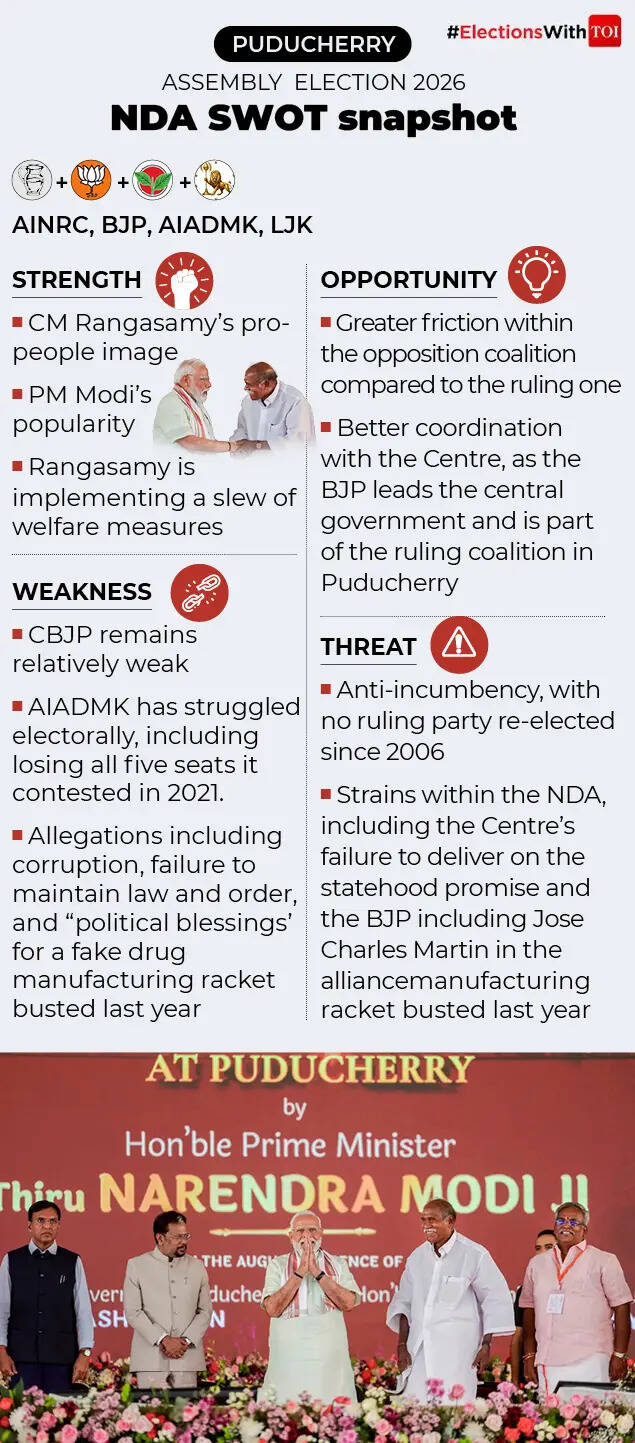
With multiple parties and independents in the race, the distribution of votes could be decisive. In many constituencies, a third force breaking into the traditional vote banks could overturn the close contest and even increase the chances of a hung assembly.Will the NDA be able to retain its ‘double engine’ rule or will the opposition faction be able to regain power in the Union Territory? Puducherry will decide tomorrow and we will know the decision on May 4.
Kerala Elections 2026: 5 factors that may decide the decision india news
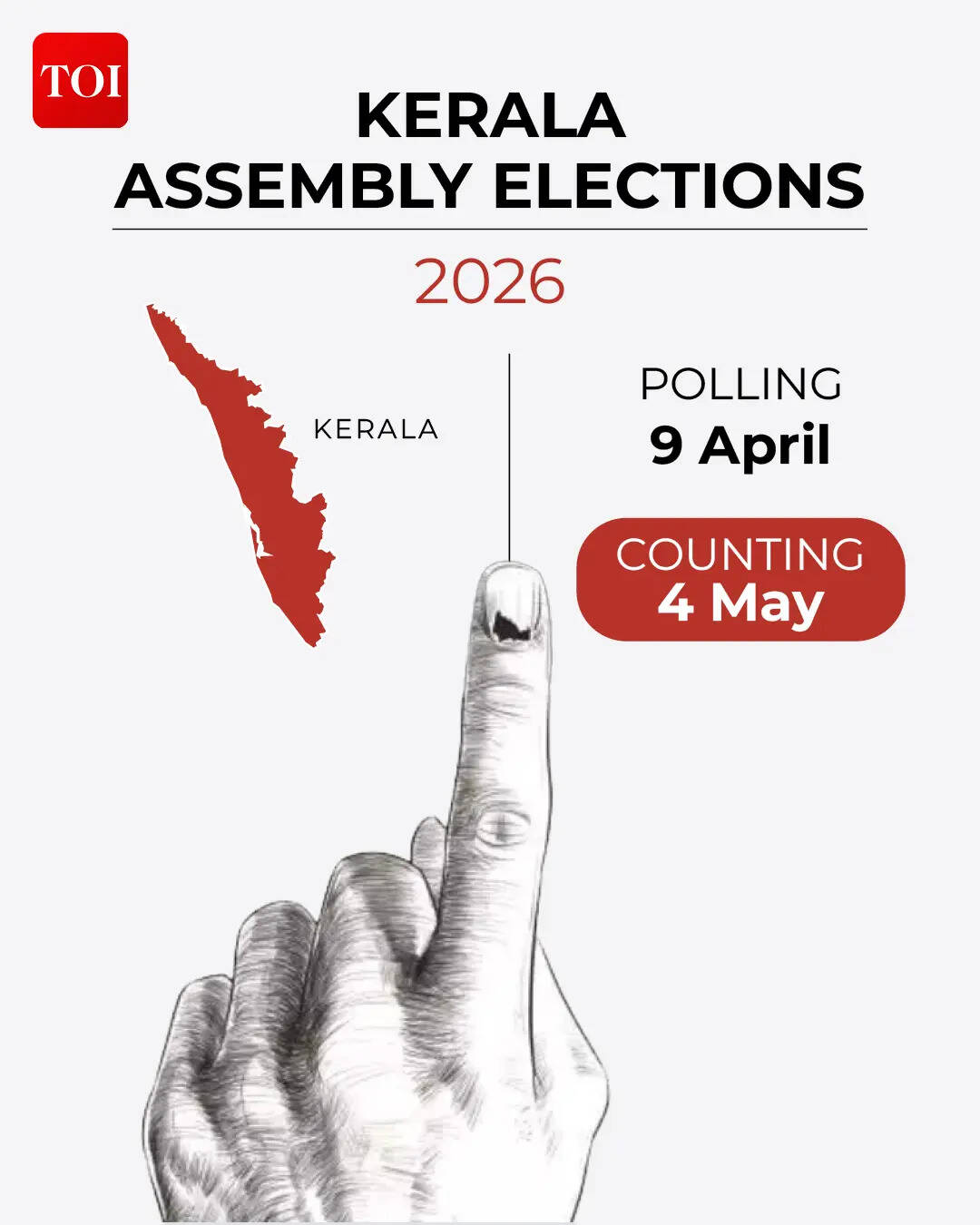
Kerala Assembly Elections 2026 Voting Date: The results of the 2026 Kerala elections will be declared on May 4, 2026.
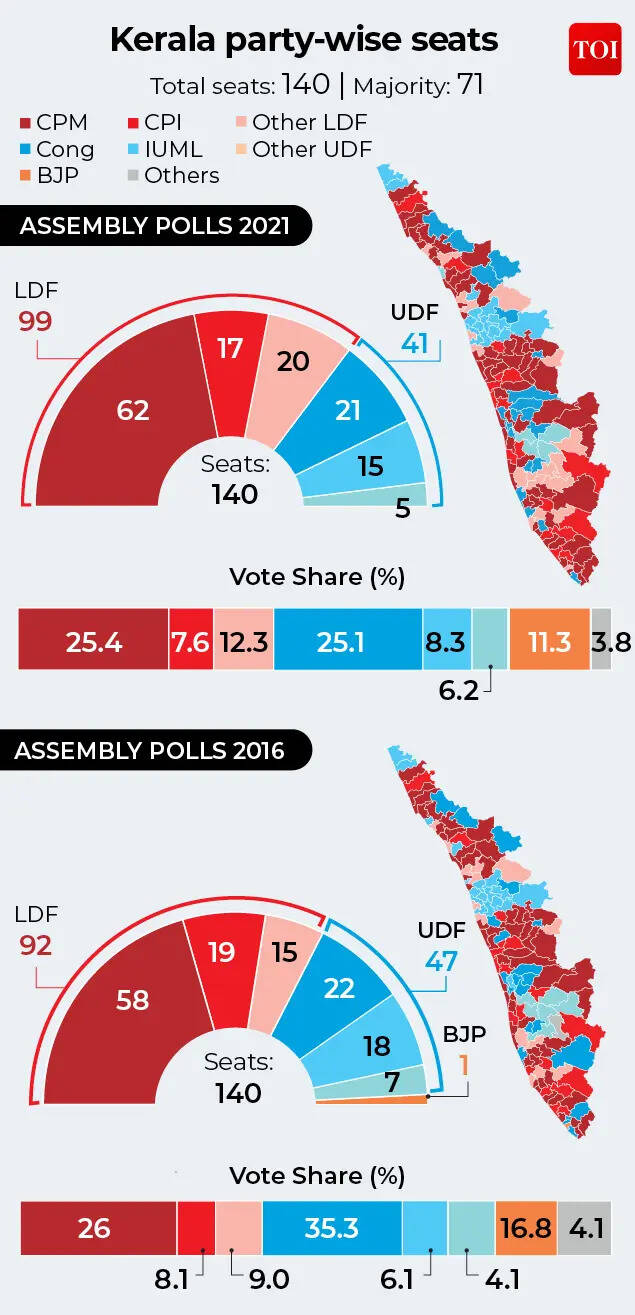
New Delhi: This time the story of Kerala is not the same. As the state prepares to vote for 140 assembly seats tomorrow (April 9), it is no longer the old “change government every five years” story. The Left Democratic Front (LDF) is seeking the chief minister’s post for the third consecutive term Pinarayi VijayanWhile the Congress-led United Democratic Front (UDF) is trying to regain power.Here are the top 5 factors to note that could decide the May 4 decision:See complete coverage of Assembly Elections 20261. Vijayan Factor CM Pinarayi Vijayan is trying to create a record for the third consecutive time, but even after being in power for 10 years, the path is not easy.Vijayan remains LDF’s biggest asset. Welfare schemes, including high social security pensions, are still strongly in place. But after a decade in office, fatigue is also visible. The United Democratic Front (UDF) has been pushing an anti-incumbency narrative claiming that governance has become slow and debt has increased over the last 10 years. 2. Development: Promise versus pushbackThis time, big infrastructure is a major election issue for Kerala. The controversial Silverline project has been shut down and replaced with a softer alternative, which has left mixed signals. While the LDF talks of development, the UDF, with leaders like VD Satheesan and Shashi Tharoor, is exploiting concerns over land and execution.
3. Increasing influence of BJPThis time, the BJP-led National Democratic Alliance (NDA) is no longer just a marginal player. Suresh Gopi’s Lok Sabha victory and the recent Thiruvananthapuram Corporation victory have given momentum to the party. It may not win many seats, but it may cut into votes and turn the contest into a triangular contest.
4. Jobs and ‘brain drain’Young voters are looking beyond ideology. With many people leaving Kerala for jobs abroad, employment has become a major issue. UDF has tried to take advantage of this by giving prominence to employment, entrepreneurship and investment in its campaign. Particularly for first-time voters, ideological loyalty is weaker than economic aspirations, making it an important swing factor.
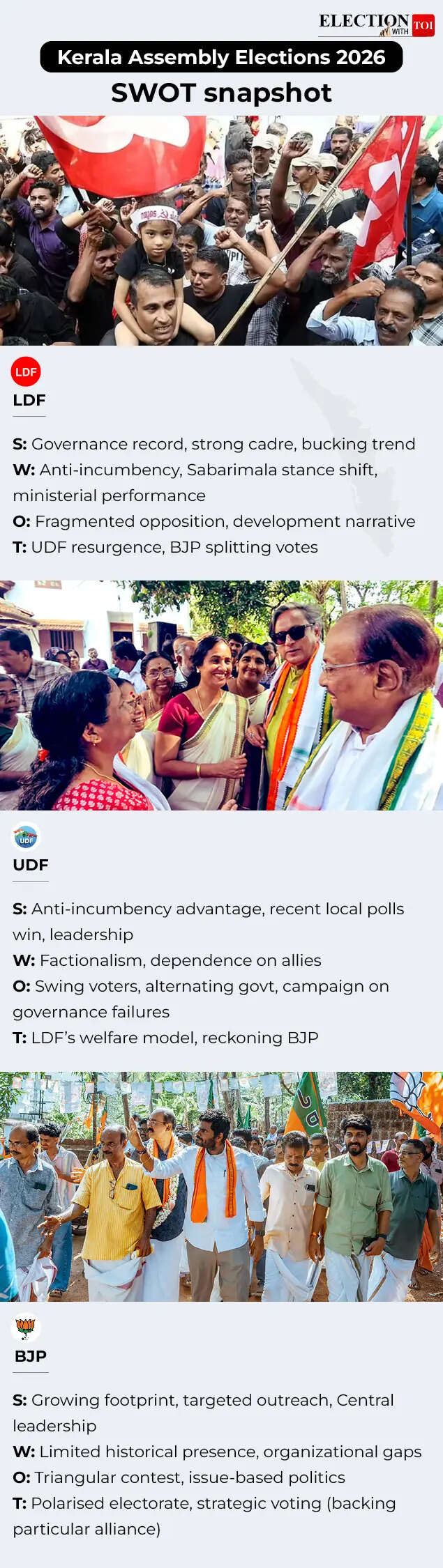
5. Community equationElections in Kerala are often decided by small changes in key communities. In the state, the arithmetic of various factions of the Indian Union Muslim League (IUML) and the Kerala Congress (representing the Christian heartland) usually decides the winner.The LDF has made a significant dent in the Christian vote bank through its alliance with the Kerala Congress (M). However, the UDF is fighting to reclaim the region by highlighting Centre-State tensions and concerns of the “secular fabric”.Issues ranging from the Waqf Board debate to international conflicts including the ongoing tensions in the Middle East often resonate deeply in local booths in Kerala, forcing all three fronts to tread carefully on communal and religious sentiments. Apart from this, issues like entry of women in Sabarimala temple have also been gaining political momentum. Additionally, controversies such as gold smuggling and related allegations have been used by the opposition to question the government’s credibility and governance record. While the LDF has pushed back strongly, these issues add another layer to voter sentiment.This phase of elections in Kerala may be in trouble. Will Vijayan create history or will UDF make a comeback? Will BJP make a dent this time? Voters will take their decision tomorrow and we will know the decision on May 5.
Assam Elections 2026: 5 big factors that can turn the situation around. india news
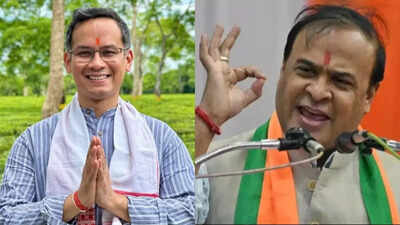
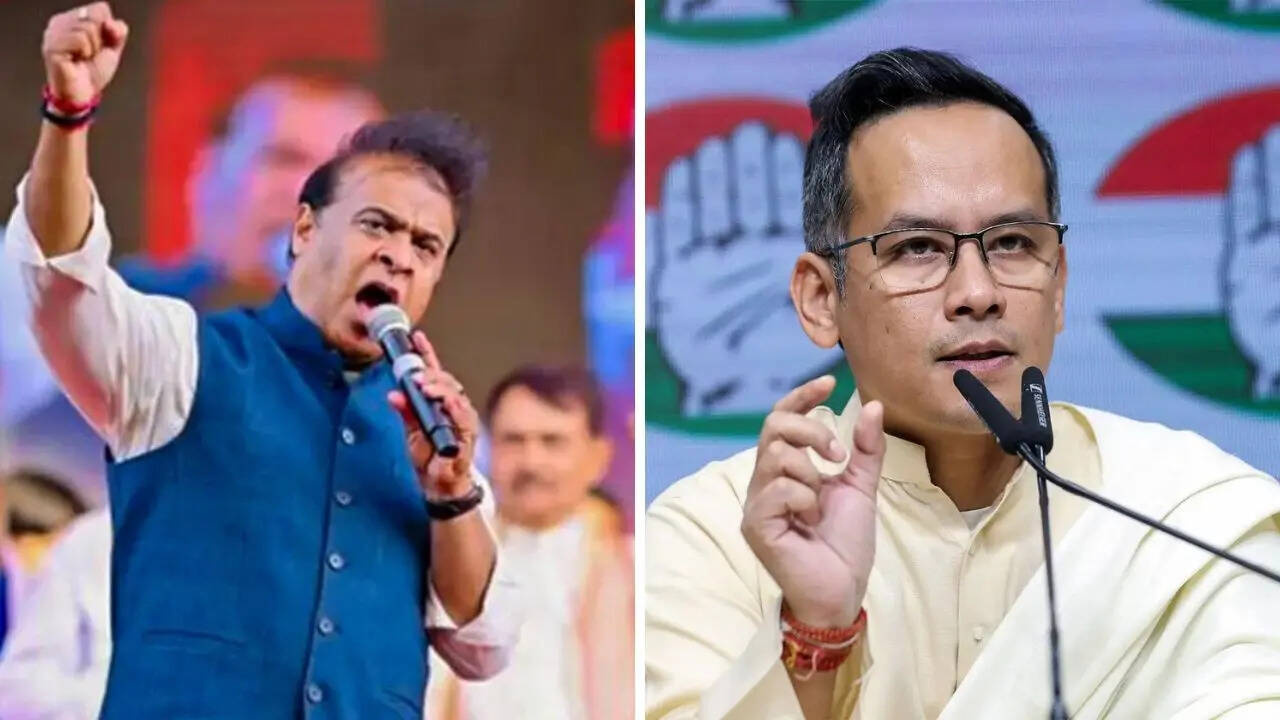
New Delhi: Assam is all set to vote for 126 assembly seats on Thursday (April 9). This contest has emerged as a direct fight between the Chief Minister Himanta Biswa Sarma and Gaurav Gogoi-led Congress in the state. Sarma is aiming for a third consecutive victory for the BJP-led alliance, while the Gaurav Gogoi-led Congress is attempting to regroup and convert anti-incumbency unrest into its electoral advantage.In the 126-member Assembly, where 64 seats mark the majority line, the outcome is likely to be determined not by a single wave, but by a host of issues in the state.See complete coverage of Assembly Elections 2026Here are the top 5 factors that could influence the decision on May 4 in Assam:1. Delimitation Domino EffectThis time the assembly election is the first after the 2023 delimitation which has redrawn the constituency boundaries based on the 2001 census. The delimitation process has reshaped constituencies and reduced minority-dominated seats from about 35 to 23. This shift has strengthened indigenous and tribal influence, benefiting the BJP, which is relying on identity politics, welfare schemes and governance delivery. In areas like Barak Valley, mergers and reclassification of constituencies have forced political stalwarts to shift ground, destabilizing long-standing vote-bank calculations that traditionally favored the Congress and the All India United Democratic Front. So, this election is not being fought on the old map, and that alone changes the arithmetic.
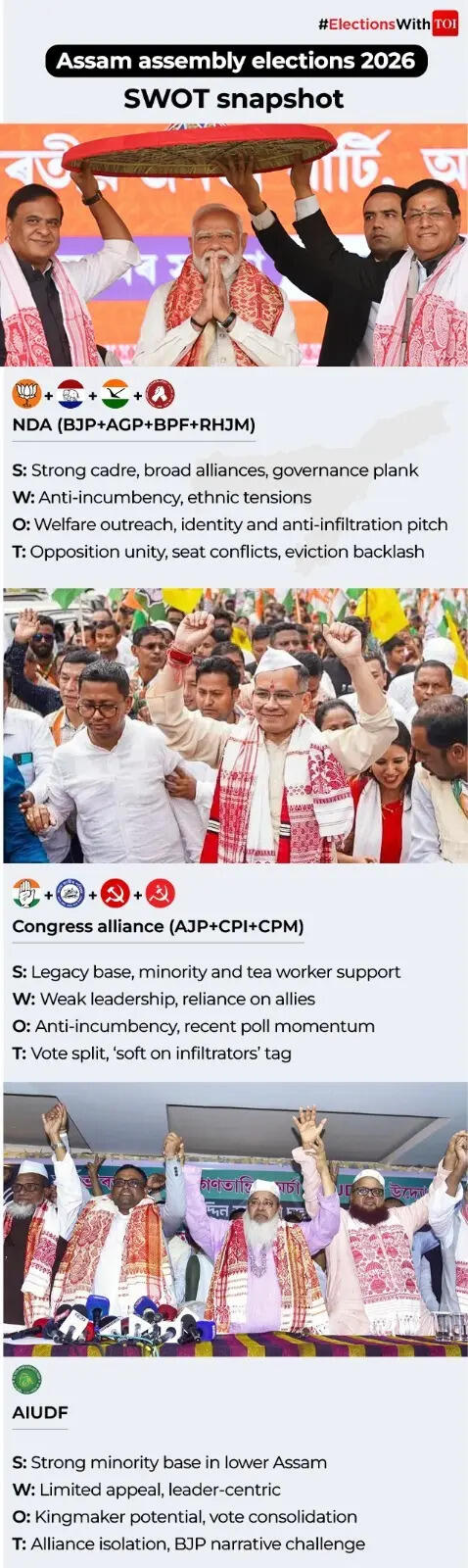
2. ‘Infiltration’ storyOn top of this there is the debate over the permanent identity of Assam, which has now been rescheduled for 2026. The twin issues of the Citizenship Amendment Act (CAA) and the National Register of Citizens (NRC) remain central, though no longer in the form of mass protests. Instead, they have become absorbed in competing political narratives. The BJP has framed its position as a defense of indigenous identity and land, heightened by controversial eviction drives in districts such as Darrang and Nagaon. On the other hand, the opposition has accused the government of weaponizing these issues for polarization. 3. ‘Orunodoi’ Economy BJP’s ‘double engine’ governance relies heavily on Direct Benefit Transfer (DBT).Fighting against anti-incumbency, Himanta Sarma’s election strategy largely hinges on welfare delivery, especially this time through his flagship Orunodoi scheme. With over 26 lakh women beneficiaries receiving monthly financial assistance, the scheme has helped build a loyal base of what the party calls ‘Shramarthi’ voters. Initiatives like Atmanirbhar Assam have further strengthened this reach. On the other hand, the Congress and the ruling parties are focusing on the “cost” of these schemes, pointing to the state’s rising debt and “paper leak” scams in recruitment as evidence that welfare is being used to hide the lack of sustainable job creation.4. Tribal and tea garden swingBeyond the statewide narrative are decisive swing areas. Tea tribes, spread across about 35 to 40 constituencies, remain one of the most influential but fluid voter groups. Both sides have invested heavily in outreach here, but there is no guarantee of uniform consolidation. Similarly, after delimitation the political importance of Bodoland Territorial Area has increased and its seats have increased from 11 to 15. The BJP’s alliance with the United People’s Party Liberal (UPPL) is being projected as a sign of stability coupled with the peace deal with the Bodo groups. Still, as in past elections, changes in these areas could swing many seats in one direction. 5. Fragmented oppositionThe arithmetic of “anti-BJP” votes will be the final decision. At present, the anti-BJP space is divided between the Congress, AIUDF, Raijor Dal and Assam Jatiya Parishad. Whether this will ultimately benefit Assam remains to be seen. Vote fragmentation had worked in the BJP’s favor in 2021 when the ruling alliance secured 75 seats. For Gaurav Gogoi, the election is as much about leadership as it is about arithmetic and about presenting a united Congress front at a time when many party leaders had defected to the BJP ahead of the elections. For Himanta Biswa Sarma, the strategy is to keep the opposition divided while consolidating gains in all areas.As Assam goes to the polls tomorrow, this election can in many ways be seen as a referendum on whether the BJP’s mix of identity politics, welfare expansion and strong leadership has become the state’s dominant political model, or whether there is room for a revival of opposition-led politics. Assam will decide tomorrow what matters most to it. We will know the decision on May 4.
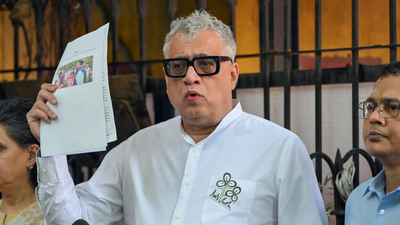
CEC’s response was ‘get lost’: TMC’s Derek O’Brien details ‘7‑minute’ meeting with Gyanesh Kumar | india news
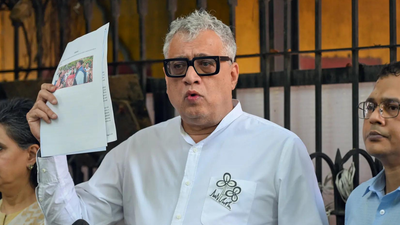
TMC MP Derek O’Brien (ANI photo)
New Delhi: After a short and stormy meeting with Election Commission on wednesday Trinamool Congress (TMC) called Chief Election Commissioner Gyanesh Kumar a “thief, criminal” and accused him of “biased attitude”. According to TMC leaders, the “seven-minute” meeting ended abruptly with the CEC ordering their delegation to “disappear”.“Outlining the details of the encounter, TMC leader Derek O’Brien said the party delegation included Rajya Sabha MPs Sagarika Ghosh and Maneka Guruswamy, former MP Saket Gokhale and he.“All like-minded anti-BJP parties will address a press conference at the Constitution Club today around 4:30-4:45 pm,” O’Brien said.
Nine letters, zero response
Rajya Sabha member O’Brien said the delegation presented nine letters written by the TMC supremo Mamata Banerjee to the Election Commission, none of which were acknowledged or replied to. “We pointed out that if these letters had come from Narendra Modi or Amit Shah, the CEC would have responded immediately,” he said.TMC also presented a list of six officials with alleged links to the BJP in Bengal with photographic evidence. O’Brien said, “We asked for their transfer, including that of the CEO seen with BJP workers in Nandigram. It only took 2-3 minutes to submit this memorandum, and the CEC’s response was simply: ‘Get lost’.”
A delegation became silent
O’Brien also noted that the CEC did not allow any of his fellow officials to speak. “I have been in TMC for 22 years and in Parliament for 16 years and I have met many constitutional authorities, but what I saw today was shameful,” he said, challenging the Election Commission to release audio or video of the meeting to prove otherwise.
contradictory media statements
Right after the meeting, a media update came out claiming, “Elections in West Bengal will be fear-free, violence-free, inducement-free and without any hush-hush, booth jam.” O’Brien questioned who had sent it, insisting, “The CEC is a thief, a criminal. He didn’t say anything about it in the meeting. The only thing he said was ‘Get out.'”Accusing the CEC of trying to play games with the party, the TMC delegation said, “Gyanesh Kumar, you don’t know who you are dealing with. This is Mamata Banerjee, Abhishek Banerjee and TMC.”O’Brien concluded by inviting all anti-BJP parties to the press conference, promising comments in Hindi, English and Bengali for inclusivity.
EC gave ‘straight talk’ to TMC
Meanwhile, Election Commission sources said the Election Commission chief had a “direct talk” with TMC leaders.He alleged that Derek O’Brien shouted at the election commissioners and asked the CEC not to speak.Election Commission sources said the upcoming elections in West Bengal will be “fear-free, violence-free, intimidation-free and inducement-free.”
‘We look forward to unimpeded freedom of navigation through the Strait of Hormuz’: India welcomes US-Iran ceasefire | india news
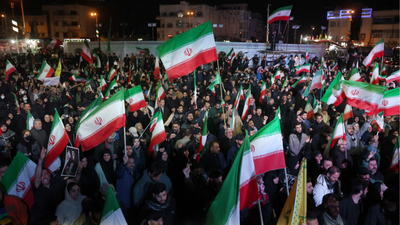
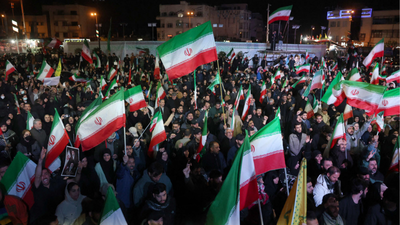
Iranians’ reaction after the announcement of ceasefire
New Delhi: The Ministry of External Affairs (MEA) on Wednesday welcomed the ceasefire agreement between Iran and the United States, expressing hope that it will pave the way for lasting peace in West Asia, while stressing the need for unhindered navigation through the Strait of Hormuz.“We welcome the ceasefire and hope it will bring lasting peace to West Asia. As we have consistently advocated in the past, de-escalation, dialogue and diplomacy are necessary to bring an early end to the ongoing conflict,” the Foreign Ministry said in a statement.“The conflict has already caused enormous suffering and disrupted global energy supplies and trade networks. We expect unhindered freedom of navigation and the global flow of commerce through the Strait of Hormuz to continue,” it said.The statement came after Iran, the United States and Israel announced a two-week ceasefire, with Tehran indicating it would enter talks with Washington in Islamabad from Friday.us President donald trump Iran was initially said to have proposed a “feasible” 10-point plan, but later dismissed it as fraudulent without elaborating. Hours before the ceasefire announcement, Trump issued a dire warning, saying, “If Iran fails to agree to terms that include reopening the strategically important Strait of Hormuz, an entire civilization will die tonight, never to be brought back.”In Israel, the Prime Minister benjamin netanyahuThe office said it supports Trump’s decision to pause strikes against Iran for two weeks. However, it was clarified that the moratorium does not extend to Israel’s ongoing conflict with Hezbollah in Lebanon, where more than 1,500 people have been killed.Iranian Foreign Minister Abbas Araghchi said passage through the Strait of Hormuz would be allowed under Iranian military management, although it was unclear whether Tehran would fully ease its control over the key waterway.The plan could allow both Iran and Oman to impose tariffs on ships passing through the strait, according to a regional official familiar with the talks. The official, speaking on condition of anonymity, said Iran could use the funds for post-war reconstruction.Despite the ceasefire, major differences between Iran and the United States remain unresolved, including issues related to Tehran’s nuclear program, ballistic missile capabilities, and its regional proxy network, all of which Washington and Israel have cited as reasons to initiate military action.Iran has also set broad conditions for ending the conflict, including the withdrawal of US combat forces from the region, lifting of sanctions and the release of its frozen assets.
Bengal election fight heats up: ‘Direct talk’ between Election Commission and TMC. india news
War of words: ECI assures free elections, TMC expresses displeasure over deletion of voters’ names (ANI photo)
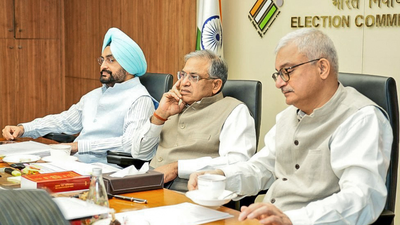
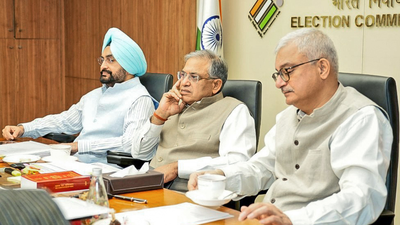
Election Commission of India (ECI) on Wednesday said the 2026 West Bengal Assembly elections will be conducted in a “fear-free, violence-free and intimidation-free” manner, issuing a strong message to the ruling party. Trinamool Congress (TMC).In a post on Twitter, the election body said there will be no booth jam or source jam during polling, adding that the elections will be free from inducements and disruptions.Voting for the 294-member assembly is scheduled in two phases on April 23 and April 29 and counting of votes will take place on May 4.The statement came after a meeting between Chief Election Commissioner Gyanesh Kumar and the TMC delegation of Derek O’Brien, Maneka Guruswamy, Sagarika Ghosh and Saket Gokhale at Nirvachan Sadan in New Delhi.Reacting strongly to this, TMC accused the Election Commission of working in favor of Bharatiya Janata Party (BJP) alleged that the ongoing Special Intensive Revision (SIR) of voter lists is aimed at removing names of voters before the elections.In its official response to the issue, the party claimed that millions of voters had been removed from the rolls, calling it “systematic disenfranchisement” of voters. It was alleged that due to fear of defeat in West Bengal, BJP is using ECI to influence the electoral process.The party also questioned the impartiality of election officials and claimed that out of the 60 lakh voters placed under the decision, about 27 lakh names have already been removed.According to TMC data, after the amendment process the total number of voters in the state has dropped from 7.66 crore to 7.04 crore – a reduction of more than 61 lakh names.The sharp exchange underlines the growing tension between the Election Commission and the ruling party as the state heads towards a high-stakes assembly election.
Bengal elections: CM Mamata Banerjee files nomination from Bhawanipur constituency, raises SIR issue. india news
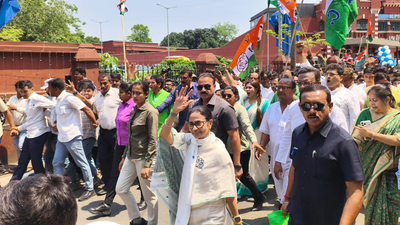
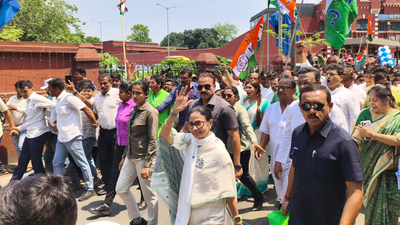
New Delhi: Chief Minister of West Bengal Mamata Banerjee On Wednesday, he filed his nomination from Bhabanipur and staged a show of strength with a road march from his Kalighat residence in Kolkata to Alipore Survey Building. Supporters raised slogans in his favor Trinamool Congress The (TMC) chief walked for about 800 meters and greeted party workers with folded hands as she tried to project confidence ahead of a high-level contest.Soon after filing her nomination, Banerjee launched a scathing attack on the Special Intensive Revision (SIR) of the voter list, saying she was “saddened” by the deletion of thousands of names in Bengal. Accusing the Narendra Modi-led Center of interference, he warned that such an exercise could undermine the fairness of the elections and promised legal aid to the affected voters.“I congratulate everyone, thank you, respect, salute, Jai Jinendra and Sat Shri Akal. Today, as I filed my nomination, I want to say that I will work for Bhawanipur constituency as well as every center and every area. TMC supremo said, we will form the government.Bhawanipur, considered Banerjee’s political stronghold for a long time, is now emerging as a major battlefield. The Bharatiya Janata Party (BJP) has fielded Suvendu Adhikari against him, making the contest a direct one-on-one reminiscent of the 2021 Nandigram elections, where Adhikari had defeated the Chief Minister.
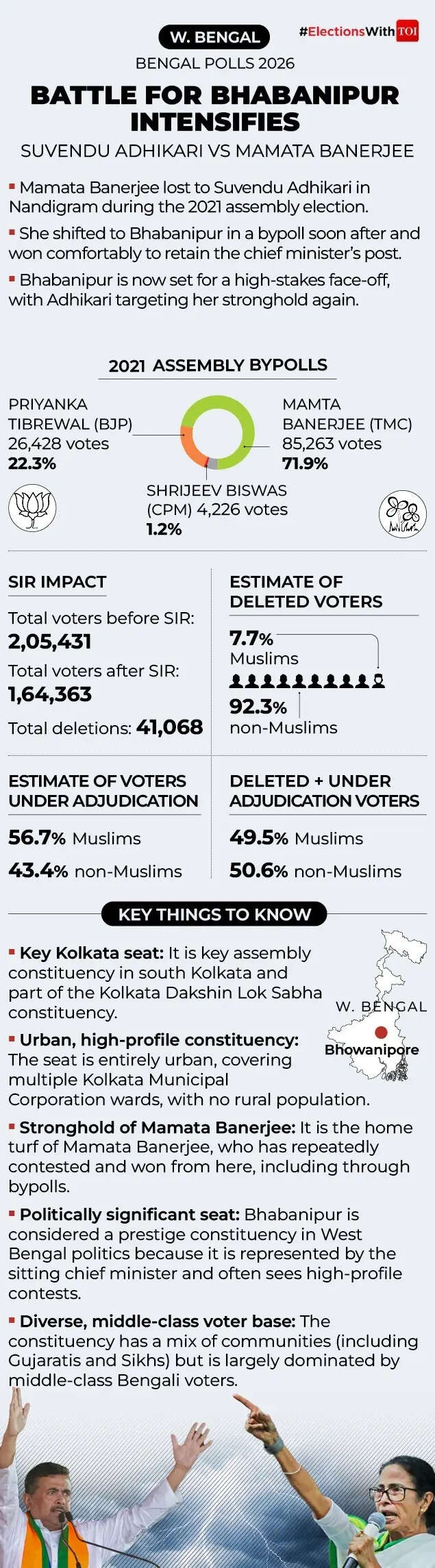
While Banerjee won the 2021 bypoll here with a landslide victory with over 71 percent votes, recent trends show that the competition is stiff. In the 2024 Lok Sabha elections, TMC’s lead in the region was significantly reduced, with the BJP taking the lead in several municipal wards. The party leadership has since urged workers to avoid complacency by setting ambitious margin targets to retain the seat.The SIR exercise has further intensified the competition. Party sources claim that over 40,000 names have been removed from the list, with several others under investigation, giving rise to competing narratives to target voters. The mixed demographic profile of the constituency – spanning Bengali and non-Bengali Hindus, minorities and migrant communities – adds another layer of unpredictability.
Real work starts after flight: ISRO chief puts mission operations at center of space ambitions india news
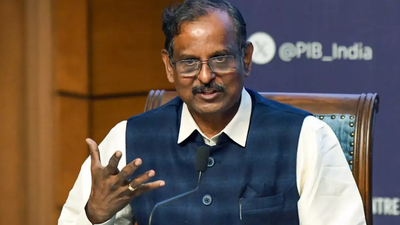
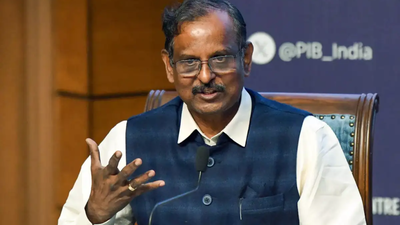
BENGALURU: India’s space missions may make headlines at the time of launch, but their real test begins only after the rocket is decommissioned. ISRO Chairman V Narayanan said here on Wednesday that mission operations, the long, invisible phase that keeps satellites alive for years, will define the next phase of the country’s space ambitions.Speaking at the Spacecraft Mission Operations (SMOP) conference, Narayanan underlined that while launches last barely 15 to 25 minutes, the spacecraft must function reliably for years, sometimes up to 15. “Ensuring that the spacecraft remains fully operational in orbit … continuous monitoring, simulation and command operations. This is a very important domain,” he said, placing mission operations at the center of future space efforts.Narayanan spoke at a time when ISRO is grappling with launch failures and project delays, which is drawing criticism, especially given that the Indian space program is transitioning from milestone-driven missions to sustained space activity. He pointed to three major achievements since the last SMOP conference: the successful docking experiment in space, the Chandrayaan-3 moon landing, and the Aditya-L1 solar mission.He described the docking experiment as particularly complex, in which two satellites traveling at more than 15,000 km per hour were brought together with precision. Highlighting the risks involved, he said, “Any wrong order… you know what the end result will be.”On Chandrayaan-3, Narayanan credited the mission operations teams for executing an autonomous landing sequence near the Moon’s south pole. He also mentioned India’s entry into an elite group of countries to study the Sun with the Aditya-L1 mission.The Chairman emphasized that mission operations are not limited to one team but involve designers, software engineers and system experts working together. He described their role as “very important” and often under-recognized.Looking ahead, Narayanan said technologies such as artificial intelligence, machine learning and cloud-based ground systems will become important. “What was considered advanced 10 to 15 years ago is now the need of the hour,” he said.He also placed mission operations in the broader context of India’s expanding space ecosystem, pointing to the increasing involvement of private players and start-ups. Private companies are contributing to both technical capacity and talent development, he said.On human space flight, a program that has been announced several times by the Center and ISRO, Narayanan described it as “not just another activity” but a big step requiring constant operational precision. Drawing comparisons with April 12, 1961 – the date of the first human space flight – he said India is now preparing for its own crewed missions.As ISRO moves towards more complex missions, including the future Chandrayaan-4 and 5 projects and human spaceflight, Narayanan’s message was clear: success will depend less on the spectacle of the launch and more on the discipline of operations that follow.
After grounding in February, Tejas fleet ready to take off again today. india news
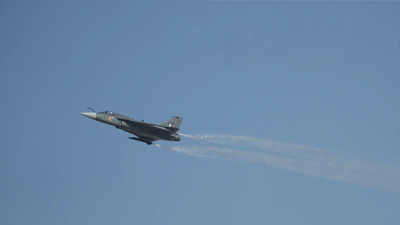
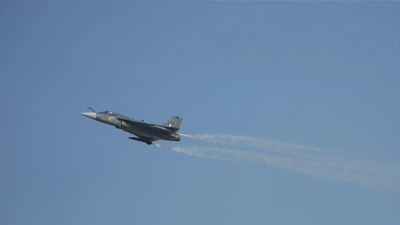
New Delhi: The good news for the Indian Air Force (IAF) is that the indigenously developed LCA Tejas fleet is likely to resume flight operations on Wednesday after nearly two-month long grounding. The fleet was grounded in early February after the Tejas aircraft encountered problems during landing.Hindustan Aeronautics Limited (HAL) CMD DK Sunil had recently said that all 36 Tejas jets are likely to resume flights from April 8 after resolution of a software-related issue identified in the aircraft. “There was a technical issue, which has been discussed and the committees are working on it. It was discussed in the Local Amendment Committee (LMC).” The good news is that the work of Tejas, LMC has been completed. Therefore, we hope that the fleet will start flying by Wednesday.“Soon after the February incident, HAL had said it was “not an accident” but a “minor technical incident on the ground”.Amidst the ongoing conflict in West Asia and repeated threats from Pakistan after Operation Sindoor, it is important for India to keep the Tejas squadrons combat ready. The Indian Air Force is already facing a shortage of squadrons, with their number reduced to 29 against the required 42 for a two-front war with Pakistan and China.The February incident was the third incident involving a Tejas aircraft since its induction in 2016. In March 2024, the fighter aircraft suffered its first accident near Jaisalmer when an aircraft crashed while returning from a firepower demonstration. The pilot managed to eject successfully. The second accident occurred during an aerobatic display at the Dubai Airshow in November 2025. Pilot Wing Commander Naman Syal died in this tragic accident.