(T)oo (M)uch (C)hows? Mamata Banerjee’s party is facing its biggest crisis – latest developments. india news
(T)oo (M)uch (C)hows? Mamata Banerjee's party is facing its biggest crisis - latest developments
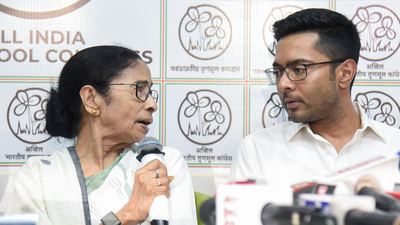
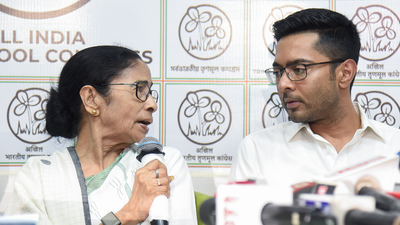
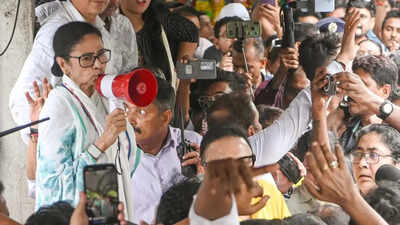
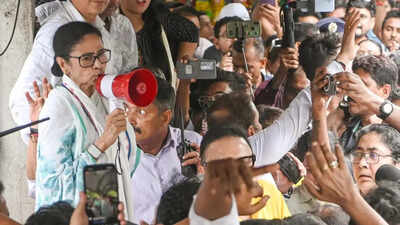
Mamata Banerjee addresses first protest rally at Esplanade, Kolkata after losing 2026 West Bengal Assembly elections

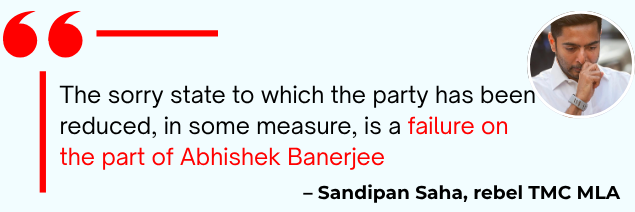
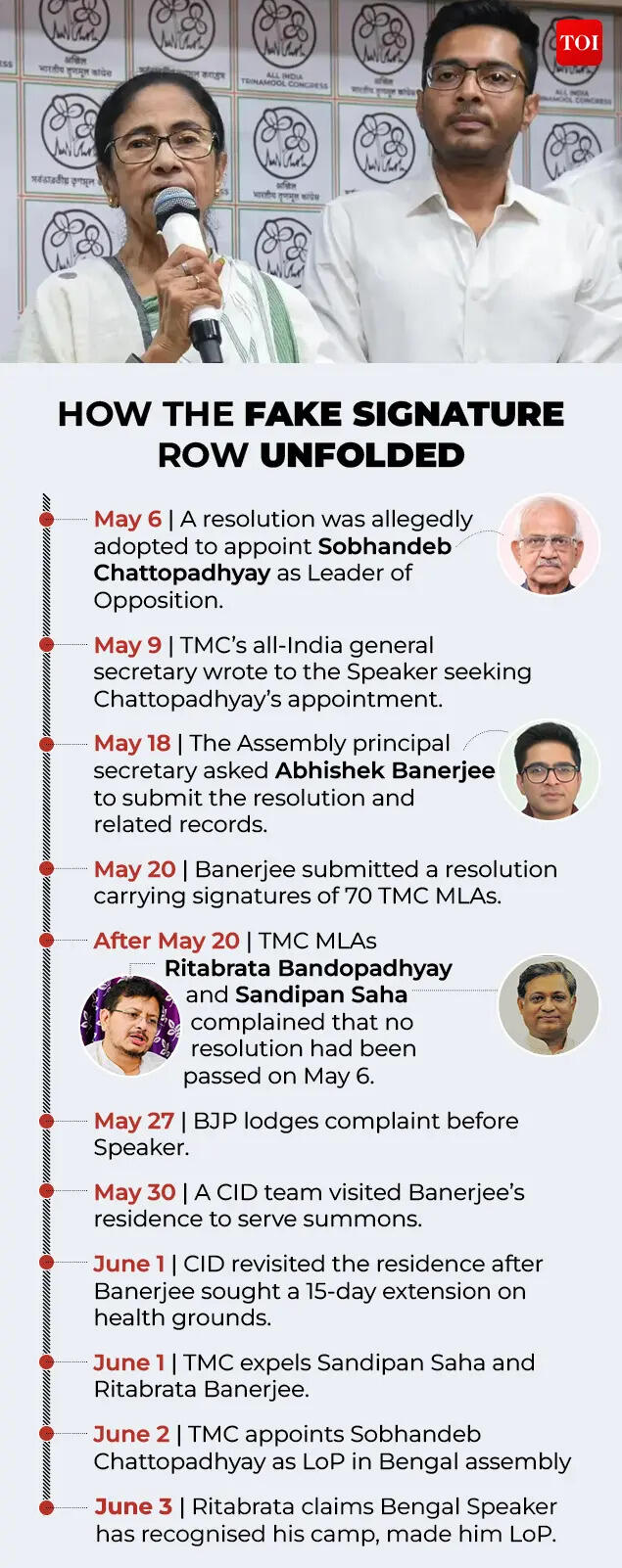
New Delhi: Trinamool means “grassroots” – the name chosen by Mamata Banerjee When he founded the party in 1998, it was to present it as a grassroots-driven movement. But on Wednesday, the palace that Mamata built over two decades seemed weak and perhaps facing its biggest crisis.In an unprecedented revolt, which has drawn parallels with the breakaway of Shiv Sena in 2022, 58 rebel TMC MLAs led by expelled leader Ritabrata Banerjee claimed control. Trinamool Congress The legislature party alleged that they had obtained recognition from Assembly Speaker Rathindra Bose. This rebellion took place a month after the election results were declared in West Bengal. The then CM Mamata had claimed that her party would win 226 seats (it won 80 seats). While the dissidents have been accepting Mamata Banerjee as their leader, they have openly rejected her nephew’s authority in the functioning of the legislature party.
Abhishek question

As the crisis unfolded, the party dissolved all its committees across West Bengal, senior leader Firhad Hakim accepted resignation as Kolkata mayor, and the Enforcement Directorate summoned Abhishek Banerjee in its probe into the teacher recruitment scam. Overall, these developments show that the TMC is grappling with challenges on multiple fronts and perhaps facing the most turbulent moment in its history.

Here are the latest developments:

Rebels claim majority

The Trinamool Congress was plunged into its deepest crisis since its formation on Wednesday when most of its MLAs staged a dramatic rebellion, threatening a split from within the party. Expelled TMC leader Ritabrata Banerjee claimed that 58 MLAs have supported him as the new leader of the opposition and Assembly Speaker Rathindra Bose has accepted the dissident camp’s claim.The dissident camp presented letters of support from 58 MLAs before the Speaker, easily crossing the two-thirds mark required under anti-defection provisions.Ritabrata Banerjee told reporters after meeting the Speaker, “The Speaker has accepted our claim.”
-

Claiming legitimacy on the basis of numbers, he said, “TMC legislative party is a team of 58 MLAs who won on the TMC election symbol. We are now the real TMC in the Assembly.”The Speaker’s approval effectively formalized the first split in the TMC’s 28-year history.Rebel’s unveiling of leadership teamFollowing the recognition of the rebel group, the dissidents announced a new leadership structure. Ritabrata Banerjee was named Leader of the Opposition, while Akhruzzaman was appointed Chief Whip.Senior MLAs Javed Ahmed Khan, Sandipan Saha, Sabina Yasmin and Shiuli Saha were named deputy leaders. Many senior MPs including Samar Mukhopadhyay, Arup Roy, Rathin Ghosh, Javed Khan and Prasun Banerjee are also reported to have joined the rebellion.Mamta agreed, Abhishek deniedDespite challenging the existing leadership structure, the rebels stopped short of directly confronting Mamata Banerjee.“Abhishek Banerjee will have no role in this. Neither our legislature party nor the party organization has any relation with him. Nor does the public have any relation with him. The people of Bengal have no relation with him. If there was any relation, he would not have remained hidden for 26 days, he would have come out.” Ritabrata said, “He was beaten just like thieves are beaten.”He said, “We will request Mamata Banerjee to play the role of chief advisor of the legislature party.”TMC dissolved all the committeesAs the crisis escalated, the party leadership announced sweeping organizational changes.“After careful consideration, it has been decided that all the committees of the All India Trinamool Congress in West Bengal, as well as all its frontal organisations, will be dissolved with immediate effect,” the party said in a statement.Political observers saw the move as an acknowledgment that the dispute had moved beyond routine factionalism into a battle for control of the party.The roots of the rebellion lie in the dispute over the selection of the opposition leader after the elections. Firhad Hakim resigns from the post of Mayor of KolkataIn another blow to TMC, senior leader Firhad Hakim sought Mamata Banerjee’s approval to resign from the post of Kolkata Mayor.“At that time, he was asked not to resign. However, today he again requested Mamata Banerjee to allow him to step down, after which she agreed,” TMC MLA Kunal Ghosh told reporters.Hakim had earlier cited difficulties in functioning after the BJP came to power in West Bengal. His resignation comes amid uncertainty within the party and follows a series of resignations of councilors in the Kolkata Municipal Corporation.One of the most prominent minority faces of TMC, Hakim has served as the mayor of Kolkata since 2018 and remains a key figure in the party.ED sent summons to Abhishek BanerjeeThe Enforcement Directorate also summoned TMC MP Abhishek Banerjee in connection with the primary teacher recruitment scam.Agency officials sent a notice directing him to appear on June 15. The summons is related to the ongoing money-laundering investigation into alleged irregularities in teacher recruitment and suspected financial misconduct.ED has already attached and seized assets worth Rs 154 crore in this case. Earlier this year, assets worth around Rs 57.78 crore were attached in connection with the widespread school recruitment scam. The investigation gained national attention following the arrest of former Education Minister Partha Chatterjee in 2022 following the recovery of cash and valuables linked to an alleged cash-for-jobs racket.(with inputs from agencies)
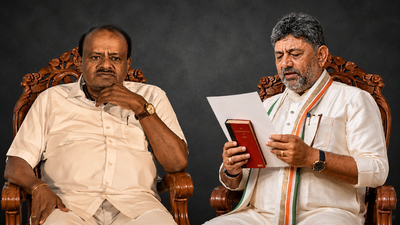
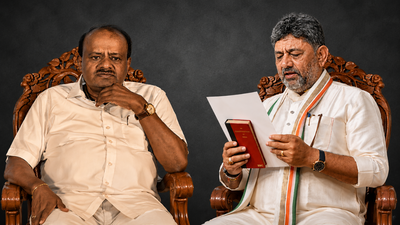
Source link

Beginning of the Shivakumar era: How the change of power in Karnataka changed the political dynamics of BJP and JD(S). india news

Beginning of Shivakumar era: How the change of power in Karnataka changed the political dynamics of BJP and JD(S)
Why will BJP and JDS keep a close eye on DK Shivkumar government?

New Delhi: D.K shivkumar The era has begun in Karnataka. CongressThe biggest troublemaker has finally arrived as the Chief Minister of his state – a dream he cherished and worked for for years. Shivakumar took the oath of office in the name of the revered saint “Gangadhar Ajja” while holding a copy of the Constitution in his hands. His promotion comes after a long wait, but it has the potential to change the political dynamics in the state. Karnataka Congress chief stakes claim to the top post for the first time in 2023 after leading the party to a record victory BJP In the assembly elections. However, the Congress high command then favored Siddaramaiah’s experience and asked Shivakumar to wait for his turn under a rotational power-sharing arrangement.

WhatsApp Image 2026-06-03 at 7.17.10 pm.

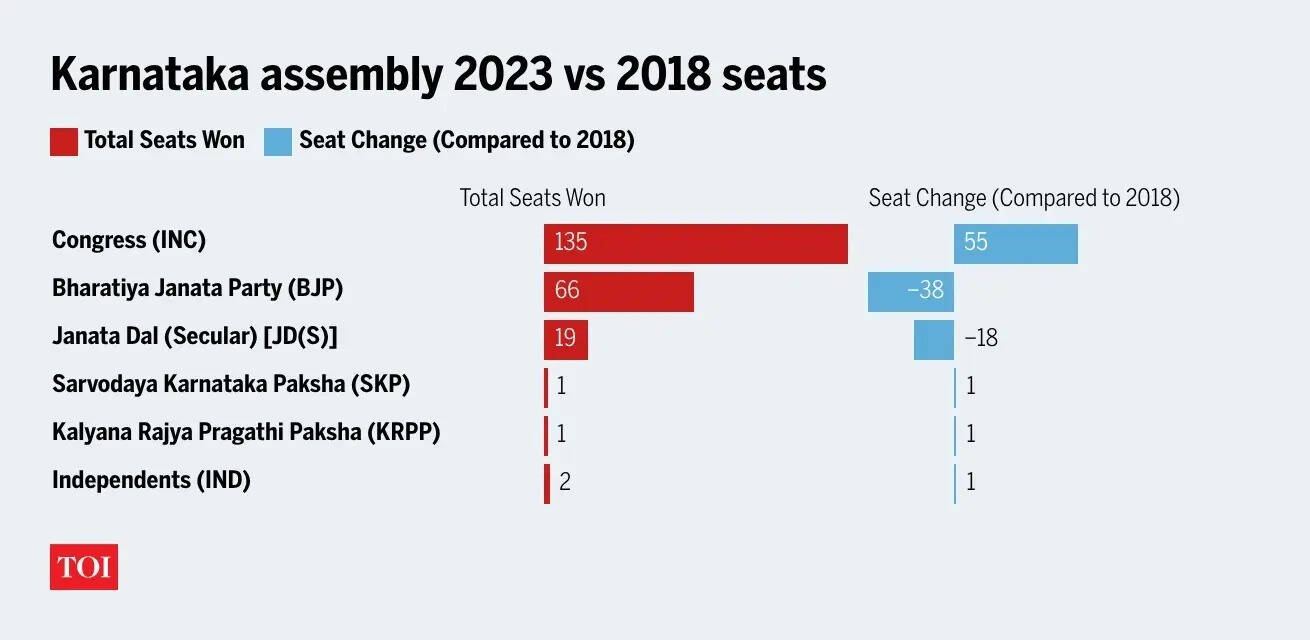
karnataka assembly 2023 results

The fact that the Congress high command managed to ensure a smooth transition of power despite hurdles has put the grand old party in a strong position ahead of the 2028 assembly elections in the state. The Congress will hope that this leadership change will help the party counter the anti-incumbency wave, if any, against the Siddaramaiah government.But this leadership change is not just about countering the anti-incumbency wave. It is also about how the change in caste equations with this leadership change could affect the success of political parties in the state.It is no surprise that the BJP and JD(S) would be closely watching the 64-year-old Vokkaliga Congress stalwart serving as the Chief Minister. The Congress move forces both the parties that hold the opposition spot in the state to go back to their drawing boards and rework their strategies and balance the caste factor ahead of the 2028 assembly elections.

Why can the rise of Shivkumar become a headache for BJP?

For the BJP, Shivakumar’s promotion could potentially disrupt the strategy the party has spent years building in Karnataka.State politics has long revolved around two dominant communities – the Lingayats and the Vokkaligas. Simply put, they hold the keys to power. Members of both these groups have held the post of Chief Minister more times than any other community in the history of Karnataka, making them central to every party’s electoral calculations.While the BJP’s strength has traditionally come from the Lingayat belt, especially under BS Yediyurappa, its expansion plans depended on making deep inroads into the Vokkaliga-dominated old Mysuru region.This was basically the reason behind BJP’s alliance with JD(S). The BJP’s strategy was clear: it would bring in its Lingayat support base, while helping the HD Deve Gowda and HD Kumaraswamy-led JD(S) garner Vokkaliga votes. Together, the alliance was expected to form a coalition capable of challenging the Congress across southern Karnataka. But the elevation of Shivakumar, one of the state’s most influential Vokkaliga leaders, as chief minister complicates that calculation.Shivakumar gave the Congress something that its rivals would have loved that it did not have, a powerful Vokkaliga face not only part of the party but actually holding the top post in the state. His rise comes at a time when the BJP is carefully balancing its caste equations. The party appointed Vokkaliga leader R Ashok as the leader of the opposition while handing over the state unit chairmanship to Lingayat leader BS Yediyurappa’s son BY Vijayendra. The message was clear: a Lingayat would lead the organization and a Vokkaliga would lead the fight against the government.Now that Shivkumar is in the Chief Minister’s chair, the balancing process may have to be changed.The concern within a section of the BJP is that it may be difficult to consolidate support for the NDA in southern Karnataka because of a Vokkaliga chief minister. There is also a possibility that the Congress may want to further expand its social alliance by reaching out to sections of the backward classes and Dalits, who may be disappointed with Siddaramaiah’s departure.For a BJP that was hoping to expand beyond its traditional strongholds, Shivakumar’s rise presents a new challenge.

How will JD(S) now be forced to protect its core support base

And while the BJP has the caste balance in check, its ally Janata Dal (Secular), led by former Prime Minister HD Deve Gowda and his son HD Kumaraswamy, faces a real challenge.The party has considered the Vokkaliga-dominated Old Mysuru region as its impregnable fortress. The community, which is one of the most powerful agrarian and socio-political factions in Karnataka, has traditionally stood behind the Deve Gowda clan, seeing them as the ultimate guardians of Vokkaliga pride.However, Shivakumar being the Chief Minister directly threatens this monopoly as he is no longer just a political challenger but now has the authority as Chief Minister to woo the community with his administrative decisions. The JD(S) now needs to rework the strategy to protect its core voter base from a formidable, incumbent Vokkaliga CM who has the state machinery, necessary resources and a point to prove. This becomes even more challenging given the fact that JD(S) has been on a decline for some time now.In the 2023 assembly elections, the party won just 19 seats and secured around 13% vote share, in sharp contrast to the Congress, which came to power with 135 seats. It is noteworthy that the Congress has made big gains in many parts of the old Mysore region, which has been a JD(S) stronghold for years.The rivalry between Shivakumar and Kumaraswamy has also intensified in the last few years. The two leaders have repeatedly locked horns, with Kumaraswamy accusing the Congress of trying to weaken the JD(S) politically, while Shivakumar has rejected the claims, saying the regional party remains indispensable in Karnataka politics.The JD(S), which had shared power with the Congress in the past, now has a task ahead of it. There is a need to formulate a strategy to ensure that Chief Minister DK Shivakumar does not marginalize the party in state politics. DK Shivakumar, on the other hand, will have to prove that his governance skills are as good as his crisis management skills. The Congress stalwart, who has spent years building his image as a skilled organizer capable of delivering victories and protecting the party in its toughest moments, will now have to show that he too can lead the party successfully.

Source link

From TMC insider to rebel leader: Who is Ritabrata Banerjee, the man at the center of the turmoil. india news

From TMC insider to rebel leader: Who is Ritabrata Banerjee, the man at the center of the turmoil?
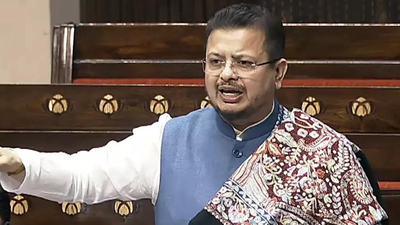
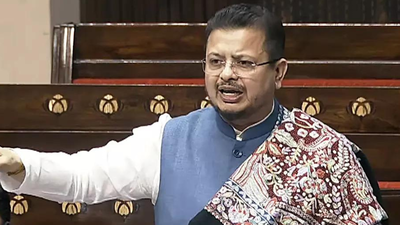
Ritabrata Banerjee (file photo)

Escalating the crisis within the Trinamool Congress (TMC) to a bigger level, expelled party leader Ritabrata Banerjee on Wednesday claimed that Assembly Speaker Rathindra Bose has recognized him as the leader of the opposition in the West Bengal Assembly and accepted the rebel camp’s claim for legislative party status.Addressing a press conference, Banerjee said the rebel faction represented the “real and main opposition” in the assembly and announced a new leadership structure. He named Javed Khan, Sandipan Saha, Sabina Yasmin and Shiuli Saha as deputy leaders of the legislature party.The development comes as 58 rebel MLAs submitted letters of support to the Speaker, easily crossing the two-thirds threshold required under the anti-defection law for the breakaway faction to avoid disqualification. The group has proposed Banerjee as the legislature party leader and Akhruzzaman as the chief whip.In an open challenge to the authority of TMC national general secretary Abhishek Banerjee, the rebels stopped short of directly confronting the former chief minister. Mamata Banerjee. Banerjee said he wants Mamata Banerjee to serve as the chief advisor of the legislature party, while the rebel camp continues to recognize her as the party president.The rebellion, which began after TMC’s defeat in the recent assembly elections, is widely seen as the biggest internal challenge the party has faced since its formation. In response, TMC has dissolved all organizational committees across West Bengal and announced a review of its party structure.

Who is the face of Ritabrata Banerjee? rebellion in tmc?

Ritabrata Banerjee’s emergence as leader of the rebel camp marks another dramatic turn in a political career defined by sharp ideological shifts and frequent clashes with the party establishment.The 46-year-old first rose to prominence as the general secretary of the Students Federation of India (SFI), the student wing of the Communist Party of India (Marxist), and was considered one of the most promising young leaders of the Left. In 2014, he entered the Rajya Sabha with the support of CPI(M) and was considered close to senior leaders including Buddhadeb Bhattacharjee and Sitaram Yechury.However, he was suspended and ultimately expelled from the CPI(M) in 2017 due to allegations of indiscipline and factionalism, bringing an abrupt end to what many in the party saw as a promising political career.After a brief period on the political sidelines, Banerjee moved closer to TMC and formally joined the party in 2020 after the completion of her Rajya Sabha term. Within the party, he quickly regained his influence, leading the Indian National Trinamool Trade Union Congress (INTTUC), securing another Rajya Sabha seat in 2024 and later winning election to the assembly.His rise within the TMC made his role in the current rebellion particularly influential. Banerjee, once seen as part of the party’s inner circle, is now leading the biggest internal challenge the party has faced since its formation, with the rebel camp claiming the support of 58 MLAs and control of the legislature party.“This is perhaps the only prominent politician from Bengal who has been expelled by both CPI(M) and TMC,” quipped a veteran political observer quoted by PTI.The developments have been compared to the 2022 political turmoil in Maharashtra under the leadership of Eknath Shinde, where legislative power became the basis for a challenge to the party leadership.

Source link

‘He wanted an honorable exit’: Firhad Hakim resigns as Kolkata mayor, TMC says Mamata Banerjee gave him ‘permission’ to step down india news

'He wanted an honorable exit': Firhad Hakim resigns as Kolkata mayor, TMC says Mamata Banerjee gave him 'permission' to step down
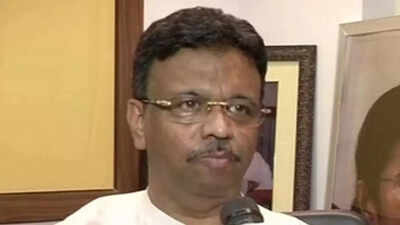
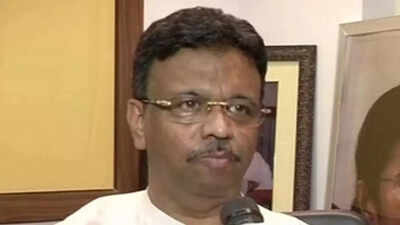
Firhad Hakim (file photo)

New Delhi: Another big shock Trinamool Congress (TMC), its senior leader Firhad Hakim on Wednesday resigned from the post of Mayor of Kolkata Municipal Corporation (KMC), a post he held since November 2018.This was announced by party spokesperson Kunal Ghosh.“Firhad Hakim requested our supremo Mamata Banerjee That he wants to resign. He wants an honorable exit because the state government is defunct the corporation,” he told reporters in Kolkata.“Till now, Mamata Banerjee had not given permission. However, after today’s administrative meeting at Nabanna, it became clear that the corporation has been effectively deactivated. In view of this situation, and to ensure that his dignity and stature remain intact, Mamata Banerjee has today allowed him to resign,” Ghosh said.Hakeem, also known as “Bobby”, is a close aide of Mamata Banerjee. He is a four-time MLA from Kolkata Port Assembly constituency, the capital of West Bengal.The development came on a day when the Trinamool came close to a split after the Assembly Speaker recognized TMC rebel faction Ritabrata Banerjee as the leader of the opposition. Following its defeat in the recent assembly elections, in which the party lost power after 15 years, it had appointed veteran leader Sovandeb Chattopadhyay as the leader of the opposition. However, the move was opposed by the rebel faction, which alleged that the documents submitted in support of Chattopadhyay’s appointment had forged his signature.The rebel group reportedly includes 59 of the 80 TMC MLAs.In the West Bengal Assembly elections held on 23 and 29 April, the BJP won 207 seats in the 294-member House to form its first government in the state.

Source link

Indian citizen killed in Iranian drone attack on Kuwait airport. india news

Indian citizen killed in Iranian drone attack on Kuwait airport
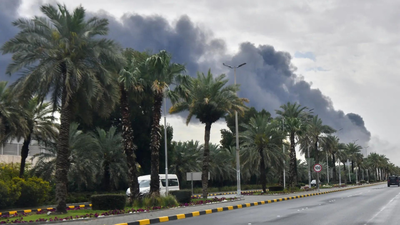
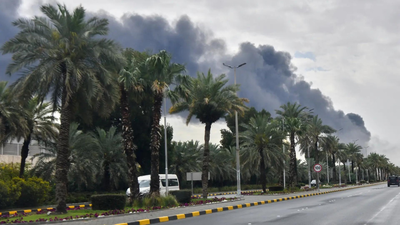
Smoke rising from Kuwait International Airport after drone attack (AP Photo)

An Indian national was the victim of an Iranian drone attack on Kuwait airport on Wednesday.“The Embassy of India in Kuwait expresses its deepest condolences on the tragic death of an Indian national due to the attack at the airport in Kuwait today,” the Indian Embassy in Kuwait told X.“The Embassy is in touch with the bereaved family and is closely coordinating with the Kuwaiti authorities to provide all possible assistance and support to the bereaved family as well as those injured in the incident,” it added.The attack came amid widespread tensions between Iran and the US despite ongoing efforts for a ceasefire. Apart from killing 1 person, the Iranian drone that attacked Kuwait International Airport caused heavy damage to the passenger terminal. Meanwhile, the US military said it intercepted several drones targeting US forces in Kuwait and intercepted Iranian missiles fired towards the country. It also said US and Bahraini forces intercepted missiles and drones aimed at Bahrain, home to the US Navy’s 5th Fleet. In response, the US launched strikes on an Iranian military ground control station on Qeshm Island in the Strait of Hormuz. Both Washington and Tehran said their actions were retaliation, as efforts to maintain a fragile regional ceasefire continued to strain.

Source link

Why is TMC’s rebellion about Abhishek Banerjee and not about Mamata? india news

Why is TMC's rebellion about Abhishek Banerjee and not about Mamata?

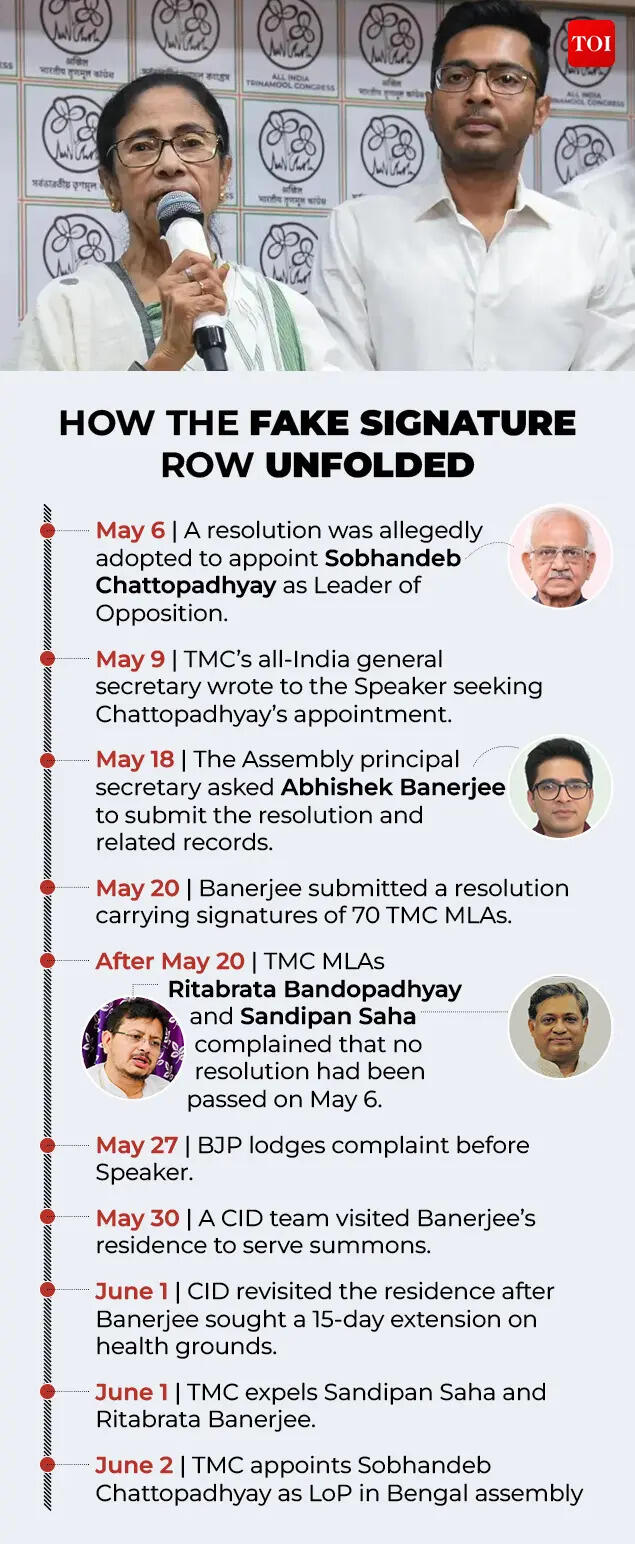
New Delhi: Internal rebellion Trinamool Congress The dispute between the (TMC) has deepened since last week, with rebel MLAs supporting expelled leader Ritabrata Banerjee for the post of leader of the opposition and it being compared to the Shiv Sena split in Maharashtra.But a closer look reveals that the rebellion may be less challenging Mamata Banerjeeand much more about questioning the leadership of and the growing authority of his nephew and political successor, Abhishek Banerjee.At first glance, this development appears to be a direct challenge to the TMC leadership. A group of rebel MLAs have questioned the validity of the party’s decision-making process, accusing the leadership of preparing a proposal on the appointment of the leader of the opposition and openly flouting the official line.Yet the rebels have been careful about one thing: they have avoided attacking Mamata Banerjee herself.Even after his expulsion, Ritabrata Banerjee has not presented himself as a rival to the TMC supremo. Instead, their fight focuses on how decisions are being taken within the party and who is exercising authority in the name of Mamata Banerjee.The letter submitted by the rebel camp to Assembly Speaker Rathindra Bose reportedly recognizes Mamata Banerjee as its leader, even as it challenges the party’s official position on the opposition leadership.The immediate trigger of the crisis explains this clearly.A controversy erupted over the appointment of the opposition leader after TMC national general secretary Abhishek Banerjee informed the Speaker about the party’s decision. Ritabrata Banerjee and Sandipan Saha challenged that process, alleging that no such resolution was passed in the legislature party meeting and that many signatures were fake.Therefore, the controversy is not about Mamata Banerjee’s leadership. This is on the authority exercised by Abhishek Banerjee and the functioning of the organization under him.

Time

Notably, even TMC’s defense on the appointment of Leader of Opposition focuses on the communication made by Abhishek Banerjee to the Speaker. Party leaders have repeatedly argued that his letter is the only valid document before the Assembly, putting Abhishek at the center of the confrontation.This is why the latest developments may be seen by many as a proxy fight over succession.For years, Abhishek Banerjee has been widely seen as the political successor to Mamata Banerjee. He has emerged as the key strategist, chief campaigner and organizational face of the party after Mamata. As his influence grew, concerns grew among sections of the older leaders who felt that they were increasingly sidelined.The current rebellion appears to have brought those tensions out into the open.After the party expelled Ritabrata Banerjee, he pointed out the sharp difference between Mamata and Abhishek. “The party has expelled me, but I believe I am still with TMC…Abhishek Banerjee is a nobody in the 18th West Bengal State Legislative Assembly,” he told reporters.However, when he was asked about Mamata Banerjee, his tone was completely different.“Mamata Banerjee is a big leader. I may have been expelled from the party, but I have not lost respect for her.” She’s still my leader,” he said.Ritabrata also made fun of Abhishek’s political troubles after his election defeat and the subsequent signature controversy. Referring to the protests against the TMC leader, he quipped to reporters: “At least people are not shouting ‘thief, thief’ at me.”However, his criticism of Abhishek was not triggered by the current crisis.In recent months, Ritabrata has emerged as one of Abhishek Banerjee’s most vocal internal critics. He questioned the increasing role of advisors and strategists in party affairs and criticized excessive centralization of decision making.Following the party’s electoral setback, he publicly expressed concern over whether a handful of advisers had become more influential than grassroots leaders. Although Abhishek was not always named directly, the criticism was widely interpreted as targeting the leadership structure associated with him.This helps explain why the rebels’ confrontation is centered on decisions conveyed by Abhishek Banerjee rather than Mamata Banerjee herself.The political mathematics may also seem obvious.Mamata Banerjee remains the party’s biggest mass leader and most recognizable face. Challenging him directly risks alienating a large section of TMC workers and supporters.For dissident leaders, challenging Abhishek allows them to present their revolt not as a revolt against the party founder, but as a fight against a leadership style, an organizational model and, ultimately, a succession process that has intensified after the assembly election defeat.This is what makes the current crisis important.Regional parties across the country have often struggled during succession changes. Bal Thackeray and the NCP’s internal fight over succession ultimately led to the Shiv Sena’s split, with Sharad Pawar showing how questions of inheritance can quickly become questions of power.It appears that TMC is now facing its own version of that dilemma.Now the question before the party is not whether Mamata Banerjee remains its undisputed leader. There seems to be very little disagreement on that issue.The more important question is whether Abhishek Banerjee can achieve the same level of acceptance across the organisation.The answer will determine whether the current rebellion remains an isolated act of dissent or becomes a broader challenge to the party’s organizational structure and succession planning.

Source link

India’s population changes: from baby boom to fertility challenges. india news

Baby boom ends, India's population test now begins

“Whatever you can say that is true about India, the opposite is also true.” The old Joan Robinson line still works because India have a way of defeating neat summaries. Most national averages come with broad patterns, outliers, and caveats.The latest sample registration system data is one such mirror. The SRS, India’s official large-scale system for tracking births and deaths, gives annual estimates of fertility and mortality. At first glance, the headline number is simple: India’s fertility has fallen below replacement level. But a closer look reveals a more unequal country. Some parts of India are already in the low fertility zone. Some of it is still above replacement. Cities are reducing fertility on a large scale, but urban Bihar is not following this scenario. Higher-order families are having fewer children, but the social consequences of smaller families are just beginning. Fewer infants are dying, but the first weeks of life remain a danger zone. And while births are now much more frequent within the hospital system, deaths are not.For years, the policy conversation moved between two extremes, fear of too many births and celebration of a young workforce. A youth population can become a dividend only if it is properly trained and empowered. Meanwhile, populations with low fertility bring their own demands, such as pensions, care for the elderly, chronic disease treatment and migration plans. Both have their own challenges.We look at five data points from the SRS data that shed light on various such issues.

averageness hides anxiety

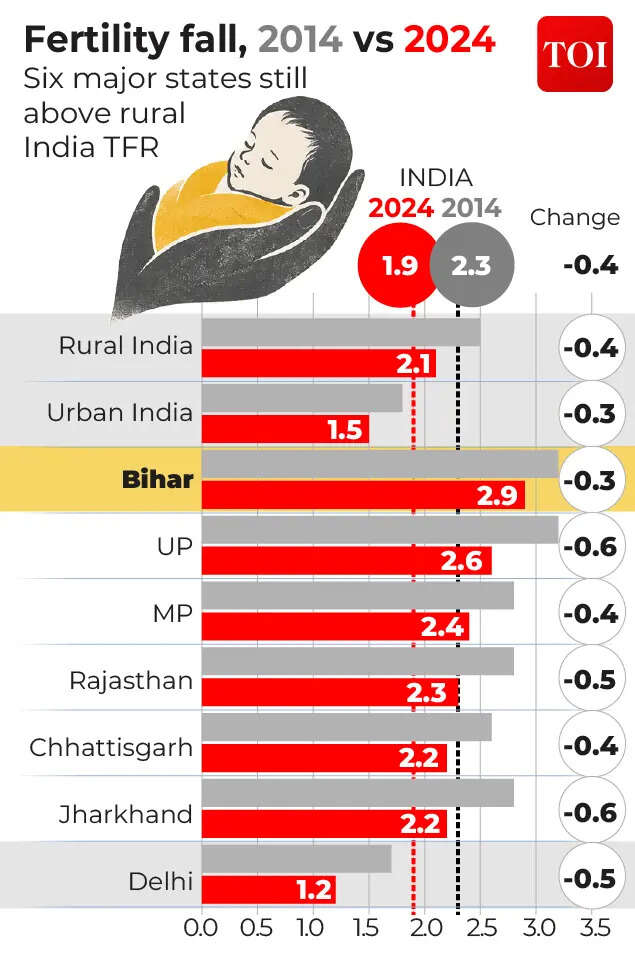
India’s total fertility rate, or TFR, is now 1.9. TFR means the average number of children a woman is expected to have in her lifetime, based on current fertility rates. India’s TFR in 2014 was 2.3. Rural India has come down from 2.5 to 2.1. Urban India has gone from 1.8 to 1.5. In demographic language, India is below replacement fertility. To put it plainly, the baby boom is over.But the national average is just the beginning. Bihar is still at 2.9. Uttar Pradesh is at 2.6. Madhya Pradesh is at 2.4. Rajasthan is at 2.3. Chhattisgarh and Jharkhand are at 2.2. Delhi, a city-state, sits at the other end of the spectrum at 1.2. The World Bank has warned that South Asia is not creating enough jobs for its working-age population, especially youth and women. When above-replacement fertility is concentrated in a few poor states of India, the policy challenge is obvious.

fertility comparison

Bihar exception

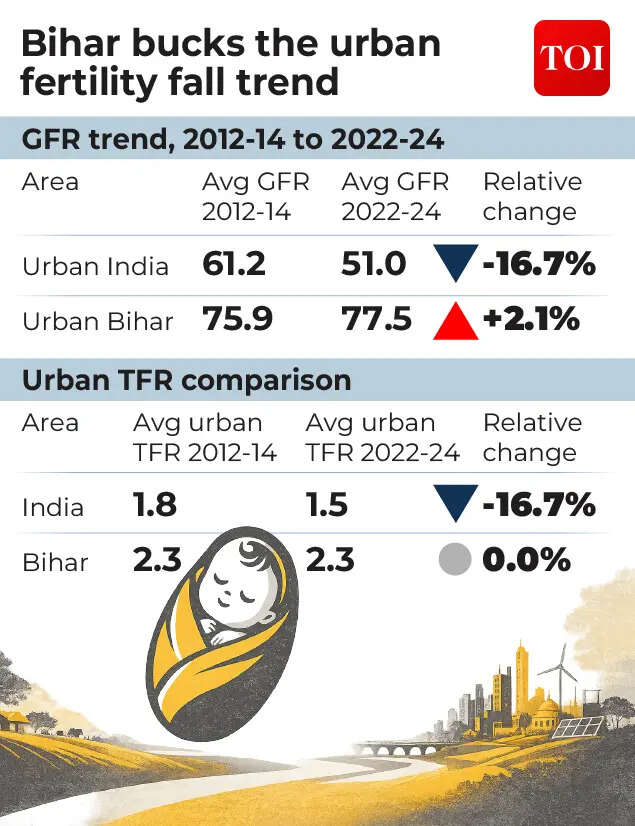
The second data comes from urban India, where a different story emerges. The common belief is that once people move to cities, families become smaller because parents want to invest more in fewer children. Across India, this overarching story persists. Urban India’s average general fertility rate, or GFR, fell from 61.2 births per 1,000 women aged 15-49 in 2012-14 to 51.0 in 2022-24. GFR measures the number of live births in a year per 1,000 women in the reproductive age group of 15–49 years. Here, live births means children born alive, which is the basis used to calculate fertility and mortality rates.But Bihar has broken this pattern. During the same period, the average GFR of urban Bihar increased from 75.9 to 77.5. One year’s data makes the difference even more stark. In 2024, the GFR of urban Bihar was 80.3, while that of urban India was 49.8.

Bihar exception

birth ladder is getting thinner

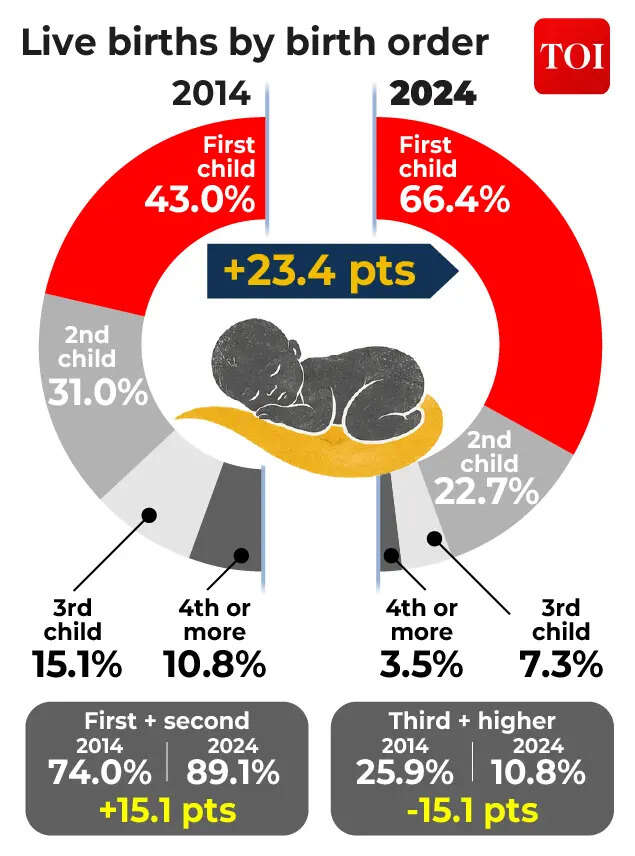
The third innings is less surprising, yet perhaps the most important. In 2014, 43% of live births in India were first-born children. By 2024, their number will rise to 66.4%. Third and higher order births fell from 25.9% to 10.8%. The fourth or higher birth rate fell from 10.8% to 3.5%.This does not mean that every family is stopping at one or two children. This means that the births that are taking place now are similar to the first and second births. The old ladder, third child, fourth child, fifth child, is getting thin. This is a much bigger social change than it first appears. Fewer children means parents invest more in each child. Education becomes a heavy condition. The underlying assumption that children will automatically become old age security for parents also begins to weaken.

birth ladder

The first week remains a matter of concern

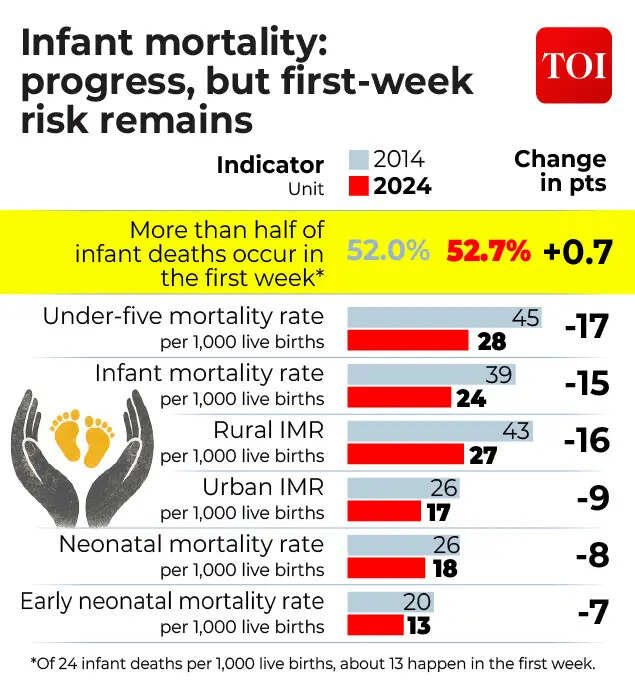
The fourth number is about survival. Here India has made real progress.Infant mortality rate to decline from 39 deaths per 1,000 live births in 2014 to 24 in 2024. Infant mortality rate, or IMR, means the number of deaths of children under one year of age per 1,000 live births. Rural infant mortality rate fell from 43 to 27. The urban infant mortality rate fell from 26 to 17. The mortality rate for children under five fell from 45 to 28. The under-five mortality rate, or U5MR, means deaths before the age of five per 1,000 live births. These are not mere statistics. They mean that children who once would have died are now alive.But the first week is the most worrying part.

first week anxiety

In 2014, 52% of infants died in the first week. In 2024 it was 52.7%. This means that, of the infants who die before turning one year old, more than half die in the first week. Infant mortality rates have declined in India, but those deaths that do occur still occur near birth. World Health Organization It is said that the first month of life is the most sensitive period for a child’s survival. UNICEF describes the first 28 days, known as the neonatal period, as the most vulnerable time for a child’s survival. India’s data fits that global warning.

Hospitals see births, miss deaths

Number five is the most frightening. It’s about how many deaths went unnoticed. At birth, the system is now in place. In 2014, 78.5% of live births received delivery care in government or private hospitals. By 2024 this will increase to 95.4%. Delivery in government hospitals increased from 52% to 71.7%.At the time of death, the system is much less visible. In 2014, 42.6% of deaths had medical assistance sought in government or private hospitals before death. In 2024 this figure was 40.2%. The category of “untrained workers, no medical care and others” increased from 22.4% to 45.5%.Now the chance of a baby being born under hospital care is much higher than that of a person dying under hospital care. WHO’s civil-registration framework states that information on births, deaths, and causes of death is central to public-health planning. If death occurs outside of formal care, the system may forget not only the person but also the cause.As India moves into its next phase of growth as one of the world’s largest economies, many issues will require high-level attention. The SRS, like all good data, is merely a reflection. What India wants to see in this will decide what happens next.

Source link

‘New generation of leaders’: Cockroach Janata Party appoints three spokespersons. india news

'Leader of the new generation': Cockroach Janata Party appointed three spokespersons
Vijeta Dahiya, Saurav Das and Ashutosh Ranka

New Delhi: Cockroach Janata Party announced three spokespersons on Wednesday, a day after worker and teacher Sonam Wangchuk What started out as one of the country’s biggest internet sensations decided to join what has since evolved into a unique political structure.CJP, which started as a viral online phenomenon before gaining popularity across the country, was named Saurav DasVijeta Dahiya and Ashutosh Ranka are its official spokespersons.In the announcement, CJP also reiterated its ambition to reshape the political discourse in India.Posting from an AlternativeThe development comes days after founder Abhijit Deepke announced that he would be returning from the United States on June 6.Continuing to criticize the Center and demand the resignation of the Union Education Minister, Dipke called on supporters to join what he described as a mass movement. Dharmendra Pradhan On the NEET-UG fiasco.

Source link

Punjab sets record of ₹84 crore in orthopedic treatment in just four months under Mukhyamantri Sehat Yojana. india news

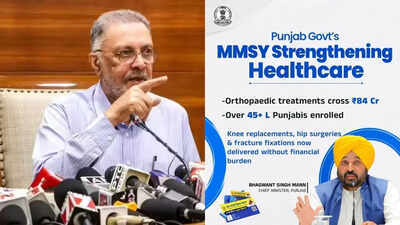
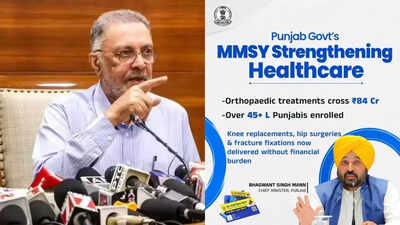
Punjab Orthopedic Treatment: Mukhyamantri Sehat Yojana hits record Rs 84 crore in four months

Punjab government’s flagship Mukhyamantri Sehat Yojana has spent over Rs 84 crore on orthopedic treatment in 4 months, showing a sharp increase in demand for bone and joint care services across the state.A new and expanded version of ‘Mukhyamantri Sehat Yojana’ (MMSY) in Punjab was launched across the state on 22 January 2026.Data released by the State Health Agency (SHA) has revealed that knee replacement surgeries account for the highest share among the orthopedic procedures performed under the scheme.Hip replacement surgeries followed closely, while a large number of patients also underwent fracture fixation procedures involving plates, nails and other implants.The government said in an ex-post that these interventions are being rapidly carried out in district and tertiary care hospitals under the cashless treatment coverage of the scheme.45 lakh registrations under the schemePunjab has now recorded over 45 lakh registrations under the Mukhyamantri Sehat Yojana, indicating widespread use of cashless health services.The increasing caseload of orthopedic conditions reflects a broader public health shift, with degenerative joint disease and mobility-related disorders becoming more common, especially among the aging population.Health Minister stressed the need for affordable treatment Commenting on the increasing demand for orthopedic care, Punjab Health Minister Balbir Singh said that the burden of bone and joint disorders is increasing rapidly, underscoring the need for accessible and affordable surgical treatment across the state.“The burden of orthopedic disorders is increasing rapidly, and thus, there is an inevitable need to promote accessible and affordable operative care across the state of Punjab.”

Source link

Atishi criticizes CBSE revaluation process over limited payment options. india news

CBSE Revaluation Payment: Atishi criticizes Education Minister Dharmendra Pradhan over limited bank options on portal
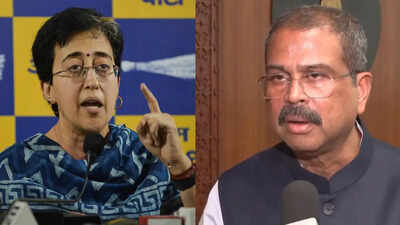
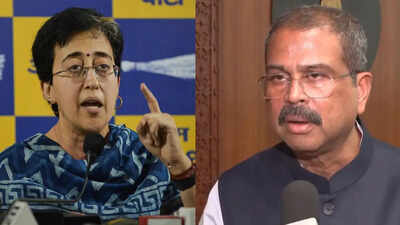
Atishi criticized Education Minister Dharmendra Pradhan over limited bank options on the portal (Image credit: ANI)

Former Delhi Chief Minister and current Delhi Assembly member LOP Atishi has criticized the CBSE revaluation process, alleging that students are facing difficulties due to limited payment options on the board’s revaluation portal.In a post on X, Atishi claimed that payment for revaluation can currently be made only through State Bank of India (SBI), Canara Bank, Bank of Baroda or Indian Bank.“Another day… another achievement by @dpradhanbjp… After the late launch of the CBSE revaluation portal, students have now learned that payment can be made only through SBI, Canara Bank, Bank of Baroda or Indian Bank.“So if a student or their parents do not have an account in these banks, they cannot apply for revaluation! The Prime Minister and his Cabinet have taken mismanagement to new heights”This criticism comes after concerns were raised about the delayed launch of the CBSE revaluation portal amid the OSM tender controversy.The controversy escalated when students started reporting smudged answer sheets, missing pages, mismatched scanned copies and frequent glitches during the revaluation process.Opposition targeted BJP Other opposition leaders Aditya Thackeray and Kapil Sibal also criticized the central government’s handling of the CBSE controversy following the transfer of the board chairman and secretary.Shiv Sena (UBT) leader Thackeray questioned whether the transfer of the two officers was a “major action” by the BJP government, calling it inadequate.Meanwhile, senior lawyer and Rajya Sabha MP Kapil Sibal described the episode as a “CBSE failure” and alleged that the government was “blaming the small fish and saving the big fish.”He questioned why the alleged irregularities, including claims related to the controversial contract, were not being investigated and asked where agencies like CBI and ED were in this matter.CBSE says the website is being improvedProviding updates on the CBSE verification and revaluation portal, officials said the platform is currently supporting around 14,000 concurrent users and over 28,000 successful submissions have been recorded till 10 pm.A post on

Source link