Breaking News
Gir Somnath Spaceport: Gujarat government planning India’s third spaceport near Gir Somnath India News

Gujarat government planning India's third spaceport near Gir Somnath

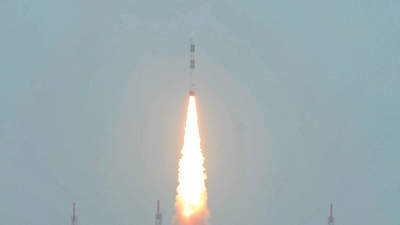
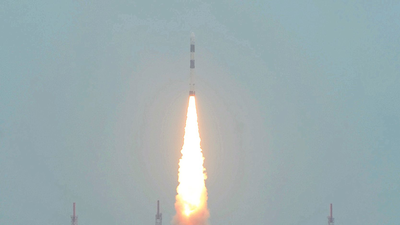
New Delhi: After Sriharikota The spaceport and the upcoming launch port at Kulasekarapattinam in Thoothukudi district of Tamil Nadu, India’s third satellite launch center are likely to come up in Gujarat.Gujarat Science and Technology Minister Arjun Modhwadia recently announced in the state assembly that a proposed launch site has been identified near Gir Somnath district along the Arabian Sea coast.Speaking on budgetary demands for his department, Modhwadia said the site was identified after consultation with space regulator and promoter Indian National Space Promotion and Authorization Center (IN-SPACE). “As per our request, IN-SPACe has found a suitable location which can be developed as a launchpad to put satellites into orbit just like Sriharikota. That location is between the Union Territory of Diu and Kodinar. We are now moving in that direction,” the minister said.Speaking to TOI, a senior space official said, “A state government or even a private entity can build a satellite launch center in India. The process has become streamlined, especially after reforms in the space sector. But conducting satellite launch operations from that site will require prior authorization from IN-SPACe, which acts as a single-window nodal agency under the Department of Space.”According to the Norms, Guidelines and Procedures (NGP) for implementation of the Indian Space Policy-2023, “Any space activity, which will, inter alia, include the launch, operation, guidance and/or re-entry of any space object, as mentioned in Section 5 of the Indian Space Policy-2023, will require authorization from IN-SPACe”.Since the Directorate General of Civil Aviation (DGCA) handles airspace regulation, it issues Notice to Air Missions (NOTAM) to warn aircraft before any satellite or rocket launch. Therefore, before any rocket launch, the role of DGCA is also important.As part of its initiative to promote the space sector, the Gujarat government is also setting up a 100-acre Gujarat Space Park near Sanand to attract companies working in space technology and satellite manufacturing. Minister Modhwadia said that the facility is expected to house space technology based industrial units, which will help in creating a comprehensive ecosystem for the region.“I am happy to say that Aegista Aerospace has started the manufacturing of small satellites at a cost of Rs 500 crore and the process of allotting land for them has started,” the minister said in the Assembly. According to him, this facility will become India’s first private sector satellite manufacturing plant capable of handling end-to-end operations. These initiatives aim to establish Gujarat as a major hub in India’s rapidly growing space sector.India’s primary spaceport at Sriharikota, officially known as the Satish Dhawan Space Center (SDSC) SHAR, became operational with the launch of an RH-125 sounding rocket on October 9, 1971. The spaceport has so far launched 434 foreign satellites, 134 spacecraft missions and 18 satellites launched by private players or students.India’s second spaceport is under construction at Kulasekarapattinam in TN, Rs 985.9 crore has been allocated for the project, and it is targeted to be commissioned this financial year.

Source link

Take lessons from West Asia conflict to improve India’s defense preparedness: Rajnath india news

Take lessons from West Asia conflict to improve India's defense preparedness: Rajnath

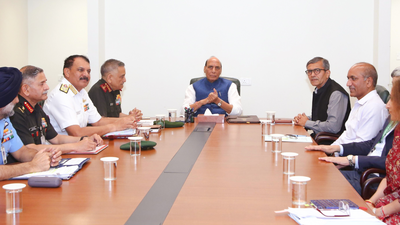
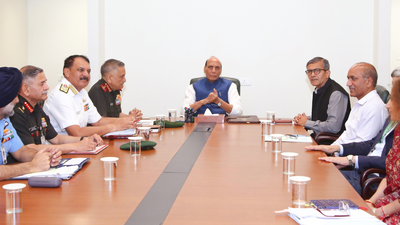
New Delhi: Defense Minister Rajnath Singh on Tuesday chaired a review meeting with senior defense officials to take stock of the situation in the wake of the West Asia crisis and said lessons need to be learned from the conflict to improve the country’s defense preparedness.Rajnath was briefed on the global and regional security scenario, the impact of possible escalation of the ongoing conflict on India as well as the challenges and opportunities presented by the current geopolitical situation.The Minister directed that operational and technical findings from the ongoing conflict should be continuously studied to improve India’s security. “We need to formalize a comprehensive integrated roadmap for the next decade, taking into account the lessons learned, challenges and opportunities while ensuring self-reliance and operational readiness on all fronts,” he said.Chief of Defense Staff General Anil Chauhan, Air Force Chief Air Chief Marshal Amar Preet Singh, Army Chief General Upendra Dwivedi, Navy Chief Admiral Dinesh K Tripathi, Defense Research and Development Organization (DRDO) Chairman Sameer Kamat and Defense Secretary Rajesh Kumar Singh were present in the meeting.The review meeting also examined the impact of the crisis on supply chain management for procurement and production of defense equipment, including maintenance and serviceability of existing equipment.Rajnath held the security review meeting just two days after the Cabinet Committee on Security (CCS) discussed the situation arising out of the conflict in West Asia and conducted a detailed assessment of the availability of critical commodities for the common people, including food, energy and fuel security.Last week, Rajnath credited PM Modi’s ability and foresight for “saving” India from the impact of global instability and said the country remained safe despite rising conflict in West Asia. The minister also supported the Prime Minister’s stance that “war is not a solution” and called for a solution through dialogue and diplomacy. “When the world is at war, no country can remain without being affected. At such times, India may also be affected, but our Prime Minister, with his capability, capacity and foresight, has ensured that the country does not get caught in such a crisis.

Source link

Railways tightened the rules for ticket cancellation, brought strict rules for quality construction. india news

Railways tightens ticket cancellation rules, brings strict rules for quality manufacturing

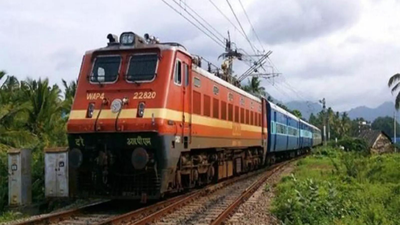
New Delhi: Last-minute changes in plans will cost you dearly, as the Railways has announced a revised rule linking refunds to the time of ticket cancellation before the scheduled departure of trains. According to the new rule, passengers who cancel their tickets less than eight hours before departure will not get any refund, while cancellations made between eight hours and 24 hours before departure will be subject to a 50% discount.Announcing the changes as a part of the ongoing reforms, Railway Minister Ashwini Vaishnav on Tuesday said that under the new criteria there will be a deduction of 25% on tickets canceled 24 to 72 hours before the train departure, while the minimum amount will be deducted for cancellations before 72 hours. The new rules will be effective between April 1 and 15.Currently, passengers do not get any refund on ticket cancellation within four hours and there is a 50% discount on tickets canceled within 4-12 hours before train departure. Similarly, only 25% is deducted on tickets canceled within 12-48 hours and minimum deduction for cancellation before 48 hours.Vaishnav said strict refund norms have been set after investigation in view of some tickets still being hoarded by brokers and their black marketing. He said the fake customers sent by the Railways discovered how brokers take advantage of the last minute cancellation provision. He said that these changes will prevent black marketing and last minute selling of tickets by agents.The minister also announced that passengers who have booked tickets online will be able to change the boarding point (station) 30 minutes before the scheduled departure. At present, change in boarding point is allowed only before the first chart is prepared.Vaishnav also announced reforms in contracting norms to improve the quality of construction. As per the new norms, Railways will assess the bidding capability of contractors bidding for all projects above Rs 10 crore. He also said that as per the new norms, contractors will have to carry out the work directly under their supervision at 60% of the total price and sub-contracting up to 40% is allowed, which follows PM Narendra Modi’s instructions to infrastructure ministries.Learning from the earlier Dedicated Freight Corridor project, where players without experience in similar projects got the work, leading to complications, now only contractors who have done at least 20% “similar work” will be eligible to bid. Bidders will also have to submit a detailed execution plan before commencement of the project for better monitoring and timely execution. Where the successful bidder bids significantly lower than the estimated project cost, Railways will take additional performance guarantee.

Source link

No one country can ensure balance of power in Asia, India’s role indispensable: US official india news

No single country can ensure balance of power in Asia, India's role indispensable: US official

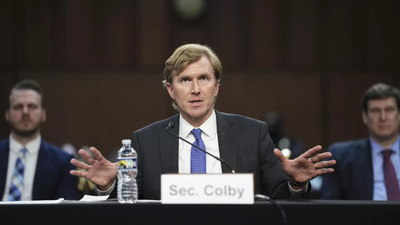
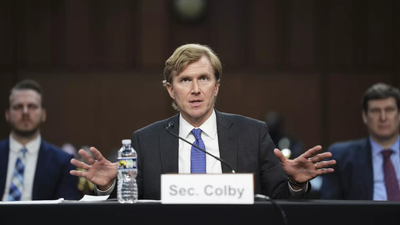
Signaling a more transactional and interest-driven focus in its relations with India, the US has said it aims to work with India to ensure peace and stability in the Indo-Pacific that is not founded in naivety or “grotesque abstractions” like the rules-based international order, but in strength, reason and rigorous cooperation. As he laid out the US vision for relations with India in the geopolitical and defense spheres, Under Secretary for War Policy Elbridge Colby on Tuesday said no single country can maintain a stable balance of power in Asia. Instead, he said, stability will depend on the collective contribution of capable states that have an interest in maintaining a free and open Indo-Pacific. Notably, while he underlined India’s “indispensable” role in maintaining a free and open Indo-Pacific, Colby in his speech made no mention of the Quad, the key US Indo-Pacific initiative first revived by the Trump administration. However, this mechanism appears to have lost some of its importance with Washington after the President returned to the White House as the US focus shifted from soft power initiatives to shared security outcomes and burden-sharing. The top US official was addressing an event at Ananta Centre. Since there is no information yet on whether Trump will come to India for the Quad summit this year, hopes for the leaders’ meeting are now pinned on the France G7 summit in June, which is likely to be attended by leaders of all the Quad countries. Colby took a dig at Europe and stressed that the US is still a rising power under Trump, but the same cannot be said about some of Washington’s traditional partners, while the US urges them to reinvent themselves. India, he said, is very different as a “rising power”. “As a result, the United States believes that India will play a central role in ensuring a favorable balance of power in the Indo-Pacific. In this context, a strong, confident India is not only good for the Indian people. It’s good for the Americans too,” said Colby, who is in India to discuss the implementation of the US-India Major Defense Partnership Framework. The official suggested that the US may not be interested in building a relationship based only on shared democratic values, as he said the Indian-US partnership is rooted in pragmatism. Colby said, “Consistently, the US approach to strategic partnerships is interests-based and realistic, shaped by geopolitics and incentives as opposed to cosmetic aspirations or detached idealism.” He said Washington wants partnerships with strong, self-confident states, not dependence. Colby also supported External Affairs Minister S Jaishankar’s remarks that a nationalist foreign policy approach is likely to approach the world with more confidence and more realism, saying this approach resonates with the US. Underscoring the importance of “strategic candor” in the relationship, Colby said strong partnerships benefit from honesty, respect and strategic clarity. As bilateral relations are showing signs of improvement after one of their worst phases in recent times, Colby also said the US and India do not need to agree on everything to cooperate effectively, as long as their interests and objectives are increasingly focused on the most basic issues. Differences and even disputes are fully compatible with deep alignment and cooperation on strategic matters, he said. The official also underlined the strategic centrality of military power to a stable balance in the region and the importance of defense industrial cooperation between India and the US.

Source link

Status of Bhagat Singh, Sukhdev and Rajguru as martyrs not linked to ‘official record’: Government informs Lok Sabha. india news

Status of Bhagat Singh, Sukhdev and Rajguru as martyrs not linked to 'official record': Government informs Lok Sabha

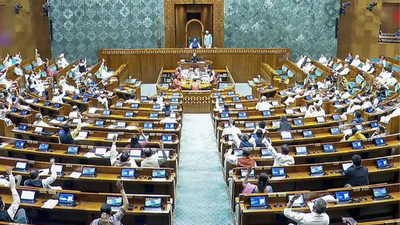
New Delhi: The government told the Lok Sabha on Tuesday that the revolutionary freedom fighter Bhagat SinghSukhdev and Rajguru – who were hanged by the then British regime on March 23, 1931 – have been martyred to achieve India’s independence and their martyrdom is a fact “not dependent on the inferred presence of the absence of official records”.“The martyrdom of these freedom fighters and their invaluable contribution to India’s freedom struggle is an integral part of the narrative of our fight for freedom and is well known in our history… Their stature is far above any award or title or status given in this regard,” junior home minister Bandi Sanjay Kumar said in a written response to a question on whether the three freedom fighters were given ‘martyr’ status.Saying that their names “will always be written in golden words in the annals of history,” Kumar said the names of all freedom fighters, including Bhagat Singh, Sukhdev and Rajguru, are recorded in the ‘Dictionary of Martyrs of India’s Freedom Struggle from 1857 to 1947’ published by the Culture Ministry. “The position of the Government of India on this has remained unchanged since 1947,” he told the House.A day earlier, on the occasion of Martyrs’ Day, PM Narendra Modi had remembered the martyrdom of the three heroes and in a post on Twitter said their ideals of justice, patriotism and fearless resistance ignite the spirit of countless Indians. He posted, “Today we pay our respects to the brave sons of Bharat Mata, Bhagat Singh, Rajguru and Sukhdev. Their martyrdom for the nation is imprinted in our collective memory.”

Source link

Tamil Nadu Assembly elections: Alliance taking shape amid AIADMK-DMK contest – past performance highlights | india news

Tamil Nadu Assembly elections: Alliance taking shape amid AIADMK-DMK contest - past performance highlights

New Delhi: As Tamil Nadu Assembly elections approach, political activities have intensified in the state, with key alliances strengthening and parties recalibrating strategies based on past performance and evolving voter dynamics. However, the contest is once again expected to center around the DMK-led alliance and the AIADMK-led NDA front. BJP Trying to expand its footprint. AIADMK The party on Monday finalized seat-sharing with its key allies, allocating 27 seats to the BJP, 18 seats to the PMK faction led by its president Anbumani Ramadoss and 11 seats to the TTV Dhinakaran-led AMMK, completing talks between key constituents of the opposition front for the assembly elections.Dravida Munnetra Kazhagam in the 2021 Tamil Nadu Assembly elections (DMK) led coalition won a decisive victory, winning 159 out of 234 seats, returning to power after a decade. The DMK itself won 133 seats with about 36.8% vote share. Its major ally, the Indian National Congress (INC), won 18 seats with about 4.4% vote share.On the other hand, the All India Anna Dravida Munnetra Kazhagam (AIADMK)-led alliance managed 75 seats, with the AIADMK winning 66 seats and securing around 33.3% vote share. The Bharatiya Janata Party (BJP), contesting the elections as part of the AIADMK alliance, won 4 seats with about 2.6% vote share.Smaller players also played a role in shaping the outcome. Pattali Makkal Katchi (PMK) won 5 seats, while Viduthalai Chiruthigal Katchi (VCK), aligned with the DMK, won 4 seats. Left parties, including the Communist Party of India (CPI) and the Communist Party of India (Marxist) (CPI(M)), won 2 seats each, contributing to the DMK-led block’s total.The vote share split highlighted a bipolar contest, with the DMK-led alliance collectively polling around 45%, while the AIADMK-led front secured around 39%, indicating a relatively consolidated anti-incumbency vote against the then AIADMK government.As the state enters the next election cycle, alliances have once again become unstable. The DMK is expected to maintain its core alliance with the Congress, Left parties and VCK on the basis of welfare schemes and governance record. Meanwhile, the AIADMK is dealing with internal challenges and alliance uncertainties, especially after the rift in its ties with the BJP.The BJP, despite its modest vote share, is attempting to emerge as a more influential player by contesting more seats this time, aiming to convert its growing vote advantage into seats.At stake in the upcoming election is not only power in one of India’s most politically divided states, but also the future of Dravidian politics, which has historically resisted the dominance of the national party. While the DMK will try to protect its mandate, the AIADMK will face the challenge of rebuilding leadership unity, and the BJP will test whether its expansion strategy can disrupt Tamil Nadu’s strong political binary.

Source link

‘A strong India is good for America’: Trump administration on countering China’s grip on Indo-Pacific india news

'A strong India is good for America': Trump administration on countering China's grip on Indo-Pacific

New Delhi: The United States views India as central to maintaining a favorable balance of power in the Indo-Pacific, a senior Trump administration official said on Tuesday, outlining a roadmap for deeper defense and strategic ties amid changing global dynamics.Addressing an event at the Ananta Centre, US Under Secretary for Policy War Elbridge Colby said India’s role is indispensable for regional peace and stability, especially at a time of rising geopolitical tensions and concerns over China’s growing military assertiveness.He said, “The United States believes that India will play a central role in ensuring a favorable balance of power in the Indo-Pacific. In this context, a strong, self-confident India is not only good for the Indian people. It is also good for Americans.”Colby stressed that the India-US partnership is based on shared strategic interests, even if differences remain.He said, “First, the United States and India do not need to agree on everything to cooperate effectively. What matters is that our interests and objectives increasingly converge on the most basic issues.”He said, “Differences and even disputes are fully compatible with deep alignment and cooperation on strategic matters. The roots of our partnership run deeper than optics and are more durable than superficial cordiality; rather, they are deeply embedded in enduring strategic mutual self-interest.”Highlighting shared goals, Colby said both countries benefit from an Indo-Pacific where no single power dominates, along with open trade and national autonomy.On defense cooperation, he stressed the need to give priority to solid capabilities.“In this light, one of the most encouraging developments in recent years has been the steady expansion of defense cooperation between the United States and India”.Citing US Defense Secretary Pete Hegseth, Colby said the bilateral defense relationship has never been stronger, with growing momentum in industrial and technology cooperation. He also mentioned the ‘Major Defense Partnership’ framework finalized in October.He said, “Our goals must be practical: ensuring that our forces can work together effectively when our interests align, and in any case seeing to it that India has the capabilities necessary to defend its sovereignty and contribute to a favorable regional balance of power.”He said the US is committed to enhancing cooperation in areas such as long-range precision strikes, flexible logistics, maritime domain awareness, anti-submarine warfare and advanced technologies.Colby also underlined the importance of co-production and co-development of defense equipment while acknowledging challenges including regulatory barriers and procurement differences.“But they are not invincible and we must overcome them,” he said.He said while Washington aims to boost military sales to India, it also supports New Delhi’s push for a stronger domestic defense industry.“A strong domestic industrial base enhances sovereignty and resilience. The United States supports that objective. And India is on its way,” he said.“India already has an impressive defense industrial base and India’s leadership in cutting-edge technologies helps further broaden our defense cooperation.”Colby reiterated that differences between the two countries are natural and should not hinder cooperation.“Strong partnerships benefit from honesty, respect and strategic clarity. The truth is that the United States and India will not agree on every issue.”“Indeed, in exactly the same spirit, we can say without embarrassment that India and the US have not always been partners or even friends. Our histories and strategic cultures are different, and our interests will certainly diverge at times,” he said.

Source link

Court: ‘Don’t just say ED, ED, ED’: Supreme Court questions West Bengal government in Mamata I-PAC raid case. india news

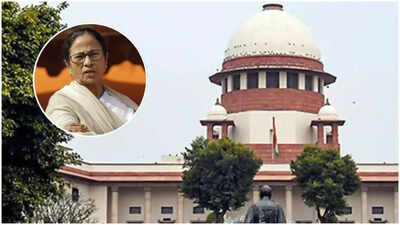
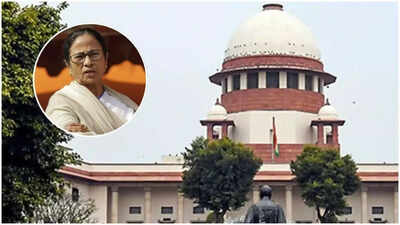
'सिर्फ ईडी, ईडी, ईडी मत कहें': ममता आई-पीएसी छापेमारी मामले में सुप्रीम कोर्ट ने पश्चिम बंगाल सरकार से सवाल किएMamata Banerjee During the raid on I-PAC on January 8, it was asked what remedy would ED officials have if their rights were allegedly violated.According to news agency PTI, a bench of Justices Prashant Kumar Mishra and NV Anjaria said that some ED officers had also moved the court in their individual capacity, raising the issue of whether they cease to be citizens merely because they work in the agency.

Court asks state to focus on powers of ED officers

During the hearing, senior advocate Kapil Sibal, appearing for Banerjee, argued that the petitioner invoking Article 32 will have to clearly show which fundamental right has been violated.He submitted that the ED officer filing the writ petition had not specifically pleaded violation of fundamental rights and said that the ED itself was not even a “person” for such a petition.At this stage, Justice Mishra asked the state to look beyond the agency as an institution and focus on the officers who had approached the court.“Please focus on the fundamental rights of the ED officers with whom the crime has been committed. Otherwise, you will miss the point. You cannot forget the second petition which has been filed by the individual officers who are victims of the crime. I am telling you that you will be in trouble. Don’t just say ED, ED, ED,” Justice Mishra was quoted as saying by Bar and Bench.The court also asked whether ED officers cease to be citizens of India merely because they are officers of the agency.The court further said, “Different political parties rule at the Center and in the states. If in 2030 and 2031 a Chief Minister from the other party does this and you come to power in the Central Government and their Chief Minister does this, what will be your reaction?”

Kapil Sibal says obstruction of statutory duty is not an issue of fundamental rights

Sibal argued that obstruction in the performance of a statutory duty cannot automatically be considered a violation of a fundamental right.He said, “If someone obstructs a police officer, he cannot file a petition under Article 32. He cannot also file a 226 petition. He will be prosecuted for obstruction in violation of his right to discharge his functions.”Quoting Bar and Bench, Sibal also told the court, “Any obstruction in the performance of statutory duty is not a violation of a fundamental right. If someone obstructs a police officer in his work, he cannot file a 32 petition.” There is a legal solution. Otherwise each police officer will register 32. We cannot interpret a law in the context of a particular situation and then open a Pandora’s box inconsistent with the basic features of criminal law.He further argued that the ED officer has only the statutory authority to investigate and not the “fundamental right” to do so. Bar and Bench quoted him as saying, “They (ED officers) have the right to investigate only under the law. And violation of that right is not a violation of a fundamental right.”

Bench questions whether ED should seek solution from CM-led state

The bench also sharply questioned the practical consequences of the state’s argument.“If the Chief Minister interferes with the ED investigation and commits a crime, your idea of ​​remedy for the ED is to go to the state government, which is headed by the Chief Minister, and inform them about it and take measures?” Justice Mishra asked.Sibal replied that the court was assuming that the Chief Minister had committed a crime. “You believe the chief minister has committed a crime,” he said, according to PTI.Justice Mishra clarified that the bench was not drawing any conclusions and was only mentioning the allegations in the petition.The judge said, “We are not admitting anything. This is an allegation. Don’t mistake us. Every allegation is based on some facts, if there are no facts then there is no need for investigation. All they are praying is that it should be investigated by the CBI.”Sibal also argued that if ED officials detect any other offense while investigating under the Prevention of Money Laundering Act (PMLA), they should inform the concerned agency – in this case the state government – ​​under Section 66 of the PMLA.

Court rejected the suggestion to postpone the hearing due to elections

The Supreme Court also strongly rejected the suggestion that the case be postponed due to the upcoming West Bengal Assembly elections.According to Bar and Bench, senior advocate Kalyan Banerjee, appearing for Banerjee, cited an earlier instance where a judge had refused to hear a case because of elections.However, the bench made it clear that it would not consider such a request.“We do not want to be a partner in elections, we do not want to be a partner in any crime. We know the court timings. We know the timing of the decision,” Justice Mishra said, as reported by the bar and bench.Kalyan Banerjee also argued that state consent is necessary for a CBI investigation, although constitutional courts have the power in appropriate cases.

Hearing inconclusive, next date 14 April

The hearing remained inconclusive and will continue on April 14.The case focuses on the ED’s plea alleging interference and obstruction by the West Bengal government, including Mamata Banerjee, during the January 8 search of the premises of the I-PAC office and its director Prateek Jain in connection with the alleged coal theft scam.The agency has demanded a CBI inquiry and has also challenged the FIR lodged in West Bengal against its officials.

The case is related to the I-PAC raid on January 8 in the investigation of coal smuggling.

While ED officials were conducting searches in connection with the money laundering probe, Banerjee allegedly barged into the I-PAC office and the residence of its co-founder and allegedly removed documents and electronic devices from the premises.He allegedly claimed the content to be related to his political party. I-PAC has been associated with Trinamool Congress since the 2019 Lok Sabha elections.The ED has said that the search was related to the investigation of the 2020 money laundering case against businessman Anup Maji, accused of involvement in coal smuggling.The agency alleged that a coal smuggling syndicate led by Maji illegally excavated coal from the leased areas of Eastern Coalfields Limited (ECL) in West Bengal and sold it to various factories and plants in the state, with a large portion allegedly sold to the Shakambhari group of companies.

Earlier, the SC had termed the allegations of obstruction as ‘very serious’.

On January 15, the top court had termed the allegations against the chief minister as “very serious” and agreed to examine whether state law-enforcement agencies can interfere with a central agency’s investigation into a serious crime.It stayed the FIR lodged against the ED officials who conducted the raid and directed the West Bengal Police to preserve the CCTV footage of the operation.The court had also issued notices to Mamata Banerjee, West Bengal government, former DGP Rajeev Kumar and senior police officials on ED’s petitions seeking CBI probe.The bench also questioned where the ED would go if it could not approach the Supreme Court under Article 32 or the High Court under Article 226, noting that “there cannot be a vacuum there.”

State says ED’s petition not maintainable under Article 32

The West Bengal government has consistently opposed the ED’s move under Article 32.The state argued that the searches at I-PAC were not hampered and the ED’s own Panchnama revealed this.It was also argued that Article 32 petition can be filed only by citizens alleging violation of fundamental rights, and hence the ED’s petition against the state government is not maintainable.The state warned that allowing a central government department to file a writ petition against the state government could be dangerous for the federal structure.

Source link

Tamil Nadu Assembly Elections: AIADMK released manifesto, Palaniswami made 297 promises. india news

Tamil Nadu Assembly Elections: AIADMK released manifesto, Palaniswami made 297 promises
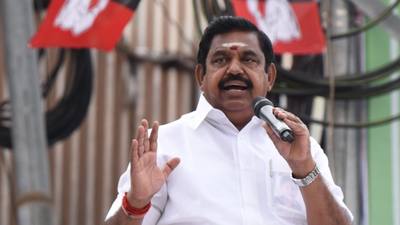
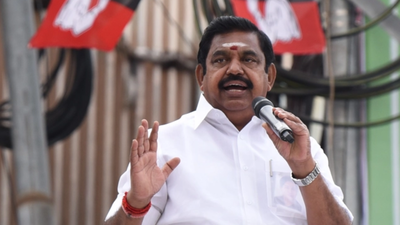
AIADMK General Secretary and Leader of Opposition in Tamil Nadu Assembly

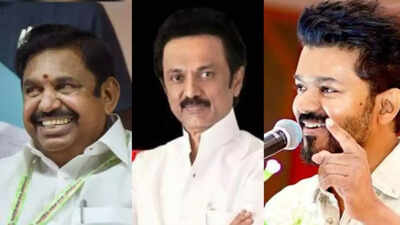
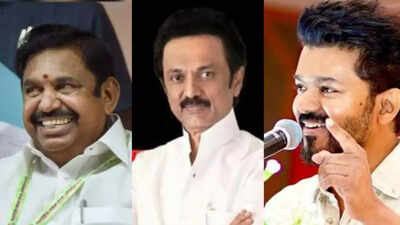
New Delhi: AIADMK general secretary Edappadi K Palaniswami on Tuesday released the party’s Tamil Nadu Assembly election manifesto, revealing 297 promises ahead of the April 23 polls.The manifesto puts welfare measures at the center of the party’s campaign, including a monthly assistance of Rs 2,000 for female heads of households and a special assistance of Rs 10,000 for each family.EPS also promised ‘Kul Vilakku Scheme’ for women. Under the scheme, monthly assistance will be given to all ration card holders and will be deposited directly into the bank account of the female head of the family.“To promote economic balance within the society, a monthly support allowance of Rs 2,000 will be provided to all ration cardholders through the ‘Kul Vilakku Scheme’. This amount will be deposited directly into the bank account of the female head of the family.”The manifesto said the special assistance of Rs 10,000 is to help households cope with rising prices and higher taxes.“Under the administratively incompetent Stalin-led DMK regime – due to its lack of foresight – prices of essential commodities have skyrocketed in the last five years. As a result, the public has been seriously affected. Besides, various taxes including property tax, house tax, electricity charges and water charges have been increased. As a result, the daily financial burden on families has increased manifold. Therefore, with the aim of reducing this burden on the people, a special assistance amount of Rs. Rs 10,000 will be provided to each family,” the manifesto read.Among other promises, the party said ration card holders will also get rice and pulses along with refrigerators. It also promised to extend the free bus travel scheme to men besides women and provide three free cooking gas cylinders a year to every ration cardholder.Tamil Nadu will go to polls in a single phase on April 23 and counting of votes will take place on May 4.Under the NDA seat-sharing agreement, the AIADMK-led alliance will contest on more than 170 seats. BJP has been allotted 27 seats, followed by PMK with 18 seats and AMMK with 11 seats.Meanwhile, the AIADMK is intensifying talks to finalize the alliance with GK Vasan’s TMC(M) and other smaller parties before the end of Tuesday.The main contest is expected to be between the DMK-led secular progressive alliance, comprising Congress, DMDK and VCK, and the AIADMK-led NDA with allies BJP and PMK. Actor-turned-politician Vijay is also set to make his electoral debut with TVK, which is likely to lead to a triangular contest in the elections.

Source link

On this day in 1977: How Morarji Desai became India’s first non-Congress PM. india news

On this day in 1977: How Morarji Desai became India's first non-Congress PM
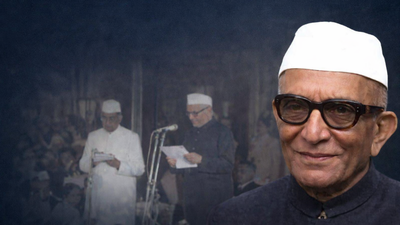
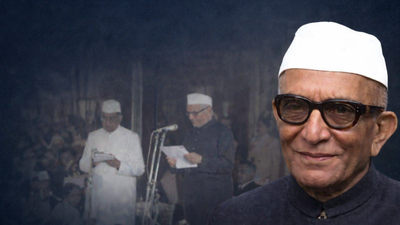
This image is used for representation purpose only (AI-generated)

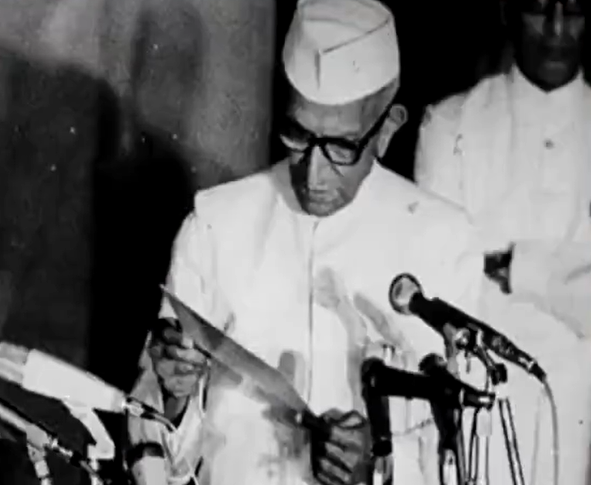
On a cool March morning in 1977, inside the stately halls of Rashtrapati Bhavan, a brief swearing-in ceremony lasting barely three minutes changed the course of Indian politics.When 81-year-old Morarji Desai was sworn in as the country’s first non-Congress Prime Minister on March 24, 1977, it was not just a change of power, it was the first real disruption of a system that had remained largely unchanged since independence.The oath was administered by the then acting President BD Jatti.

Moraji Desai taking oath (Image/X)

At first glance, the ritual seemed routine, a formal transfer of power to the presidential residence. But behind its brevity lies a historic change, the end of almost decades of Congress dominance, the post-Emergency political reckoning and the beginning of coalition politics at the Centre.

1977 elections: the vote that changed everything

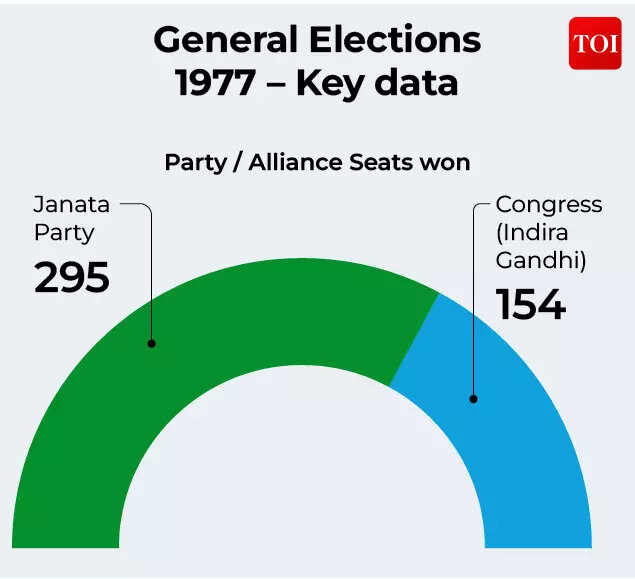
The general elections of 1977 were unlike any election held in India since independence.In the months before the vote, four major opposition factions – Samajwadi, Jan Sangh, Bharatiya Lok Dal (BLD), and Congress (O) came together. Janata Party.This unprecedented unity was driven by a common goal: to challenge the Congress rule under then Prime Minister Indira Gandhi and end the Emergency.The campaign gained momentum from widespread anger over the Emergency – which included forced sterilization campaigns, slum demolitions, arrests of political opponents, and press censorship.Perhaps for the first time, voters in rural and urban India were not just participating – they were abstaining.The result was decisive. Of the 542 seats, the Janata Party won 295 seats, while the Congress was reduced to 154, losing more than 200 seats compared to the last election.
.

.

Morarji Desai emerged as the unanimous choice to lead the new government.A veteran of the independence movement, Desai served as Chief Minister of Bombay (1952–1957) and Deputy Prime Minister (1967–1969).At 81, he became the oldest person to hold office as Prime Minister, a symbol of continuity at a moment of disruption.

Morarji Desai: Experienced politician sitting at the top

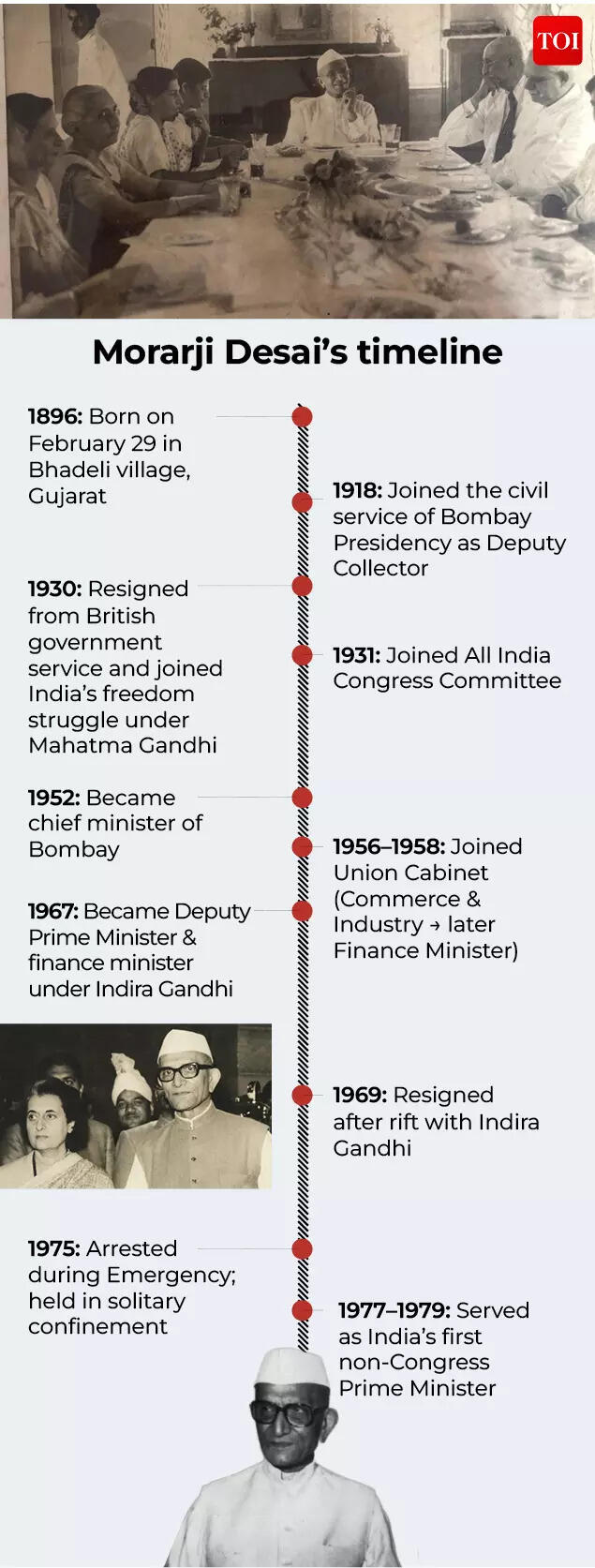
Morarji Desai’s rise was shaped by political currents as well as personal convictions.Born in 1896, he resigned from government service in 1930 to join the independence movement led by Mahatma Gandhi.

Morarji Desai's timeline

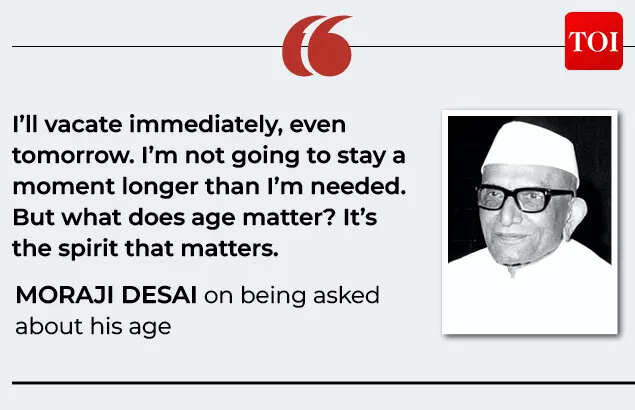
He was sent to jail several times and later played important roles in the Congress.During the Emergency, Desai was arrested on June 26, 1975 and spent several months in solitary confinement.His return from political prisoner to prime minister in 1977 reflects the larger story of the reset.He consistently argued that no one should be above the law, including the Prime Minister.“One must act in life according to the truth and one’s faith,” he had said – a line that defined both his politics and his moment.
.

.

Desai was later awarded the Bharat Ratna in 1991 and Pakistan’s Nishan-e-Pakistan in 1990.

Understanding the 1977 transition: What scholars say

The extraordinary change in Indian politics in 1977 did not happen suddenly. Political scientists and historians have long studied how and why India’s democracy, which appeared intact for decades, suddenly changed.Rajni Kothari: Congress SystemRajni Kothari was among the first scholars to describe the post-independence political system in India as the “Congress system”. in its original work congress system in indiaKothari points out that Indian politics in the 1950s and early 1960s was not dominated by any one party in a simple sense, but by a system in which the Congress functioned as the center of political life.Kothari argued that the Congress system contained a unique internal mechanism of political competition. Opposition parties existed, but played roles similar to pressure groups; There was very little chance of him coming to power directly. Myron Weiner: elections, emergency and democratic reformsIn his influential 1977 analysis, political scientist Myron Weiner examined the parliamentary elections that abruptly ended Congress. Weiner portrayed the 1977 election as a moment when Indian democracy corrected itself following the authoritarian precedent set during the Emergency.Weiner highlights that the Emergency was expected to strengthen Indira Gandhi’s authority. Between 1975 and 1977, the central government under Gandhiji suspended fundamental rights, imposed press censorship and used the state machinery to suppress dissent. Instead, the polls produced resounding congressional disapproval:

  • Many opposition parties united in Janata Party
  • Opposition leaders, many of whom have recently been released from jail, launched a nationwide campaign
  • Voters gave clear majority to Janta alliance

Yogendra Yadav: The era of four party systemBuilding on the work of scholars such as Kothari and others who have tracked Indian politics over decades, Yogendra Yadav has contributed to the understanding of how Indian party systems evolved through distinct stages. Yadav’s framework identifies four broad party-system eras in post-independence India:

  1. First-party system (1952–1967): dominance of congress system
  2. Second-party system (1967–1989): Congress maintains central position amid growing challenges, resulting in brief public intervention
  3. Third-party systems (1989–2014): Marked by coalition politics and fragmented national competition
  4. Fourth-party systems (since 2014): Characteristics of BJP’s dominance

Rift, Emergency and restoration of Congress

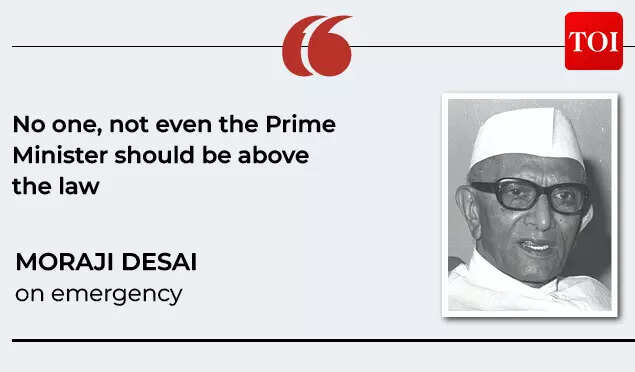
Rift between Morarji Desai and Indira GandhiThe conflict between Morarji Desai and Indira Gandhi was one of the defining power struggles in post-independence India.It began after the succession battle following the death of Lal Bahadur Shastri in 1966, when the party’s traditionalist leadership, the Congress syndicate, supported Gandhi over Desai.Desai, a senior leader and believer in conservative economic and administrative principles, represented the old faction, while Gandhi adopted a new, populist approach that consistently challenged the status quo.Tensions increased further in 1969 when Gandhiji removed Desai from the Finance Ministry. At this moment the Congress split into Congress (R), led by Gandhiji, and Congress (O), an organizational faction led by Desai and other senior leaders. Ideologically, the two leaders diverged sharply: Gandhi embraced socialist measures, including the nationalization of fourteen major banks, while Desai favored limited government intervention. Emergency: The dark chapter of democracyThe Emergency (1975–1977) was the climax of the political conflict between Gandhi and Desai. Following the Allahabad High Court’s decision to invalidate his election to the Lok Sabha, Gandhi imposed a nationwide emergency for 21 months, citing threats to national stability. Opposition leaders, including Desai, were arrested and kept in solitary confinement. During this period, the government took sweeping measures that increased its control over political and social life. Yet, the Emergency also created an unprecedented anti-Congress wave, prompting opposition parties to unite under the Janata Party banner.
.

.

Upon his release in early 1977, Morarji Desai became the face of this coalition, campaigning across the country and taking advantage of public dissatisfaction with authoritarian rule. The general elections of 1977 ultimately gave a decisive verdict in favor of Desai. Restoration of Congress: Return of Indira GandhiHowever, the Janata Party’s tenure proved unstable. Internal divisions, factionalism, and lack of united rule weakened its ability to govern effectively. Meanwhile, Indira Gandhi, although out of power, gradually regained her political base. His resurgence was marked by significant victories in the state assembly elections of Karnataka and Andhra Pradesh.Gandhi’s victory demonstrated his enduring appeal among the rural poor, minorities and women. The general elections of 1980 cemented his comeback. Gandhi’s party won a landslide majority by securing 353 seats out of 529, while the Janata Party’s seat share dropped to 41.

Could 1977 happen again?

The 1977 election remains the most striking example of a united opposition defeating a major ruling party at the national level.Ahead of the 2024 Lok Sabha elections, opposition parties attempted a similar consolidation under the Bharat Alliance.Despite coordination between more than two dozen parties, the BJP returned to power.Nearly five decades after Desai was sworn in, the country has again entered a phase of dominance, this time with the BJP raising a familiar question: Can a fragmented opposition repeat the unity of 1977?History offers both hope and caution. While 1977 proved that electoral waves can topple a strong regime, it also showed that it is not just victory but cohesion that determines longevity.1977 was a reminder that democratic systems can be reset, but only if voters, opposition forces, and institutions unite in a single moment.

Source link