Evening News Wrap: Government urges calm on LPG supplies; 2 Indians killed, 10 injured and more in Oman attack. india news

Evening News Wrap: Government urges calm on LPG supplies; 2 Indians killed, 10 injured and many others in Oman attack
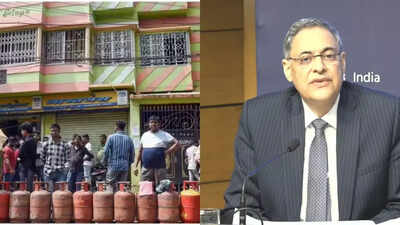
  • The government has urged citizens not to panic buy LPG as tensions in West Asia are disrupting global energy routes and increasing supply concerns.
  • US President Donald Trump claimed Iran is “about to surrender”, ramping up the rhetoric as the Middle East conflict intensifies.
  • The Ministry of External Affairs confirmed that two Indian nationals were killed and 10 others were injured in an attack in Sohar, Oman.
  • A US KC-135 refueling plane has crashed in western Iraq during the ongoing conflict in the Middle East, killing four crew members.
  • After Sunrisers signed Pakistan spinner Abrar Ahmed for The Hundred, the BCCI said it had no right to interfere.

Here are the top 5 stories of the day

Government urges peace on LPG supply amid tension in Hormuz

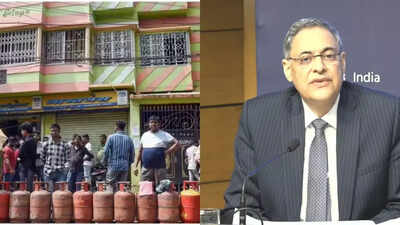
The government has asked consumers not to stand in queues outside LPG distributors or make panic purchases despite concerns over supply disruptions linked to the Strait of Hormuz crisis. Officials said domestic LPG production has increased by 30 per cent since March 5 and so far no distributor has reported supply stoppage. Officials said refineries were operating at full capacity, while action was being taken against hoarding and black marketing. Read the full story

Amidst the panic over LPG shortage, the Center has urged citizens not to hoard cylinders and opt for PNG.

Trump claims Iran ‘about to surrender’ amid escalating conflict

US President Donald Trump told G7 leaders that Iran is “about to surrender”, according to reports citing officials familiar with the talks. The comments came as Washington continued its military campaign against Iran and missile and drone attacks heightened tensions across the region. The US military also said the USS Abraham Lincoln Carrier Strike Group will continue to support ongoing operations in the conflict area. Read the full story

Two Indians killed, 10 injured in attack in Oman’s Sohar city

Two Indian nationals were killed and 10 others injured in an attack in Oman’s Sohar city, the Ministry of External Affairs said. Additional Secretary (Gulf) Asim R Mahajan confirmed that five injured Indians have been discharged, while five others are undergoing treatment in local hospitals. The Indian Mission in Oman is coordinating with local authorities and the company concerned to assist the affected people. Read the full story

Four US crew members killed as refueling plane crashes in Iraq

Four of the six crew members aboard a US KC-135 refueling aircraft have died when the plane crashed in western Iraq, US Central Command confirmed. The US military said the circumstances of the crash were being investigated but ruled out hostile or friendly fire. The incident marks another aircraft loss during the ongoing conflict in the Middle East. Read the full story

BCCI says it can’t interfere after Sunrisers sign Abrar Ahmed

The BCCI has made it clear that it cannot interfere in the controversy over Sunrisers’ signing of Pakistan spinner Abrar Ahmed in The Hundred. Vice-president Rajiv Shukla said that the league is played abroad and hence it is outside the jurisdiction of the board. The signing has sparked criticism on social media, but the franchise has not yet issued any formal statement. Read the full story

Source link

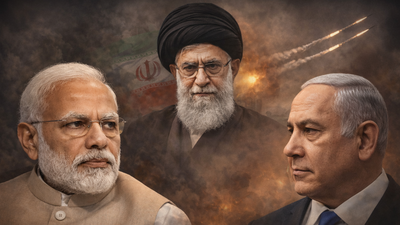
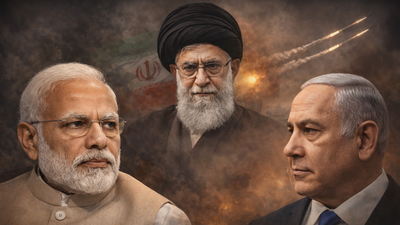
Iran-Israel-US ‘triangle trap’: Decoding India’s stance amid rising Middle East tensions | India News

Iran-Israel-US 'triangle trap': Decoding India's stance amid rising Middle East tensions

Is New Delhi recalibrating its approach to West Asia? The question has resurfaced after India’s notably cautious response to the latest escalation involving Iran. When the United States and Israel launched strikes on Iran on February 28, triggering retaliatory missile attacks across the region, several global powers reacted swiftly. India, however, avoided taking a clear position on Tehran.In the crucial hours after the escalation, Prime Minister Narendra Modi did not directly comment on Iran. His first response came nearly a day later and focused instead on attacks on the United Arab Emirates. Subsequent conversations with leaders across the Gulf emphasised respect for their territorial integrity and the need for de-escalation, but again avoided directly naming Iran. Even after the death of Iran’s Supreme Leader Ali Khamenei was confirmed, New Delhi stopped short of condemning the killing, offering only a condolence gesture days later.Experts describe this cautious approach as deliberate and calculated. “India’s policy has been very careful. Its interests are far more aligned with the US than Iran. That explains why it condoled and did not condemn Khamenei’s killing, even though it was a clear violation of international law,” said JNU professor Rajan Kumar. He noted that even though both India and Iran are BRICS members, New Delhi chose restraint over confrontation, highlighting the delicate balancing act in play.

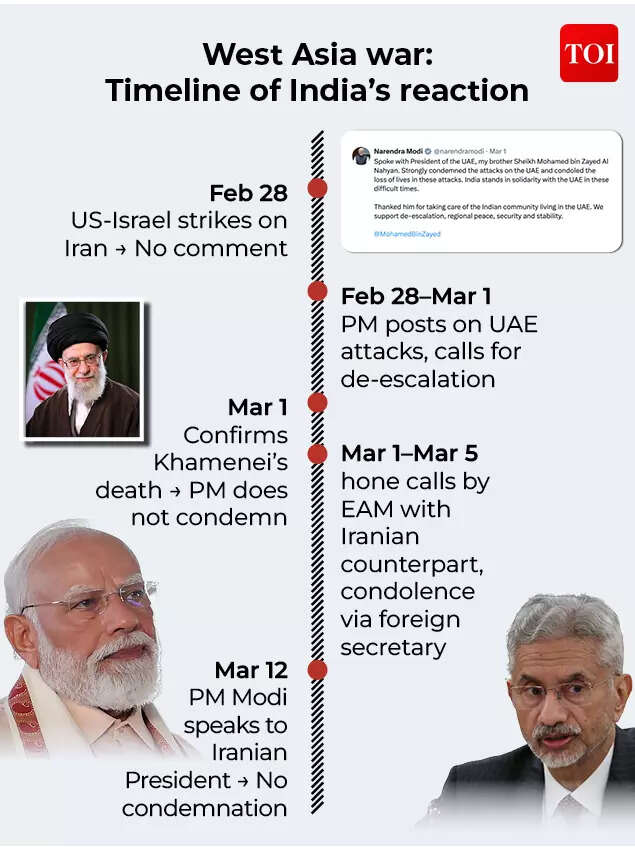
How (When) India reacted on Iran war

28 Feb: US-Israel attack Iran

The United States and Israel launch strikes on Iran amid negotiations between Washington and Tehran over its nuclear programme.Iran retaliates with missile and air attacks across the region, targeting military sites in Israel as well as US bases in Bahrain, Saudi Arabia, Qatar, the United Arab Emirates and Iraq.Prime Minister Narendra Modi makes over 15 posts on his social media X after the news of the war breaks out, but none of it on Iran situation.

March 1: Khamenei’s death confirmed

By midnight early March 1, the news that Iran Supreme Leader Ayatollah Khamenei is killed in the strikes gets confirmed.India, again, sees no reaction on breach of Iran’s sovereignty or the killing of its Supreme Leader Khamenei, even as its long-standing friend Russia is quick to condemn it in strong words, with President Vladimir Putin calling it a “cynical violation of law”.The first post by PM Modi comes on March 1, his 25th on his X account, at 11.26pm. The post condemns “attack” on the UAE. The Prime Minister was referring to Iran’s retaliatory strikes on US military bases in UAE, which had led to one death. However, he did not directly name Iran in his post.By midnight, PM Modi makes another post where he informs that he had a conversation with Israeli PM Benjamin Netanyahu, whom he had two days before the war broke out. In the post, the PM again makes no mention of Iran, but calls for “early cessation of hostilities”.In a series of posts by the next day, PM Modi speaks to the leaders of Bahrain, Saudi Arabia, Jordan, Oman, Kuwait, Qatar, condemning any violation of their territorial integrity. The PM was again referring to the strikes on US military bases in these nations by Iran in retaliation. India’s reaction to Khamenei’s death came five days after the incident. Foreign secretary Vikram Misri signed the “condolence” book in the Iranian embassy on behalf of the government. MEA dismissed this “delay” argument saying that the book was signed by India the first day it was opened, which was on March 5. However, MEA’s clarification failed to explain why the government itself took five days after the incident to formally convey its condolences.PM Modi’s reaction to Iran came only on March 12 when he spoke to Iranian president. The wording of the post was clear: “The safety and security of Indian nationals, along with the need for unhindered transit of goods and energy, remain India’s top priorities.” No condemnation or solidarity.

-

India did not condemn the death, neither did the PM or EAM make any direct comments on the killing. Then what explains this refusal to condemn the killing?Experts have termed it a “very cautious and very careful” move.“India’s policy has been very cautious and very careful. Its interests are much more aligned with US than Iran. Maybe that’s why it condoled and not condemned Khameinei’s death, while it was Khamenei’s death which was actually a violation of international law, said JNU professor Rajan Kumar, an international relations expert.“In fact, both Iran and India are members of Brics, still India chose not to condemn the attack,” he said.

Why historical Iran ties make current restraint notable

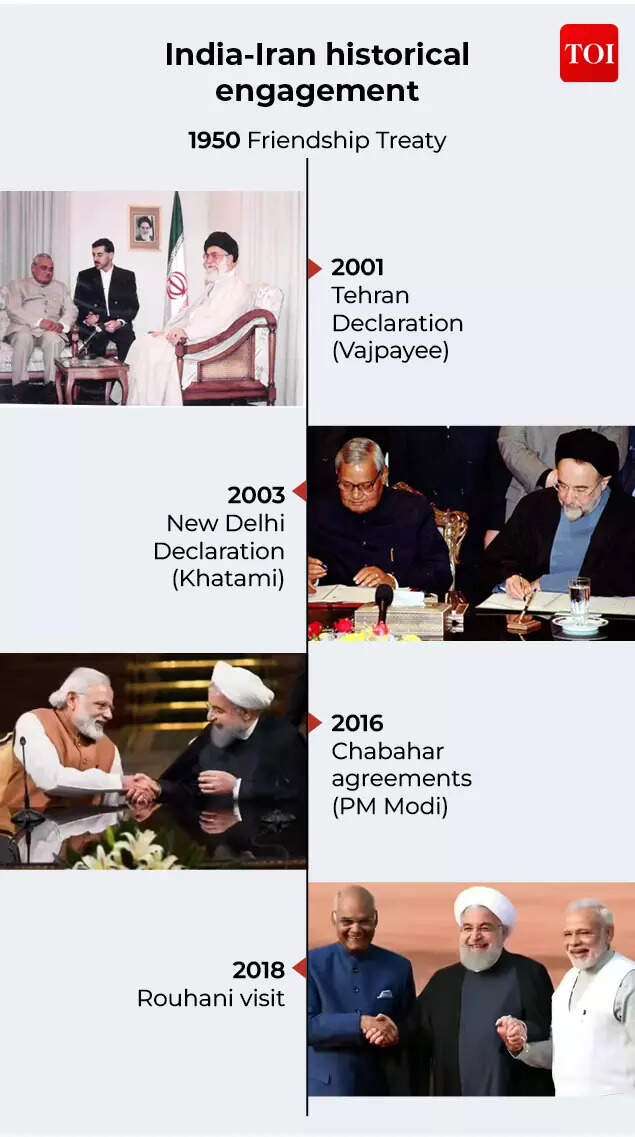
India’s historically close engagement with Iran makes this caution notable. The two countries share civilisational links stretching back centuries, which have shaped a modern partnership built on trade, culture and strategic cooperation. Diplomatic ties were formalised with a Friendship Treaty in 1950, and successive governments in New Delhi invested in maintaining strong political engagement with Tehran.Leaders from the Bharatiya Janata Party (BJP) were also central to strengthening these ties in the past. Prime Minister Atal Bihari Vajpayee’s visit to Iran in 2001 led to the signing of the Tehran Declaration, marking a new phase of strategic cooperation. This was followed by Iranian President Seyyed Mohammad Khatami’s visit to India in 2003 and the New Delhi Declaration, which expanded political and economic engagement between the two countries.Under Prime Minister Narendra Modi, the relationship continued to see high-level outreach. Modi’s 2016 visit to Iran resulted in multiple agreements and the trilateral transit pact with Afghanistan centred on the development of Chabahar Port, a project seen as strategically important for India’s connectivity to Central Asia. Iranian President Hassan Rouhani’s visit to India in 2018 further reinforced cooperation in connectivity and trade.

-

So, what explains this shift away from Iran?

Analysts point to a mix of immediate security concerns and long-term economic dependencies that have pushed New Delhi to adopt a more cautious posture in the current West Asia crisis.A major factor is the safety of the large Indian diaspora across the Gulf. References to the Indian community appeared consistently in Prime Minister Modi’s statements on the unfolding conflict. There are over one crore Indians who work and live in Gulf nations, external affairs minister S Jaishankar informed the Parliament on Monday. This, he said, makes the West Asia war even more concerning for India. He informed that India has already lost two of its mariners, with one missing in the current situation. “We are committed to supporting the Indian community at this time,” Jaishankar said in the Parliament.Moreover, India is significantly dependent on Gulf supplies, especially in energy sector. The key economic concerns include:Oil: India exports nearly 40% of crude oil from Gulf. In 2025, it sourced around $70 billion crude oil and petroleum products from West Asia.LNG needs: The country is heavily dependent on West Asia for LNG requirements. It sourced liquefied natural gas or LNG worth $9.2 billion from West Asia, which is around 68.4% of its total LNG imports.LPG: LPG imports from West Asia were $13.9 billion in 2025, making up 46.9 % of India’s total LPG purchases. Cities such as Bengaluru, Mumbai and Chennai are seeing disruptions in commercial LPG supplies as authorities prioritise domestic cooking gas for households.

Recent closeness towards Israel

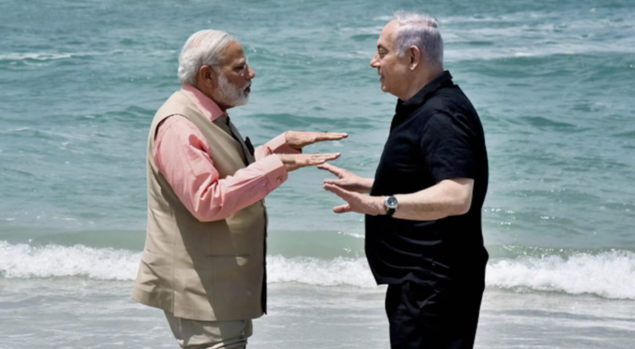
For decades after independence, India’s policy on Israel and Palestine was cautious. New Delhi supported the Palestinian cause and often voted with Arab countries in international forums, even voting against Israel’s admission to the United Nations. At the same time, India recognised Israel in 1950 and maintained limited contact while presenting itself as neutral. India later became the first non-Arab country to recognise the State of Palestine in 1988 and established diplomatic relations with Israel in 1992 after consultations with Yasser Arafat, leader of the Palestine Liberation Organization.Relations with Israel began expanding gradually after the Cold War, particularly in defence and trade. However, earlier governments often kept the relationship relatively low-key to avoid upsetting Arab partners or appearing to move away from India’s traditional support for the Palestinian cause.A more visible shift came after Narendra Modi became prime minister in 2014. Under his government, India’s ties with Israel grew more open and politically prominent. Defence cooperation increased and bilateral trade expanded, with both countries emphasising shared security concerns and technological cooperation.In 2017, PM Modi became the first Indian prime minister to visit Israel, marking a symbolic turning point in the relationship. During the trip, he was warmly received by Israeli prime minister Benjamin Netanyahu, and images of the two leaders walking together on Ogla beach became widely circulated, highlighting the new warmth in ties.

-

PM Modi’s 2017 Israel visit: PM with Israeli counterpart at Ogla beachThe closeness between the two governments has continued in recent years to a point where PM Modi was in Israel merely two days before Israel attacked Iran with the US.Referring to Israel as the “fatherland” and India as the “motherland”, PM Modi’s visit came at a time when Israel faced intense international criticism over its military campaign in Gaza, which has killed more than 60,000 Palestinians according to various estimates. “The timing of it was clearly wrong. The policy makers did not expect that to happen very soon. That sent a very wrong optics from a balanced policy perspective,” professor Rajan said.The war has also drawn renewed scrutiny of Netanyahu’s leadership, with critics and some international legal bodies describing him as responsible for alleged war crimes.The shift under PM Modi reflects both ideological and strategic factors. The Bharatiya Janata Party has long been seen as more openly supportive of Israel than previous governments. At the same time, India sees Israel as a key partner in defence technology, intelligence cooperation and innovation. As a result, India’s West Asia policy today attempts to balance closer ties with Israel while continuing to express support for Palestinian statehood.

-

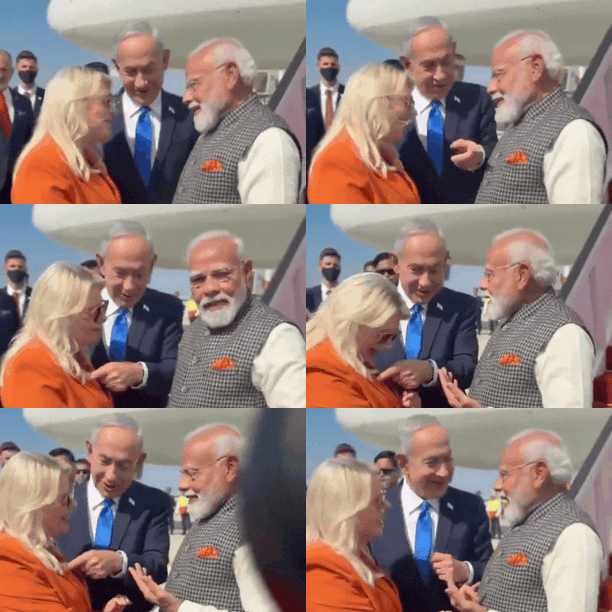
PM Modi’s 2026 Israel visit: Netanyahu pointing out ‘saffron match’ between PM Modi and SaraHowever, professor Rajan said that India’s policy is not “completely determined by Israel”, rather, currently, it is more concerned about “offending” the US.“India’s policy is not completely determined by Israel. Yes, Israel is an important partner but in the past also we have pursued our ties with Israel without damaging our relations with other countries,” he said.“India is primarily concerned about offending the US. At this time, it would not like to offend the Trump administration. And that’s exactly why it is not issuing any statements condemning of killing of Khamenei,” he said.

So, is there a shift?

Rajan Kumar, a professor at JNU, who teaches international relations said that currently, there is no shift in India’s policy towards the Middle East. Rather, he said, that the shift might happen after the war is over.“At the moment, I don’t see any shift happening. It is a continuation of policy where India’s preferred partner was United States and Israel. But at the same time trade ties were linked with many other countries in the region,” he said.“So, a shift is not apparent at the moment, but it might happen after the outcome of the event. Because if India thinks that Iran remains an important part and if the regime survives, it will pursue a different strategy. But if US wins, which is very unlikely, if the regime survives, resistance persists, it will have a different strategy. Now, India is pursuing a wait-and-watch policy in West Asia,” he added.However, he added that there was a need for India to go for a policy of multipolarity, rather than unipolarity under the influence of Israel and the US.Experts argue that India should embrace multipolarity in West Asia, rather than a unipolar tilt toward Israel and the US. While Israel is a valuable partner, destabilizing relationships with other West Asian countries could jeopardize India’s economic and security interests in the region.“India should pursue multipolarity, rather unipolarity under the influence of Israel and US in West Asia. Although we have good ties with Israel, we cannot de-stabilise our ties with other West Asian countries, for the reason that our economic and security interests are aligned there,” he said.

Source link

Uttar Pradesh boosts investment, says projects worth over Rs 13 lakh crore have moved forward for implementation. india news

उत्तर प्रदेश ने निवेश पर जोर दिया, कहा कि 13 लाख करोड़ रुपये से अधिक की परियोजनाएं कार्यान्वयन के लिए आगे बढ़ी हैंThe state estimates that these grassroots projects could create more than 80 lakh jobs. Projects worth Rs 10.11 lakh crore were launched during the Ground Breaking Ceremony (GBC) 4.0 in February 2024.The state has focused on investment commitments as well as project execution, while also emphasizing digital governance measures aimed at improving ease of doing business.Among the key initiatives listed was the state’s single-window clearance portal, Nivesh Mitra, which currently offers over 467 online services across 43 departments. The government also said that its Nivesh Sarathi platform is being used to monitor investment proposals from the MoU stage to operationalization. Additionally, 4,074 regulatory compliance or procedural burdens have been reduced.The state has also outlined the expansion of region-specific industrial infrastructure. These include a PM-Mitra Mega Integrated Textile Region and Apparel Park in Lucknow and Hardoi, a medical device park in Gautam Buddha Nagar, a plastics park in Gorakhpur and a leather park in Kanpur. It said approval has been given for 11 toy parks in places like Greater Noida, Aligarh and Jhansi.On the MSME front, the government said Uttar Pradesh has over 96 lakh units, making it the largest MSME base in the country.It also pointed towards the Chief Minister Youth Self-Employment Scheme, under which financial assistance up to Rs 25 lakh is given to young entrepreneurs.The state further said that foreign direct investment received between 2017 and 2023 was almost four times more than the inflows recorded during 2000-2017. It said the 2024 UP International Trade Show saw participation from over 100 countries and business inquiries worth Rs 10,000 crore.
Source link

The opposition submitted notices in both the houses today demanding the removal of CEC. india news

The opposition today submitted notices in both the Houses demanding a proposal to remove the CEC.

New Delhi: Stepping up the attack on the Election Commission, the opposition has served notices to the presiding officers of both the Houses of Parliament for the removal of Chief Election Commissioner Gyanesh Kumar. This is the first time that notice for removal of CEC has been given. The notice has been signed by 130 Lok Sabha MPs and 63 Rajya Sabha MPs.

After reviewing the election preparations, the Election Commission will announce the dates of assembly elections next week.

As per rules, at least 100 MPs have to sign a notice to remove the CEC in the Lok Sabha, and the required strength in the Rajya Sabha is 50.An opposition leader shared that despite the required number having already been reached, opposition MPs continued to come till Thursday afternoon to sign the notices. By around 1.30 pm, 130 signatures had been received from members of the opposition parties in the Lok Sabha and 63 signatures in the Rajya Sabha. According to sources, all the Indian block parties have signed the notice. Apart from this, MPs from AAP, which is not part of the India Bloc, have also signed the notice.

voting

Should election commissioners have more accountability mechanisms?

The 10 page long notice contains charge sheets in seven cases. According to sources, these allegations range from biased conduct of the CEC to large-scale disenfranchisement of voters. The opposition has also raised the issue of the manner in which SIR was handled by the CEC in previous elections like Bihar and upcoming elections in states like West Bengal; his “proven misconduct”; His partial conduct towards a political party are also issues which have been mentioned in the notice.Notice of removal of CEC by Pilot TMC After increasing allegations by opposition parties against Gyanesh Kumar. He has accused the CEC of being biased and arbitrarily carrying out the ongoing Special Intensive Review (SIR) exercise to help the BJP. West Bengal Chief Minister Mamata Banerjee is leading the protests over the SIR process in her state. Other opposition parties are also attacking the CEC, with Rahul Gandhi running a “vote stealing” campaign.The process of removing the CEC is similar to the process of removing a Supreme Court judge, and the incumbent can be removed only “on the ground of proven misbehavior or incompetence”.The fact that the BJP alliance has a majority in both houses makes this move a non-starter, but it allows the opposition to register their joint protest against the CEC.

Source link

VK Sasikala announces new party name and election symbol before Tamil Nadu elections. india news

Homecoming or strategic masterstroke? How can the DMK comeback of former Tamil Nadu Chief Minister reshape the state's politics?

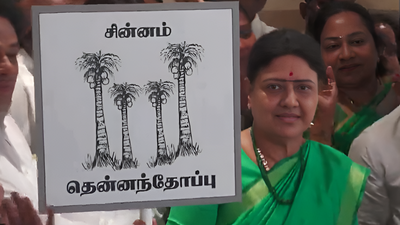
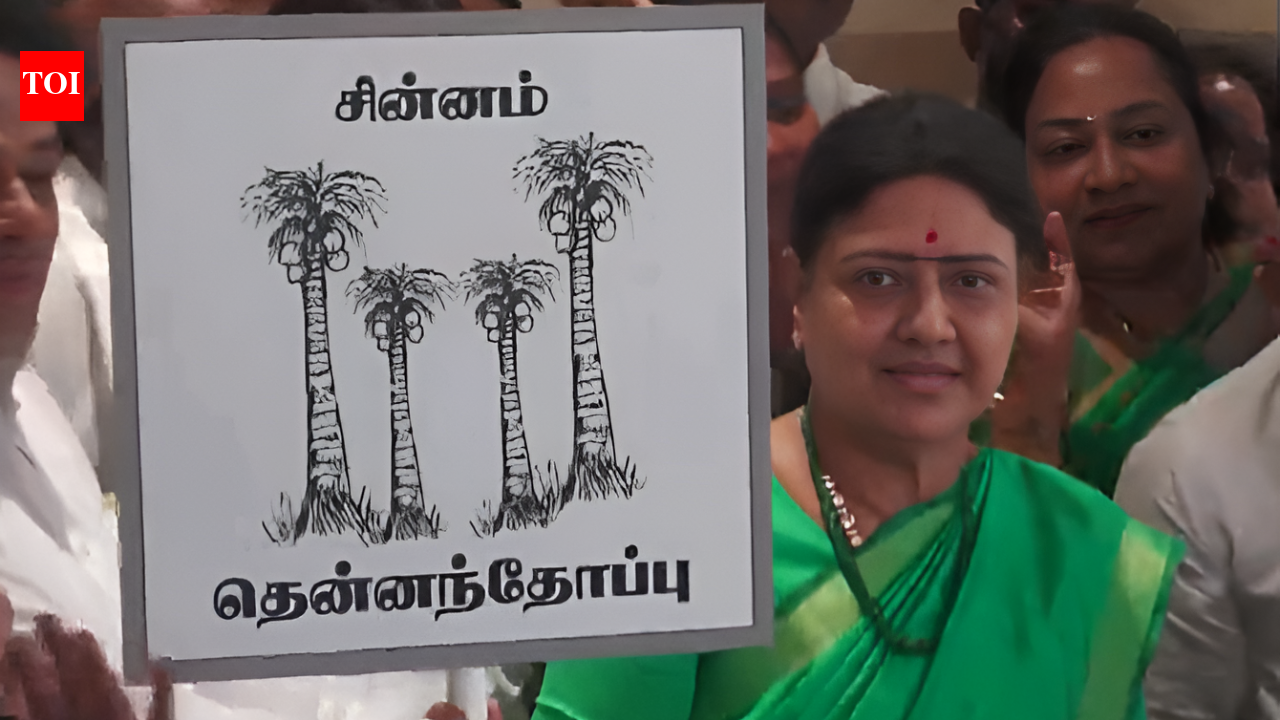
New Delhi: Jayalalitha’s longtime aide expelled AIADMK, VK Sasikala On Friday he announced the name of his new political party – All India Puratchi Thalaivar Makkal Munnetra Kazhagam – and said its symbol would be “coconut tree farm”, as political action intensifies in poll-bound Tamil Nadu, where several stakeholders are eyeing his fate.He said the party’s symbol represented “unity” and the organization would work like a “joint family”. Sasikala also said that the party will field candidates in Tamil Nadu and Puducherry in the upcoming assembly elections. “I am in the same position as our leader (MG Ramachandran), who once joined a party started by a cadre,” he said, referring to his decision to associate himself with a party started by one of his supporters.He unveiled the party flag at Kamuthi in Ramanathapuram district on the birth anniversary of former AIADMK supremo Jayalalithaa. The flag has black, white and red colors, with photographs of former chief ministers CN Annadurai, MG Ramachandran (MGR) and Jayalalitha in the centre.Sasikala will now enter the political battlefield with her own brigade in the hotly contested race, which already includes many veterans, including some of her former party colleagues.

Homecoming or strategic masterstroke? How can the DMK comeback of former Tamil Nadu Chief Minister reshape the state’s politics?

Major players in Tamil Nadu elections include mk stalinEdappadi Palaniswami and O Panneerselvam. Meanwhile, national parties like BJP And Congress is also looking to expand its presence in the state.

voting

Do you think VK Sasikala with her new party will be a significant contender in the upcoming Tamil Nadu elections?

Source link

‘Why hesitate now?’: Congress reiterates ‘compromising PM’ charge over silence on Ayatollah Khamenei’s death. india news

'Why hesitate now?': Congress reiterates 'compromising PM' charge over silence on Ayatollah Khamenei's death
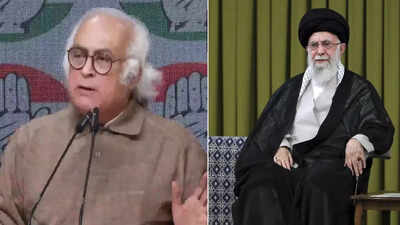
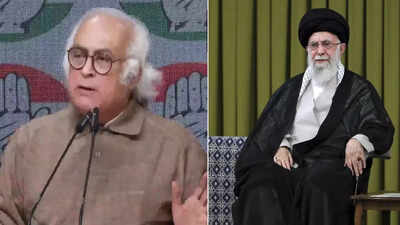
Jairam Ramesh and Ayatollah Khamenei (Images/PTI)

New Delhi: Congress leader Jairam Ramesh took a dig at the Prime Minister on Friday. Narendra ModiQuestioned his hesitation to condemn the death of Iran’s late supreme leader Ali Khamenei.Recalling his earlier allegation of a “compromising PM”, Ramesh claimed that PM Modi “wanted to avoid angering his American and Israeli friends”, referring to US President Donald Trump and Tel Aviv Prime Minister Benjamin Netanyahu.In a post on X, he wrote: “Why the hesitation now? A compromised Prime Minister undoubtedly wants to avoid angering his American and Israeli ‘friends’.”The Congress leader also questioned the silence of PM Modi and the Ministry of External Affairs after the death of Ayatollah Khamenei. He wrote, “Ayatollah Khamenei, the constitutional head of state in Iran, was assassinated by the US and Israel on February 28, 2026. The PM is silent. The Foreign Minister is silent. There is no obituary reference in Parliament yet.”His comments come after India supported the United Nations Security Council (UNSC) resolution condemning Iran’s attacks on Middle Eastern countries.He further wrote, “India has rightly condemned Iran’s attacks on Gulf countries, but is completely silent on the US-Israeli attack on Iran. It must be remembered that Iran is a part of the BRICS+ forum, which India chairs this year.”Recalling the death of former Iranian President Ebrahim Raisi, who died in a helicopter crash in 2024, Ramesh said the government had earlier announced a one-day state mourning and was now hesitating. He wrote, “In May 2024, Iran’s President Ebrahim Raisi died in a mysterious helicopter crash. The Modi government ordered a day of mourning on May 21, 2024, and a condolence message was delivered in the Parliament meeting on July 1, 2024.”Khamenei was killed in a coordinated attack by Israel and the United States earlier this month. He was later succeeded by his second eldest son, Mojtaba Khamenei.

Source link

The hidden costs of excessive screen media use in children india news

The hidden costs of excessive screen media use in children

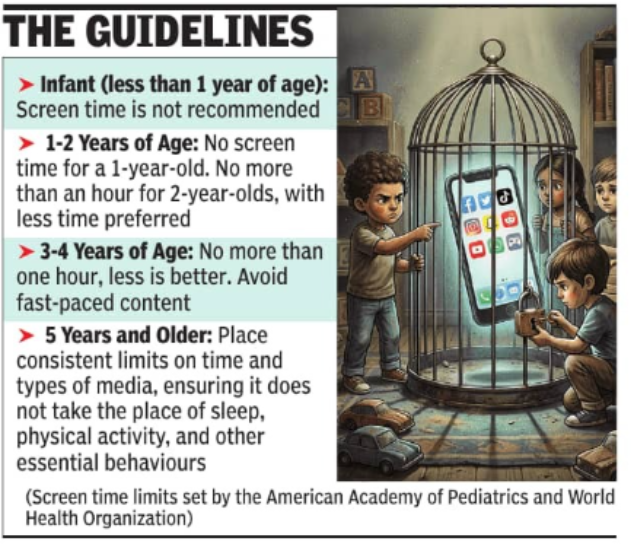
New research highlights how children in India lag behind the global average screen time guidelinesWith lasting effects on health and cognitive abilitiesMultiple screens have become an integral part of children’s lives. But is it safe for young teens to spend so much time on screens? Existing research findings suggest that devices such as smartphones, laptops, tablets, and TVs can aid learning, but their excessive use is associated with adverse health and developmental outcomes.A recent study* published in the Indian Journal of Psychiatry examined children and adolescents with mental disorders to assess their screen usage habits. The findings are shocking: The average daily screen time was 3.1 hours. Importantly, two-thirds of the 212 study participants (average age 13 years) exceeded the recommended screen time limits set by the American Academy of Pediatrics (AAP) and the World Health Organization (WHO). These guidelines recommend no screen exposure for children under two years of age (except video calls), less than one hour per day for ages two to four years, and a maximum of two hours per day for children ages five years and older.

-

The study revealed that television (66%) and mobile phones (70.3%) were the most commonly used devices among the 212 children and adolescents who were part of the study. Alarmingly, 22.2% of children meet the criteria for screen media addiction based on DSM-5 standards for Internet Gaming Disorder. DSM-5 is the Diagnostic and Statistical Manual of Mental Disorders, fifth edition, a guide used by researchers to diagnose, classify, and treat mental health disorders.Addiction was more prevalent among boys from joint or extended families and among children suffering from neurodevelopmental or disintegrative disorders.Excessive screen use contributes to obesity, sedentary behavior, poor dietary habits, and disrupted sleep. Cognitively, prolonged exposure can impair language development, executive functioning, and emerging literacy skills. Research also shows that structural brain changes occur in preschool children with high screen exposure, particularly affecting white matter pathways (which act as the brain’s communication network), which are important for learning and communication.Psychosocially, children addicted to screen media often display deception (hiding or lying about using devices), preoccupation, withdrawal symptoms, and conflict within families. Screen use also interferes with friendships and family activities, while increasing susceptibility to cyberbullying, unsafe online content, and negative emotional states.The study underlines the urgent need for parental awareness and regulation. Parents often allow children with neurodevelopmental disorders extra screen time as a coping measure, but this leads to more problems. In a joint family setting, inconsistent parenting rules can further compound the problem.In conclusion, screen media use among children is not inherently harmful, but excessive and unregulated use poses significant risks to physical health, cognitive development, and emotional well-being. With approximately one-quarter of children in psychiatric care showing signs of addiction, regular assessment of screen habits and strict adherence to recommended guidelines are essential steps to protect the next generation.(*Problematic screen media use among children and adolescents attending child and adolescent psychiatric services in a tertiary care center in North India, by Venkatesh Raju, Akhilesh Sharma, Ruchita Shah, Ravikant Tangela, Sana Devi Yumnam, Jyoti Singh, Jayvinder Yadav and Sandeep Grover)

Source link

When medical care fails: What the Supreme Court’s passive euthanasia ruling means india news

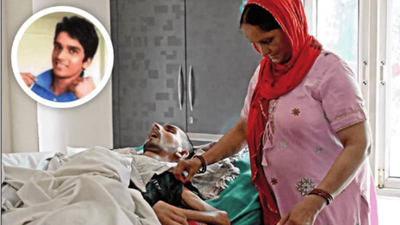
Historic decision: Supreme Court allows passive euthanasia to Harish Rana after being in coma for 13 years

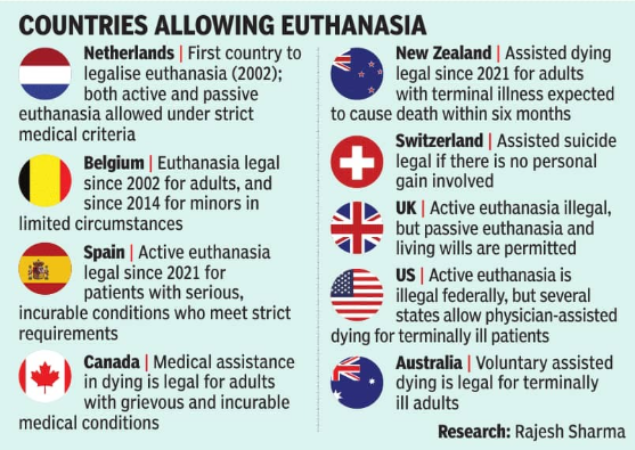
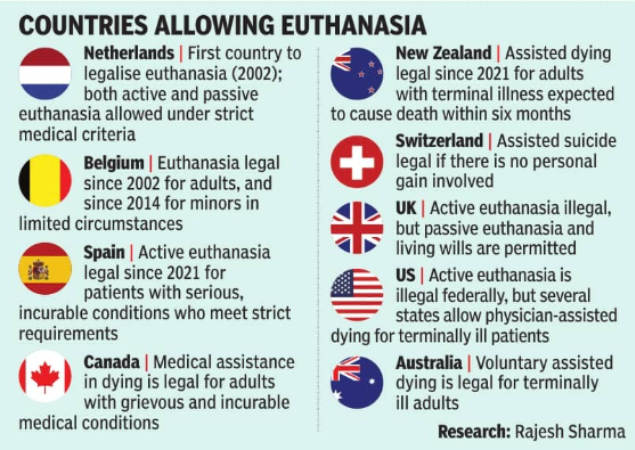
In a landmark ruling that revisits one of medicine’s toughest ethical questions, the Supreme Court on Wednesday allowed the withdrawal of artificial life support — or passive euthanasia, as it is commonly called — for a 31-year-old man who had been in a coma for more than 13 years. The judgment in the Harish Rana case is the first time that the court has directly allowed passive euthanasia for a patient in a permanent vegetative state. Dr. Sushma Bhatnagar Former AIIMS chief and professor of onco-anesthesia and palliative medicine explains times of India What does this mean in medical practice, and how do doctors decide when to withdraw life support?What does passive euthanasia mean in medical practice?In simple terms, it involves withdrawal of life support, stopping some types of artificial support that prolong life without improving the patient’s condition. For example, doctors may discontinue artificial nutrition, fluids, or other life-sustaining measures when they are no longer beneficial. The aim is not to actively end life, but to prevent treatments that only increase suffering, and allow the disease to continue its course when recovery is not possible.

Historic decision: Supreme Court allows passive euthanasia to Harish Rana after being in coma for 13 years

In what situations do doctors consider withdrawing life support?Doctors consider this when the treatment is not providing any benefit to the patient and his suffering is only increasing. In such cases, continuing aggressive medical support may not be in the best interests of the patient. Conditions may include permanent vegetative state, severe and irreversible brain injury, terminal cancer, end-stage kidney failure where dialysis is no longer effective, or advanced heart disease where treatment options have been exhausted. This may include withdrawal of ventilatory support, stopping medications that artificially maintain blood pressure, dialysis, artificial feeding through tubes, or other interventions that maintain physical functions without improving the patient’s condition.

-

How do doctors determine whether a patient has no chance of recovery, and what safety measures should be followed before withdrawing life support in India?There are established medical criteria and tests. For example, specific instruments are used to confirm conditions such as coma or vegetative state. In incurable diseases such as advanced cancer, prognosis and chances of cure are assessed using evidence-based medical guidelines. In India, review is usually done by primary and secondary medical boards before any decision is taken. In some cases, hospital ethics committees may also be involved to ensure that the procedure follows medical ethics and legal guidelines set by the Supreme Court. These measures ensure that the decision is medically appropriate and ethically correct.How important are living wills or advance directives?They are extremely important. If a patient has clearly stated in advance what type of treatment they would or would not like in such circumstances, the doctor and family may follow their wishes. Respecting patient autonomy is a fundamental principle of medical ethics.How often do doctors in India receive requests to withdraw life support?It is still relatively rare in India.Awareness of advance directives is limited. Culturally, many families find it difficult to accept death as a natural part of life.What is the difference between active and passive euthanasia, and how does the latter differ from assisted suicide or assisted death?Active euthanasia involves deliberately administering drugs that cause death. Passive euthanasia refers to the withdrawal or stopping of treatments that artificially maintain life and includes stopping medical interventions that are no longer beneficial. Assisted suicide involves actively helping a person end their life, usually by providing medication that the person takes themselves.What are some common misconceptions about passive euthanasia?Many people believe that this means that doctors are actively trying to end the patient’s life. In fact, it usually involves stopping medical interventions that are no longer useful, and focusing on comfort, care, and respect at the end of life.From a medical ethics perspective, why are these practices treated differently?Medical ethics emphasize doing no harm and avoiding treatments that provide no benefit. When treatment only increases suffering with no real possibility of cure, it may be considered morally justified to withdraw it.

Source link

Ruckus in Lok Sabha due to Rahul Gandhi’s speech. india news

Uproar over Rahul Gandhi's speech in Lok Sabha

New Delhi: There was uproar in the Lok Sabha on Thursday after Rahul Gandhi took a dig at the Oil and Gas Minister during his speech on the energy crisis. Hardeep Puri Due to his name allegedly appearing in the files of an American sex-offender. He also attacked the government over the American exemption given to India to buy crude oil from Russia. “It has been a very puzzling fact as to why a nation the size of India would allow any other nation...The President of another country should allow us to buy Russian oil… I have solved the puzzle. And the puzzle is about compromise,” he said and referred to Puri’s alleged affair.This caused disruption in the House and the Speaker was forced to Om Birla He intervened, saying members could not raise the issue, while Gandhi insisted he was speaking on energy and economic security. Later, opposition members came to the well of the House and Puri had to read out his statement amid sloganeering.

Source link

Government leaving no stone unturned to minimize impact of war on civilians, opposition spreading fear: PM Modi | india news

PM Modi said, the government is not making any efforts to reduce the impact of war on civilians, the opposition is spreading fear.

New Delhi: Amid concerns over the impact of the Iran war on India’s energy supplies, Prime Minister Narendra Modi on Thursday said his government is making no efforts to mitigate its impact on citizens and accused opposition parties of spreading fear to further their agenda at the cost of national interest.He said that no country is untouched by this global crisis and India is making efforts at various levels to deal with it, including efforts to deal with supply chain disruptions. He said at the NXT Summit, he has spoken to global leaders.On a day when Leader of Opposition in Lok Sabha Rahul Gandhi hit out at the government over the “LPG crisis” in the House, Modi hit back without naming anyone and said everyone, including political parties, has a role to play in ensuring that the country successfully deals with the crisis.He said, “Some people are trying to spread panic. They want to push their agenda. I do not want to give any political reaction right now, but I would like to say that they are exposing themselves to the people and causing huge loss to the country.” He stressed that India will definitely be able to deal with the challenges posed by the war.He listed several measures taken by his government since 2014 to build India’s alternative energy sources, reduce its dependence on oil, increase its petroleum storage capacity as well as ensure more people benefit from them.India used to have negligible storage capacity to deal with any crisis but now it has 5 million tonnes, while it has become one of the largest refining centers in the world. Before targeting his critics, he said, people’s aspirations have increased and their government welcomes them.“Many of my ‘well-wishers’ are hoping that I will collapse under the weight of expectations… their intentions are dishonest and their expectations will never be fulfilled,” he said, adding that he has people’s blessings. He asked the states to take strict action against those spreading rumors and black marketing.He said India will emerge from the crisis as successfully as it did during Covid, describing the present era as a period like never before.He compared the rise of the Indian economy to people’s enduring interest in cricket, saying that now they are curious to know about the latest details all the time. “If you want to be part of the future, you have to live in India,” he said. “Despite many global challenges, the world looks at India with great hope,” he said.

Source link