


Chirayu Rana took leave for father’s death in 2024 but his father is alive; He says he knows nothing about JPMorgan controversy

Chirayu Rana, who made sexual harassment allegations against Lorna Hajdini (left), took leave in 2024 to make up for his father’s death but his father is alive, a report has claimed.
Viva Rana’s father Chaitanya Rana has reacted to his son’s controversy and told the New York Post that he was not aware of the sexual assault case that Viva had brought against JPMorgan executive Lorna Hajdini. But more interestingly, the post revealed that Viva had claimed in mid-December 2024 that her father died and she took leave from work to be with her family. While the post cited sources for this information, they claimed that they reached out to Viva’s family and learned that his father is alive and well. He said that Chirayu did not tell him anything about the matter.“I don’t know anything about it. They didn’t talk to us,” Chaitanya Rana told The Post. “He’s my son. He’s a good boy.”The report described Chirayu as a liar and said that she was allowed to work remotely after she told her superiors that her father was seriously ill. He eliminated a series of holiday allowances between the beginning of March and the end of May last year, when an initial draft complaint was sent to the bank’s legal team, the report said, citing people familiar with the matter.A source with direct knowledge of its contents said it read: “In or around November 2024, Plaintiff’s father passed away, and he moved to his parents’ home in Virginia.” “The company thought he was doing something,” one source said. “You could tell he was trying to game the system.”Attorney Greg Chiarello prepared the document, dated May 2024, which also claimed that Rana’s mother, Baruna, was ill.At the end of 2025, Viva left JPMorgan and joined investment firm Bregel Sagemount and then left this job in April 2, 2026. In late April, 2026 he filed a civil lawsuit in New York County Supreme Court under the pseudonym “John Doe”, accusing 37-year-old Executive Director Lorna Hajdini of drugging him with Rohypnol and Viagra, forcing him to perform humiliating sexual acts, and threatening his career if he refused to do so.JPMorgan denied his claims and said Viva never reported Hajdini.

‘Buy Spirit Airlines’ website crashes as everyone expected: ‘The movement impacted our servers’

Spirit Airlines announced on May 2 that it was ceasing all operations.
Spirit Airlines became so popular that after its closure was announced, a website created to purchase and revive Spirit Airlines crashed due to the overwhelming response from people who wanted to pledge money to save the airline from the dust. Hunter Peterson, a TikToker, started the website to crowdfund Spirit Airlines after the airline announced it would cease operations on May 2. The company cited financial difficulties due to rising fuel prices and canceled all flights while announcing that their customer service had also been closed.Spirit President and CEO Dave Davis said in a statement, “Sustaining the business requires hundreds of millions of dollars of additional liquidity that Spirit does not have and cannot afford. This is extremely disappointing and is not the outcome any of us wanted.”Peterson released a video proposing that people raise money to fly Spirit Airlines, and the site crashed within days. “This is a genius idea: We nationalize Spirit Airlines,” Peterson said in the video. “People-owned. Airlines gone. We create a new airline.”Letbuyspiritair.com allowed interested patrons to offer a stake in the proposed ownership of Spirit Airlines, with no money involved, but only an expression of interest. “This started as a joke and it’s quickly spiraling out of control in the best possible way,” Peterson said in a TikTok video after it was posted on the website.The website now (4 May) says there were 124,755 founding patrons who pledged a total of $88,071,428, which was unverified by website officials and the average pledge size was $667. “The movement grew so fast that it overwhelmed our servers. We are upgrading the infrastructure right now and will be back with full pledge functionality within 24-48 hours. You can still browse the site. Pledges are temporarily disabled. Follow us for real-time updates when pledges reopen,” the site reads.In a TikTok video posted on May 3, Peterson said he was looking to connect with developers to upgrade the pledge website, public relations professionals to manage news outreach, attorneys with experience in aviation, and airline executives who can provide much-needed details.
Why is Hunter Peterson interested in saving Spirit Airlines?
Peterson flew 24 hours straight on Spirit to create the material. In a YouTube video viewed nearly 93,000 times, Peterson visited five of Spirit’s busiest airports, and only counted the time spent on the plane as part of the project.

‘Can a neighbor hear the gunshot?’: Shocking forensic details emerge in the murder of two Bangladeshi students in the US

The case of the alleged murder of two Bangladeshi students in the US took a serious turn after the body of Nahida Sultana Bristy was found and investigators detailed how they solved the case of the mysterious disappearance of two students from the University of South Florida campus. Bristy’s body was found days after the body of his friend Jamil Ahmed Limon was recovered. The investigation is ongoing as the bodies have been sent to Bangladesh for cremation.
Forensic technology reveals hidden blood stains
Hillsborough County Sheriff Chad Chronister called it a horrific crime because the accused, Hisham Saleh Abugarbih, who was Limon’s roommate, planned the murders, carried out them and then erased all traces.Lymon’s body was found stuffed inside a garbage bag left on the shoulder of the Howard Frankland Bridge. Bristi’s remains were found in a garbage bag in Tampa Bay after a kayaker reported smelling something indescribable and found the remains of a human body inside an open plastic bag.The two, believed to be in a relationship, went missing on April 17. Their friends and family members described this as unusual as both of them were very responsible.Detectives visited the apartment that Limon shared with Abugarbieh and a third roommate. Sherif revealed that while one roommate cooperated fully, Abugharbieh gave evasive and contradictory answers. Investigators noticed a gash on his left pinky and a deep gash on the back of his left hand that required stitches — wounds he could not explain and detectives believe were defensive injuries, the sheriff said.A fellow roommate later told investigators that Abugharbih had used a large cart to carry items from his room to the garbage compactor on the nights of April 16 and 17. Acting on that tip, detectives searched the compactor and found Limon’s glasses, student ID, wallet and clothes – all covered in blood.The sheriff said this was the first point where investigators ruled out all other theories such as the two running away to get married and realized that they were not just two missing persons, but two missing persons in danger.Chronister said forensics used BlueStar technology and found blood in the outline of a human body curled up in the fetal position on the floor behind Abugharbih’s bed. Traces of blood were also found in his car.
‘Can any neighbor hear the gunshot?’
Abugharbieh erased his phone’s search history, but forensic investigation revealed that a few days before his disappearance, Abugharbieh had searched for “Can a knife penetrate the skull?” Search for phrases like. and “Can any neighbors hear the gunshot?” He also ordered heavy-duty black contractor bags, Lysol wipes, duct tape, lighter fluid, and a lighter, some through Amazon, others through DoorDash. “It was calculated. That’s what makes it so premeditated,” Chronister said.The motive for the murder has not yet been established and the accused has not responded even after his arrest.
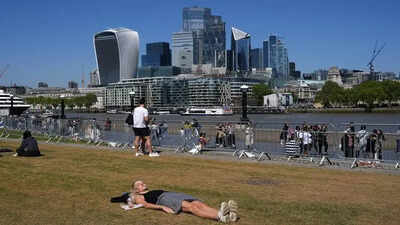
UK weather forecast: Temperatures to drop with warm spells across all regions after bank holidays
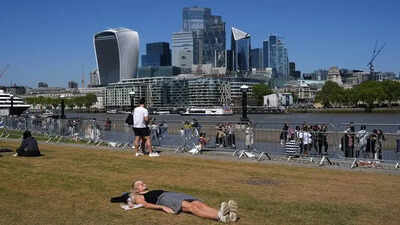
There has been a marked change in weather patterns across all regions of the United Kingdom, which will see temperatures cool in the first week of May, with maximum temperatures in England reaching around 25 °C on Friday, following a period of warm weather. Weather experts predict that the change in wind direction will bring sunshine, clouds and occasional rain as well as cooler days and frost in the mornings.According to the Met Office forecast report, which is confirmed by media reports from the BBC, the change in weather patterns reflects a trend of warmer weather to springtime variability. Meteorologists have attributed this to changes in pressure patterns and development of northern winds.Frost marked the start of Scotland’s bank holiday weekend season, with rain falling across northern parts as the weather approached. Due to clear weather in other parts, the weather became pleasant. The weather in Northern Ireland was largely dry and sunny, while in England and Wales the fog cleared early and clouds became dominant.There was some sunshine in northern England and Wales, which increased the day temperature to some extent. It remained cloudy in the southern areas and there is a possibility of rain and thundershowers at isolated places.The passage of cold air southward will result in cooler night temperatures and frost on local ground, especially in rural areas. With clear skies, nights will be cool in Scotland and Northern Ireland with the possibility of frost. Some winter rainfall is also possible in the higher plains.Cold and fog are expected to start on Tuesday and most of the northern and central parts of the country will see sunshine and occasional rain. Wednesday is expected to be the coldest day of the week due to strong northerly winds, bringing cool days and isolated showers.Warm weather will arrive on Thursday due to a southerly flow which will bring light winds. However, strong winds and persistent rain could affect Scotland, while other parts of the country will see sporadic showers during the day. The next day will see neutral weather conditions with no dominant pressure system, but some rain.Based on weather models, there is a sign that a low pressure may form over the southern region this weekend, which will favor more rainfall in areas that have seen little rain recently.
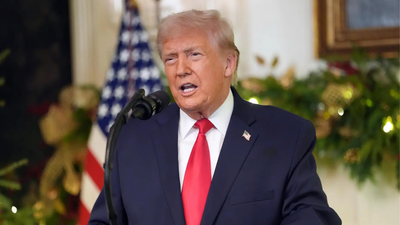
‘Force vs. Geography’ Trump’s Project Freedom meets Iran’s remaining firepower
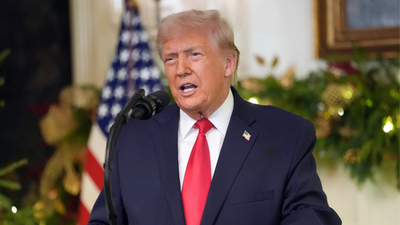
TOI correspondent from Washington: The United States and Iran are on the verge of resuming their shooting match in the Gulf after Tehran attacked the UAE with drones and missiles in response to US efforts to militarily rescue stranded ships in the Strait of Hormuz under “Project Freedom”.“In a high-stakes gambit that blends humanitarian rhetoric with hard power signaling, US President Donald Trump on Monday initiated a Washington-led move to move commercial ships out of the choppy waterway under protective US cover. But when Tehran attacked the UAE’s Fujairah province, it was forced to take defensive measures against incoming missiles and drones, as the power move was met with remaining Iranian firepower. The US, for its part, claimed that two merchant ships had passed through the strait but Iran rejected the claim, saying it had full control over the strait. The tit-for-tat announcements come amid a two-month-long conflict in the Gulf that has blocked one of the world’s most vital oil arteries and rattled global energy markets – and the US. Domestic politics – in a reversal.The competition for control of the Strait of Hormuz has now turned into a stark reality: the US clearly commands superior military power, but Iran appears to be dictating the terms of engagement, with clear warnings from Tehran revealing a situation where geography and asymmetric strategy are blunting Washington’s power, forcing it to work within the red lines set by its rival. What the US has portrayed as independence is being seen as provocation by Iran as both sides headed down a slippery path to renewed fighting on Monday. Earlier, defining the operation as humanitarian intervention, Trump said neutral countries had appealed to Washington to help free ships “locked” in the strait, many of which lacked food and essential supplies. The US will “safely escort its vessels out of these restricted waterways,” he said, warning that any interference “will have to be dealt with forcefully.” The operation, which began Monday morning Middle East time, was presented as a goodwill gesture – including to Iran – even if it had unmistakable coercive undertones.But Project Freedom had a hesitant start at the grassroots level. Shipping through the strait remained difficult, with most ships opting to use the Iranian-controlled traffic separation scheme instead of the US-proposed corridor near Oman. Shipping officials said the plan lacks operational clarity and it is unclear whether it is sustainable, with industry concerns that without Iranian coordination, any large-scale transit risks rekindling hostilities. Tehran’s attacks on the UAE within hours of the US move showed that fears were not unfounded. In strictly military terms, the US retains overwhelming superiority. The U.S. Navy could deploy forces across the Gulf with carrier strike groups, surveillance systems, and associated bases. But geography – and politics – complicate that advantage. Iran’s proximity to the strait, combined with its arsenal of coastal missiles, drones, and fast-attack craft, gives it effective control over the dynamics of escalation. Even limited harassment could halt commercial shipping, as insurers raise premiums and companies refuse to risk multimillion-dollar ships.Shipping companies, for their part, are voting with their hearts out: Most are staying out. Officials say Trump’s assurances fall short of the security guarantees needed to restart transit. Without a comprehensive agreement – ideally involving Iran – insurers are unlikely to underwrite voyages through the strait. The result is a disruption that will have a global impact, disrupting markets from Asia to Europe.In America itself, the crisis is hitting kitchen-table economics. Gas prices nationwide have risen to an average of $4.46 per gallon, up from $2.98 before the conflict – an increase of nearly 50 percent. Analysts have warned that if the hurdle persists, prices could cross $5.The spike is putting intense pressure on Trump, who has made energy affordability a central political message. The president has responded with a mix of external appeals and strategic pressure, repeatedly asking China and NATO allies to help reopen the waterway, whether by pressuring Iran or contributing naval assets.Critics argue that the administration’s approach has been reactive and lacks a coherent end game. Some lawmakers are questioning whether Project Freedom risks embroiling the US in a broader conflict without Congressional approval, while others argue that the President has little choice but to take action to stabilize global energy flows.However, Trump has maintained a defiant tone that the operation is both necessary and limited. He has pointed to “very positive discussions” with Iran as evidence that diplomacy is still in play, even as he stressed a willingness to use force if necessary.

’20 years on H-1B’: Big controversy over Indian man’s viral post about not being able to see his dying mother

A major controversy has arisen over the viral post of Indian technologist Gautam Dey, in which he regretted that he could not go to meet his dying mother for the last time due to delay in visa stamping.
After Gautam Dey’s LinkedIn post on how he could not come to India to see his dying mother for the last time due to embassy issues, a huge controversy erupted as many said that he should have opted to bring his mother back home instead of staying in the US. Many social media users questioned how he had been living in the US with his family for 20 years on the H-1B visa program – and why he was expecting anything more when he knew his life in the US was temporary and when it came to such an important situation he chose money. However, many experts, including Indian-origin entrepreneurs, stood by Dey and said that the reaction was unfair as there could be many reasons for Dey not getting a green card.Immigration policy analyst Sam Peek said, “If America is no longer a place where people feel empowered to be the best versions of themselves while celebrating, struggling, and mourning, then it ceases to be not only a land of opportunity, but also a land of respect and purpose.”Indian-origin entrepreneur Vijay Thirumalai called out MAGA, asking Dey why he has not become a permanent resident in the US in 20 years. Describing the incident as ‘overall very sad’, Thirumalai posted, “All those talking about why he did this, H1B is a dual intent visa (dual intent to work and last way to go to GC) which is now in a mess due to archaic country border.” He also cited other reasons why it was a difficult choice for Day.Tirumalai posted, “So all the MAGA people preaching on what H1Bs should and shouldn’t do, stop preaching and go after illegal immigrants and not after honest, tax paying Indian H1Bs, because once they decide they are doing that, all the equity you have built in your comfortable homes, all the technological dominance and everything else will collapse.”
‘You chose money over mother’
Gautam Dey, in his heartfelt LinkedIn post, wrote that he could not go to India as he could not get a visa stamping appointment in India. He said he had sent hospital documents to the Consulate explaining how important it was for him to come to India but even after trying for 26 days he could not get an appointment and his mother passed away. If he travels to India without an appointment for visa stamping, he will not be able to re-enter the US and will have to wait in India for months for a slot to open up.Thousands of H-1B visa holders traveling to India last December were stuck in their home country as all visa slots were rescheduled and even now, no new slots have opened.“You don’t have to measure success just by leaving home. Because no dream of a career should ever put you in a position where you have to choose between your mother’s last moments and the future of your children. I have lost that choice. And I will bear that pain forever,” Day said, only to be criticized by users that he chose money over his mother herself.

Peter’s comedy show bomb suspect Omar Majid ordered to leave court after outrage

English comedian Peter Kay
A 19-year-old accused of spreading bomb hoaxes at Peter’s comedy show was removed from court after repeatedly disrupting proceedings. Omar Majid was taken to cells mid-way through a brief hearing at Birmingham Magistrates’ Court on Monday after failing to follow the judge’s instructions.District Judge Michelle Smith, appearing via video link, repeatedly instructed Majid to remain calm and remain seated. However, when he objected to the proposed bail conditions and described them as “not acceptable”, he was thrown out before the end of the hearing.Majeed, of Saltley, Birmingham, is accused of giving false information to police about the presence of a bomb at the venue.Prosecutors alleged that he signaled to a police constable and others that an explosive device might have been left inside the field.He did not enter any plea during the hearing and was remanded in custody. The court ruled that due to the seriousness of the case it was necessary for him to be tried in the Crown Court, where he is due to appear in June.The court heard that the incident had “serious consequences”, as around 13,000 people were expected to attend the event. Authorities ordered a complete evacuation of Birmingham’s Utilita Arena, which can seat more than 15,000 spectators.Police later confirmed that an extensive search did not find any suspicious items, and described the evacuation as a precautionary response to a perceived threat.Comedian Peter Kay was forced to abandon his performance on Friday evening about 45 minutes after taking the stage. Eyewitnesses said that two men approached them in the middle of the show, before they were immediately escorted out.Initially, many in the audience believed that the interruption was part of the acting. However, the situation soon became clear as announcements were made and venue lights were switched on, allowing a controlled evacuation to begin.Video circulating online showed a large crowd leaving the ground while police vehicles arrived at the scene. Despite the scale of the response, officials later confirmed that the site was safe.The canceled show was part of Peter Kay’s “Better Late Than Never” national tour, with proceeds going to several cancer charities. Organizers said ticket holders will be contacted with further updates. Police investigation into the incident is ongoing.
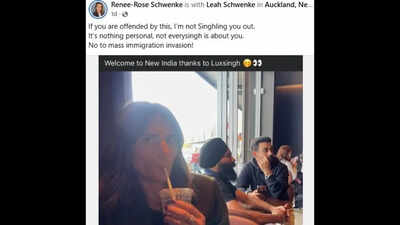
It wasn’t racist: New Zealand woman says police came to her home for ‘Welcome to New India’ FB post
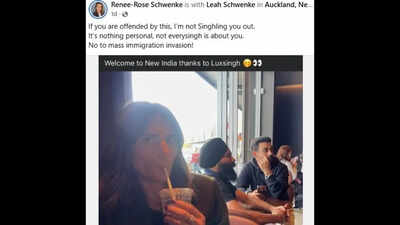
New Zealand woman says police were searching for her because of her Facebook post ‘Welcome to New India’.
Renee-Rose Schwenke, a New Zealand woman, has claimed that after she posted a picture on Facebook with the caption ‘Welcome to New India’, police knocked on her door and accused her of racist attitudes. It was a picture of her with two Indian looking men in the background. But the post was a jibe at Prime Minister Christopher Luxon who recently signed a free trade agreement with India. The post read, “Welcome to New India, thanks to Laxsingh”.Schwenke said the Facebook post, which she does not consider racist, was flooded with derogatory comments from Indians and the post was eventually reported to police, who tracked it down.He wrote, “The police called me in relation to my ‘racist’ post. This was not to threaten or incite violence. I was called to the police station by a senior sergeant to tell me that my post was cruel and ‘racist’, which was unwelcome to the Indian community.”“He had to walk away from us twice because he was being pushy because of his personal views and couldn’t handle a little pushback and the truth instead of behaving as a professional. This is what happens when you live under the soft tyranny of angry people. I will not silence my views to accommodate your feelings.”The woman also shared a recording of a female policeman calling her mother, who was looking for her, in connection with her social media post. The policeman said they were planning to come to her house “in relation to some posts that she was putting online, which people basically didn’t take that well, so they have made some complaints to the police”.“I regularly receive death threats for my views and beliefs, I’ve been called every kind of racist, transphobic, Islamophobic name but somehow I’m wrong. This world is upside downGood is now evil and evil is now good,” the woman doubled down.Schwenke re-shared his post and said: “If you’re offended by this, I’m not singling you out. This is nothing personal, not every lion is about you. No to the mass immigration invasion!”

Plane hits truck while landing at Newark Airport, heartbreaking dashcam video shows what happened

Moments before the plane collided with a truck near Newark Airport, a loud engine noise confused the truck driver.
Heartbreaking dashcam video captured the exact moments a United Airlines flight landing at Newark Liberty International Airport collided with a streetlight and a tractor-trailer on a nearby highway in a bizarre accident Sunday. A Boeing 767 was flying from Venice, Italy to Newark with more than 200 passengers and 10 crew members on board. The truck driver suffered injuries but not life-threatening injuries and the plane landed normally and no one was injured.CNN reported that a preliminary investigation blamed the crash on the plane’s landing gear and the plane’s undercarriage tire, after it first hit a pole and a tractor-trailer. After this the pole hit a jeep.“The driver of the tractor-trailer suffered non-life-threatening injuries and was taken to an area hospital,” New Jersey State Police spokesman SFC Charles Marchan said in a statement.Chuck Paterakis, senior vice president of transportation for Schmidt’s Bakery and co-owner of H&S Family of Bakeries, told CNN that the truck driver, identified as Warren Bordley of Baltimore, was heading north on the Turnpike to deliver bread products to the Newark Airport depot.Dashcam video from the truck showed Bordley singing seconds before the plane’s landing gear tires hit the truck. The driver got confused due to the loud noise of the plane’s engine. The next moment, only shards of glass were flying.CNN reported that according to recordings of air traffic control communications captured by LiveATC.net, the pilots and air traffic control were not aware that the plane had struck a light pole upon landing. The 767 was instructed to taxi to the gate as other aircraft continued to land on the same runway. According to another recording from LiveATC.net, air traffic controllers reported “a hole in the side of the airplane” to an operations vehicle preparing to inspect the runway about half an hour after landing.“The aircraft landed safely, transported normally to the gate, and no passengers or crew were injured,” United said. He said the plane’s crew has been removed from service pending investigation.
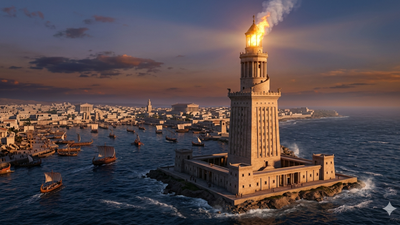
Lost wonder found underwater? 80 tons of stones revealed the secret of Alexandria’s lighthouse. world News
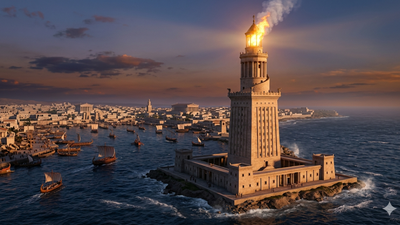
The discovery under the sea of huge stone blocks weighing 80 tons, considered part of the Lighthouse of Alexandria, one of the wonders of the ancient world, has aroused interest in the study of ancient engineering, maritime archeology and the history of the Mediterranean region. Found on the floor of Alexandria’s eastern port, these massive architectural fragments, including lintels, gateways and paving stones, provide valuable information on the structure, degradation and methods used in the construction of this massive lighthouse. Through research initiatives such as PHAROS, scientists are studying the lighthouse through photogrammetry, computer reconstruction, and stone analysis.
Scientists have discovered 22 huge stones related to this Pharos of Alexandria
The existence of the sunken remains of the Pharos of Alexandria has been known for decades, but only recently has it been possible to make many more discoveries. Dassault Systèmes’ The team managed to find 22 huge stone blocks, each weighing about 70 to 80 tonnes. Details such as the door lintel, threshold stone and huge stones indicate that they formed the entrance to the lighthouse. takes place within the framework of the current investigation Pharos Project Organized by scientists from the Center National de la Recherche Scientifique (CNRS).As Isabelle Héry, the mission’s lead archaeologist, said, the fragments of the lighthouse should be analyzed as puzzle pieces, allowing digital reconstruction of the monument. Thus, the present discovery is considered a breakthrough in underwater archeology as it helps in uncovering the secrets of ancient architecture.
Lighthouse of Alexandria: one of the seven wonders
The Lighthouse of Alexandria, called the Pharos, was built during the reign of Ptolemy II Philadelphus in the 3rd century BC. It was over 100 meters high and served as a navigation aid that facilitated the safe docking of ships in the busy Egyptian port. For many years, the lighthouse was considered one of the tallest buildings ever built by man and an example of Hellenistic architectural excellence. It is believed to have three levels, including square, octagonal and cylindrical shapes.However, several earthquakes from the 10th to the 14th century contributed to its destruction, causing much of the building to fall into the water. Thus, the discovery of these huge rocks is related to the written record on the decline of the lighthouse.
Marvels of Engineering: How the Ancient Builders Moved 80 tons of stones
An interesting aspect of this discovery is the weight and precision of the carved stones. Even in modern times, transporting stones weighing approximately 80 tons is a difficult task, raising many questions on the engineering capabilities of ancient civilizations.According to experts, the use of leverage, ramps and manpower would have allowed ancient individuals to transport and install these heavy stones. It also brings to mind architectural elements from Greece and Egypt, an indication that there was fusion between the cultures.The level of precision displayed in the stones, as well as the incorporation of the stones into large-scale structures, shows how sophisticated the engineering skills of ancient civilizations were.
Digital reconstruction and the way forward
Instead of building an exact replica of the lighthouse in reality, the new approach involves building a digital replica of the lighthouse. With modern technology, each stone is scanned and used in a digital reconstruction of the lighthouse.In addition to being useful in determining whether certain theories about the lighthouse’s construction or fall are true, it gives historians and those interested in history the opportunity to see this marvel of engineering in all its glory.To summarize, although the discovery of eighty tons of rocks confirms the existence of the structure, there is another extremely important factor; It’s a reminder that traces of our imagination and innovation lie beneath the surface of the ocean.