
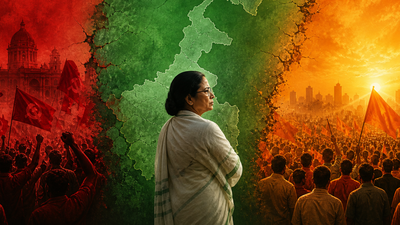

From red to green to saffron? BJP is eyeing a change of power in Bengal as Mamata is saving her ground. india news
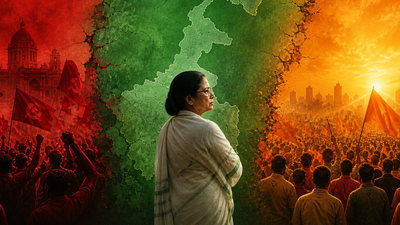
New Delhi: The Bengali ‘Manush’ have traditionally displayed deep-rooted political loyalty, often uniting decisively behind a single political force and allowing it to rule for long periods. In the nearly eight decades since independence, West Bengal’s political journey has not been merely a sequence of changing hands of governments, but a story taking shape in clear, influential eras, each of which has been marked by ideological conviction and long mandates.However, the 2026 assembly elections have injected a new intensity into this legacy. What is unfolding is not just another election contest, but a high-stakes, high-voltage battle between the long-serving Chief Minister Mamata Banerjee and a determined, aggressively expanding Bharatiya Janata Party brigade.
Didi’s 15-year rule is facing its toughest challenge yet. BJP has waged a relentless, grassroots campaign, deployed its top leadership and stepped up its attacks Trinamool Congress. The high command of the saffron party has even said that “the sun has set for TMC in Bengal.”But to understand the weight of BJP’s claim, the story of how Bengal’s political journey evolved has to be told.
Congress Era: Foundation of power and post-partition reconstruction
Like most states in newly independent India, the early political leadership of Bengal was shaped by the Congress. Bidhan Chandra Roy, one of the most important icons of the state’s history, became its first Chief Minister at a time when Bengal was struggling with the devastating effects of partition in 1947.Bidhan Chandra’s leadership extended beyond regular rule. He played an important role in stabilizing a fragmented society and laid the foundation of the administrative and infrastructure of modern Bengal. Among his lasting contributions was the development of Salt Lake City, a planned township that epitomized visionary urbanization.Kolkata, then Calcutta – was not only the state capital but also a political center for the Congress Party. The city hosted several historic sessions of the party over the decades, becoming a stage for defining moments of India’s freedom struggle and political evolution. From the first singing of Vande Mataram to the declaration of Swaraj, Bengal remained at the center of Congress.However, the dominance of the Congress gradually began to wane. Internal divisions, changing political aspirations and turmoil at the national level weakened its hold. The emergence of the Bangla Congress marked the first serious crack in its monopoly, introducing coalition politics and opening the door to alternative ideologies.The death of strong national leaders like Jawaharlal Nehru and Lal Bahadur Shastri further destabilized the party’s structure and its influence. The 1967 elections, often described as a “political earthquake”, dealt a decisive blow to Congress dominance in Bengal.
Red Age: rise and consolidation of left Effect
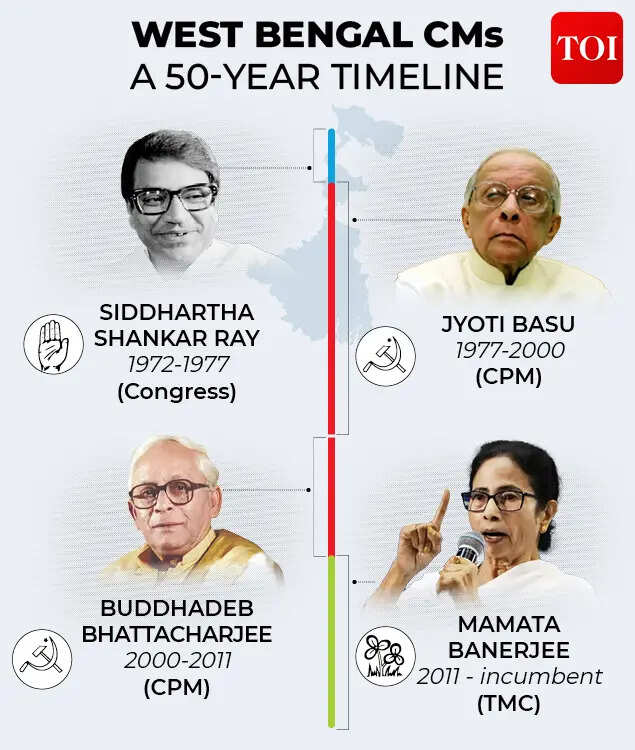
Even as Indira Gandhi consolidated her political dominance at the national level, especially after the 1971 election victory and the India–Pakistan war, Bengal was moving in a different direction.The Congress continued to lose in the state and its last Chief Minister to date, Siddhartha Shankar Ray, represented the end of an era. The political void was quickly filled by the Left Front, which came to power in 1977 on the back of strong grassroots mobilization and ideological clarity.At the center of this change was Jyoti Basu, a stalwart Marxist leader who went on to become one of India’s longest-serving chief ministers. Under his leadership, Bengal saw a profound restructuring of its rural and administrative systems.Major initiatives such as Operation Barga redefined land relations by strengthening the rights of sharecroppers, while the institutionalization of the Panchayati Raj system in 1978 decentralized governance and empowered local bodies. These reforms created a durable political base for the left.The Left Front ruled Bengal uninterrupted from 1977 to 2011, one of the longest tenures for any democratically elected communist government in the world. By 2000, Basu stepped down due to health reasons and handed over the command to Comrade Buddhadeb Bhattacharjee. While Bhattacharjee attempted to recast the Left’s image by focusing on industrialization, the ground reality had begun to change. Discontent was growing and a new political force was gaining momentum under the leadership of Mamata Banerjee.
Mamata Moment: Disintegration and Domination
Mamata emerged as a new strong leader in the state.Emerging as a fierce and persistent challenger, Mamata ended the Left’s decades-long dominance in the 2011 assembly elections. Leading the Trinamool Congress, she secured a sweeping mandate of 184 seats and became the first woman Chief Minister of Bengal.
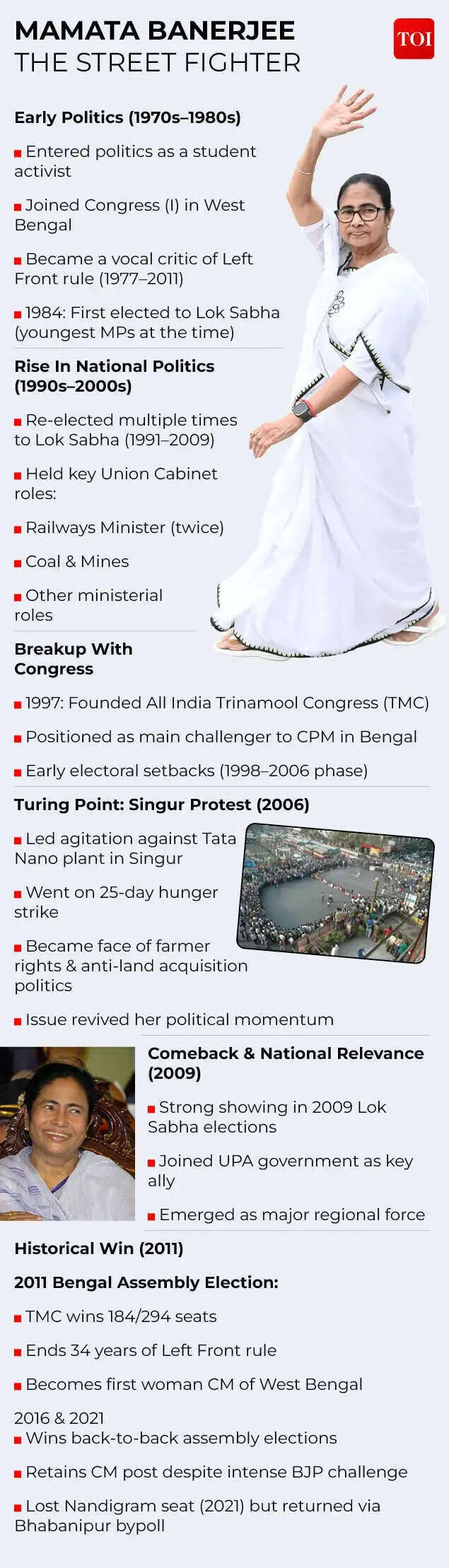
His victory marks not only a change in government but also a complete political reset. The Congress and the Left, once the major forces in the state, were pushed to the margins. Despite ruling at the Center for almost 6 years under the leadership of Atal Bihari Vajpayee, the BJP remained an insignificant player in Bengal politics at that time.In 2016, Mamata further strengthened her hold and returned to power with an even bigger mandate, crossing the 200-seat mark. At this stage, their dominance appeared unquestioned, with opposition forces scattered and struggling to regain relevance.His style of governance, welfare reach and strong personal connect with the voters ensured that the Trinamool Congress remained the central pole of Bengal politics.
Rise of BJP: From marginal to formidable force
The political balance began to shift dramatically in 2021.The BJP launched an unprecedented campaign in Bengal under the leadership of its stars Prime Minister Narendra Modi and Union Home Minister Amit Shah, who is also considered “Chanakya” for the saffron party. The scale, intensity and resources deployed marked a new phase in the electoral politics of the state.While Didi retained power, the BJP’s performance indicated a major success. Winning 77 seats in the 294-member assembly, the party emerged as the principal opposition, defeating both the Congress and the Left.In fact, the strong rise of the BJP pushed the Congress and the Left parties to insignificant margins.This increase was significant not only numerically, but also symbolically. A party that was once struggling to make electoral inroads in Bengal has now established itself as the primary challenger to the ruling establishment led by TMC supremo Mamata.
2026 Showdown: Continuity or Change?
Now, as Bengal records the highest-ever voting percentage and sees an intense, high-decibel campaign, the stakes have never been higher.Is the state signaling change? As the BJP leadership claims, has “the sun set on TMC in Bengal”?Furthermore, the traditional notion of high voter turnout was interpreted as an undercurrent against the incumbent.The contest has increasingly assumed a bipolar character, squeezing out other political players and turning the election into a direct face-off between the Trinamool Congress and the BJP.Buoyed by its victory in 2021, the BJP has also fielded a huge number of candidates in TMC’s traditional strongholds like Bhawanipur and other constituencies in south Bengal. As a clear message – no seat is being given without a fight.Many pollsters have also given BJP an edge over Mamata’s TMC in their exit poll predictions. This could be the first sign of uneasiness for Didi. Poll of polls predicted that TMC will no longer be the single strong and leading force as it has been taken over by BJP. In 2021, Mamata faced her former ally and BJP leader Suvendu Adhikari in Nandigram and suffered a rare personal defeat, even as she retained power across the state. This time, the dynamics appear more complex, with both sides in a strong contest from Bhavanipre.The elections also saw a massive administrative exercise, including a special intensive vetting process that Mamata criticized but the Election Commission defended, adding another layer of political tension.Will it continue its long-term tradition of supporting a major power, or embrace change and write a new chapter?The answer to this question lies with Bengali ‘Manush’.