

Iran’s missile map decoded: Who falls within its extended strike range?

New Delhi: Iran’s missile arsenal has emerged as a cornerstone of its military doctrine, giving Tehran the ability to project power across the Middle East and shape the trajectory of any conflict. Built steadily over the past three decades, the program spans short-range tactical systems to long-range ballistic and cruise missiles, creating a layered strike capability that complements the country’s aging air force.The range of these missiles is not just a technical detail. It defines the geography of the conflict, sets out potential targets and outlines Iran’s strategy of deterrence. From nearby Gulf bases to Israel and beyond, the range of Iranian missile reach continues to influence military calculations throughout the region.
Short-range missiles: immediate battlefield dominance
At the lower end of the spectrum are short-range ballistic missiles, which typically have ranges between 300 km and 800 km. These systems form the first layer of Iran’s strike capability and are designed for rapid deployment against nearby targets.Missiles like Fateh-110, Zolfagher, Qiyam-1 and Shahab-1 and Shahab-2 fall in this category. Their relatively short range provides a tactical advantage. They can be launched quickly, often in large numbers, reducing warning time for adversaries and increasing the possibility of overwhelming air defense systems.This class of missiles is particularly suitable for targeting US military bases, naval assets, and regional infrastructure in the Gulf. Their role is to deliver the “first punch” in any stress situation, giving a signal while causing immediate damage.Iran demonstrated this approach in January 2020, when it launched ballistic missiles at Iraq’s Ain al-Asad airbase following the assassination of General Qassem Soleimani. The attack caused significant damage and injuries, demonstrating Iran’s ability to deliver precise strikes without relying on conventional air power.
Medium-range missiles: expansion of the strategic map
The second layer of Iran’s missile arsenal consists of medium-range ballistic missiles, which typically have a range between 1,000 km and 2,000 km. This category marks the shift from tactical warfare to strategic deterrence.Major systems include Shahab-3, Imad, Ghadar, Sejjil and Khorramshahr. These missiles significantly expand Iran’s strike range, bringing a wide network of military facilities linked to Israel and the US within reach. All bases in Qatar, Bahrain, Kuwait, Saudi Arabia and United Arab Emirates come under this scope.Among these, the Sejjil missile stands out due to its solid-fuel propulsion. Unlike liquid-fuel missiles, which require more time to prepare, solid-fuel systems can be launched more quickly, increasing survivability in a conflict where pre-emptive attacks are a constant threat.This layer effectively turns any conflict with Iran into a regional issue. This ensures that escalation cannot be limited to a single battlefield, as multiple countries fall within the range of retaliation.
Long distance systems: outer limits of reach
Iran’s longest-range missiles are estimated to reach between 2,000 km and 2,500 km, forming the outer limits of its publicly known capabilities. Advanced versions of the Shahab series, systems such as the Sejjil and Khorramshahr operate in this range band.Apart from ballistic missiles, Iran has developed cruise missiles like Soumar, which can cover a range of up to 2,500 km while flying at low altitude. These missiles are difficult to detect and intercept, especially when used in conjunction with drones or ballistic systems.The geographical implications of this category are very deep. The 2,000 km radius from Iran covers not only Israel and the Gulf but also parts of Southeastern Europe, Central Asia and North Africa. This allows Tehran to put at risk a broad spectrum of military and economic targets, including ports, energy infrastructure and airbases.However, despite reach, Iran’s missile capability does not extend to the continental United States. This limitation underlines that Tehran’s strategy focuses on regional dominance rather than global strike capability.
Attempt to attack Diego Garcia: testing the limits
However, a recent development has raised questions about the upper limit of Iran’s missile reach. Reports of an attempted attack on Diego Garcia – a remote island in the Indian Ocean that is home to a major US-UK military base – suggest that Tehran may be experimenting with long-range capabilities.Located approximately 4,000 km from Iran, Diego Garcia is well beyond the established range of Iran’s missile systems. According to available information, two missiles were reportedly fired towards the island, although neither successfully hit the target.Although this effort was not successful, its implications are important. This points to either an experimental expansion of Iran’s missile technology or a strategic signaling effort aimed at deterring Western forces by demonstrating intent rather than proven capability.If Iran develops reliable systems capable of reaching such distances, it would fundamentally alter the strategic balance, giving it access to the Indian Ocean and potentially parts of Europe and the Indo-Pacific.
Geography of Threat: A Layered Coverage
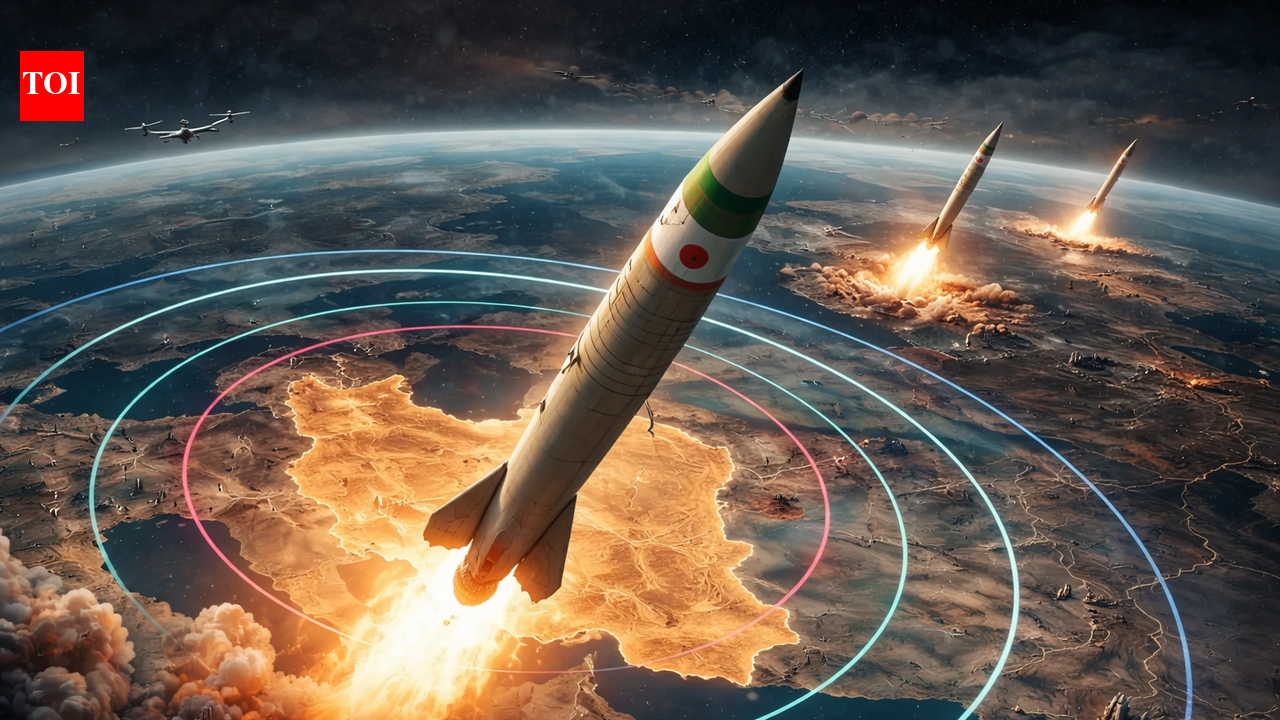
Image of Iran’s missile range shows a layered pattern of concentrated reach. Short-range systems dominate the near-neighborhood, covering the Persian Gulf and adjacent states. Medium-range missiles extend this reach to Israel and deep into West Asia, while long-range systems push the range outward to cover an even wider arc.This layered structure ensures that Iran can respond simultaneously at multiple ranges. It also complicates defense planning for adversaries, who must account for threats coming at different ranges, trajectories, and speeds.In practical terms, this means that no major US military installation in the Gulf region is beyond Iran’s reach. Energy infrastructure, shipping lanes and urban centers are also at great distances throughout the region.
Volume and Survival: Beyond Limits
While range defines reach, Iran’s missile strategy is equally dependent on quantity and survivability. The country has invested heavily in underground facilities, often referred to as “missile cities”, where weapons are stored and prepared for launch away from surveillance.Mobile launch platforms further increase flexibility, allowing missiles to be fired from multiple locations. This dispersion makes it difficult for adversaries to neutralize Iran’s arsenal in a single preemptive strike.Joint tactics—the use of ballistic missiles, cruise missiles and drones—adds another layer of complexity. Drones can be used to satiate air defenses, while cruise missiles fly low to avoid detection, and ballistic missiles strike at high speed.This integrated approach increases the likelihood that at least some weapons will penetrate defensive systems, thereby ensuring that Iran will retain a credible retaliatory capability.
Strategic Implications: Resistance and Escalation
Iran’s missile range is central to its deterrence strategy. By demonstrating the ability to strike across a wide geographic area, Tehran wants to discourage adversaries from launching attacks or escalating conflicts.Additionally, this capability increases the risk of any collision. The broader the scope, the wider the pool of potential targets, increasing the risk of a regional conflict escalating into a major war.The attempted attack on Diego Garcia, although unsuccessful, underscores this dynamic. This indicates that Iran may be willing to expand the geographic scope of its operations, challenging perceptions about the limits of its reach.Iran’s missile program is not just about weapons – it is about shaping the battlefield. From short-range systems designed for immediate impact to long-range missiles that define regional power projection, the extent of Iran’s arsenal determines how conflicts unfold.As tensions persist, this limit ensures that any military involvement involving Iran will not remain limited. Instead, it would apply across a vast and interconnected region, where distance offers little protection and escalation has far-reaching consequences.