
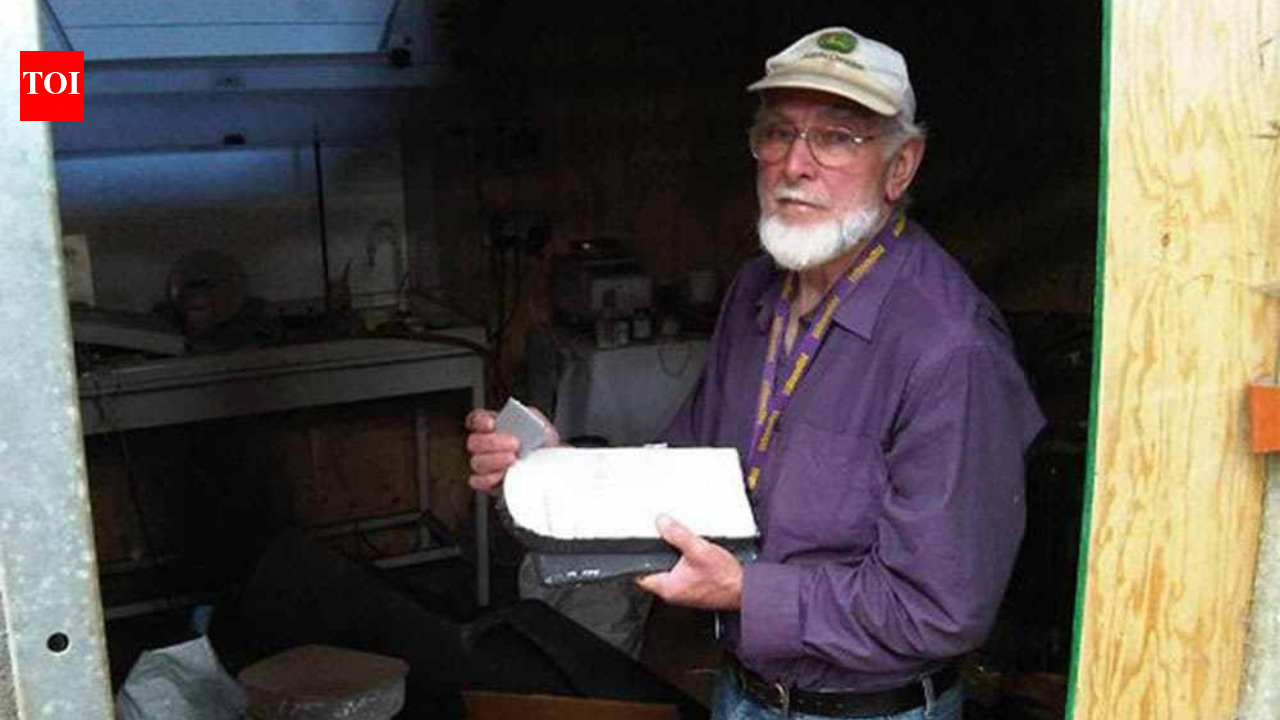

Meet Maurice Ward: the hairdresser who invented ‘anti-nuclear’ material and took his secret to the grave.
In an era dominated by institutional science and billion-dollar laboratories, an unlikely man from Blackpool claims to have created one of the most extraordinary materials ever seen. Maurice Ward, a British hairdresser with no formal scientific training, developed a heat-resistant substance in the 1970s and 80s that seemed to defy traditional boundaries. They called it Starlight. Demonstrations showed that it could withstand intense heat and protect whatever was beneath it, attracting global attention and interest from major organizations. Yet despite its potential, the material never reached commercial use. Ward fiercely guarded his formula, rejected deals and refused to share full details, ultimately taking the secret of Starlight with him when he died in 2011.
Who was Maurice Ward?
Ward’s success came to the public eye in 1990 through Tomorrow’s World. In a now famous demonstration, an egg coated in starlight was exposed to a blowtorch flame for several minutes. When it was opened on live television, the egg inside remained raw.The performance was simple but powerful. This revealed that starlight acts as an exceptional thermal insulator, able to block heat transfer far more effectively than conventional materials. Although the test could not prove extreme scientific boundaries, it was enough to arouse widespread curiosity and intrigue.As interest grew, so did the claims about Starlight. Ward suggested that the material could withstand temperatures of up to 10,000 degrees Celsius and survive conditions equivalent to nuclear explosions. These claims soon became central to the legend of the material.However, no peer-reviewed data or publicly released test results have ever confirmed such extreme abilities. Although some testing reportedly took place, complete information was not disclosed, leaving a gap between what was shown and what was claimed.
Interest from governments and aerospace giants
Starlight’s ability has not gone unnoticed. Reports indicate that organizations such as NASABoeing and the UK defense establishment expressed interest in evaluating the material. Its potential applications ranged from spacecraft heat shields to fireproof coatings and military security systems.Yet despite this attention, no formal agreement was ever finalized. Starlight never progressed beyond testing and demonstration to real-world deployment.
The secrecy that stopped everything
At the center of the story was Ward himself. Highly protective of his invention, he refused to patent the Starlight because he feared it could be reverse engineered. He also refused to provide the full sample for independent analysis and insisted on maintaining majority control in any potential deal.This approach led to a stalemate. Without transparency or reproducibility, organizations were unwilling to invest, while Ward was unwilling to compromise. As a result, the material remained limited to demonstrations rather than development.
what starlight might have really been
Scientific observers believe that Starlight was probably a form of polymer-based ablative material. Such materials work by forming a protective char layer when exposed to heat, slowing thermal transfer and shielding the underlying surfaces.Similar principles are used in spacecraft re-entry shields and fire-resistant coatings. What made Starlight remarkable was not that it defied physics, but that it appeared to achieve impressive results using relatively simple components.
A formula lost to time
When Maurice Ward died in 2011, he left no publicly verified formula for starlight. According to his family, the recipe may exist in private notes, but no one has successfully reproduced the ingredients in their original form.In the years since, researchers and enthusiasts have attempted to recreate the starlight using available clues, with varying degrees of success. However, none have been confirmed to be identical to Ward’s version.
A legacy shaped by mystery
Starlight remains one of the most interesting “what if” stories in modern materials science. It sits at the intersection of genuine innovation and unanswered questions, its reputation shaped by performance as much as privacy.Whether it was a revolutionary breakthrough or simply an effective but overhyped ingredient may never be fully known. What is certain is that Maurice Ward’s invention attracted global attention – and its true potential, if any, was never fully realised.