

Seats less, stakes high: Is BJP quietly expanding in Kerala? | india news
New Delhi: As Kerala awaits election results on Monday, the bigger political question may not be whether the BJP can win power in the state, but whether it has begun to disrupt Kerala’s long-standing two-front system. For decades, politics in the state has been strongly bipolar, with power alternating between the CPM-led Left Democratic Front (LDF) and the Congress-led United Democratic Front (UDF). In the 140-member assembly, strictly managed vote transfer, strong cadre networks and local caste-community equations left little room for the emergence of a third force.But recent elections show that the BJP is gradually making political inroads in some parts of the state. Its first Lok Sabha victory in Thrissur in 2024, increase in vote share, lead in local body elections and growing presence in urban constituencies like Thiruvananthapuram and Palakkad have indicated a gradual change in Kerala’s electoral landscape. Although the party is still far from a statewide challenge, its strategy of focusing on select constituencies has started turning the traditional LDF-UDF contests into a triangular fight, enough to make the BJP a significant factor in Kerala politics.
Is BJP the third wheel in LDF vs UDF?
For nearly four decades, elections in Kerala followed a script that was so consistent it seemed almost structural. Every five years, power changes between the CPM-led Left Democratic Front (LDF) and the Congress-led United Democratic Front (UDF), turning the state into one of India’s most tightly sealed two-front political systems.In the 140-member assembly, contests were often decided by local equations and disciplined vote transfers, leaving little scope for a third force to gain a permanent footing.That political cycle broke in 2021. Breaking the strong pattern of Kerala’s anti-incumbency wave, the Chief Minister Pinarayi Vijayan Returned to power with an overwhelming mandate, the LDF gained 99 seats, while the UDF was pushed to 41 seats. The verdict was read not only as an endorsement of the regime during the crisis years, but also as evidence of how strongly the two-front structure dominated Kerala politics.Yet, beneath that binary, the BJP is trying to make quiet political inroads. Far from the sweeping successes achieved elsewhere, the party’s Kerala project has been incremental, focused less on immediate power and more on deepening vote share in certain constituencies, expanding organizational networks and establishing itself as a disruptive third pole in contests traditionally controlled by the LDF and UDF.
Quiet rise of BJP
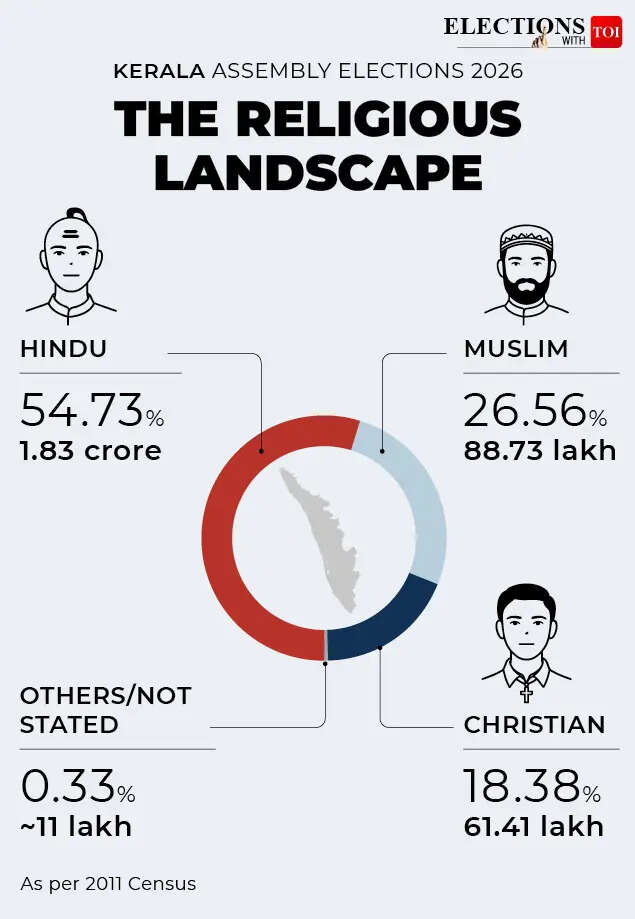
BJP’s expansion in Kerala has started moving beyond symbolism. A party that struggled for decades to gain a foothold in the state’s entrenched LDF-UDF political structure has started registering measurable gains in both vote share and representation in the last few election cycles.The turning point came in the 2024 Lok Sabha elections, when the BJP won its first parliamentary seat in Kerala through the victory of actor-turned-politician Suresh Gopi in Thrissur. Along with winning the seat, the NDA increased its vote share in the state to 19.24 per cent from 15.64 per cent in 2019, indicating that the party’s support base has expanded beyond isolated localities.This increase is in contrast to the CPM’s declining presence in the parliamentary elections. The party, which had won 12 Lok Sabha seats from Kerala in 2004, saw its seats drop to four in 2009 and five in 2014, before being reduced to one seat in both 2019 and 2024. While the Left has retained its dominance in assembly politics, the Lok Sabha results show a gradual weakening of its national-level electoral influence in the state.The BJP’s lead has also become more visible in local body elections, which are often seen as an indicator of organizational strength ahead of assembly elections. In Thiruvananthapuram, the BJP-led NDA ended CPM’s three-decade control of the municipal corporation, and emerged as the single largest front with 50 wards out of 100. The result marked one of the BJP’s most significant urban gains in Kerala and signaled a change in contests that have traditionally been bipolar.The party’s strategy has focused on expanding its presence in the constituency rather than attempting statewide success. Its gains have been concentrated in urban centers and Hindu-majority areas, while the BJP has also attempted to reach out to sections of the Christian community in central Kerala.Demographically, Hindus constitute 54.73 percent of the population of Kerala, while Muslims constitute 26.56 percent and Christians 18.38 percent. The BJP’s growth in some parts of the state has increased the pressure on the Left, especially in Hindu-dominated constituencies where triangular contests are beginning to affect the traditional LDF-UDF vote equations.
Which seats is BJP eyeing?
The BJP’s Kerala strategy is no longer focused on achieving statewide success. Instead, the party is concentrating resources on a handful of constituencies where it believes organizational growth, demographic gains and recent electoral gains can be translated into winnable contests.At the center of that strategy are districts like Thiruvananthapuram, Palakkad, Thrissur, Kasaragod and parts of Pathanamthitta – areas where the BJP has either established its grassroots presence or seen scope for social consolidation.In Thiruvananthapuram, the BJP’s confidence stems from its growing urban influence. The party-led NDA won control of the municipal corporation in 2025, ending the CPM’s decades-long dominance in the capital. The result gave the BJP a significant administrative and organizational foothold in the district where it has consistently improved its vote share in successive elections.Palakkad has emerged as another major focus area. The BJP first made inroads there in 2015, when it secured the post of municipal president for the first time in Kerala’s history – a feat it repeated in 2020 and 2025. Over the past few years, the constituency has transformed from a traditional LDF-UDF contest to a competitive triangular fight.Palakkad Assembly seat is now considered to be one of the most closely watched contests. Known as the “Gateway to Kerala”, the constituency’s urban-rural mix and proximity to the Tamil Nadu border has made it politically isolated from most parts of the state. The BJP sees Palakkad as one of the few constituencies where its cadre network, municipal presence and expanded vote base can translate into an assembly victory.
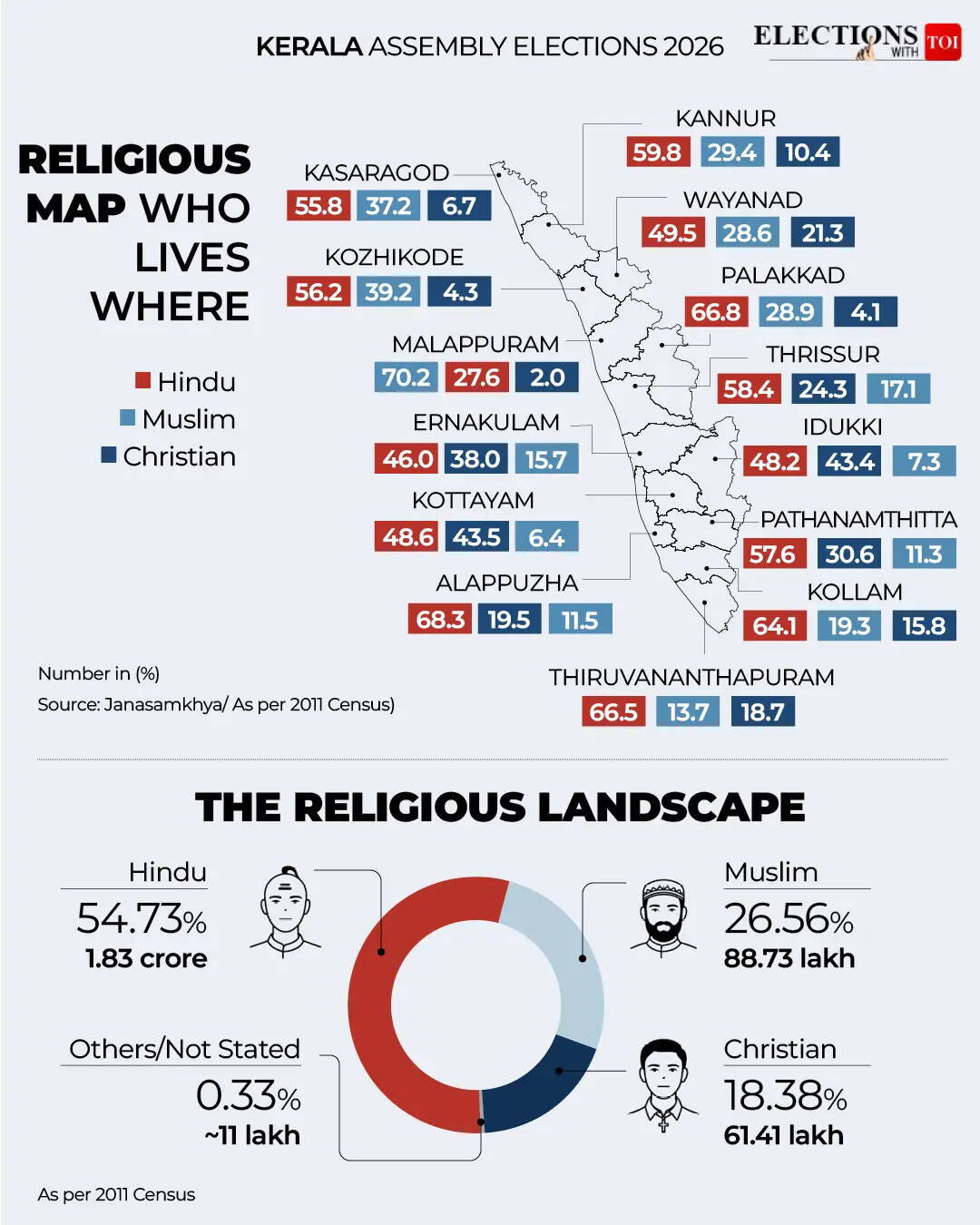
The party has fielded senior NDA leader Sobha Surendran, who had earlier emerged as a strong challenger in the constituency during the 2016 assembly elections and 2024 Lok Sabha elections. His campaign has focused heavily on infrastructure and urban development, with the BJP believing that these themes resonate with Palakkad’s rapidly growing urban electorate.Thrissur remains central to BJP’s Kerala calculations after Suresh Gopi’s Lok Sabha victory in 2024 gives the party its first parliamentary seat in the state. The victory strengthened the BJP’s belief that focused campaigns in socially mixed urban constituencies could deliver results even within Kerala’s bipolar political structure.In Kasaragod, the BJP is counting on the support of Kannada-speaking voters and its organizational proximity to coastal Karnataka, where the party has traditionally been strong. Meanwhile, Pathanamthitta remains politically sensitive due to the Sabarimala issue, with the BJP seeing the district as fertile ground for Hindu solidarity politics.Rather than spreading itself across all 140 assembly constituencies, the BJP’s approach reflects a more targeted calculation – deepening influence in a limited number of seats, creating triangular contests and gradually building durable regional strongholds.