

The politics of giving: How Tamil Nadu laid the blueprint for India’s free stuff race india news
New Delhi: It seems that politics in India is in the era of freebies, where every party gives cash or concessions before the elections. Last year, the NDA offered Rs 10,000 to over 75 lakh women in Bihar just before the elections, helping the alliance win a massive majority.Riding on this trend, AIADMK and DMK have also raised their stakes ahead of the upcoming assembly elections. In what the DMK calls the biggest financial assistance given to women in the state’s history, the government last month gave Rs 5,000 to 1.31 crore women under ‘Kalaignar Magalir Urimai Thittam’.
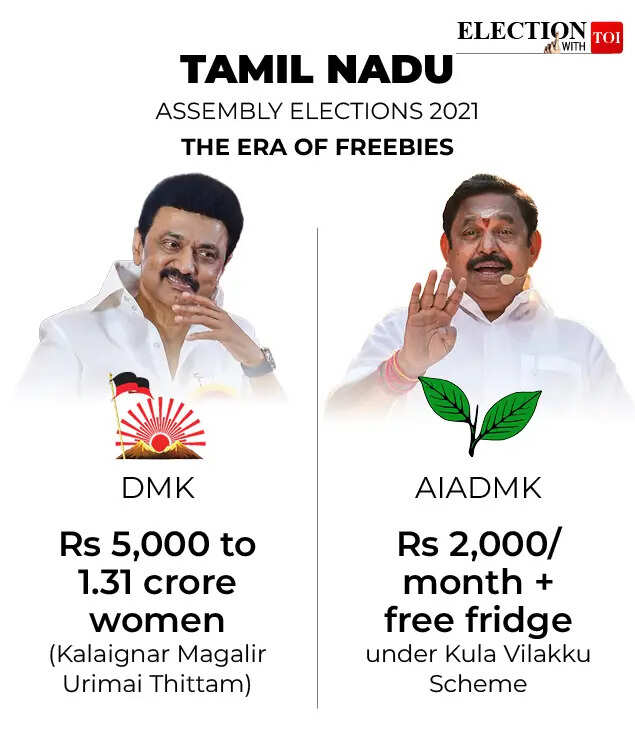
Meanwhile, the AIADMK manifesto promises to deposit Rs 2,000 per month directly into the bank accounts of women heads of families under the ‘Kul Vilakku Scheme’ for all ration card holders. The party also promised a “free refrigerator” for every rice ration-card holder if returned to power.Interestingly, this is not the first time that parties have tried to woo voters with pre-poll gifts. Welfare politics in Tamil Nadu dates back to the Dravidian movement, which established the state as an active instrument of social justice.
Congress Chief Minister K Kamaraj can be seen as the originator of populist schemes in the state. He also started free school uniform as well as mid-day meal scheme for the students.The scheme – designed to address malnutrition and encourage low-income families to send their children to school – has led to a significant increase in school enrollment and attendance, thereby reducing dropout rates.three pounds of rice for one rupeeIn 1967, CN Annadurai had promised to provide three seers of rice at Re 1 through the state public distribution system (PDS). However the scheme proved costly and difficult for the government to maintain.After winning the elections, Annadurai became the Chief Minister and implemented the scheme in some areas for some time, but later canceled it due to financial burden. However, this move established welfare as a political tool that is still used today.lunch plan experimentAIADMK founder MG Ramachandran became Chief Minister in 1977 and increased welfare measures to improve school participation. The landmark 1982 midday meal scheme, which later expanded, became one of the largest programs globally, leading to significant increases in enrollment among children from poor families.Subsequent governments led by M Karunanidhi and J Jayalalithaa built on this model, adding benefits such as free uniforms, shoes and educational assistance.
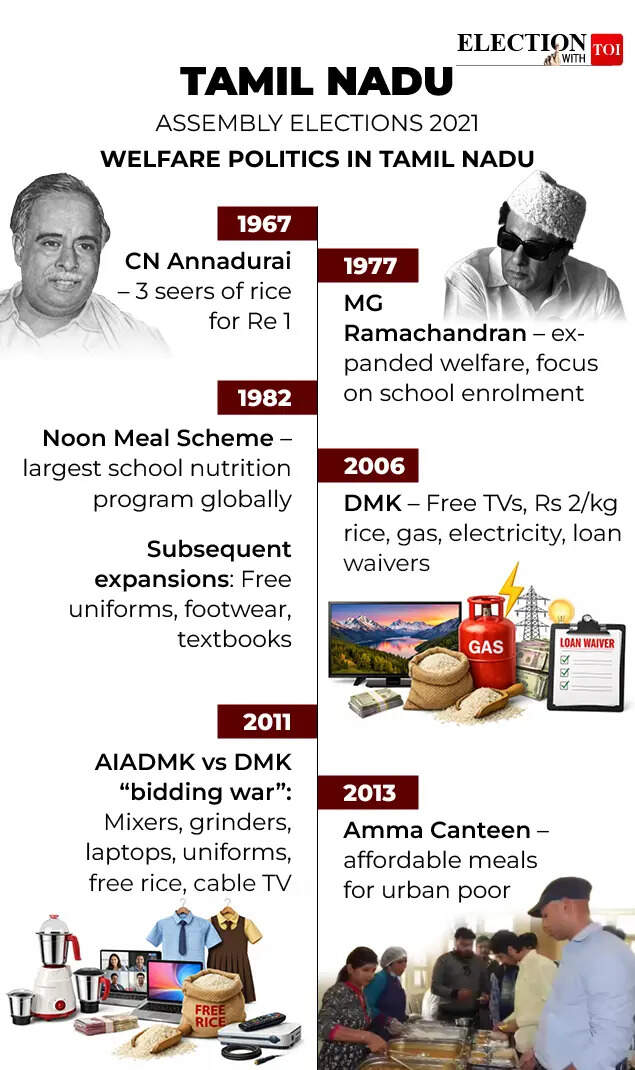
By the late 1980s and 1990s, welfare schemes also included consumer goods, reaching a turning point in 2006 when the DMK promised free color TVs, Rs 2 per kg rice, cooking gas connections, free electricity and loan waivers for farmers and weavers. The TV scheme alone cost about Rs 3,600 crore and reached about 45 lakh homes.Jayalalitha’s Amma Canteen SchemeIn 2011, the promises turned into a bidding war. DMK offered mixer or grinder, AIADMK promised both; When free laptops were offered to college students, Jayalalitha extended it to high school students as well. Additional offerings included uniforms, shoes, 20 kg of free rice per month and free cable TV.After returning to power, Jayalalitha further expanded welfare, distributing mixers, grinders, fans, laptops, textbooks, goats and cows, gold for mangalsutras, subsidized scooters and free electricity up to a specified limit to rural families.Jayalalitha’s government also launched the Amma Canteen Scheme in 2013. These canteens were designed to provide nutritious, hygienic food to the urban poor, daily wage laborers and students at deeply subsidized prices. Despite political changes in the state, canteens have continued to operate on a large scale due to their immense popularity and the essential service they provide to the working class.By 2016, the DMK promised Rs 7 per liter milk, while the AIADMK promised farm loan waiver, 100 units of free electricity, two-wheeler subsidy for women and gold for would-be brides.Development of social service schemesNow, social justice schemes seem to be shifting towards cash transfers and universal benefits. DMK’s free bus travel for women, launched in 2021, saw 4-5 crore trips monthly, improving mobility for low-income women.The AIADMK has now proposed to extend such benefits to men as well and give Rs 2,000 per month to female household heads.However, the fiscal question cannot be ignored. Tamil Nadu is not a poor state, but it cannot do fiscal magic. The state has long touted borrowing as productive and linked to development – an argument that can more easily support schemes like subsidized breakfast and bus travel than promises like a refrigerator for every ration-card holder.Such plans have substantial fiscal implications. Reportedly, monthly cash transfers alone could cost around Rs 36,000 crore annually, while Tamil Nadu’s total welfare expenditure is already between Rs 45,000-50,000 crore per year. The state’s outstanding debt is over Rs 8 lakh crore, of which the annual interest payment is around Rs 40,000 crore.Voting for all 234 constituencies in Tamil Nadu will be held in a single phase on April 23, with counting taking place on May 4.