

Trump: ‘Over 7,000 targets attacked’ Donald Trump says Iran has been ‘literally wiped out’ as he pressures allies to help reopen the Strait of Hormuz.
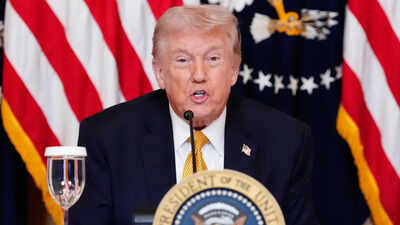
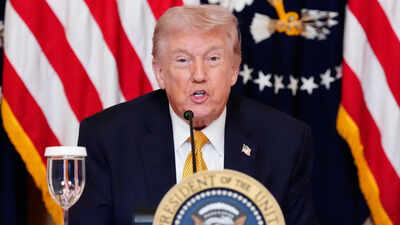 donald trump Claiming on Monday that the United States has “virtually destroyed” Iran’s military capabilities, he said US forces have attacked more than 7,000 targets across the country since the beginning of the conflict, even as he urged other countries to join efforts to secure shipping through the Strait of Hormuz.Speaking before a meeting with the Kennedy Center Board of Trustees, Trump offered one of his most comprehensive assessments of the US-led campaign against Iran, declaring that Tehran’s air force, navy, air defense and command structure had been devastated.Trump said, “Our powerful military campaign to eliminate the threats posed by the Iranian regime has been continuing in full force for the last few days. They have been virtually destroyed. The Air Force is gone. The Navy is gone. Many, many ships have been sunk.”“They are battlecruisers, anti-aircraft guns have been destroyed, their radar is gone and their leaders are gone. Other than that, they are doing quite well,” he said.
Trump claims over 7,000 US strikes, huge decline in Iranian strikes
Trump said the US has struck more than 7,000 targets across Iran since the war began, targeting both commercial and military sites, and claimed the operation had sharply reduced Tehran’s offensive capabilities.Trump said, “Since the beginning of the conflict, we have struck more than 7,000 targets throughout Iran, and these were mostly commercial and military targets. We have achieved a 90 percent reduction in their ballistic missile launches and a 95 percent reduction in drone strikes.”He said the US has also attacked facilities involved in missile and drone production.“We have also attacked manufacturing plants, places where they manufacture missiles and drones, and this is going on even today. We killed three of them today,” he said.Trump further claimed that more than 100 Iranian naval vessels were “sunk or destroyed” in the past week and a half, including 30 mine-laying vessels, as Washington seeks to blunt Iran’s ability to threaten commercial shipping in the Gulf.“We are aggressively destroying Iran’s defense industrial base and its ability to rebuild its missiles and drone capability is becoming close to zero,” he said.
Claim of attack on Kharg Island and warning on Iranian oil infrastructure
Trump also said the US had attacked Kharg Island, home to Iran’s main oil export terminal, but claimed Washington had deliberately avoided completely destroying the energy infrastructure.Trump said, “We attacked Kharg Island and destroyed it. We destroyed everything on the island except the area where the oil is. We left the pipes.”He said, “We didn’t want to do it, but we will do it… but for the purpose of someday rebuilding that country, I think we did the right thing.”Tehran has accused the United States, without any evidence, of using “ports, docks and bases” in the UAE to launch attacks on Kharg Island.
Trump says the Strait of Hormuz is in ‘very good shape’ but asks other countries to ‘come and help us’
Despite his claims of battlefield success, Trump said the Strait of Hormuz – the strategic waterway through which about one-fifth of the world’s traded oil normally flows – remains vulnerable due to its narrow geography and Iran’s ability to launch short-range attacks.Trump said, “We have it (the Strait of Hormuz) in very good shape. We’ve already taken care of Iran, but now, because of the fact that literally a single terrorist can fire a missile, and it’s very close range, because it’s a tight area…Iran has always used it as an economic weapon.”“It won’t be in use for a very long time. A number of countries have told me they are on the way. Some are very excited about it and some are countries we have helped for many years,” he said.Earlier, Trump had said that he wanted countries dependent on Gulf oil flows to move forward.“Come and help us across the strait,” he said, according to CBS News, adding that he would not reveal which countries had agreed to assist.Trump’s comments came as the US tries to build a coalition to protect shipping through the waterway after tanker traffic was effectively disrupted due to Iranian attacks and mining threats.
Allies respond coolly to Trump’s call for Navy support
But Trump’s appeal has so far received a cautious — and in some cases downright negative — response from allies.US allies around the world have responded coolly or rejected Trump’s call to send warships to escort merchant ships through the Persian Gulf, reflecting the strain in Washington’s alliance ties after the US and Israel launched the war without extensive prior consultation.According to the New York Times, the sharpest denial came from Germany, where Defense Minister Boris Pistorius said, “This is not our war; we didn’t start it.”Japan, Italy and Australia indicated on Monday they would not participate in efforts to reopen the Strait of Hormuz, while France, South Korea and Britain were more non-committal.In London, the Prime Minister keir starmer He said Britain would not “get drawn into a broader war”, while still working with allies on a “viable collective plan” to restore freedom of navigation in the strait.Starmer said Britain was discussing with the US and partners in Europe and the Gulf whether to use mine-hunting drones already deployed in the region, but indicated Britain was unlikely to send warships.Italy also showed reluctance. Foreign Minister Antonio Tajani said Rome supports strengthening EU naval missions in the Red Sea, but added, “I do not think these missions can be expanded to include the Strait of Hormuz.”Trump has also publicly warned that a lack of support from allies could damage the coalition. He told the Financial Times on Sunday that if NATO members refused or responded negatively, “it would be very bad for the future of NATO.”