

Delimitation Bill: Since 1951, the Lok Sabha share of the Hindi belt has fallen more than that of the South. india news
Amid the oft-repeated debate over whether northern states could benefit from future Lok Sabha expansion at the expense of the South, the historical record tells a more complex story. Between 1951 and 1977, when parliamentary seats were periodically reallocated following the census exercise, the share of Lok Sabha seats in both the Hindi belt and the southern states saw a decline. But the Hindi belt’s share fell much more – 3.1 percentage points, while the South’s declined by 1.2 points.The main reason was not the rise of the South over the North or vice versa, but the increased representation of the Union Territories and the increasing share of the Western and Eastern States. The comparison also needs to be read carefully: the map of India looked very different in 1951, before the linguistic reorganization of states. By 1956, the states were more or less in their present form, but at that time many union territories had little or no representation in the Lok Sabha.
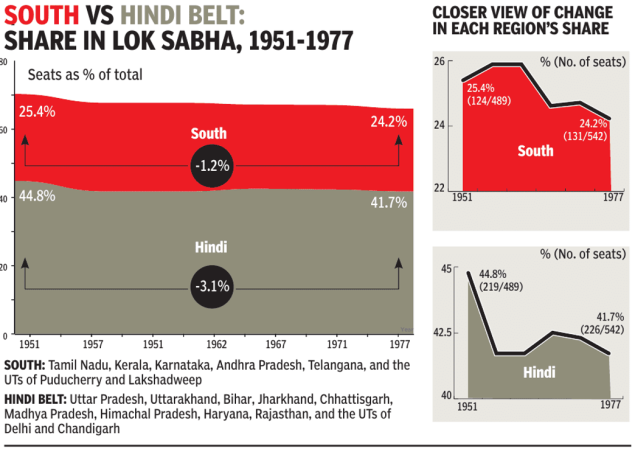
Overall, the data shows that changes in parliamentary representation were shaped not only by the North-South balance, but also by state reorganisation, UT representation and the evolving federal map of India.
► The 1951 election took place before the linguistic reorganization of states, so state boundaries were very different from what they are today ► After the reorganization of 1956, the states were largely in their present form, but many union territories still had little or no representation in the Lok Sabha ► The decline in share was partly driven by increased representation of Union Territories and gains from western and eastern states ► Even in 1977, the last election in this analysis, because there was no reallocation of Lok Sabha seats thereafter, Daman and Diu did not exist as a separate union territory. ► This comparison tracks total Lok Sabha seat share, not voter population per Member of Parliament or constituency size ►Figures for 1951 and 1957 refer to seats, not constituencies, as some constituencies then elected two members