
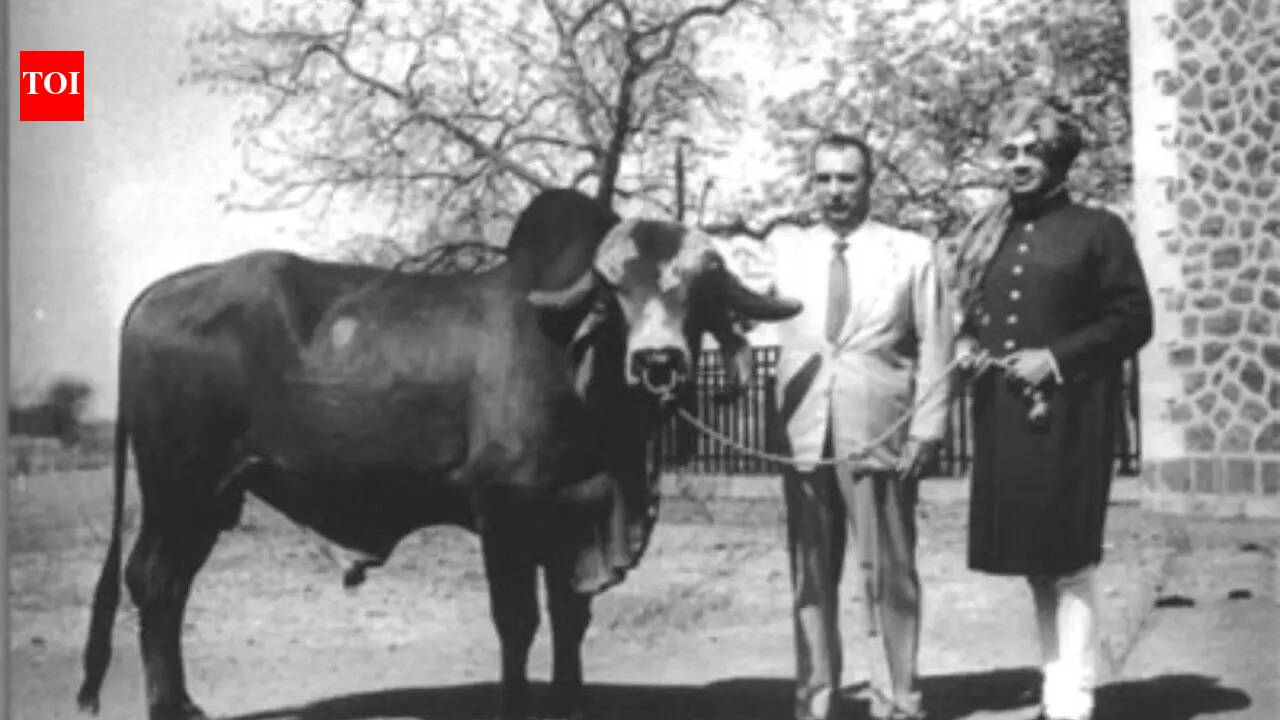

Gujarat Krishna Bull: Meet Krishna: a bull from Gujarat credited with producing 80% of Brazil’s milk production since 1960.
A jingle from the 90s said, “Doodh hai adamav, peesha kar karte hai everyday glass full”, in which most of the people of India drank milk like fine wine in different combinations. Dairy and especially milk has an important history in the Indian subcontinent, not only in terms of consumption but also production. It is the world’s largest milk producer, contributing about 24% to 25% of global milk production.Along with maintaining its excellent dairy production system, India has also helped other countries in their dairy sectors. The earliest example of this comes in the form of a bull that traveled from Gujarat, India to Brazil.
Krishna : Bull
According to the BBC, it was the year 1958 when Brazilian cattle trader Celso Garcia Cid sent cowboy Ildefonso dos Santos to India with the aim of finding a bull that could increase Brazil’s livestock.Sid was looking at pictures when his eyes fell on a calf named Krishna. His coat was red and white and his horns hung downwards. The cattle dealer immediately ordered the purchase of the strong bull, which arrived in the country two years later.During that time, the shepherd described Krishna as “a giant of a man”. He said, “Nothing can be inferred from what has been said about this animal – it is a giant creature.”However, instead of being purchased, Krishna was gifted to the cowboys by Krishna Kumarsinhji Bhavsinhji, the Maharaja of Bhavnagar and the first Indian Governor of Madras.
Indian bull behind Brazilian milk production
Krishna’s arrival proved extremely beneficial to Brazilian cattle and dairy. They brought about a genetic revolution in the country’s cattle market and now, their lineage makes up 80% of Brazil’s milk production.In India, Krishna helped increase the value of the Gir breed, which is now considered one of the most valuable breeds in the bovine embryo market. In recent years, this breed almost became extinct in the country due to failed crossbreeding attempts and the government sought help from Brazil to import this breed back to India.According to Guilherme Sachetim, the shepherd’s grandson, the Krishnas were a turning point in the history of livestock farming in Brazil. “They renewed the bloodline of the national dairy cattle at a time when inbreeding was holding back productivity,” he said.Not just Krishna, it is believed that the Maharaja of Bhavnagar visited the shepherd’s farm in Sertanopolis and before his death, left all his cows to him, thereby deepening the friendship that is remembered even today.
Where is Krishna now?
Krishna was much more than a bull. She left a legacy of her own in Brazil, changing the future of the country with healthy milk. After she died, Sid placed her body in a glass coffin and preserved it in the farmhouse, where it remains to this day. A sign that someone had pressed between Krishna’s toes read: “Want to meet Gir? Keep an eye on me!” Additionally, Krishna also received tribute to the country’s White Revolution, with his image appearing on stamps and coins.Today, a strong Brazilian Gir can produce up to 20 liters of milk per day. This is ten times more than the original cattle brought into the country nearly a century ago.