

West Bengal Assembly Elections 2026: How split in minority votes helped BJP break into TMC strongholds. india news
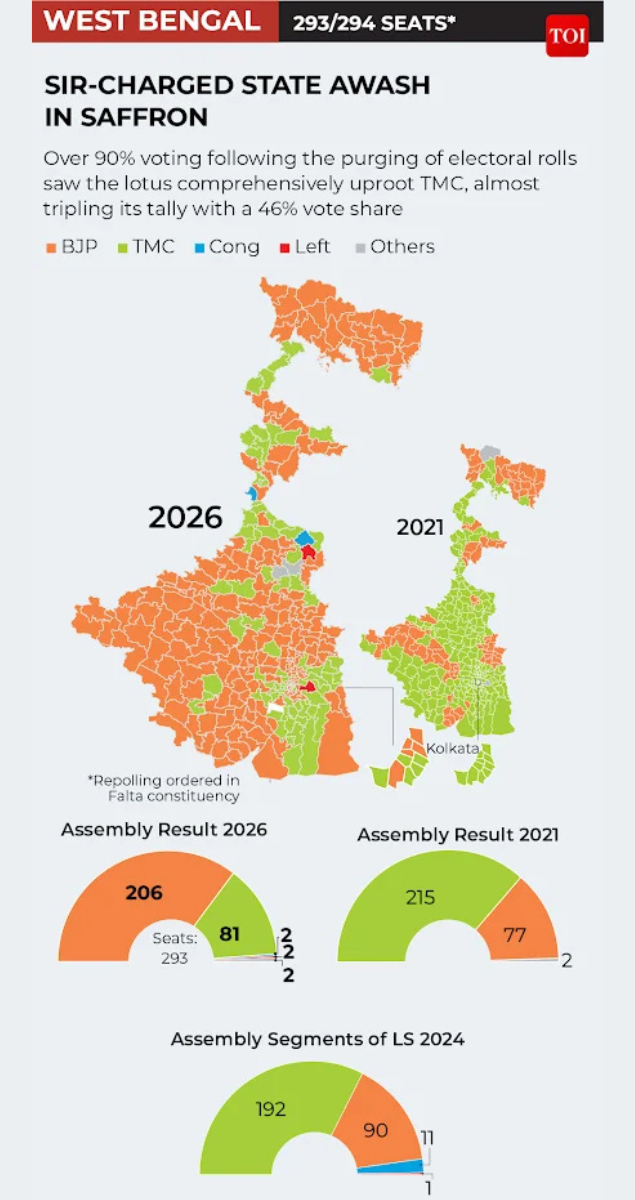
The 2026 assembly elections have turned the political fortunes of West Bengal into saffron. BJP Not only won, he swept the state. But beyond the blockbuster headline numbers, the real political plot twist is where some of its most surprising successes came: the Muslim-majority and Muslim-influenced constituencies it had been working on for decades. Mamata BanerjeeSupport system of. These weren’t just routine victories, these were TMCThe bastion of which was once considered politically untouchable. However, this time the old equations have been reversed and the election book of Bengal is being rewritten.For years, Bengal’s minority vote, especially in districts like Murshidabad, Malda and North Dinajpur, was seen not just as a demographic factor but as a political stronghold. Firstly, it protected the left front. Then, after the rise of Mamata Banerjee in 2011, it became one of the strongest pillars of the Trinamool Congress. The formula was simple and remarkably effective: unify Muslim voters, engage them with women-centric welfare support, position TMC as Bengal’s savior against Hindutva politics, and neutralize the BJP challenge. That strategy performed brilliantly in 2021. Mamata Banerjee won 215 seats, while despite an aggressive national campaign, the BJP was restricted to 77. In the minority belt of Bengal, especially 43 seats in Murshidabad, Malda and North Dinajpur, TMC dominated 35 seats, while BJP won just 8 seats. Murshidabad alone, where Muslims constitute more than two-thirds of the population, gave TMC 20 out of 22 seats.Five years later, that political certainty has been dealt a severe blow.It is not necessary that in the 2026 elections, the bulk of Muslims will be inclined towards BJP. Instead, it has revealed something perhaps even more important politically: the minority vote in Bengal no longer functions as a cohesive block. That fragmentation, combined with the BJP’s disciplined Hindutva consolidation, local anti-incumbency, welfare competition, identity politics and strong grassroots systems, created a new electoral equation that went beyond even the TMC’s most protected constituencies.
Figures behind political earthquake
The scale of change becomes clear when 2021 is compared with 2026.In 2021:
- TMC won 215 seats across the state
- BJP won 77 seats
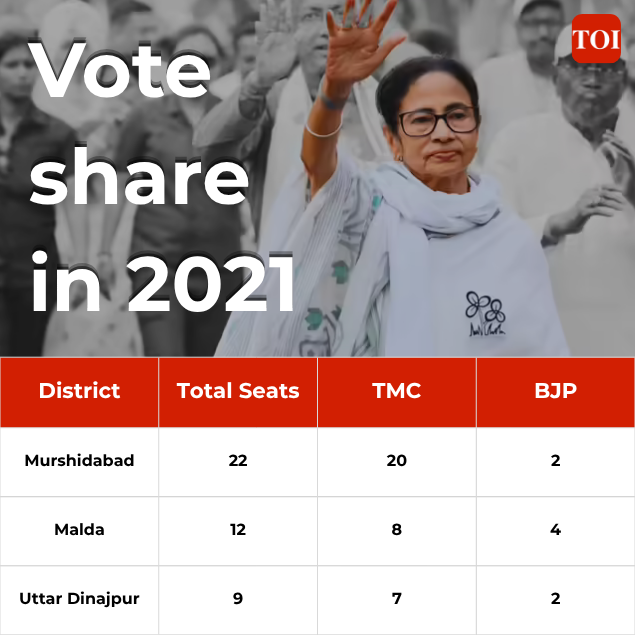
2026 was a moment of complete script reversal, a shock that gave BJP 206 seats, while TMC’s map was reduced to 80 seats.Now, let us focus on the important minority belt of Bengal:
–
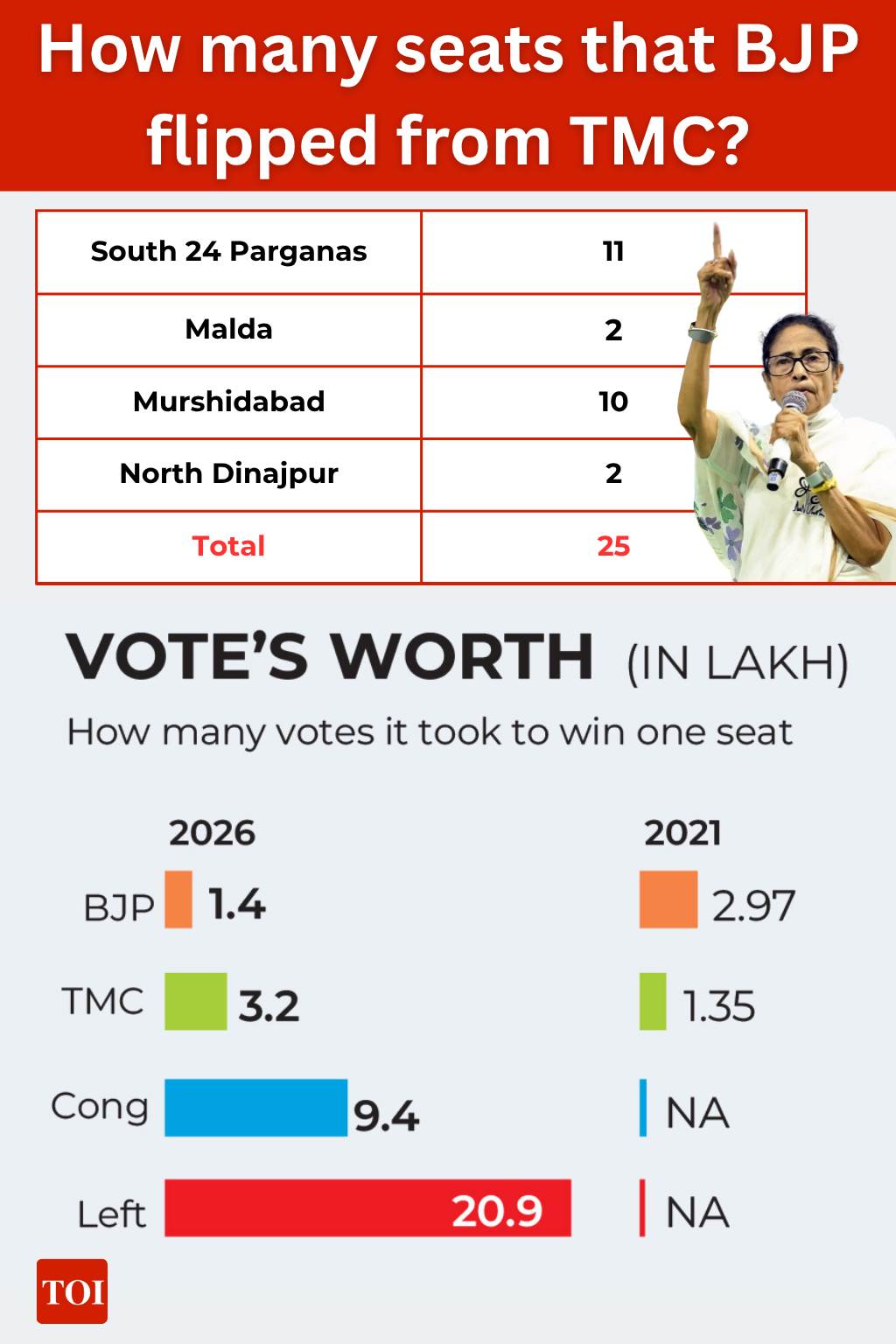
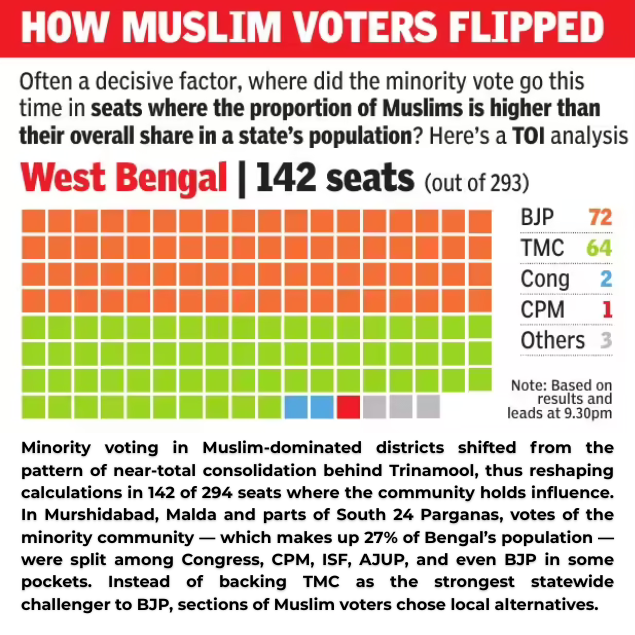
Overall, TMC’s dominance on these 43 seats created a significant safety net.In 2026, BJP almost doubled its seats in these districts, from 8 to around 18-19 seats, while TMC lost significant ground. Of the seats with widespread minority-influence, out of an estimated 142 constituencies across the state, the BJP reportedly won 72, the TMC 64, while the Congress, CPI(M) and others won the rest.This was not just a swap of seats, but a major upset in the political game of Bengal.
Biggest factor: Dispersion of minority votes
The most defining story of Bengal 2026 is that Muslim voters, long considered strategically united anti-BJP, were divided across multiple political channels.
–
Instead of TMC emerging as the sole anti-BJP beneficiary, the Muslim vote got divided among:
- TMC
- Congress
- CPI(M)
- Indian Secular Front (ISF)
- Humayun Kabir’s Aam Janata Unnayan Party (AJUP)
- Small regional parties and independents
This fragmentation proved disastrous for TMC in tightly contested seats. here’s whyIn 2021, the electoral logic in many minority-heavy seats was binary: TMC or BJP. Strategic voting often happens due to fear of BJP.In 2026, local discontent, anti-incumbency, allegations of corruption, candidate fatigue and the revival of dormant opposition players changed that pattern.This meant that the BJP often did not need dramatic expansion of Muslim support. All it needed was opposition votes to split it.
Murshidabad: Cracked Fort
Murshidabad became the most visible symbol of this change.Historically one of TMC’s safest minority strongholds, Murshidabad’s more than 66 per cent Muslim population had made it a politically difficult area for the BJP.In 2021:
- TMC: 20 seats
- BJP: 2 seats
In 2026:As the BJP moved forward and many opposition players moved into the TMC core, TMC’s dominance rapidly weakened.The Humayun Kabir factor was particularly important. A former TMC stalwart, Kabir’s AJUP emerged as a local disintegrator by converting anti-TMC discontent into political relevance. AJUP reportedly won seats like Rejinagar and Nauda, while there was strong voting elsewhere, spoiling TMC’s arithmetic.At the same time:
- Congress’s hold becomes stronger again in Rani Nagar
- CPI (M) demonstrated strongly in Domkal
- Left and Congress together made a dent in TMC’s traditional Muslim support
The result was politically seismic: the BJP could win or become competitive even without dominating minority voters, because TMC was no longer monopolizing them.
Malda: TMC suffers loss due to survival of Congress
Malda politics has always been more important due to the historical roots of Congress.In 2026, Congress may not necessarily dominate, but its revival matters a lot.Even Congress’s slight lead among minority voters was enough to reduce TMC’s margin. Combined with the Hindu solidarity of the BJP, this brought about major changes.Englishbazar became an extraordinary example, where BJP candidate Amlan Bhaduri reportedly won by more than 93,000 votes, showing this difference:
- consolidated hindu voting
- support of business class
- minority fragmentation
- TMC’s slippage
Malda proved that TMC no longer has automatic ownership of the anti-BJP minority arithmetic.
Uttar Dinajpur: Identity politics sharpens division
In North Dinajpur, the rise of the BJP was shaped by both fragmentation and identity mobilization.Party campaign:
- Sir (Special Intensive Review)
- checking voter list
- “Ineligible voters” allegations
- OBC and Rajbanshi concerns
Helped in uniting a section of Hindu voters
–
At the same time, the Congress and the Left retained enough influence to hurt the TMC in close contests.In many seats, the combined Congress-Left votes exceeded TMC’s defeat margin.This pattern became central to the BJP’s Bengal strategy: hold your vote, let the opposition divide.
sir and electoral identity
The SIR exercise became one of the most politically charged subtexts of the election.Large-scale deletion of voters’ names in some minority-dominated districts sparked anger and controversy. TMC argued that this had an adverse impact on its support base.Yet contrary to expectations, the fear of voters being cut off did not fully unite Muslim voters behind the TMC.Instead, local grievances often push voters toward alternative platforms.Similarly, BJP’s narratives on Waqf politics and identity issues energized its core supporters, while forcing TMC into reactionary politics.
Female Voter: Mamta’s shield has weakened!
One of TMC’s strongest social coalitions has long been women, especially through schemes like Lakshmir Bhandar.But the BJP’s Annapurna Bhandar promise of Rs 3,000 monthly support directly challenges that advantage.Combined with:
- Concern about women’s safety after incidents like RG Kar
- anti corruption message
- wellness competition
The BJP significantly reduced TMC’s lead among women voters, including in minority-dominated areas.For many poor women, especially Gen Z and young families, practical economics began to compete with traditional loyalties.
Governance fatigue and corruption
TMC also had to bear the burden of more than a decade in power.Major issues included:
- recruitment scams
- corruption allegations
- local syndicate politics
- governance fatigue
- Notions of dynastic or centralized control
In many constituencies, this did not automatically make the BJP popular, but it made the TMC weak.That vulnerability when combined with vote fragmentation was substantial.
–
BJP’s organizational change
Unlike 2021, in 2026 the BJP was not running on national charisma alone.It took five years to build:
- booth level infrastructure
- strength of local cadre
- Regional influence of Suvendu Adhikari
- Organizational expansion of Sukant Majumdar
- Strong local candidate network
Its victory in the 2024 Lok Sabha was a stepping stone, not a peak.This allowed the BJP to take full advantage of the fragmented opposition areas.
More shocking waves: How did Mamata lose in Bhabanipur and beyond?
Perhaps the most symbolic moment was Mamata Banerjee’s defeat in Bhawanipur, where Suvendu Adhikari reportedly defeated her by over 15,000 votes. This was much more than the loss of a seat. This again put the focus on BJP’s claim that TMC’s political invincibility has ended.West Bengal 2026 shatters one of the most enduring notions of Indian politics: that a large minority population, if politically united, can permanently stop the BJP.That assumption now appears to be conditional, not guaranteed.BJP’s Bengal success shows that:
- The disintegration of the opposition may outweigh the demographic arithmetic.
- There are limits to welfare politics
- Identity politics can be countered by governance fatigue
- Regional strongholds will be vulnerable if the core alliance breaks up
bottom line
This result is a blunt political warning for Mamata Banerjee.The Muslim vote remains important, but no longer appears automatically integrated enough to act as an electoral veto.The story of Bengal 2026 is not that Muslim-majority constituencies suddenly turned saffron.That is, the political unity that had once kept the BJP out became too weak for the BJP to enter. The minority vote did not disappear. This brought diversity.And in that diversification, the old electoral map of Bengal was redrawn. This election was not just the victory of BJP.It was the end of a political certainty and the beginning of a much more conflicted Bengal.