

Annamalai breaks ties with BJP: What could be the reason for the exit of Tamil Nadu’s most prominent leader. india news
New Delhi: K Annamalai resigns from Bharatiya Janata Party (BJP) has capped months of discontent and his diminishing role within the organisation, raising fresh questions over the saffron party’s ambitions. Tamil Nadu And the political future of one of its most recognizable faces in the state.The former IPS officer, widely known as “Singham” for his aggressive political style, joined the BJP in 2020 and quickly rose in the party. He was appointed president of the party’s Tamil Nadu unit in 2021 and played a key role in expanding its presence in the state.Under his leadership, the BJP achieved its strongest Lok Sabha performance in Tamil Nadu in 2024, securing 11.4 per cent vote share, a significant improvement from 3.7 per cent in the 2019 general election. However, this momentum faded ahead of the 2026 assembly elections.
BJP’s U-turn on AIADMK
Annamalai’s 2024 padayatra significantly increased the BJP’s visibility in Tamil Nadu and helped the party achieve its highest-ever vote share in a Lok Sabha election in the state. The BJP secured 11.38 percent votes in 2024, a dramatic improvement from 3.62 percent in 2019. Yet the electoral success was incomplete, as the party failed to win a single parliamentary seat for the second consecutive election. This contradiction was particularly shocking as the BJP had managed to secure a Lok Sabha seat in 2014 with a much lower vote share of 5.56 per cent.Throughout his tenure, Annamalai distinguished himself through consistent attacks on Dravidian politics and the leaders who shaped it. His criticism was not limited to political opponents. Even when the BJP was in alliance with the AIADMK, they repeatedly targeted people from the ally’s camp, causing friction within the alliance and increasing differences between the two parties.
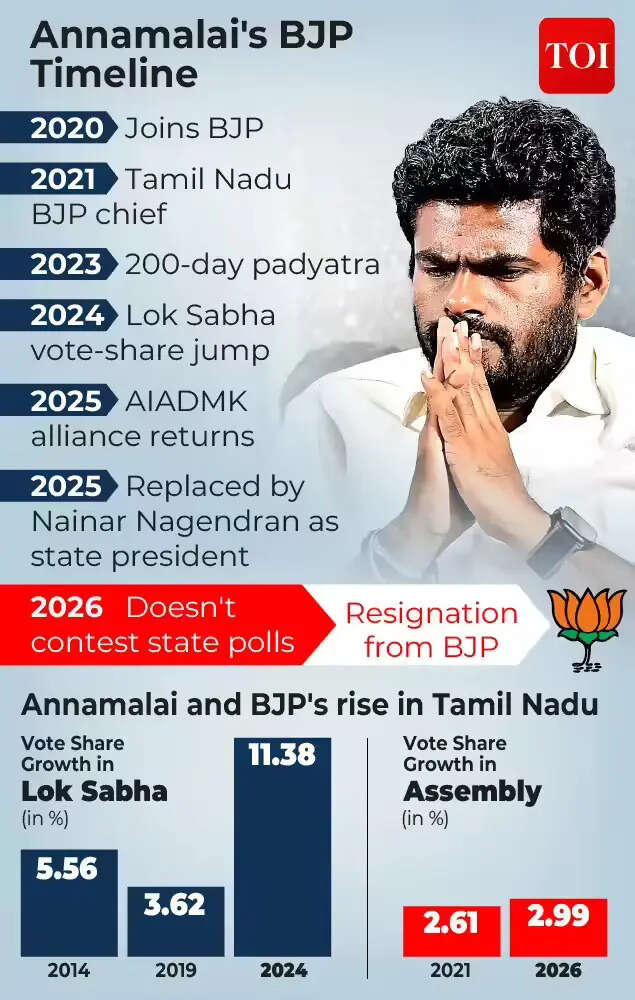
Annamalai’s BJP timeline
As relations deteriorated, sections within the BJP began to reevaluate the political costs and benefits of maintaining distance from the AIADMK. Ultimately, the party leadership decided to revive the alliance ahead of the 2026 assembly elections despite strong objections from Annamalai. This decision proved to be a turning point in his political journey within the BJP. Soon after, he was replaced as the state unit chief, a move widely seen as an attempt to smooth over relations with the AIADMK and adjust to the realities of coalition politics in Tamil Nadu.
outcome
Annamalai was replaced by Nainar Nagendra as state president and he gradually divested himself of important organizational responsibilities, reportedly a part of the BJP’s pre-poll pact with rival AIADMK to wrest power from the ruling DMK.The alliance was seen as a major point of disagreement as Annamalai reportedly favored building the party independently at the grassroots level rather than relying on coalition politics. The emergence of Vijay’s TVK as a significant political force further complicated the BJP’s position in the state.As a result, Annamalai stepped down as election in-charge of six constituencies and was subsequently dropped from the party’s Legislative Assembly Election Management Committee. He also did not contest the assembly elections, although he said that this decision was his own.He said, “How can the leadership allot me a ticket when I have shown no interest in contesting the elections? If I had decided to contest the elections, it would not have mattered from which constituency I could have contested.” “I am grateful to the BJP leadership for respecting my decision and giving me an opportunity to campaign in support of the NDA alliance candidates,” he said.
First public indication of results
For years, K Annamalai was largely associated with the central leadership of the BJP. This changed when he publicly criticized the Union Education Ministry’s decision to push back the implementation of the three-language requirement for Class IX students. The intervention was widely seen as his first open disagreement with the party line and led to speculation that tensions within the BJP had reached a breaking point.The controversy began when CBSE issued a notification on May 15 directing affiliated schools to introduce the third compulsory language for Class IX students from the current academic year, several years ahead of the previously scheduled 2029-30 deadline.
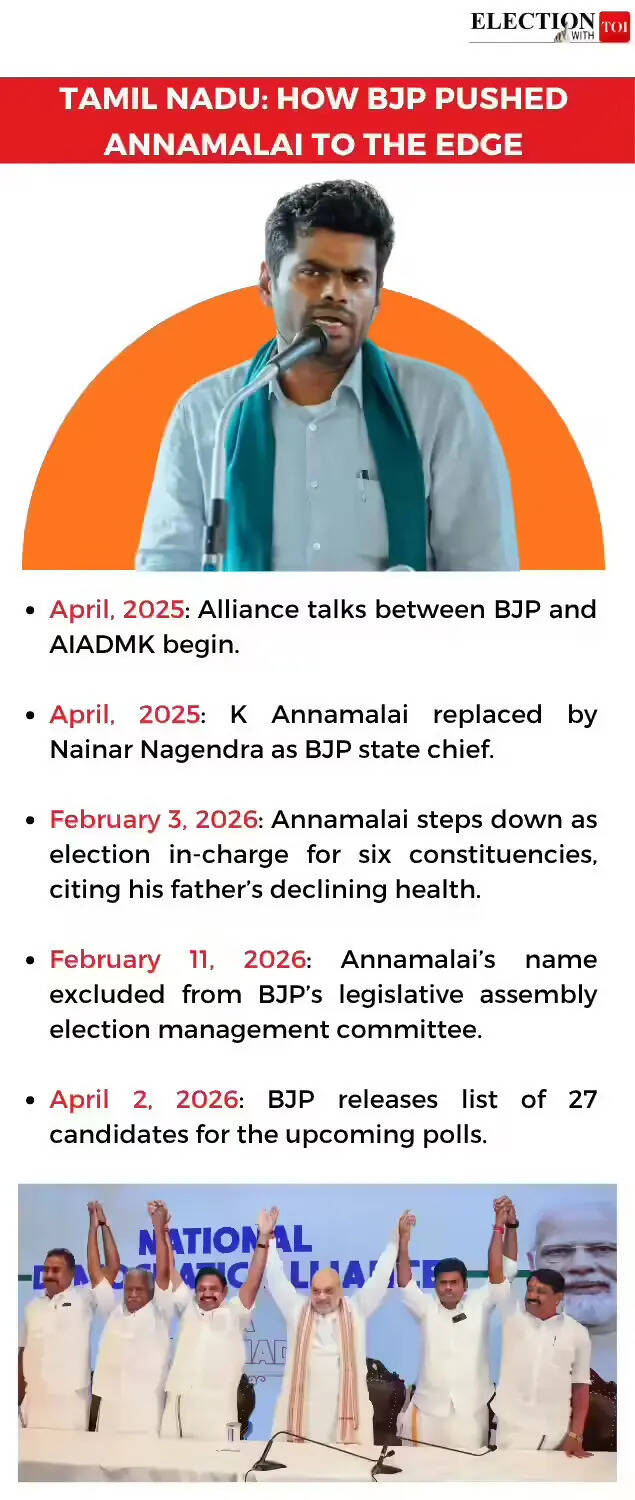
How Annamalai was sidelined
Reacting to the decision, Annamalai wrote on The revised notification now mandates that Class IX students learn three languages from July 1, 2026, two of which must be native languages of India. Expecting a Class 9 student to learn a new language in such a short period of time will only put pressure on children and affect their overall learning outcomes.“These comments are important as language is one of the most politically sensitive issues in Tamil Nadu. By openly expressing objection to the policy, Annamalai looked set to distance himself from the BJP’s official position and signal a more independent political identity.Therefore, his final resignation came out of nowhere. The seeds of discontent had been visible for some time, especially when the BJP leadership chose to revive its alliance with the AIADMK ahead of the 2026 assembly elections. Annamalai had consistently argued for building the party as an independent force in Tamil Nadu rather than relying on established regional allies.
A political experiment cut short
With Annamalai’s departure, the BJP faces a difficult question whether it has abandoned the long-term strategy before it has had a chance to mature.Although he did not lead the party in any of the assembly elections that followed his elevation, Annamalai became the most recognizable face of the BJP in Tamil Nadu and helped energize a cadre that had long been struggling for visibility. He assumed the post of state president after the 2021 assembly elections, in which the BJP won four seats with 2.62 percent vote share.By the time the 2026 elections were over, Annamalai was no longer at the top. The party’s seat tally dropped to one seat, while its vote share saw a marginal increase and stood at 2.99 per cent. With his exit, the BJP now faces the prospect of losing local leaders and grassroots workers, who were largely attracted to the party because of his leadership.The election results also revealed another reality. The overwhelming support received by Vijay and his party TVK suggested that Tamil Nadu voters were ready to embrace a new political alternative. The BJP had attempted a similar experiment through Annamalai, but ultimately chose a different path.While Annamalai never had the mass appeal of Vijay, the former IPS officer, popularly known as “Singham”, had built a strong following among young voters. His straightforward style and aggressive campaigning gave the BJP visibility it has rarely enjoyed in the state.In hindsight, the party appears to have faced a difficult choice between continuing Annamalai’s grassroots expansion strategy and joining hands with the AIADMK to form a broader anti-DMK alliance. It ultimately chose the latter. That decision may have strengthened the alliance’s arithmetic, but it also reduced the room for maneuver for Annamalai.Ironically, the combative approach that made him one of the most effective campaigners for the BJP in Tamil Nadu may also have contributed to his exit. For both Annamalai and the BJP, the question of what might have remained may remain for some time.
What’s next for Singham?
His resignation comes amid reports that he is preparing to launch a new political party with a Tamil-first and more centrist political approach. While an official announcement is expected, the possibility of a new organization with independent political space beyond the BJP has cast a foreshadowing on the saffron party’s ambitions.His departure leaves the party facing the challenge of replacing a leader whose confrontational style and direct message struck a chord with a section of young voters. For the BJP, the exit raises concerns not only about the leadership in Tamil Nadu, but also about its long-term strategy in a state where it is struggling for political relevance.