
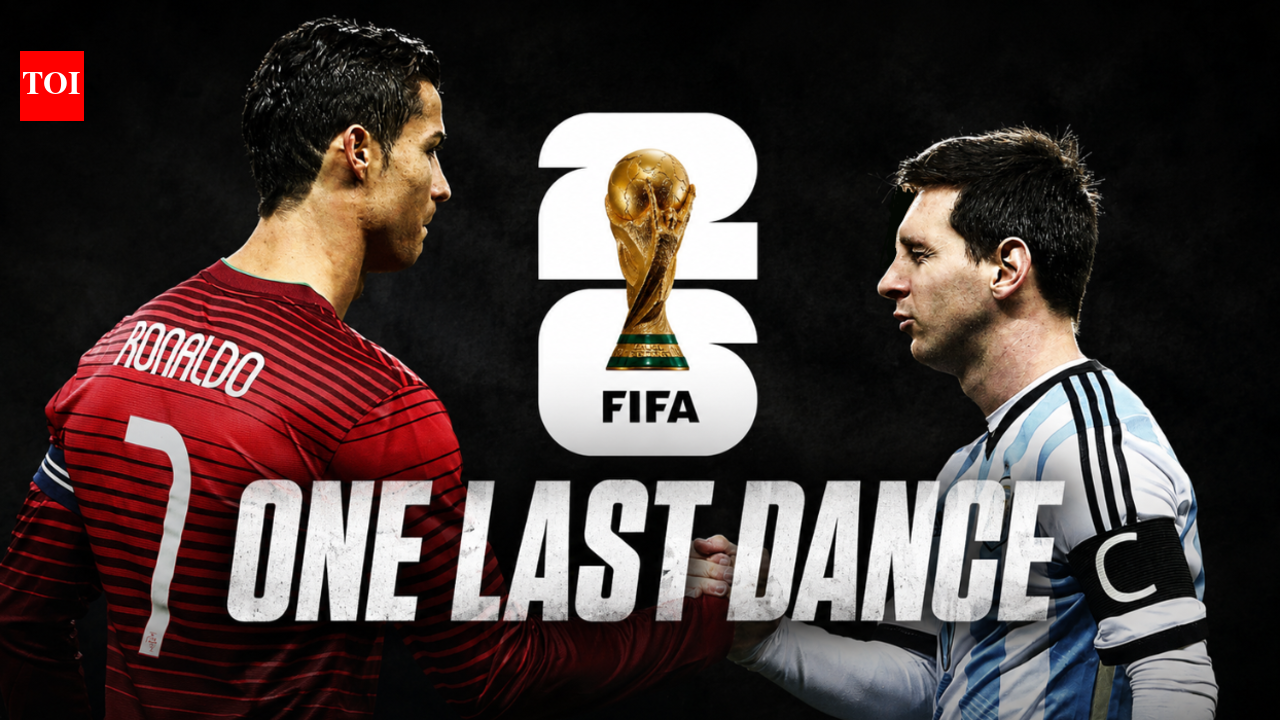

FIFA World Cup 2026: Only three scenarios where Messi and Ronaldo could eventually face each other ‘for the last time’ football news
A record-breaking sixth FIFA World Cup for both Lionel Messi and Cristiano Ronaldo could finally produce a meeting like never before in football: a World Cup showdown between the sport’s ultimate rivals. Argentina and Portugal arrived in North America in encouraging form after both winning their opening pre-tournament friendlies, with Argentina defeating Honduras 2–0 and Portugal defeating Chile 2–1. While Messi is recovering well from a minor hamstring strain, Ronaldo is fully fit and is expected to lead Portugal’s challenge.The prospect of a clash between the two icons takes on added significance, as despite defining an era of football for almost two decades, they have never faced each other on the game’s biggest stage. Their rivalry spans leagues, continents and competitions, yet the FIFA World Cup remains the one major tournament where their paths have never met in a competitive match.This may eventually change in 2026. Ronaldo is close at 41 and Messi at 39, both widely expected to be appearing in their final World Cup. As a result, the extended tournament could provide one last opportunity for football’s most famous rivalry to clinch a World Cup chapter.However, whether that dream matchup becomes reality depends on a very specific series of results, knockout pathways and qualification scenarios that unfold in FIFA’s newly expanded 48-team format. Before exploring those possibilities, it’s worth understanding how the tournament is structured, because the format is what makes a potential Messi-versus-Ronaldo meeting both more attainable and more complicated than ever.
How the 48-team World Cup actually works
The 2026 tournament, held in the United States, Canada and Mexico, is expanded from 32 to 48 teams, changing the entire tone of the competition.Instead of eight groups, there are now twelve groups, labeled Group A to Group L, and each group has four teams. Argentina have been drawn in Group J with Algeria, Austria and Jordan, while Portugal have been drawn in Group K with Colombia, Uzbekistan and DR Congo.The way forward from these twelve groups works in two layers.First, the direct part: the first and second placed teams in each group automatically qualify for the knockout stage. It includes 24 teams.After this comes the part which was not present in the last World Cup. All twelve third-placed teams throughout the tournament are compared on points, goal difference and goals scored, and the best eight of them also qualify. With this, the total number of teams reaching the knockout has become 32.From there, the tournament moves straight into an elimination bracket, starting with the Round of 32, then moving on to the Round of 16, quarterfinals, semi-finals, and finally the final. A team that advances all the way will now play eight matches instead of seven, reflecting the expanded structure, and the tournament will expand to 104 matches in total.This format makes sense because it creates multiple entry points into the knockout bracket, where a Ronaldo-Messi meeting becomes possible.
Both teams will be burdened till 2026
Argentina arrived as defending world champions after lifting the trophy at Qatar 2022, a moment that reshaped Messi’s international legacy after years of near-misses, including a World Cup final defeat and three Copa America final defeats before 2021 success. Since then, Argentina have captured another Copa America title and head into 2026 with continuity, depth and a team built around their captain.The story of Portugal has been different. Ronaldo, the all-time leading scorer in men’s international football with 143 goals, has won the European Championship and two UEFA Nations League titles, but the World Cup has remained out of his reach. Portugal’s best performance in the Ronaldo era came in 2006, when they reached the semi-finals, and since then they have twice been eliminated in the round of 16 in 2010 and 2018, exited the group stage in 2014, and reached the quarter-finals in 2022, where they were eliminated by Morocco, while Ronaldo was largely used as a substitute in the knockouts.Individually, Messi has played 26 World Cup matches and scored 13 goals, while Ronaldo has played 22 matches with eight goals, and both are expected to attend their sixth World Cup, with Messi yet to officially confirm his participation.
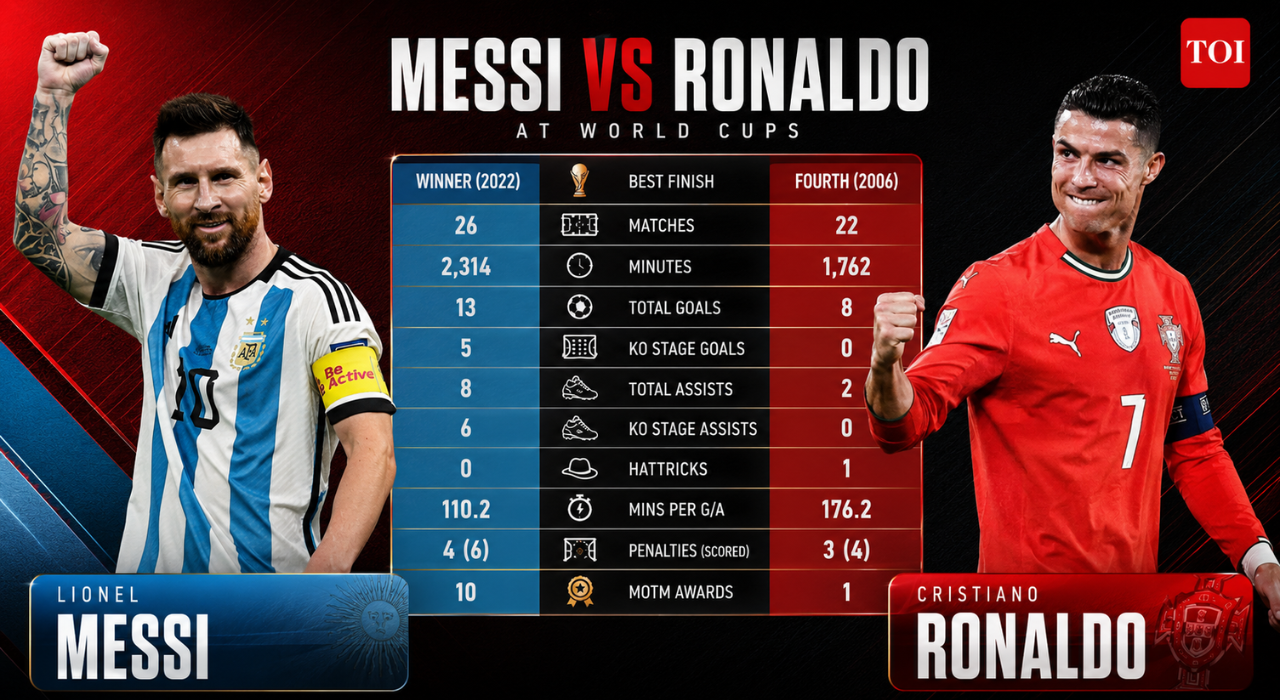
messi vs ronaldo world cup stats
All this context boils down to the simple fact that they are now in different groups, Argentina in Group J and Portugal in Group K, meaning any meeting can only take place after the knockout rounds begin.
Group stage expectations and prospects
Argentina are widely seen as strong favorites to top Group J, with projections placing their chances of finishing first at around 75% to 77%, reflecting both their status as defending champions and the relative balance of the group which also includes Austria, Algeria and Jordan. Austria is considered the primary challenger, with an estimated 20% to 22% chance of winning their group.
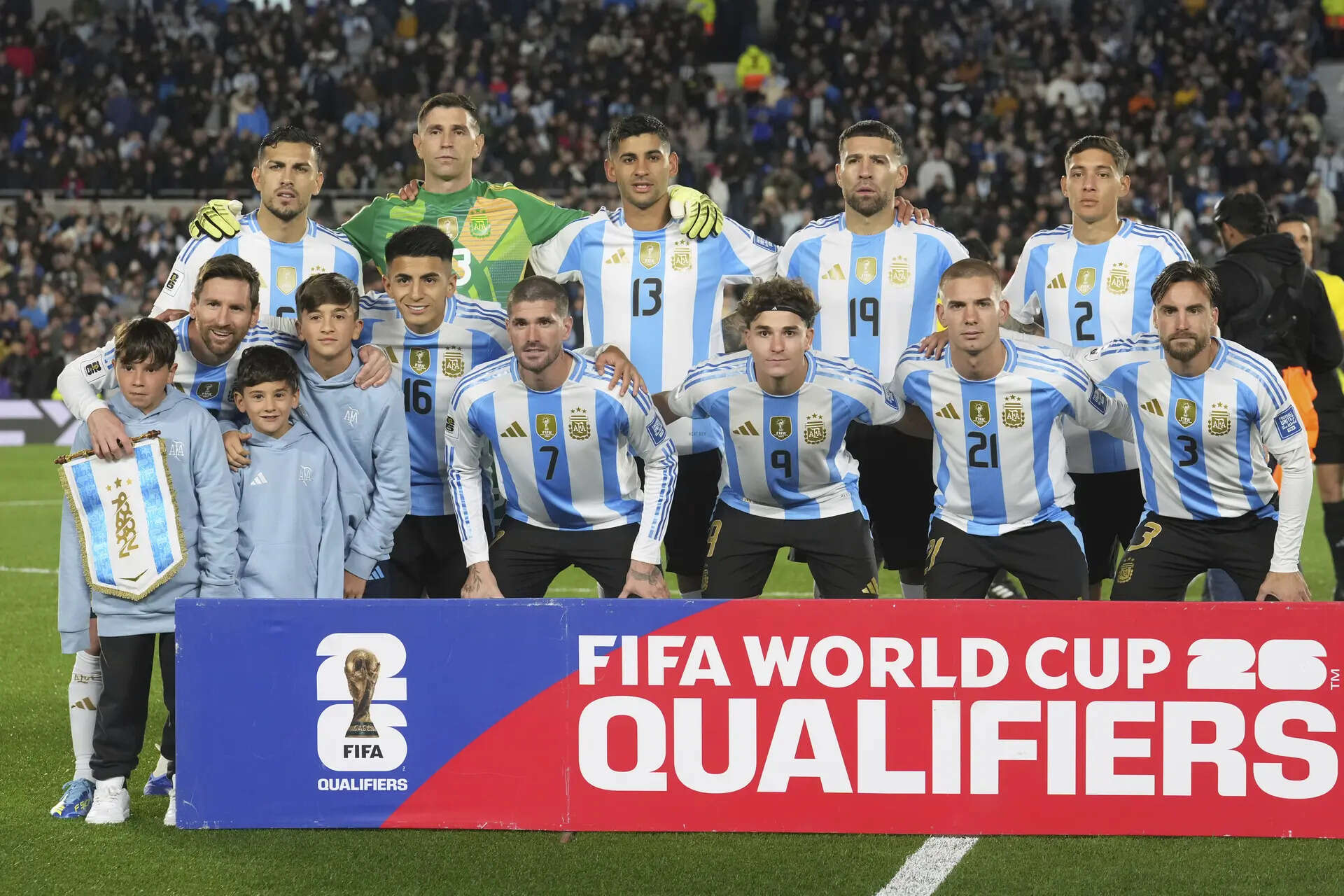
Argentina’s Lionel Messi, second from left, poses with teammates and his sons before a World Cup 2026 qualifying soccer match against Venezuela at Monumental Stadium in Buenos Aires, Argentina, Thursday, Sept. 4, 2025. (AP Photo/Gustavo Garello)
Portugal, drawn in Group K, are also expected to lead their group, featuring players like Bruno Fernandes and Joao Felix along with Ronaldo. According to leading betting sites, Portugal are strong favorites to top the group at the 2026 FIFA World Cup, with an implied probability of around 65% to 71%, although Colombia are seen as a real threat after a strong qualifying campaign in South America, led by Luis Diaz, James Rodriguez and Davinson Sanchez along with other key forwards such as John Córdoba, Jefferson Lerma and Richard Ríos. People have done it.
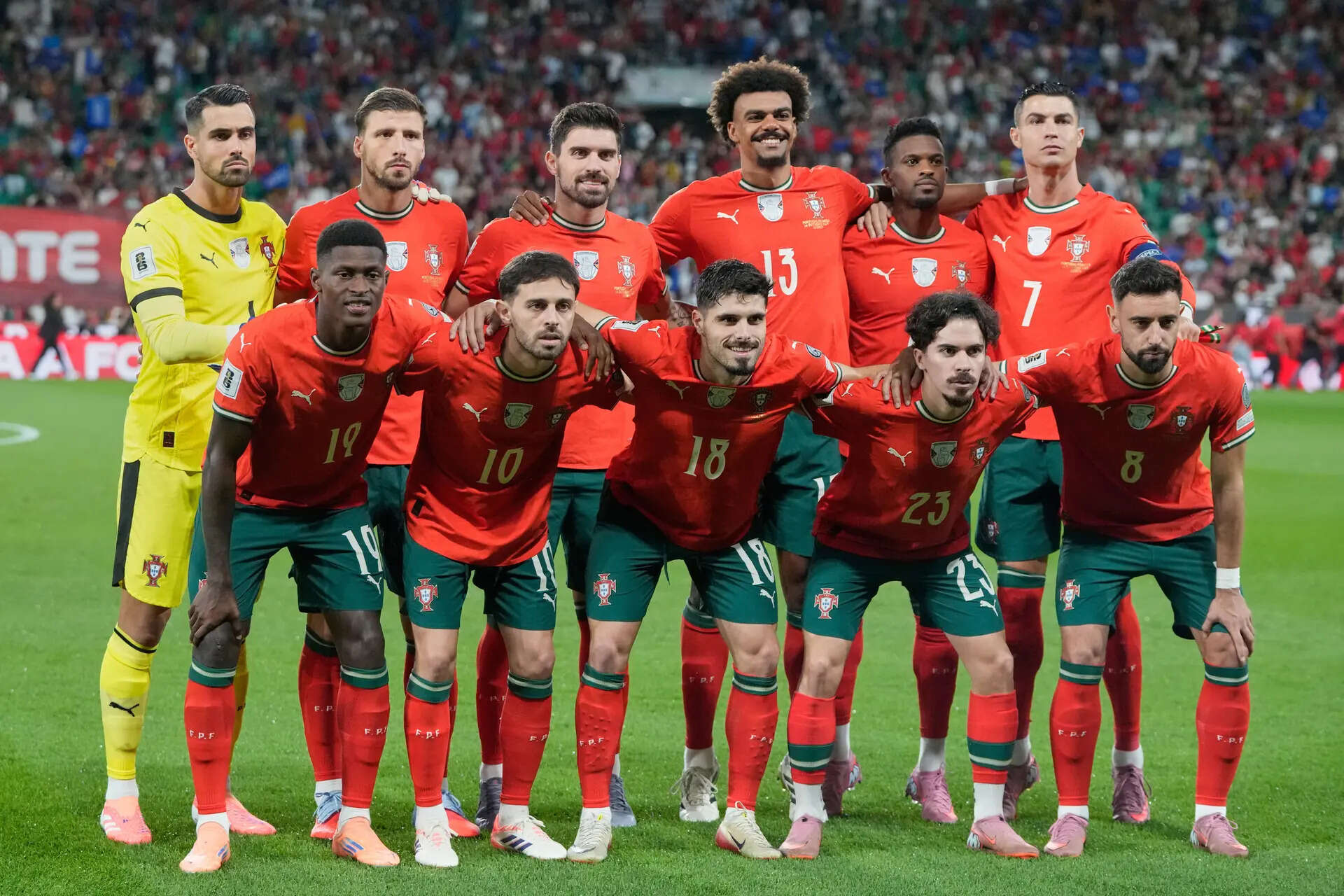
FILE – Portugal players pose for a team photo before the World Cup 2026 Group F qualifying football match between Portugal and Hungary in Lisbon on Tuesday, October 14, 2025. (AP Photo/Armando Franca, File)
Bracket Reality: Why They Can’t Meet Early
Because Argentina and Portugal were both top seeds in Pot 1 during the draw, FIFA structured the bracket so that teams from the same seeding pot were separated into different routes. In simple terms, this means they cannot meet in the group stage and are set aside up to a certain number of points in the knockout round, depending on how they finish.Their placement in Groups J and K also places them on intersecting sides of the bracket, which is why their meeting depends heavily on specific finishing conditions.
Scenario 1: Both win their groups, quarter-final clash
If Argentina finishes first in Group J and Portugal finishes first in Group K, both teams will enter the knockout rounds on a route that brings them together in the quarterfinals in Kansas City on July 11, provided they win their Round of 32 and Round of 16 matches.In that scenario, Argentina’s journey would begin in the round of 32 against the runners-up of Group H, followed by a round of 16 tie against the winners emerging from the clash between the second-placed teams in Groups D and G.Conversely, Portugal will face one of the third-placed qualifying teams in their round of 32 match, before moving on to a round of 16 tie against the winner of the match involving the winner of Group B.Only if both successfully clear those two knockout rounds, the bracket aligns for a Ronaldo vs Messi clash in the quarterfinals.
Scenario 2: Both finish second in the Round of 16 meeting
If both teams finish as runners-up in their respective groups, the structure brings them together much earlier, with a possible round of 16 clash at Arlington on 6 July, again assuming both win their opening knockout matches.In this situation, Argentina will face the winner of Group H in the Round of 32, while Portugal will face the runner-up of Group L, which includes teams like England, Croatia, Ghana and Panama.The main difference here is that finishing second compresses the timeline, creating a path where the meeting takes place exactly one round after the initial knockout stage.
Scenario 3: Split position, only last remaining
If one of the two teams wins its group while the other finishes second, the bracket separates them completely until the finals on July 19 in New Jersey.In that configuration, they are placed on opposite sides of the knockout draw, meaning they must advance through every round, round of 32, round of 16, quarter-finals and semi-finals, without slipping for a meeting to occur.It is the longest and most demanding route, but also the one offering the most symbolic ending: a World Cup final between two players whose rivalry has defined an era.
Wildcard variable: third-place qualification
The expanded format introduces another layer of uncertainty through the best third-place teams.If Argentina or Portugal finish third, but still qualify among the top eight third-place teams, their exact position in the knockout bracket cannot be determined until all group matches are completed, as those rankings depend on points, goal difference and goals scored across all groups.This makes any Ronaldo-Messi meeting in that scenario unpredictable, as their paths will only become clear once the group stage is over.
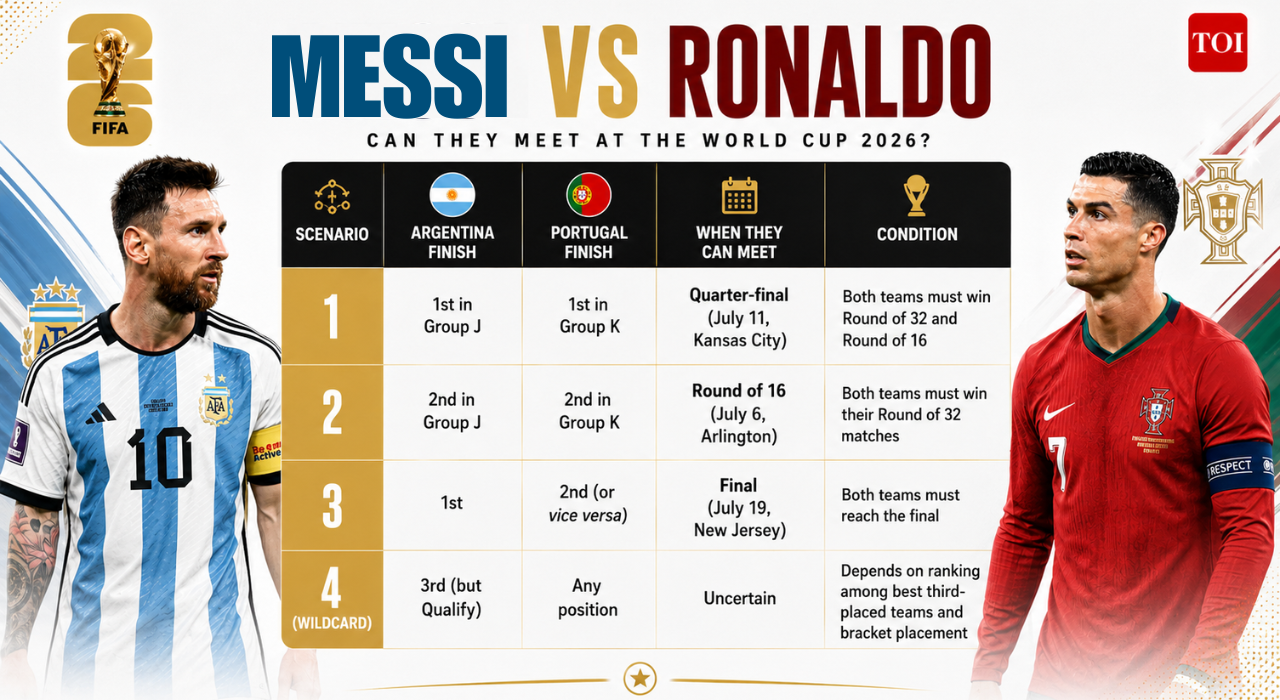
The sixth World Cup for Messi and Ronaldo could ultimately prove to be the biggest match for football fans.
Why does this World Cup feel different?
For all the permutations and routes, the underlying reality is simple. This is likely the last time the two players will share the World Cup stage, and the structure of the 48-team tournament makes it possible, but does not guarantee they will eventually meet.For this, Argentina will have to perform as expected, Portugal will have to advance in the competitive group and both teams will have to make it through at least one or two knockout rounds without making any mistakes depending on the route.Only then does the bracket open up in a way that allows the rivalry to reach the stage it has always missed.