


Ben Stokes: The man who refused to go quietly, then went to tea cricket news

There is a special cruelty in the way Ben Stokes decided to retire. On the afternoon of the fourth at Trent Bridge, with the Test still in progress and tea time approaching, he announced that it would be his final match for England. Not at the end of a series, neatly wrapped up in a guard of honor and orchestral montage, but halfway through the story, which was the way he seemed to play most of his cricket. Wait a moment—wait a moment—and that moment was already gone.I have spent a large part of my adult life saying that Test cricket is dying, that five-day cricket is a colonial relic awaiting euthanasia as an attention-grabbing economy. And then along came a left-handed man, born in Christchurch and brought up in Cumbria, who almost single-handedly and certainly with a single mind decided that the patient would not go quietly. They called it Buzzball, after Koch, because the British always liked to name their revolutions after some safe antipodean. Yet it was Stokes who batted as if the scorecard was a personal affront, who declared that when sensible people will settle for survival, and who turned dead rubbers and lost causes into the only kind of cricket that interested him.Of course, there’s Headingley in 2019, because there always is. England were all out for 67 in the first innings, chasing 359, stumbling to 286 for 9, and had only Jack Leach, whose contribution was the equivalent of moral support in cricket. What happened next was less an innings than an argument with probability. Stokes won because, somehow, Stokes usually did. Leach’s solitary run has become one of the most famous singles in cricket history, while a man at the other end was determined to convince mathematics that he had underestimated his authority.
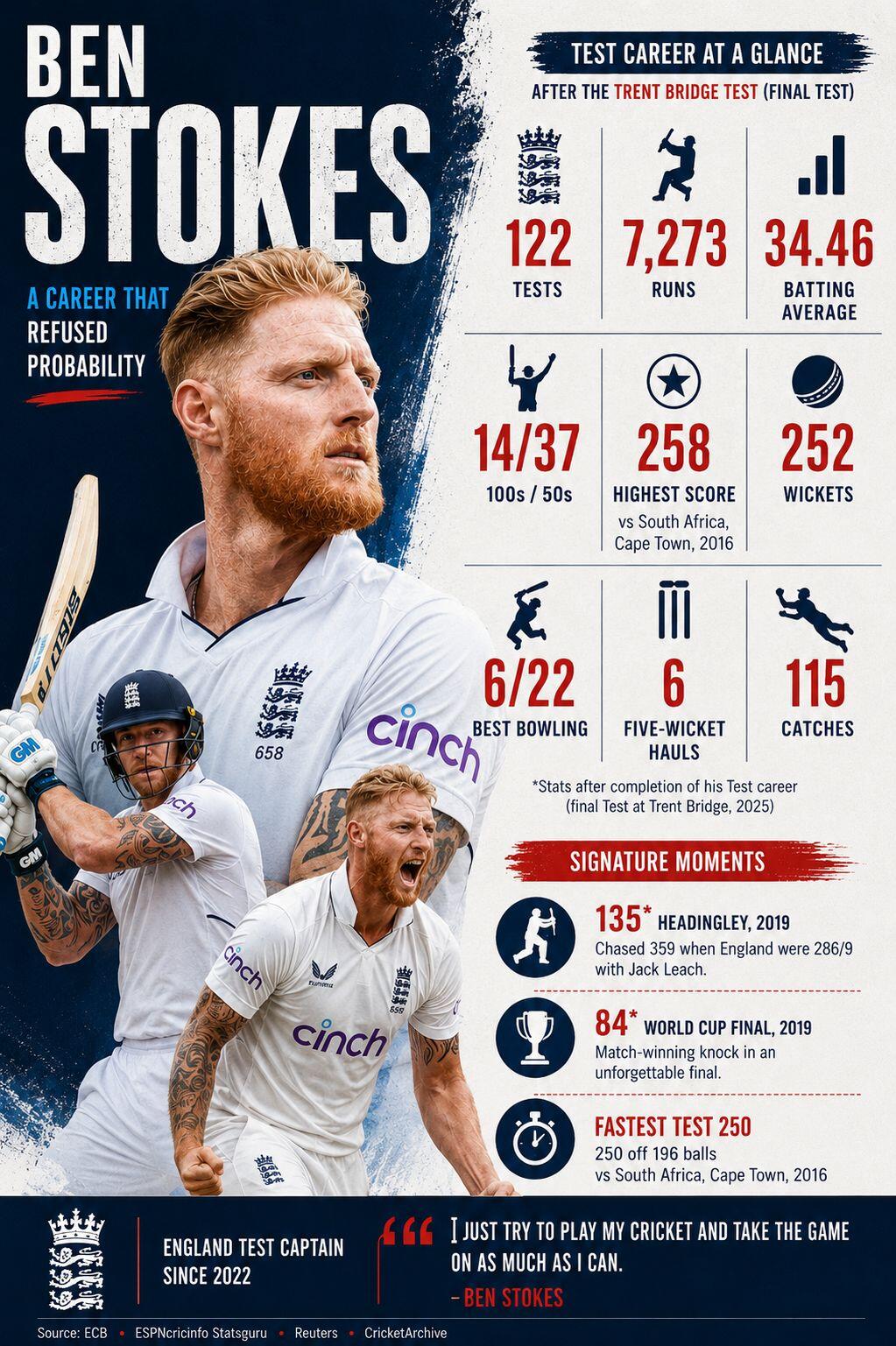
The numbers, while impressive, always felt a little inadequate. Over 7,200 Test runs, over 240 wickets before this final match was over, fourteen Test centuries, and a batting average that critics continue to talk about as if it settled an argument. This does not decide anything. Stokes was never a mediocre man. He was concerned with moments, and moments have an inconvenient habit of resisting arithmetic. 258 runs in Cape Town, the fastest Test 250 ever, tells you more about him than any spreadsheet. The mean is for actuaries. Stokes described, in the extreme, the farce, the impossible stories that grandparents tell to children who politely pretend they have never heard them before.
What I keep coming back to, however, is that the first part of his career did not look like a biography. There was Bristol, controversy, arrests, missing the Ashes, being stripped of the vice-captaincy, and a reputation that appeared beyond repair. Kolkata had Carlos Brathwaite, who sent four consecutive balls into the stands and with him, every comfortable assumption was that redemption from the game followed a straight line. For a while, Stokes became a cautionary tale of English cricket.That it re-established itself in its conscience is, perhaps, its greatest achievement. He spoke openly about mental health at a time when elite sports still considered the vulnerability an administrative error. He stepped away from the game indefinitely and in doing so tacitly gave others permission to do the same. He captained with a body that often appeared to be laced with surgery, stubbornness and belief in almost equal measure. Those are the innings that highlight reels rarely replay.And so he went, not at the end of the series, where tradition would have preferred him, but in the middle of the Test match, when tea was approaching and the result was unresolved. This is the most brilliant end to Ben Stokes that can be imagined. For more than a decade, he played as if the prospect was just another opponent to be defeated. Now they have decided to announce the end of the match even before it ends.Khuda Hafiz, Ben.There will always be a scoreboard and statistics in the fourth innings. It may take longer before he finds someone else who is willing to accept both as mere suggestions.