Canadian man linked to more than 100 deaths in Britain will not be extradited, families demand inquiry. world News

Canadian man linked to more than 100 deaths in Britain will not be extradited, families demand inquest

A Canadian man accused of supplying deadly substances linked to the deaths of more than 100 people in Britain will not be extradited to face prosecution in Britain.Kenneth Law, 60, is currently facing criminal proceedings in Canada and is expected to appear in court in Ontario on Friday. He is accused of inciting suicide after allegedly delivering packages containing deadly substances to customers in dozens of countries.The National Crime Agency linked Law’s alleged operation to 112 deaths in the UK after finding 286 people had received packages from websites selling substances linked to assisted suicide, Sky News reports.Investigators found that 330 products were sent to the UK. Law is accused of sending approximately 1,200 packages to customers in 40 countries.The NCA and the Crown Prosecution Service (CPS) informed the families this week that they will not seek Law’s extradition after the Canadian proceedings conclude.In a letter sent to the families of those killed, the agencies said they agreed that the full scale of the alleged crime should be punished through the same legal process as in Canada. “After careful assessment, we agreed that Mr. Law should be sentenced for the full extent of his crime under the same sentencing process in Canada,” the letter said.Officials acknowledged that some families had expected a separate prosecution in England and Wales, but said the decision was taken after detailed consideration of all available options.The move prompted renewed calls for a public inquiry from relatives of those who died.Adele Zeynep Walton, whose sister Amy Walton died aged 21 in Southampton in 2022, said the family were still waiting for answers about how the substance was able to reach vulnerable people in Britain.“Foreign sentencing hearings cannot answer this. Only a statutory public inquiry can answer this,” he said, as quoted by Sky News.The law has also been investigated by authorities in the United States, Italy, Australia and New Zealand as law enforcement agencies investigate the international reach of the alleged scheme.

Source link

A day after resignation, Siddaramaiah meets Congress high command in Delhi – what’s on his ‘wish list’ india news

Siddaramaiah meets Congress high command in Delhi a day after resignation - what's on his 'wish list'

New Delhi: Outgoing Chief Minister of Karnataka Siddaramaiah Met top Congress leaders in Delhi on Friday, a day after stepping down from the state’s top post.During his meeting with Rahul Gandhi at 10 Janpath, Siddaramaiah reportedly told him that he had fulfilled his promise of resigning as chief minister, paving the way for change in Karnataka.“He thanked Rahul Gandhi for giving him the opportunity to serve the state and informed him that he has resigned from the post of chief minister,” sources told PTI.A day earlier, Siddaramaiah had claimed that he was offered a Rajya Sabha seat and a national role in the party, but he “politely” declined.“I will continue to be in active politics. I have no interest in national politics,” Siddaramaiah said soon after stepping down on Thursday.He said, “I was also asked about Rajya Sabha. I rejected it. I want to stay in Karnataka politics.”PTI quoted sources as saying that during the meeting, Siddaramaiah presented a new list of demands.Sidda’s wish listEven though Siddaramaiah has resigned from the post of Chief Minister due to the agreement reached with the party high command and Deputy DK Shivakumar, his hold on the state politics and party remains intact.During the meeting with Rahul Gandhi, he discussed his future plans and the formation of a new government in Karnataka.According to PTI, Siddaramaiah has sought a place in the cabinet and an important ministry for his son Yatindra. It is understood that he has also submitted a list of his loyalists whom he wants to include in the new cabinet.Sources further told PTI that the Congress may restructure the party structure in the state, a process in which Siddaramaiah, considered the party’s tallest leader in Karnataka, is expected to play a major role.After meeting Rahul Gandhi, Siddaramaiah also met Congress chief Mallikarjun Kharge and discussed the formation of the new government in Karnataka and his future role in the party.“Shri Siddaramaiah’s public life has consistently reflected a deep commitment to dignity, compassion and social justice. From humble beginnings to serving as Chief Minister of Karnataka twice, he remained steadfast in his commitment to equality, harmony and the welfare of the marginalized.“Karnataka and Congress are grateful for his contribution to public life. Best wishes for his good health and continued service to the people,” Kharge said in a post on X while sharing pictures with Siddaramaiah.Shivakumar held separate meetings with Kharge and Venugopal during the day and later told the media that the Congress Legislature Party meeting would be held after confirming the timing with the party high command.Congress leader Salim Ahmed said a CLP meeting has been scheduled for 4 pm on Saturday in Bengaluru, which will be attended by Venugopal and Surjewala.Ahmed said, the name of the new chief minister will be announced in the meeting, after which the schedule of the swearing-in ceremony will be finalised.He said, “As far as the Cabinet composition is concerned, the decision on it will be taken by the party high command and the Chief Minister. Everything is going smoothly. The BJP may be surprised by the disciplined manner in which the Congress is handling the situation. They were predicting that the Congress would split or face disruption, but this process has sent a clear message.”

Source link

French Open: Paraguay player Adolfo Vallejo faces criticism after controversial comment on female chair umpire Ana Carvalho

Paraguay player Adolfo Vallejo has found himself at the center of a major controversy at the French Open 2026 after making controversial comments about female chair umpire Ana Carvalho following his dramatic second round defeat at Roland Garros.

Vallejo drew a backlash after suggesting his five-set tie against French teenager Moise Koume needed to be officiated by a man. Vallejo’s comments came after an emotionally charged match on Court Suzanne-Lenglen, where the 22-year-old surrendered a two-set lead. Before eventually losing 6-3, 7-5, 3-6, 2-6, 7-6 (8) In a marathon lasting about five hours.

The atmosphere inside the stadium was tense throughout the match, with the Paris crowd loudly supporting home favorites Koume. Vallejo was clearly frustrated with what he believed to be excessive time being allowed between points and criticized Carvalho’s way of handling the noisy crowd.

Speaking to Clay Magazine after the match, Vallejo said: “A match like this has to be umpired by a man, it’s very difficult for a woman to do that. It has to be refereed by a man, because it’s a very demanding crowd and you need a lot of strength to go against the crowd.”

“The crowd was out of line, but I understand they are supporting their compatriots. It’s a pretty intense crowd and so I was prepared. I already knew it was going to be like that and to be honest, it didn’t hurt me at all, it strengthened them,” said Vallejo.

Adolfo Vallejo was criticized

The comment immediately sparked criticism from the tennis world and social media, with many fans labeling the comments sexist and outdated. Many supporters pointed out that both male and female umpires regularly face criticism from players, arguing that gender has nothing to do with crowd management.

Despite the controversy, the match was one of the most extraordinary contests of the tournament so far. Just 17 years old and making his Grand Slam debut, Koume made a spectacular comeback from two sets down and later going down 5-2 in the deciding set. The French teenager, fed by the electric home support, eventually prevailed in a final set super tie-break to complete one of the biggest wins of his young career.

The crow keeps rising

Kouame has emerged as one of the biggest breakout stars of the French Open 2026 with a sensational performance at Roland Garros. The 17-year-old wildcard has captured the attention of the tennis world with fearless performances, spectacular comebacks and remarkable composure under pressure.

Koume made his presence felt in the opening round by defeating former US Open champion Marin Cilic 7-6 (4), 6-2, 6-1 in his Grand Slam debut. The victory made him the youngest male player to win a Grand Slam main-draw match since 2009 and the youngest French player to accomplish the feat at Roland Garros in decades.

The teenager then achieved an even more dramatic win over Paraguayan Vallejo in the second round. Kouame will face Chile’s Alejandro Tabillo in the third round.

– ends

published by:

Sabyasachi Chaudhary

Published on:

May 29, 2026 17:41 IST

Source link

Man arrested with painkiller pills worth Rs 1 lakh in Erode. coimbatore news

One person arrested with painkiller pills worth Rs 1 lakh in Erode

Erode: Erode North police on Thursday arrested a man for possessing banned medicines worth Rs 1 lakh for illegal sale near a private college in Erode. The arrested person has been identified as A Kalaiselvan, 30, of Muniyappan Kovil Street, Manikampalayam in Erode district. Acting on a tip-off about illegal sale of intoxicating pills near the college, a special police patrol reached the area and kept it under surveillance. During the operation, officers noticed Kalaiselvan behaving suspiciously and stopped him. During the search, 3,000 banned medicine pills were seized from him. Police registered a case against him. He was sent to judicial custody. Police said strict action will continue against those involved in such crimes.

Source link

Meet Tibor Ganti: the forgotten scientist who explained life decades before modern biology.

Meet Tibor Ganti: the forgotten scientist who explained life decades before modern biology

The history of science is full of people whose ideas came before other fields were ready for them. Tibor Ganti fell somewhere in that uncomfortable category: respected within small circles, barely recognized outside them, and for years virtually absent from the broader discussion about how life began. His work circulated quietly through Hungarian scientific publishing during the Cold War, at a time when geography could dictate whether a theory went into local archives or disappeared.When Ganti died in 2009, most people studying the origins of life were still focusing on RNA, genetics, or isolated chemical reactions, National Geographic reports. His name rarely appears in mainstream biology articles. Yet the model he spent decades refining, which he called chemotone, has slowly re-entered the scientific conversation, partly because modern laboratory work has begun to move toward the questions he asked long ago.

Tibor Ganti’s journey in question of life

Ganti was born in 1933 in Vác, a town north of Budapest. His early life was marked by the political turmoil that reshaped Hungary after World War II. By the time he entered higher education, the country was firmly in the Soviet sphere, and scientific exchange with Western Europe remained limited and uneven.He trained as a chemical engineer before switching to biochemistry. The distinction mattered. Many biologists of that period approached living systems through taxonomy or genetics, while Ganti thought in terms of reactions, structures, and interacting processes. It appears that he was less interested in cataloging life, instead reducing it to just its mechanics.In the 1960s, he began writing about molecular biology at a time when DNA research was transforming the field. Nevertheless, he seemed to disagree that scientists really understood what makes an organism alive. Genes alone did not seem sufficient. Nor did metabolism occur automatically.

How genti designed minimalist model for life Self

At the heart of Ganti’s model is a surprisingly simple system. He argued that the smallest viable living system would require three interconnected parts working at the same time. One component would process raw materials from the environment and convert them into useful energy and chemical building blocks. In general biology it resembles metabolism.The second part will store and replicate the information. Modern organisms use DNA and RNA for this role, although Ganti did not emphasize any specific molecule. The third element was physical containment: a membrane separating the system from the outside world. Without any limits, reactions will easily spread into the environment and disappear.What mattered was not the individual parts but their interdependence. The membrane will depend on metabolism for construction. The genetic system will need metabolic products to copy itself. Metabolism, in turn, will depend on the organization produced by the membrane. Overall, the system can maintain and reproduce itself.

Why Tibor Ganti’s chemoton theory Ignored for decades

One reason for Ganti remaining obscure was also practical. Most of his works were first published in Hungarian and translations followed gradually. Scientific impact often depends as much on timing and visibility as on the quality of ideas.Cold War isolation did not help. Eastern European scientists often find themselves isolated from major Western academic networks, conferences, and publishing channels. Some theories simply travel poorly across that divide.There were intellectual reasons also. During the latter half of the twentieth century, many researchers of the origins of life moved toward simpler models. The RNA world hypothesis became particularly influential because it presented a neat narrative: perhaps self-replicating RNA emerged first, everything else later.Chemoton looked dirtier in comparison. Multiple systems were required to emerge together in some coordinated manner. To researchers searching for the single decisive spark separating chemistry from biology, Ganti’s framework seemed overly complex.

From isolated reactions to cooperative networks: new directions in the study of the origin of life.

Over the past two decades, research on the origin of life has moved away from the search for a magic molecule. Attention has shifted to interactions: how membranes, replication systems, and chemical cycles could have reinforced each other on the early Earth.This does not mean that scientists have “proved” chemotone. He hasn’t. No laboratory has designed a complete artificial system matching Ganti’s complete description.Nevertheless, several areas of research are now moving in directions that resemble his thinking. Experiments involving protocells, small membrane-bound structures capable of growth and division, explore how primitive compartments might behave under early Earth conditions. Other work investigates how simple chemical networks can maintain themselves through cycles such as metabolism.Some teams have managed to produce fatty acid membranes that grow naturally in water. Others have explored RNA replication inside simple cellular compartments. Gradually, the field has become less focused on isolated reactions and more interested in cooperative systems. Kemoton sits comfortably within that new perspective.

Source link

Who will be the next Chief Minister of Karnataka? What did DK Shivkumar say on ‘nameplate change’? india news

Who will be the next Chief Minister of Karnataka? What did DK Shivkumar say on 'nameplate change'

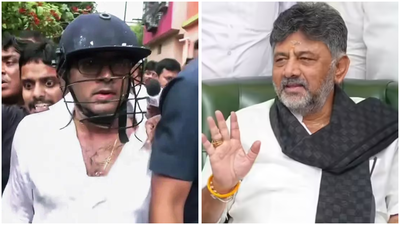
New Delhi: Deputy Chief Minister of Karnataka DK Shivakumar Siddaramaiah on Friday remained silent on the ongoing speculations regarding “nameplate” change in the state after his resignation from the post of Chief Minister.When asked about the “nameplate change”, Shivakumar said, “I will not open my mouth.”Earlier, while talking to reporters in Delhi, Shivkumar also refused to comment on the Rajya Sabha nomination. “There is no update at the moment. As discussed earlier, the central leadership will announce the list along with other states. This is the information available with us, and they will inform you later. This is not my domain…I don’t know. Some discussions and consultations are going on. The party high command will take the decision,” he said.Also read: After breakfast diplomacy, Sidda-DKS meet for lunch in DelhiThe development came a day after Siddaramaiah resigned as Karnataka Chief Minister and traveled to Delhi for a series of meetings with senior Congress leaders, including Rahul Gandhi and party president Mallikarjun Kharge.Shivakumar later confirmed that the Congress Legislature Party meeting will be held in Bengaluru on Saturday after consultation with the party high command. Congress leader Salim Ahmed said the meeting to be held at 4 pm, to be attended by KC Venugopal and Surjewala, is expected to formally announce the next chief minister, with DKS the clear frontrunner for the post.

CM created a tussle in the timeline.

The outgoing Chief Minister has rejected the Rajya Sabha nomination and has stated his preference to remain active in Karnataka politics rather than move into a central role. Congress general secretary Randeep Surjewala described Siddaramaiah’s meeting with Rahul Gandhi as “very pleasant” and asserted that “there will be no hindrance in the smooth transition of power in the state”.

Source link

3 bikers killed, 1 seriously injured as truck laden with onions overturns in Amethi. Lucknow news

3 bikers killed, 1 seriously injured as truck laden with onions overturns in Amethi
On the Tanda-Banda Highway, a truck loaded with onions went out of control and overturned on two motorcycles.

Lucknow: Three youths were killed and another seriously injured when a speeding onion-laden truck lost control and overturned on two motorcycles on the Tanda-Banda highway under Munshiganj police station area of ​​Amethi district late on Friday night. After the accident, the truck driver left the vehicle and ran away from the spot.This tragic incident happened near Lokipur village of Munshiganj area at around 12:30 in the night. According to the police, the onion-laden truck was heading towards Sultanpur from Gauriganj when the driver allegedly lost control in an attempt to avoid a motorcycle moving ahead of the vehicle. The speeding truck lost its balance and overturned on two motorcycles passing by.The collision spread panic among the people standing nearby, who reached the spot and informed the police. Local residents and police personnel carried out a rescue operation and pulled out the victims from under the overturned truck before taking them to the hospital.Two victims died on the spot, identified as Prince Verma (16), son of Shyamlal Verma, and Sunny Kumar (25), son of Ramdev Verma, both residents of Ghazipur village under Antu police station in Pratapgarh district.Another victim, identified as Raju, a resident of Sultanpur, suffered serious injuries and was taken to the district hospital. However, he died during treatment.The fourth victim, Ajit, a resident of Shravasti district, was seriously injured and is admitted to the district hospital, where he is undergoing treatment.Preliminary investigation revealed that the four youths were relatives and were returning home after attending a community feast (bhandara) when the accident occurred. This sudden tragedy plunged their families into grief and sorrow.On receiving the information, a team from Munshiganj police station reached the spot and supervised the rescue and recovery operations. After completing the legal formalities the bodies were sent for post-mortem.Munshiganj police station in-charge Shivakant Tripathi said the truck has been seized and efforts are being made to trace and arrest the absconding driver. The families of the deceased have been informed and further investigation into the circumstances of the accident is underway.Police are investigating all aspects of the case, including the speed of the vehicle and possible negligence on the part of the driver.

Source link

Vladimir Putin: Gene therapy, mini-pigs, organ printing: Putin’s $26 billion quest to beat aging

Gene therapy, mini-pigs, organ printing: inside Putin's $26 billion quest to beat aging
Vladimir Putin (file photo)

for years, Vladimir Putin He has created an image of a strongman who rides horses without a shirt, plays ice hockey and uses physical stamina as a symbol of political authority. But behind the carefully staged display of enthusiasm lies a much deeper passion that is now shaping Russian state policy: the pursuit of longevity.The latest sign of that ambition emerged through a Kremlin-backed scientific effort that includes gene therapy, organ printing, mini-pig organ cultivation and even ultralow-temperature cryotherapy, all under a $26 billion state initiative called “New Health Preservation Technologies.”The program has fueled new speculation about whether Putin, now in his eighth decade and already one of Russia’s longest-serving rulers, sees the science of aging not just as a health care innovation but as part of a broader quest to preserve power.A hot mic moment captured during Putin’s meeting with Chinese counterpart Xi Jinping at a military parade in Beijing last year indicated the Russian leader’s fascination with the expanse of human life, according to a report in The Wall Street Journal. Putin was heard discussing the possibility that humans could achieve immortality by replacing organs, a conversation many initially dismissed as eccentric banter between aging strongmen.Notably, the long-serving leaders of both Russia and China are of similar age, adding another layer to their conversations about longevity and power.But these comments appear to reflect a very real scientific agenda going on inside Russia.Last month, the Russian government announced that scientists were developing a gene-therapy treatment designed to slow cellular aging as part of a state-backed longevity initiative.“This drug represents one of the most promising methods in the fight against aging,” Deputy Science Minister Denis Sekirinsky said on April 23.Another pillar of the project involves the creation of human organs ready for transplantation in laboratories, one of the same futuristic ideas Putin reportedly referred to in Beijing. Russian researchers are now working on xenotransplantation as well as bioprinting, or 3D-printing living tissue, a process for growing human-compatible organs inside genetically modified mini-pigs.Scientists associated with state agencies claim to have already bioprinted human cartilage tissue and a mouse thyroid gland, with the ambition of achieving complete human organ replacement by 2030.“In the Russian Federation, work is underway on a whole range of scientific programs in this area,” the Kremlin press service said in an email. “These projects are supported by the state, and many scientists and research institutions are participating in them.”At the center of the initiative are two influential figures from Putin’s inner circle, his daughter Maria Vorontsova, who oversees several state genetics programs, and physicist Mikhail Kovalchuk, head of the Soviet-era Kurchatov Institute.Kovalchuk has become one of the intellectual architects of the Kremlin’s anti-aging campaign, often arguing that science will soon allow humans to constantly repair and replace body parts.“It is difficult to discuss immortality, but man’s ability to repair will undoubtedly increase,” Kovalchuk told Russian media.Unlike long-lived enterprises backed by Silicon Valley billionaires like Jeff Bezos, Sam Altman and Peter Thiel, however, Russia’s efforts have produced limited peer-reviewed scientific research.Critics say many of the bold claims remain ambitious, the WSJ reports.“If there are no publications there are no real results, and their statements should probably be taken not as dreams but as aspirations,” said Alexander Ostrovsky, a Russian scientist known for pioneering bioprinting research in the country.Ostrovsky later left Russia after the full-scale invasion of Ukraine and sold his company, which now reportedly cooperates with the government.“It is impossible to do science in isolation,” Ostrovsky said, referring to sanctions that have kept Russian researchers away from Western collaboration. “They are likely telling Putin what he wants to hear in order to secure funding.”Yet the Kremlin’s interest in anti-aging science extends beyond laboratories. Over the years, Putin and his allies have toyed with fringe theories, unorthodox medicine and broader civilizational concerns about the West.Kovalchuk once publicly warned that Western countries were moving towards the creation of “servant humans”, controlled people with manipulated reproduction and limited self-awareness. He has also promoted conspiracy theories regarding the Covid pandemic.Putin himself has long shown an affinity for similar narratives. Kovalchuk publicly praised the 1968 Soviet film “Dead Season”, in which the CIA conspires with former Nazi scientists to control humanity. Putin has said that the film inspired him to join the KGB.Another major influence was Vladimir Khvinson, often referred to in the Russian media as “Putin’s gerontologist”, who promoted peptide-based antiaging therapy derived from calf tissue.Khvinson argued that humans are biologically meant to live up to 120 years old and reportedly believed that preserving Putin’s health was vital to Russia’s stability.He later received one of Russia’s highest state honors directly from Putin before he died in 2024 at the age of 77.Putin’s personal commitment to physical decline is becoming increasingly visible in public life as well. During the Covid pandemic, the Kremlin imposed extreme quarantine measures around the Russian president, including disinfection tunnels and long-term isolation requirements for visitors. His famous long meeting tables became a global symbol of both political distance and outright germophobia.Western and Russian media have also repeatedly speculated about cosmetic procedures as Putin’s appearance appears to have noticeably smoothed over time.Even cryotherapy, in which the body is kept at temperatures as low as minus 170 degrees Fahrenheit, reportedly caught Putin’s attention. Former Austrian Chancellor Sebastian Kurz once recalled how Putin enthusiastically recommended the treatment during a meeting in the Kremlin in 2018.Much of Putin’s inner circle is itself aging. Many of Russia’s most powerful figures, including Yuri Kovalchuk, Sergei Chemezov and Nikolai Patrushev, are now in their seventies. In that sense, Russia’s state-backed longevity obsession reflects not just individual concerns, but the concerns of the entire ruling elite facing mortality.And yet, despite the Kremlin’s futuristic ambitions, Russia faces one of the harshest mortality rates in the developed world. The average male life expectancy in Russia is about 68 years, much lower than in the United States and most of Western Europe.Despite all the billions invested in anti-aging science, one reality still overshadows the Kremlin’s grand ambitions.Unlike elections, managing deaths remains difficult even for the Kremlin.

Source link

Rise of the Cockroach Janata Party: Understanding the Viral Phenomenon india news

Who will become the cockroach: Why are millions of people joining the Cockroach Janata Party? Theories behind the incident

A new, or 325 million year old, creature has just taken the subcontinent by storm. It was this “misinterpretation” of cockroaches being compared to humans that gave rise to a satirical online organization – Cockroach Janata Party.CJP). But what perhaps started as a simple joke or political satire for a few thousand people has captured the imagination and support of millions.The party’s manifesto demanded a ban on post-retirement Rajya Sabha seats for chief justices, media neutrality, 50 per cent reservation for women in Parliament and a 20-year election ban on MLAs and MPs who switch parties. The eligibility criteria for its membership were: ‘unemployed, lazy, online for a long time, ability to boast professionally.’While critics have questioned the purpose of the CJP, the fact remains that this “party” now technically has more followers than both mainstream political parties combined – BJP And Congress – Have been united. Accusations are made from both sides of the coin, people are on the fence and engagement is skyrocketing at even a single mention of this “party”. Why?Why is it resonating among millions of people? Or is it actually resonating?To understand this impact, one must situate memes within the contemporary attention economy, where scarcity of human attention has replaced scarcity of information (Lanham, 2006). The 21st century has seen a fundamental change in the way youth consume politics. They don’t even wake up to newspapers anymore. There are no longer news channels playing on TV as ambient noise in the evening. The medium is now in your hands – you scroll for knowledge. You scroll, you don’t see. You have to find what you want to know, it has to make enough noise over the other 1.5 billion posts made per day.

lack of attention

This is what Gil de Zuniga, Strauss, and Huber have called the “news finds me” perception. This explains why the initial comment on the cockroach comparison during a court hearing did not spread through court transcripts – it was interpreted through memes, which multiplied the excitement over the comment. When news has to be found for you through an algorithm, only the most unsettling pieces emerge. CJP is, at its core, a meme that you found and then became news. Its virality forced its changes and coverage. It is currently under this cycle that has retained its popularity. The moment he breaks from the cycle – what is his future?An organization like the CJP is almost a textbook case of what falls under Bakhtin’s carnival. According to Bakhtin, carnival is a licensed space where hierarchy is suspended, where the king can be mocked by the jester. The word cockroach was reportedly used to refer to unemployed youth. But then these comments got involved within the carnival itself, the people who had to bear the brunt of this statement formed a party against him and believe that this is wrong in Indian politics. Dissent within the political sphere is prevalent, expected and encouraged in social media but the popularity of this movement turns it into the definition of carnival. Yet the tent ultimately falls on whether CJP truly wants to become an entity of its own or just become a viral carnival.Poe’s law complicates any simple answer. Online, honest extremism and satirical extremism wear the same clothes. Is CJP a real political movement? a joke? a demonstration? The answer is all three together. Its obscurity protects it from fair persecution. Threats can be sent, allegations of being a Pakistani front can be made and accounts can be deleted. But at their core they are protected and political. You can’t capture a punchline. You cannot file an FIR against a meme. The CJP exists in a fog between sarcasm and sincerity, and that fog is its best defense and the reason its numbers can grow.Steps taken by some in power to curb CJP’s popularity, such as allegations and platform inefficiencies, are helping him remain popular. Each act of censorship brings new sign-ups, new attention, and fresh memes. This can be compared to the Streisand effect. Named after Barbra Streisand, who sued a photographer for removing an aerial photograph of her Malibu mansion from the public shoreline erosion collection in 2003. The photo had been downloaded only six times before the lawsuit. After she filed it, the image was viewed by more than 400,000 people. Trying to hide something made it impossible to ignore. The same logic applies here also.Social identity theory (Tajfel and Turner, 1979) explains the rest. People derive their sense of self from the groups to which they belong, and Homo sapiens is a social animal. We have an inherent need to belong. By calling themselves cockroaches, millions of young Indians aren’t just sharing a joke, they’re signaling membership. This membership was also inspired by those around them, there was group level consideration in the decisions made Because a lot of CJP’s membership did no background research on what and who they were supporting in an effort to be a part of something bigger, they created something extremely viral but also extremely empty. What does anyone really know about CJP? Do the founders even understand what CJP is?Memes have become the language of the internet. That means they have become the language of online politics. Accessible. Easy. No conflict. A meme asks nothing from you except a second of recognition. You don’t think about it. You watch it, it entertains you, you share it and you move on. This is why the form works. This is why it fails. The shared language is fine for basic conversation. But it struggles with depth. This allows you to not project any depth and still go viral but isn’t really critical. A party legitimized through AI and memes lacks the depth to be sustained or taken seriously.

anatomy of meme party

Which leads us to slothism.The Internet has made it incredibly easy to align yourself with a purpose. A follow button. A Google Form. Repost a story. CJP has mastered this low-inhibition engagement. you wanna join? Fill out this form. Do you want to show support? Repost this meme. Do you want to feel like you’re part of something? Here’s a hashtag. #MeTooCockroach. Done. Our purpose, something we ourselves are not entirely clear about, is something you stand by? Add a cockroach emoji to your username. You are now a member. You have contributed. You can scroll.But what does that actually mean?CJP’s eligibility criteria – unemployed, lazy, constantly online – is a joke. But it is also a mirror. What’s the point of membership if it only takes one click to join? If the primary activity of the movement is to share memes, what has really been accomplished?This is the slacktivism problem. The ease of online participation creates the illusion of influence. You hit follow. You sign a Google form. You repost a meme. You are feeling good. You feel like you’ve accomplished something. But do you have it? Carnival needs spectators. The meme needs to spread. But when the carnival is over, when the meme phase is over, what is left?We commend CJP for its impact. But we must not forget that membership is a form of social currency. And membership here also requires currency.CJP performs inclusively but is exclusive. People are talking about it. Member. People who are “in” on the joke. They are the elite people of our country. High class. upper middle class. English speaking. Constantly online by choice, not circumstance. They have the data plans, the tools, the hours of scrolling, the cultural capital to understand the contexts. They are the only people who can afford to be lazy.This is not a true people’s party. There may be a voting symbol in it. Social media can be taken advantage of in this. But beyond that, what’s really in it?

digital divide

The digital divide is not just about access to technology. It’s about access to culture. Memes require knowledge. Learning requires time. Time requires privilege. CJP’s humor is internal humor. If you don’t get the joke you are an outsider. And if you are an outsider then this movement does not matter to you.So who exactly is CJP for? The answer is inconvenient. This is for people like us. Educated. Joined together. Those who already have a voice.Its virility may potentially be the only trace left.

Source link

TG ICET Answer Key 2026 Released at icet.tgche.ac.in: Direct Link to Download Here

TG ICET Answer Key 2026 Released at icet.tgche.ac.in: Direct Link to Download Here

Telangana State Council of Higher Education (TGCHE) has released the preliminary answer keys and response sheets for Telangana Integrated Common Entrance Test (TG ICET) 2026 on May 29, 2026. Candidates who appeared for TG ICET can now check their entered responses and compare them with the official preliminary key through the official website.The examination was conducted by Kakatiya University, Warangal on behalf of TGCHE for admission to MBA and MCA programs offered by colleges across Telangana.With the release of answer sheet and master question paper, candidates can now estimate their probable marks before the final result is declared. The Council has also opened the objection window for students who want to challenge any of the answers mentioned in the preliminary key. Students are advised to carefully verify their responses with the official key to calculate their expected raw marks.The release of preliminary answer keys is considered an important step in the admission process, as it allows candidates to identify potential discrepancies before the final answer keys and results are declared.

TG ICET Answer Key 2026: Steps to download

Candidates can follow these steps to download TG ICET 2026 Answer Key and Response Sheet:

  • Visit the official website icet.tgche.ac.in.
  • On the homepage, go to the “Applications” section or ticker announcement area.
  • Click on the link titled “Download Response Sheet (TG ICET-2026)”.
  • Enter Registration Number, ICET Hall Ticket Number and Date of Birth.
  • Click on “Get Response Sheet”.
  • During the computer based test the response sheet with marked answers will appear on the screen.
  • Return to the homepage and click on “Master Question Paper and Preliminary Key”.
  • Download the answer key according to the session in which the exam was given.

Alternatively, candidates can click on the given link Here To download TG ICET Answer Key 2026.

Objection window is open till June 1

Along with the release of preliminary key, TGCHE has also started the process of online objection submission. Candidates who find any discrepancy in the official answers can raise objections through the online portal.The last date for submitting objections is June 1, 2026 till 5 pm. After reviewing all the objections submitted by the candidates, the Council will prepare the final answer key.

Source link