Top 10 countries with fastest growth of billionaires by 2031: Saudi Arabia, Poland and Sweden lead the global wealth race. world News

Top 10 countries with fastest growth of billionaires by 2031: Saudi Arabia, Poland and Sweden lead global wealth race

The next few years are expected to reshape parts of the global wealth map in ways that do not always match familiar economic narratives. Some of the fastest movements in the billionaire population are projected to occur outside the typical Western centres, with changes associated with capital flows, policy changes, technological expansion and regional investment cycles. Some countries show unusually sharp percentage jumps rather than steady growth, indicating concentrated bursts of wealth creation rather than slow accumulation. The pattern is not uniform, and it does not follow a single model of development. Instead, it looks like a scattered boom across Asia, Europe, and the Middle East, each driven by different local engines and timing effects.As reported by the World of Statistics (ex Twitter) post, projections for 2026-2031 highlight a sharp increase in the billionaire population, with selected global economies expected to have the fastest growing number of billionaires by 2031.

Countries with fastest growing number of billionaires by 2031

Post
Country
projected growth
1 saudi arabia 183%
2 poland 123%
3 sweden 81%
4 Australia 77%
5 denmark 75%
6 Japan 65%
7 Mexico 63%
8 philippines 63%
9 norway 53%
10 India 51%

Countries with the Highest Growth Rate of Billionaires Expected

saudi arabia

Saudi Arabia stands out with a leap that is far ahead of the rest of the list. This shift is often linked to ongoing economic diversification, where oil-related assets are increasingly deployed into new sectors such as logistics, tourism and large-scale infrastructure. Private capital is moving into areas that previously did not attract that level of attention.What makes this figure unusual is not just the shape but also the movement inherent in it. This suggests a relatively compact base of high-net-worth individuals that is growing rapidly rather than a broad, gradual spread.

poland

Poland ranked unexpectedly high due to a mix of manufacturing strength, technology outsourcing and deep integration with European supply chains. Wealth creation here feels less tied to old industries and more to new business structures, often as medium-sized companies enter global markets.There is also a sense of time. Capital that once flowed westward within Europe has begun to circulate more locally, allowing domestic entrepreneurs to maintain larger stakes in growing companies.

sweden

Sweden is showing steady growth rather than rapid disruption. Much of its billionaire growth is tied to technology, green industries, and export-heavy industrial clusters that have long operated internationally.The pattern here is less about sudden emergence and more about existing companies continuing to compound value in quiet ways. Ownership structures also matter, with long-standing family or founder shares increasing in value over time.

Australia

Australia represents a combination that is becoming increasingly visible: traditional resource wealth coupled with a growing technology sector. The luck associated with mining still plays a role, but new wealth clusters are forming around fintech, biotech and digital platforms.The growth rate suggests a system where capital cycles between old and new sectors without complete replacement. This overlap seems to be working quite well.

denmark

Denmark does not typically feature heavily in the global wealth discussion, yet the projected growth points to strong performance in companies involved in specialized industrial design, pharmaceuticals and renewable energy.It is a relatively small economy, which may exaggerate percentage movements, but the underlying businesses tend to be globally rather than domestic-facing.

Japan

Japan shows a more modest climb than emerging markets, but it is still notable given the already established wealth base. This shift is often linked to the impact of corporate restructuring, new shareholder focus and the gradual reopening of parts of its economy.Here wealth creation proceeds through large corporate ecosystems rather than fast-moving startup cycles.

Mexico

Mexico shows a mix of manufacturing expansion, particularly tied to near-term trends, and long-standing industrial houses expanding their reach. Proximity to US supply chains has changed investment patterns in subtle but persistent ways.Growth is not spread evenly, with some regions and sectors growing while others remain stagnant.

philippines

The Philippines is benefiting from service-based expansion, including outsourcing, remittance-linked consumption, and a gradually growing digital economy.Wealth accumulation here is often linked to service networks rather than heavy industry, giving it a different rhythm than resource-based economies.

norway

Norway shows more modest growth, shaped by energy-related capital and sovereign wealth effects. While not explosive, it remains stable, with wealth often concentrated in long-term holdings rather than rapidly traded sectors.

India

India features in the list with a lower percentage growth than some peers, albeit with a much larger base of entrepreneurs and family wealth. Technology services, digital platforms and manufacturing expansion all contribute to this movement.Growth feels distributed rather than concentrated, causing percentage changes to often be over-measured even if the absolute numbers are important.

Source link

Delhi government to launch CBDC-based smart ration distribution system for greater transparency and consumer choice india news

Delhi government to launch CBDC-based smart ration distribution system for greater transparency and consumer choice

New Delhi: In a major welfare-oriented decision aimed at expanding food security coverage in the national capital, the Delhi Cabinet has approved a proposal to increase the annual income eligibility limit for ration cards under the Public Distribution System (PDS) from Rs 1.2 lakh to Rs 2.5 lakh.The decision is expected to benefit lakhs of families across Delhi who were earlier excluded due to low income limits, a release said.Speaking on the Cabinet decision, Food and Supplies Minister Manjinder Singh Sirsa said that the Delhi government under CM Rekha Gupta is also working towards implementing a CBDC (Central Bank Digital Currency) enabled ration distribution mechanism.Under this system, financial assistance for ration will be deposited directly into the accounts of the beneficiaries, allowing them to purchase ration as per requirement through digital currency at ration shops.“This will increase transparency and eliminate mismanagement in the system,” Sirsa said.The minister said the proposed CBDC-based model will be gradually implemented at ration shops and integrated with banking systems, including private banks, in the future. The initiative aims to ensure efficient delivery of benefits, reduce leakages and empower beneficiaries to access food supplies with greater flexibility and dignity.CBDC in the PDS system refers to the use of central bank digital currency to deliver food subsidy benefits to beneficiaries, instead of relying only on physical food grain distribution through Fair Price Shops (FPS) or unrestricted cash transfers to bank accounts. CBDC is a digital form of sovereign currency issued by the Reserve Bank of India and has the same legal status as physical currency.Under the proposed CBDC-based PDS model, the government will calculate the subsidy equivalent to the entitled food grain and transfer the amount to the CBDC wallet of the beneficiary. Beneficiaries will be able to purchase ration from authorized FPS shops after authentication through Aadhaar/e-POS system, wherein all transactions will be digitally recorded and adjusted for greater accountability.The CBDC-enabled PDS model is expected to make the system more transparent, portable and citizen-friendly, the release said. This mechanism will provide beneficiaries greater flexibility in choosing authorized outlets, real-time visibility of subsidy eligibility and transaction history and a robust grievance redressal framework through digitally traceable records.This model is also expected to reduce disputes at FPS levels, strengthen audit trails, improve monitoring of subsidy utilization and simplify reconciliation processes.CM Rekha Gupta had earlier talked about increasing the income limit for ration card eligibility in Delhi.To benefit more and more low-income families, the income eligibility limit has been increased from Rs 1 lakh to Rs 1.2 lakh and now to Rs 2.5 lakh.“Earlier, the income eligibility for a ration card was very low. Today, even an annual income of Rs 1 lakh is below the minimum wage level for a family. Keeping this in mind, the Rekha Gupta-led Delhi government has increased the income limit to Rs 2.5 lakh so that more eligible families can avail subsidized ration under the PDS system,” Sirsa said.“The Delhi government under the leadership of Chief Minister Rekha Gupta is also working towards implementing a CBDC (Central Bank Digital Currency)-enabled ration distribution mechanism,” he said.He said, “Under this system, financial assistance for ration will be deposited directly into the accounts of the beneficiaries, enabling them to purchase ration as per requirement through digital currency at ration shops. This will increase transparency and eliminate mismanagement in the system.”

Source link

Byju’s founder Raveendran sentenced to six months in jail for contempt of court: Report

Byju's founder Raveendran sentenced to six months in jail for contempt of court: Report
Byju Raveendran (file photo)

Byju Raveendran, founder of collapsed edtech company Byju’s, has been sentenced to six months in jail by a Singapore court in a contempt case, people with knowledge of the development told Bloomberg.The court directed Raveendran to face jail term after he failed to comply with several court orders related to his assets from April 2024.He has also been asked to surrender to authorities, pay legal costs of S$90,000 (about $70,500) and submit documents establishing his legal ownership of Beaar Investco Pte, an entity that holds shares in an affiliated company.The decision is another blow to the entrepreneur, who is already facing legal challenges from foreign investors in multiple jurisdictions. In the United States, lenders are attempting to recoup losses associated with $1.2 billion of loans.According to the report, it is not clear whether Raveendran is currently in Singapore or any other country.Raveendran founded Think & Learn Pvt Ltd, widely known as Byju’s, which once emerged as one of India’s biggest startup success stories and turned him into a billionaire amid increased interest from global investors in Indian technology firms.He is currently facing legal action in Singapore on behalf of a subsidiary of the Qatar Investment Authority, which participated in a funding round for the edtech company during a period when the company was cutting jobs and scaling back operations.Qatar Holdings was represented by Drew & Napier in the case, while Byju Investments was represented by Fervent Chambers, the report said.(This is a top Google Trends topic.)

Source link

Ugandan returnee quarantined in Bengaluru amid Ebola alert; No case has been confirmed yet. india news

Ugandan returnee quarantined in Bengaluru amid Ebola alert; No cases have been confirmed yet

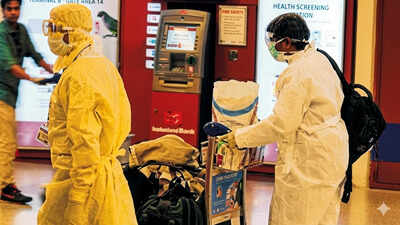
New Delhi: A traveler who recently traveled from Uganda has been quarantined at a government hospital in Bengaluru after complaining of mild body ache, prompting heightened surveillance by the Center amid the Ebola outbreak in parts of Africa.The Union Ministry of Health and Family Welfare on Wednesday said the man has been admitted to the state-run Epidemic Diseases Hospital in Bengaluru for observation and further evaluation. Officials said the man is otherwise healthy and stable except for mild body pain.A sample has been collected and sent to the National Institute of Virology for laboratory testing, the results of which are still awaited.The ministry stressed that there is no case ebola virus disease This has been confirmed so far in India.“In view of the recent Ebola virus outbreak in parts of Africa, the Government of India is closely monitoring the emerging Ebola virus disease situation,” the ministry said in a statement.Health officials said the Centre, in coordination with the Karnataka government and other concerned agencies, is keeping a close watch and all necessary public health protocols are being followed in line with World Health Organization guidelines.The government said screening and surveillance measures are continuing at designated points of entry and in the public health system as part of preparedness efforts.The ministry also urged citizens not to panic or spread misinformation and advised people to rely only on official sources for updates related to the Ebola situation.

Source link

RCB vs GT: Rajat Patidar starts discussion with six-hitting masterclass in Dharamshala. cricket news

Rajat Patidar kicks off the buzz with six-hitting masterclass in Dharamshala

TimesofIndia.com in Dharamshala: On the eve of IPL 2026 Qualifier 1 against Gujarat Titans (GT), the Royal Challengers Bangalore (RCB) captain Rajat Patidar He said that he wants to change a perception about him that he likes to play spinners; Instead, he believes his game is more suited to fast bowlers.He had said, “This year I have dominated fast bowlers more. There is a perception about me that I play spinners better. But if anyone asks me, I always say that I like fast bowlers.” And the numbers don’t lie. Patidar has hit 41 sixes in this year’s IPL, 27 of which have been against fast bowlers. He has scored 486 runs in 14 matches, but the statistics do not fully reflect the impact he has made. Batting at number 4, he has scored five half-centuries and scored runs at a strike rate of 196.76.On Tuesday evening, before the picturesque HPCA Stadium in Dharamshala lit up with a laser show, it was Patidar who set the stage on fire. The 32-year-old player performed one of the most brilliant innings of the season, scoring a brilliant 93 runs in 33 balls. It was an innings built on timing and relentless intent. He hit nine sky-high sixes, seven of which were against fast bowlers. Among them, Kagiso Rabada had an extraordinary hit in the seventh over. The right-handed batsman made a comeback and easily lofted a good length delivery over cover for a maximum. It was a stroke that perfectly reflected the confidence and authority with which he batted. Patidar’s innings did not explode immediately. He worked his way through the start with measured singles and calm accumulation, rotating the strike while allowing the innings to settle. At that time, RCB had lost two set batsmen in quick succession in the form of Devdutt Padikkal and Virat Kohli. Patidar’s approach was one of patience rather than immediate aggression.His first significant statement came in the 11th over when Jason Holder dropped short and Patidar immediately shifted his weight onto the backfoot and pulled the ball deep into the stands over mid-wicket. This shot not only completed RCB’s century but also reduced the pressure that was building.There were also moments of good fortune. In the 12th over, against Prasidh Krishna, a big shot attempt took an inside edge which went past Jos Buttler, resulting in a bye. Soon after, Patidar survived a major scare when a leading edge flew over the wicketkeeper’s head and fell safely among the gathered fielders. In the same over, a pull shot almost ended his innings but Rabada gave a direct chance in the deep.

Dharamshala, May 26 (ANI): Royal Challengers Bangalore captain Rajat Patidar...

Royal Challengers Bangalore captain Rajat Patidar plays a shot during the Indian Premier League 2026 Qualifier 1 match against Gujarat Titans at the Himachal Pradesh Cricket Association Stadium in Dharamshala on Tuesday. (ANI)

Those moments proved costly for GT.Patidar started scoring runs rapidly against Kulwant Khejroliya in the 15th over. An ill-timed stroke reached the ropes, before he used the angle of the delivery brilliantly to hit a stylish six over long leg. He finished the over by clearing the ropes again and then finding the boundary, collecting 28 runs in a pace-change that strongly turned the contest.The spinners also did not get any relief.Rashid Khan, usually one of the toughest bowlers to dominate, became Patidar’s next target. A slightly shorter delivery disappeared over long-on, dancing with the spin and hitting it with complete freedom, before Patidar finished the over with a brilliant inside-out six over cover.The attack against Rabada intensified. Patidar brought up a blistering half-century off just 21 balls with a ferocious pull over deep midwicket and then immediately followed it up with that brilliant back-foot drive over cover. Some batsmen attempt this type of stroke against fast pace; Even fewer execute it so cleanly.

Rajat Patidar

Till this situation, Patidar looked invincible.The next loss was to Mohammed Siraj. A wide full toss was clipped over backward point for six runs, before another over-pitched delivery was launched for four runs. Patidar had entered a phase where almost every scoring opportunity became a boundary.In the last over of RCB’s innings, Prasidh Krishna felt the full force of Patidar’s final attack. A fulltoss on the hips went missing over backward square leg for six. Another powerful hit straight at the bowler took him into the nineties.Patidar almost single-handedly changed the momentum of the innings. He survived the pressure, rode his luck and then destroyed both pace and spin with equal authority. His 93 was more than just a collection of runs; This was a display of fearless batting.

Source link

IPL 2026 | ‘It’s a terrible question’: Glenn Phillips loses his cool during press after GT’s playoff loss to RCB cricket news

IPL 2026 | 'It's a terrible question': Glenn Phillips loses his cool during press after GT playoff loss to RCB
Glenn Phillips (screengrab)

New Delhi: Royal Challengers Bengaluru completely defeated Gujarat Titans in IPL 2026 Qualifier 1, winning by 92 runs after posting a massive score of 254/5. Rajat Patidar He played a brilliant inning of 93 unbeaten runs with the help of nine sixes and five fours in just 33 balls. Virat Kohli And Krunal Pandya also scored 43 runs as the GT bowlers struggled badly under pressure.Gujarat’s chase never really materialized as their top order collapsed early on. Shubman Gill, Sai Sudarshan and Jos Buttler were all out cheaply, leaving the team with a lot to do. Ultimately GT was out for 162 runs.Gujarat Titans batting after the match glen phillips Attended the press conference despite not being part of the playing eleven. During the conversation, a reporter asked whether GT had mentally given up after seeing RCB score 254. This question apparently troubled Phillips, who strongly rejected the suggestion.“It’s a silly question. It’s a really silly question. No one goes out there waiting to be like, ‘Oh, you know what? We’ll just drop it.’ Why would we do this as professional cricketers? It’s a terrible question,” he told reporters.“We went out there, we did everything. Unfortunately, when you’re trying to chase 250, everything has to be perfect. And we went out there to try to do everything right, and obviously that didn’t happen.”Phillips said that chasing such a big score always creates pressure and every small mistake becomes costly.Phillips acknowledged that scoreboard pressure played a large role in the collapse but insisted that the team gave its all on the field.“There’s huge scoreboard pressure when you’re trying to chase 250. And, you know, very few teams have done that,” he said.

Source link

What is the Tower of Babel? Pope Leo XIV compares AI risks to ancient Biblical warnings world News

What is the Tower of Babel? Pope Leo XIV compares AI risks to ancient Biblical warnings

Pope Leo XIV has referenced one of the Bible’s most famous stories, the Tower of Babel, when warning about the rapid rise of artificial intelligence. In recent comments about AI ethics and global technological power, the pontiff compared the modern AI race to the ancient Biblical story of humanity attempting to build towers that reach to the heavens. The purpose of the comparison was to warn against uncontrolled ambition, concentration of power, and the pursuit of technological progress without moral responsibility. By referencing Babel, Pope Leo XIV highlighted concerns that artificial intelligence could deepen confusion, inequality and social division if developed without ethical boundaries and human oversight.

What is the Tower of Babel?

The Tower of Babel is a story from the Book of Genesis in the Bible. According to the legend, humanity once shared a single language and began building a city and a tower in the land of Shinar, often associated with ancient Mesopotamia. The builders said that they wanted to make a name for themselves and build a tower whose top would reach heaven.In the story, God confuses the language of the people so that they cannot understand each other, and creation stops. People are then scattered throughout the earth, and the place is called Babel, which the Biblical text associates with the confusion of human language. The story has traditionally been interpreted as a warning about human pride, ambition, and the limits of human power.

Why did Pope Leo XIV use the Babel comparison?

Pope Leo XIV used the Tower of Babel as a symbolic warning about the direction of modern technology, especially artificial intelligence. His comments focused on fears that AI could become a tool of excessive control and centralized power if governments and technology companies pursue innovation without ethical safeguards.The Pope suggested that, like the builders of Babel, modern society risks believing that it can overcome all limitations through technological progress alone. He warned that AI systems designed without accountability could undermine the truth, increase misinformation and diminish human individuality by treating people as data rather than human beings.The comparison also reflected concerns about global reliance on a small number of powerful AI developers. According to the Pope’s broader message, technology should serve humanity rather than dominate it.Over the centuries, the Tower of Babel has become an enduring symbol of failed human ambition, communication breakdowns, and the dangers of achieving power without knowledge. Pope Leo XIV’s AI warning shows how the ancient story is being used to explain modern global challenges.

Source link

Karnataka CM discussion: DKS, Siddaramaiah to meet over breakfast on Thursday. india news

Karnataka CM discussion: DKS, Siddaramaiah to meet over breakfast on Thursday

New Delhi: Amid growing speculation about possible leadership change in Karnataka, Deputy Chief Minister… DK Shivakumar Scheduled to attend the breakfast meeting called by the Chief Minister Siddaramaiah At 9 am on Thursday at Kaveri, the CM’s official residence in Bengaluru.The meeting comes a day after intense discussions between the Karnataka leadership and the Congress high command in Delhi, intensifying discussions over a possible change in the state’s top post.According to party sources, Siddaramaiah and Shivakumar met Congress president Mallikarjun Kharge, opposition leaders Rahul Gandhi, KC Venugopal and Karnataka in-charge Randeep Surjewala separately for over six hours on Tuesday.Sources told TOI that Rahul Gandhi is understood to have asked Siddaramaiah to consider playing a national role in the party and respond within a week. The Congress leadership is also believed to have discussed a possible Rajya Sabha seat for the Karnataka Chief Minister as part of the leadership change plan.Speaking to reporters after the meetings in Delhi, KC Venugopal dismissed reports of leadership change and said the discussion was limited to the upcoming Rajya Sabha and Legislative Council elections. He termed these reports as “speculation”.However, party insiders said Siddaramaiah conveyed that he had no ambitions in national politics, although Rahul Gandhi was keen to bring in the experienced OBC leader at the national level to strengthen the party organisation.The latest development is being seen as a major breakthrough for Shivakumar, who has long maintained that he was promised a rotational chief ministerial arrangement when the Congress formed the government in Karnataka after the 2023 assembly elections.Sources also said Siddaramaiah sought time to consult loyalists before taking a final decision. After returning from Delhi, the discussion is expected to continue in Bengaluru also.The Congress leadership is understood to be working towards a negotiated transition to avoid internal instability like the crisis seen in Rajasthan during the party’s previous rule.

Source link

Siddaramaiah to meet his loyalists in Bengaluru today as Congress mulls leadership change in Karnataka; DK Shivakumar is waiting. bengaluru news

Siddaramaiah to meet his loyalists in Bengaluru today as Congress mulls leadership change in Karnataka; DK Shivkumar is waiting
Karnataka Chief Minister Siddaramaiah is consulting his loyalists in Bengaluru after crucial Delhi talks on possible leadership change.

New Delhi: After over six hours of intense discussions with the Congress leadership, including Mallikarjun Kharge, Rahul Gandhi, KC Venugopal in Delhi, Chief Minister Siddaramaiah is scheduled to meet his loyal ministers and MLAs in Bengaluru on Wednesday, escalating fresh speculation over leadership change in Karnataka.The Congress high command is understood to have proposed a negotiated transition plan under which Siddaramaiah could be catapulted into national politics as a Rajya Sabha member and in a bigger organizational role. The deliberations followed marathon meetings of Congress president Mallikarjun Kharge, Rahul Gandhi, KC Venugopal and Karnataka in-charge Randeep Surjewala on Tuesday with Siddaramaiah and Shivakumar amid growing talk of a possible cabinet reshuffle.While the Congress officially denied that leadership change was discussed, party insiders indicated that the issue dominated the deliberations as the high command sought a formula that would ensure a smooth transition without creating factional unrest.Siddaramaiah is understood to have told the leadership that he has no ambitions in national politics, but Rahul is said to have stressed that the Congress wanted his experience and OBC reach at the national level. Sources said Siddaramaiah sought time to consult his loyalists before taking a final decision.Sources said that during the one-on-one meeting, Rahul Gandhi asked the experienced leader to consider taking responsibilities at the national level and to respond within a week.The latest development is being seen as a big boost for Shivakumar, who has consistently said that a rotational chief minister system was discussed when the Congress formed the government after its victory in the 2023 assembly elections. Shivakumar’s supporters argue that depriving him of the top post following his role in rebuilding the party organization could damage the morale of the Congress’s Vokkaliga support base and cadre.Also, given his strong influence among backward classes, minorities and Dalits through the Ahinda social alliance and government guarantee schemes, Congress leaders are wary of destabilizing the Siddaramaiah camp.Party insiders said the leadership is keen to avoid a Rajasthan-like factional crisis and hence is insisting on a consensus-based change in leadership rather than confrontation.The uncertainty has left ministers and cabinet contenders in a dilemma, with many MLAs lobbying for a cabinet reshuffle along with the leadership issue. There are currently three cabinet posts vacant in the Congress, and leaders from both camps are closely watching the next round of consultations for clues on the final decision of the high command.

Source link

“Worried about getting sued”: Hasnabi accuses Fox News of running “stalker operation” during heated livestream

"worried about getting sued": Hassanabi during heated livestream on Fox News
Twitch streamer Hassanabi criticized Fox News after the network referenced the 2025 “Collargate” controversy involving his dog Kaia during a segment about his federal subpoena related to his trip to Cuba. Responding to the stream, Hasan accused the network of employing “literal stalkers” and called its coverage a “stalker operation.” He argued that the evidence had already refuted the key allegations and expressed disappointment when the controversy resurfaced months later.

Hassan Pikar found himself in the headlines again this week when a Fox News segment reignited the controversy that many viewers had previously written off from public discussion. The popular Twitch streamer reacted live to comments made during a broadcast that referenced allegations involving his dog, Kaya, while discussing an unrelated federal subpoena linked to his March 2026 trip to Cuba.The moment quickly gained popularity online. What appeared to be a passing comment during the segment turned into a sharp response from Hassanabi, who accused the network of focusing on a controversy that he believes has already been addressed.

Hassanabi responds after Fox News references dog collar controversy

During a recent livestream, Hasan watched a Fox News clip in which a reporter discussed his legal situation and then unexpectedly mentioned concerns about the so-called “Collargate” controversy. This comment appeared to take the dreamer by surprise.Responding to the segment, Hasan argued that mainstream outlets face stricter standards than social media users when discussing sensitive allegations.“They can’t even say it… because they’re worried about being sued. Isn’t that ridiculous? Fox News is trying to entertain it, but they can’t, like, completely say it because random… people chirping on the Internet, obviously, don’t have the same fear. But when you’re a mainstream media outlet, there’s a level of editorial control; so they can only point it out, they can’t completely lean into it. You know?”The streamer’s frustration grew when he saw references to his dog appear in the segment. He then said one of the most talked about lines in broadcast reaction.(A Fox News reporter says, ‘I made sure we had a picture of Kaia…’) This is crazy, brother! This is a Fox News Sunday program! What do you mean?! I literally have stalkers on the payroll, man!”

Hassanabi accuses Fox News of running a “stalker operation”

As the discussion continued, Hassan turned his attention to the excessive surveillance of his content and personal life. He refuted claims that Kaya spent all day sitting on his back during watercourses and argued that publicly available evidence already refutes that narrative.“Brother, your own stalker operation literally…destroyed the meta. Not only did it prove it’s a…vibration collar, but it also proved she goes on long walks all day! So, obviously, she…isn’t sitting behind me all day; she’s literally…out in pictures! I know, it doesn’t matter. None of that…matters. But Jesus Christ, dude! This is so weird!”The latest round comes amid ongoing tensions between Hassanabi and conservative media outlets. Meanwhile, the discussion has spread across streaming communities, and fellow creators and viewers continue to debate both the controversy and the media attention it has received.

Source link