

From lab to market: IISc team, surgeons develop dissolvable stent to cut down on second surgeries india news
BENGALURU: A tiny, disintegrating tube developed in a Bengaluru lab is moving a step closer to hospital use, offering a way to avoid repeat procedures after major abdominal surgery.The device, called the “Asthana Stent”, is the result of a collaboration between liver transplant surgeon Sonal Asthana at Aster CMI Hospital and researchers led by Kaushik Chatterjee at IISc, spanning the departments of materials engineering and bioengineering.It has now been licensed under an Indian patent to Advanced MedTech Solutions Pvt Ltd, marking the transition from a laboratory prototype to a product that can reach the operating room.The idea originated from a frequently observed problem after liver transplantation. Surgeons must connect the bile ducts, a delicate connection that can later leak or narrow. These complications affect 11% to 40% of patients and often require a second procedure to correct.
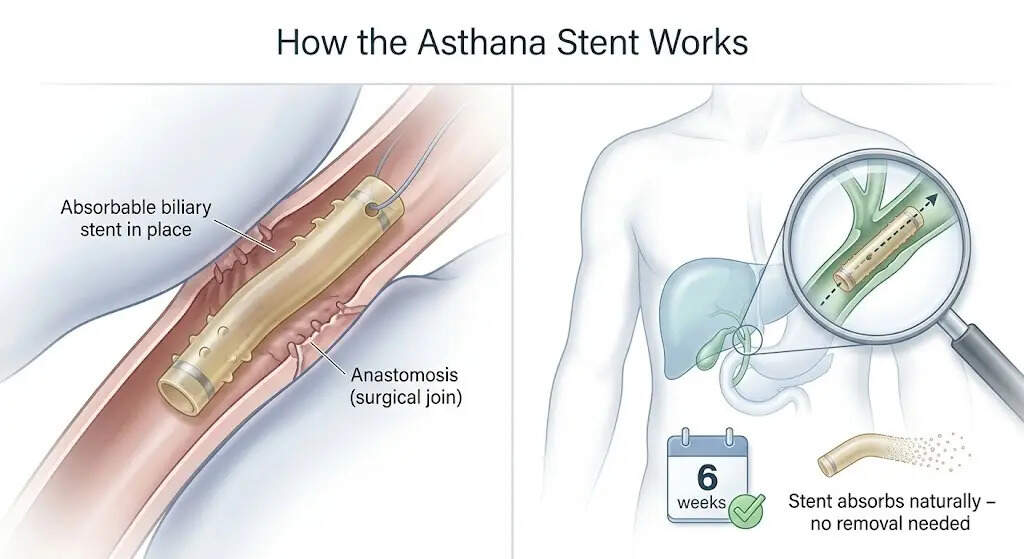
Current solutions rely on a plastic tube or stent to keep the vessel open while it heals. But these come with trade-offs. Some are protruding outside the body and require careful management. Others remain inside but must be removed later through an additional procedure, adding cost and risk.“The new stent takes a different approach. It is made of polydioxanone (PDS), a biodegradable polymer already used in dissolvable surgical sutures. Once placed inside the body, it keeps the vessel open for about six weeks, then slowly breaks down and is absorbed. It does not need to be removed,” the research team said.Converting that idea into a working device required engineering work by Thaseeb Rahman of the Department of Materials Engineering at IISc and Saswat Chaudhary of the Department of Bioengineering. The team designed the tube to stay open under pressure and resist migration using surface ridges and Velcro-like hooks, while a flexible middle section allows placement even if the duct opening is misaligned. Small radiopaque markers allow doctors to track it using X-rays.“Tests showed that the stent could withstand more than 16 newtons of pressure, far greater than bile ducts experience. It maintained its structure for up to six weeks in both laboratory conditions and human bile, covering the critical treatment window,” the researchers said.Now with the technology licensed, the focus has turned to manufacturing and approval. The company will take it through the regulatory scrutiny prescribed by the Central Drugs Standard Control Organization (CDSCO). The project has also received support from the Indian Council of Medical Research (ICMR).If approved, the stent would be used only during surgery and would be available in several sizes. For patients, the benefits are straightforward: one operation instead of two, and less chance of complications after going home.