
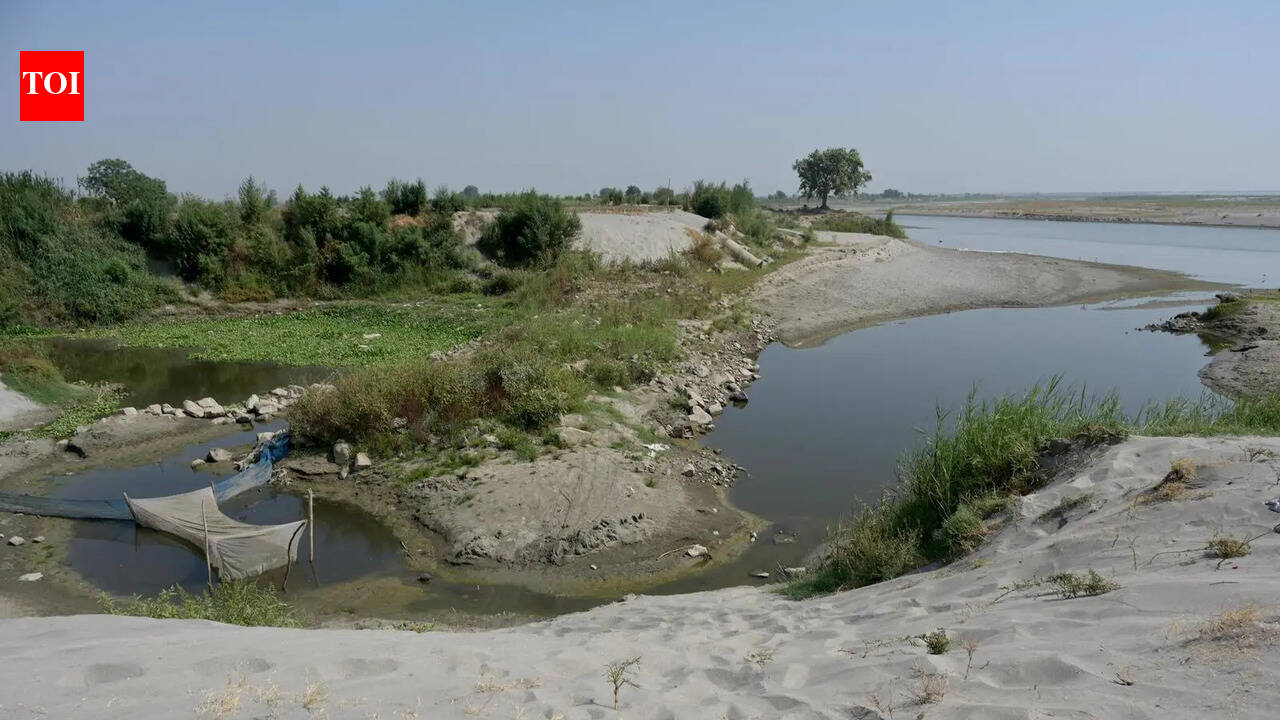

Why Yamuna has now become a brown narrow stream. delhi news
New Delhi: At the point of flowing from Haryana into Delhi, the Yamuna has been reduced to a thin brown stream. The stream, surrounded by open sand dunes and dry river beds, has made it easy for people from villages in Delhi and Haryana to cross the river. Uttar Pradesh On foot.For villagers living along its banks in this region, parts of the river turning into shallow, stagnant pools of water are an annual sight.on wednesday, times of India Visited Palla village in north Delhi, where the Yamuna enters the city, and saw children, knee-deep in water, using a narrow channel to cross from villages in one state to another. Bullock carts carrying agricultural produce were running on this river route from Palla and Dahisra villages of Haryana to Sankrod in UP.The Yamuna shrinks significantly between the end of winter and the beginning of summer, resulting in a perennial river turning into an almost seasonal river in its upper and middle section, including Delhi. Rajpal Singh (71), a retired bailiff from Delhi’s Irrigation and Flood Control Department, said, “Every year, around this time of the year, it is reduced to a thin stream. Haryana’s drain number eight releases water into the river only during the monsoon. With limited amount of water being released into it from Haryana in the summer, the Yamuna is no longer a river.”As per an official mandate, Haryana’s Hathnikund barrage is releasing just 9.9 cumecs (352 cusecs) of water into the Yamuna. “However, this is very low and cannot meet the ecological needs of the river. Moreover, this water can travel barely 10 kilometers in summer through vast stretches of flood plains, which involves seepage and evaporation,” said Bhim Singh Rawat, a Yamuna activist and associate coordinator of the South Asia Network on Dams Rivers and People. He said a study by the National Institute of Hydrology in 2019 had recommended an inflow of 23 cumecs in the low rainy season.The total length of Yamuna flowing through Delhi is about 52 km, out of which 22 km is highly polluted.Rawat said, “Natural depressions and sinkholes have formed upstream of the bridges, giving a false impression that the water level is satisfactory. The Yamuna no longer looks like a river in the summer season, as it does not have adequate water level throughout the year except the monsoon.”Manu Bhatnagar, principal director of the Indian National Trust for Art and Cultural Heritage (INTACH), said the condition of the river is critical this year. “During the lean season, it is fed by melting snow in the Himalayas and groundwater seepage. However, snowfall was less this winter. Additionally, the ongoing heat wave is leading to reduced evaporation, making the situation worse than normal.”Pointing towards the brown waters of the river at Palla, Singh recalled that about 30 years ago, he would often check the water level there and would find lots of fish. Singh, a resident of Bakhtawarpur village, said, “However, I have not seen a single fish in this area for many years. Even two decades ago, the Yamuna water was largely clean. However, now it is so dirty that I cannot see anything. The river is slowly dying.”No response was received from Delhi government regarding Yamuna turning into a brown stream.Recent testing of the river water quality has revealed that of the eight locations from where samples were collected on April 7, the water in Palla was found to be the least polluted. However, the last monitoring station in Delhi, Asgarpur (after the confluence of Shahdara and Tughlakabad drains) was the most polluted. Dissolved oxygen, the level of which should be 5 mg/litre or above in the river, was within the norm only at Palla (5.2 mg/litre) but was zero at six other locations. Dissolved oxygen indicates the possibility of survival of aquatic life in the river.Fecal coliform, an indicator of untreated sewage in the river, was recorded at 2,800 MPN/100 ml in Palla, but rose to 3,10,000 in Asgarpur. The safe limit is 2,500, and the desired level is below 500.The shrinking and dirty river has affected the lives of the people dependent on it. Farmer Vinod Kumar said, “We have grown up drinking Yamuna water but now it is impossible to do so. In summers, we used to bathe in the river for hours to get relief from the heat. But due to its polluted water, we have stopped this practice for many years.”The picture changes considerably during monsoon. While the water level at Delhi’s Old Railway Bridge stood at 200.9 meters at 1 pm on Wednesday, it reached 207.4 meters last September – the third highest level recorded in the city. Recalling last year’s flood, Devendra Singh of Palla village said that his field, in which he had sown ridge gourd and paddy, was destroyed due to intrusion of river water.