
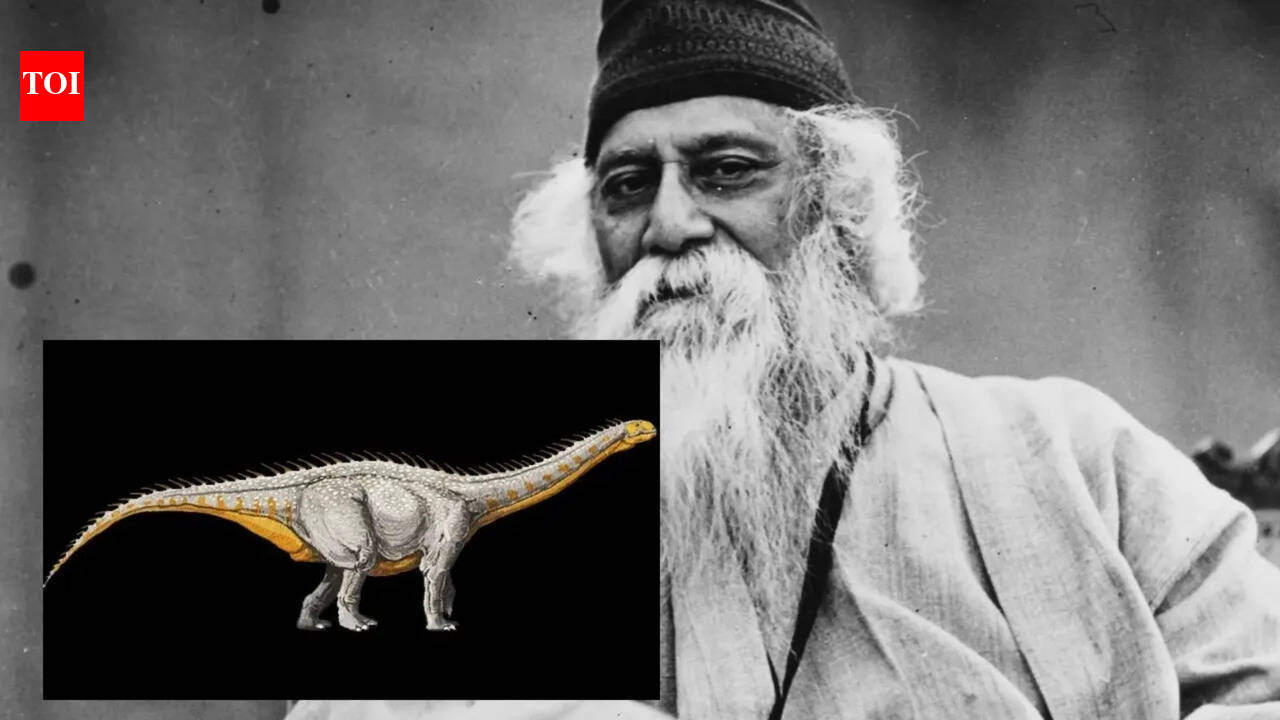

Did you know that the Jurassic dinosaur was named after Rabindranath Tagore? Meet Barapasaurus tagori
It would not be an exaggeration to say that Rabindranath Tagore It is one of India’s most famous – and deservedly so – majorities ever. His legacy spans poetry, music, philosophy, education and national identity. He wrote India’s national anthem, became the first non-European Nobel laureate in literature, transformed Bengali art and culture, and influenced generations beyond South Asia.But it turned out that Tagore’s legacy touched more than just this. However, what almost no one knows is that his name became associated with something completely wild: a Jurassic dinosaur.Yes – there’s a dinosaur named Barapasaurus tagori, and its story is pure science-meets-culture magic!
Barapasaurus tagori: Dinosaur named after Rabindranath Tagore
Meet Barapasaurus tagori: This dinosaur was a giant, long-necked vegetable eater that roamed the land during the Early Jurassic, about 180 million years ago. The fossils were found in India and, once the dust settled, scientists realized they had found one of the oldest and largest sauropods ever known – think of it as a prehistoric “gentle giant”!Now, the story begins in the 1960s near Pochampalli in today’s Telangana. Indian paleontologists from the Indian Statistical Institute dug out the bones from inside rocks dating back to the Jurassic period. Immediately, they knew this was no ordinary find – these were the bones of a creature that didn’t look like any other dino found in India.When he officially named the species in 1975, he called it Barapasaurus tagori. “Barapa” is Bengali for “big foot”, which fits, since this dinosaur originally walked on stilts. “Saurus” means lizard in Greek. and “Tagori?” This is to honor Tagore, his 100th birth anniversary. So, basically, the national poet of India has now been, forever, linked to a bus-sized dinosaur.For some reason, it just feels right!Barapasaurus belonged to the family of sauropods, which had huge, massive bodies, awkward necks, and small heads. Most people know of the later, even larger sauropods like Diplodocus and Brachiosaurus, but Barapasaurus was the beginning of the “Can a dinosaur be huge?” There is an initial experiment in.In fact, experts believe that Barapasaurus was about 14 meters long and weighed several tons. Its massive limbs and body already show the classic sauropod blueprint: super-sized, but not as huge as some of its futuristic cousins. At the time, India was a lush dinosaur paradise, still part of the southern supercontinent Gondwana, so the scene there looked nothing like it does today.This is the crazy part – today’s India, full of bustling cities, cricket and monsoons, used to be a straight-up dinosaur feeding ground. The land was rich in forests and rivers, and long before there was tea or Tagore’s poetry, herds of dino-giants roamed here and there.
Rabindra-Solar Crossover
Now, although it dates back to the prehistoric era, Barapasaurus tagori holds great significance in science.Why?For a long time, India did not have any big name in the discovery of dinosaurs. The discovery of these fossils changed this, putting India on the paleontological map. There were so many bones there – multiple individuals, multiple skeleton parts – that scientists got a clearer picture than most ancient discoveries.But now, you can actually see the skeleton of Barapasaurus tagori by visiting the Indian Statistical Institute in Kolkata. It is one of the largest vehicles ever installed in India. There’s something hilarious (and a little heartwarming) about a dinosaur named after Tagore, on display in the center of his own city.However, this is not that unusual, as scientists often name species after writers, artists, and great thinkers. But Tagore’s case seems special. He wrote much about the universe, nature and time; He’ll probably appreciate being part of the strange, ancient web of life. Plus, imagine the Indianness of Dino: it’s thoroughly Indian – a world where poetry, dinosaurs and philosophy collide without warning!And really, that’s the beauty of it: Rabindranath Tagore lived just over 80 years, while Barapasaurus – 180 million!Yet now, thanks to a group of determined scientists, they are linked forever. The human story and the prehistoric story overlap in the most unexpected ways.After all, it’s not every day you hear, “Did you know that a Jurassic dinosaur was named after Tagore?” But once you do, you know you’ll never forget it. And honestly, given Tagore’s thoroughness and worldview, he would probably be pleased!