

Agni-6: Pakistani journalists enraged by posing on India’s Agni-6; How US Secretary of War Peter Hegseth responded india news

A Pakistani journalist got stuck on a key factual detail when asking US War Secretary Pete Hegseth at the Shangri-La Dialogue in Singapore on Saturday for Washington’s view on India’s alleged “Agni-6 ICBM test”, a missile test which India has not officially conducted.The question came amid discussions on nuclear deterrence and long-range missile programs in South Asia.Referring to recent US concerns over Pakistan’s potential intercontinental ballistic missile (ICBM) ambitions, the journalist asked Hegseth: “Recently Pakistan’s potential ICBM program was identified as a threat to the US. I wanted your comment on India’s Agni-6 ICBM test with a range of ~12,000 km which could potentially put the US and parts of Europe within reach.”However, India has not announced or confirmed any testing of the Agni-6 missile.
Hegseth avoids taking the bait
In his response, Hegseth refused to consider either India or Pakistan a threat to the United States.“India and Pakistan are two nuclear-capable countries. I think both sides will see understandable threats coming from each other, maybe some of them we will see differently, and countries will want to develop ICBM threats,” he said.“But we, at least from our perspective right now, are not pointing the finger at any country and calling them a threat to us, and we are grateful for the benefits they have given to peace around the world, in each of their lanes.”His remarks echo comments he made earlier at the summit, where he said the two countries would continue to view each other through the prism of security concerns.
Confusion over India’s recent missile test
The question appears to stem from speculation surrounding India’s missile launch earlier this month.Ahead of the test, there was widespread discussion that Defense Research and Development Organization (DRDO) Chairman Sameer V Kamat said that India is preparing to conduct the flight test of Agni-6 as the organization is technically ready and is awaiting government approval.India had also issued a notice to airmen (NOTAM), leading to speculation.
For several hours after the launch, defense observers speculated that India had finally test-fired the Agni-6, a missile often described as a future intercontinental-range system with a potential strike range of more than 10,000 kilometers.However, the Defense Ministry later clarified that the test involved the advanced Agni missile equipped with Multiple Independently Targetable Re-entry Vehicle (MIRV) technology instead of Agni-6.
what did india actually test
The ministry confirmed that the missile was successfully test-fired from Dr APJ Abdul Kalam Island off the Odisha coast and carried multiple payloads aimed at various targets spread over a large area of the Indian Ocean region.
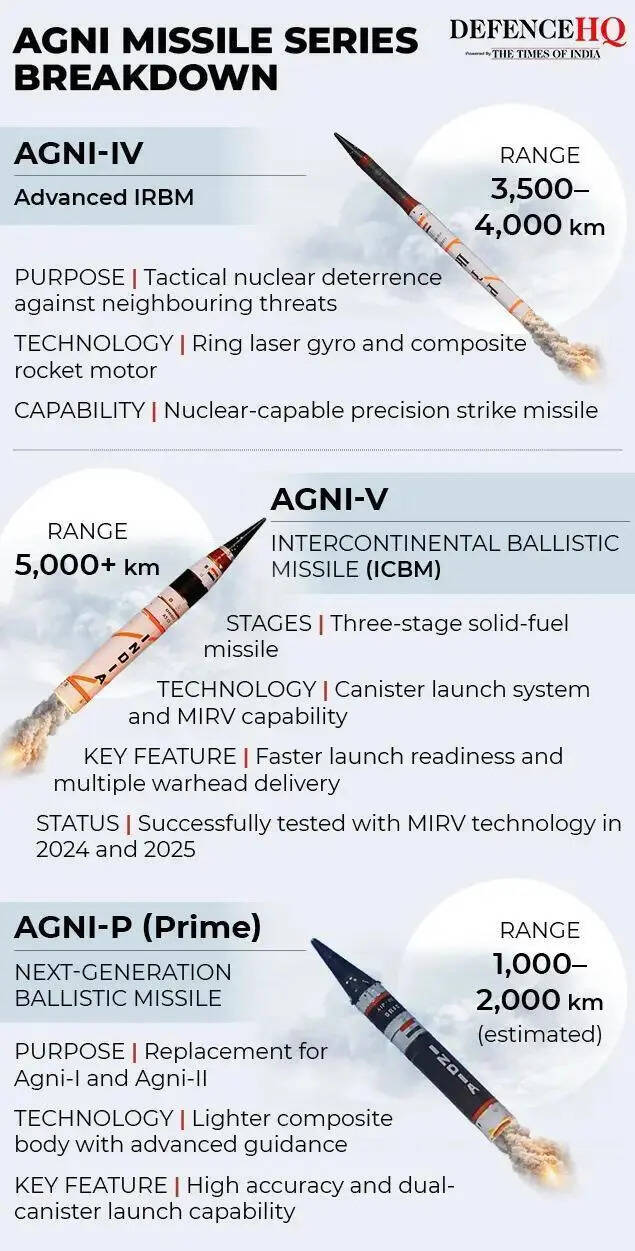
The launch marks the second publicly known test of the MIRV-capable Agni-5 variant, also known as “Mission Divyastra”. MIRV technology enables a single ballistic missile to carry multiple warheads capable of striking different targets, significantly increasing its effectiveness.India’s officially declared Agni-5 has a range of over 5,000 kilometres, covering large parts of Asia, including China. The government has not officially disclosed the existence, specifications or testing timeline of the Agni-6 missile.
Pakistan’s focus is on Indian missile capabilities
The questioning also comes in the backdrop of Pakistan rejecting a US intelligence assessment that cited Islamabad’s missile program as among the potential long-term threats to the United States.Responding to the allegations, Pakistan’s Foreign Ministry argued that its missile program was aimed solely at deterrence against India and claimed that “India’s development of missile capabilities of more than 12,000 kilometers reflects a trajectory that extends beyond regional security considerations”.The ministry’s comments came after then US intelligence chief Tulsi Gabbard identified Pakistan as one of the countries posing the greatest nuclear threat to the United States, along with Iran, China, Russia and North Korea.He said these countries are actively developing new missile delivery systems capable of carrying nuclear and conventional weapons, which could potentially target the US.While speculation about the Indian ICBM program has continued for years, New Delhi has not announced any testing of the missile, which has a declared range of about 12,000 kilometres.