


How to protect your money when the rupee is falling?

The rupee is falling and your investment portfolio is at risk. India may be a fundamentally strong growth story, but you may get negative returns on your investments right now. As the US-Iran conflict impacted the economy dependent on fuel imports, the currency witnessed a sharp decline, requiring continued intervention by the RBI.Is the rupee’s depreciation impacting your investment returns? What should investors do to protect their portfolio in the current scenario? The first thing to understand is that basically, a falling rupee does not have a direct impact on your investments.However, it indirectly affects the performance of your investments through its impact on the economy, growth, inflation and others. A weak rupee increases the cost of imports, which could lead to inflation and impact interest rate policy. For a retail investor, the impact depends on what they hold and why the rupee is weakening in the first place.
What impact can falling rupee have on your portfolio?
As Nirav R Karkera, head of research at W by Grow, points out, for home equities, the impact is not uniform. Export-oriented companies, IT services, pharma and other businesses with dollar revenues may get some benefits. Import-heavy sectors, dollar-cost companies, or businesses taking foreign currency loans may come under pressure. A weaker rupee could also make Indian equities less attractive for FPIs as their dollar returns diminish, and this could increase volatility at a time when global risk appetite is already weak. Carcera says the main channels for fixed income are inflation and interest rates. If rupee weakness drives imported inflation through oil, commodities or other inputs, it could limit the RBI’s scope for rate cuts and make long-term debt more vulnerable.
So what should you do?
Many lessons can be learned for portfolio allocation and diversification amid global economic turmoil. Experts and financial planners TOI spoke to had some general tips to share:continue SIPdon’t chase currency movesExperts believe that one of the biggest mistakes investors make is taking drastic portfolio decisions after the rupee falls. Instead of panic-driven reactions, stay calm, invested for the long term. don’t ignore goldAt such times, gold acts as a portfolio insulator. With a falling rupee, gold has historically acted as a hedge during currency weakness, inflation and geopolitical uncertainty. Simply put, when the rupee weakens, domestic gold prices often get an additional boost from currency movements. Experts recommend adopting the digital route – ETFs, mutual funds – instead of physical gold.Nirav R Karkera points out that gold is a more direct beneficiary in rupee terms as domestic gold prices reflect both global gold prices and exchange rates. In the current environment, gold is also being supported by global risk aversion and central bank diversification. Karkera told TOI that gold should still be treated as a portfolio hedge and not a return guarantee.But Mukesh Kumawat, director, Anand Rathi Wealth Ltd, cautions. During these uncertain times, gold has traditionally served as a safe asset, however, with speculative activity, it has turned into a volatile asset in recent times. Therefore, while gold is an important portfolio diversifier, it should not be treated as a primary wealth producer.
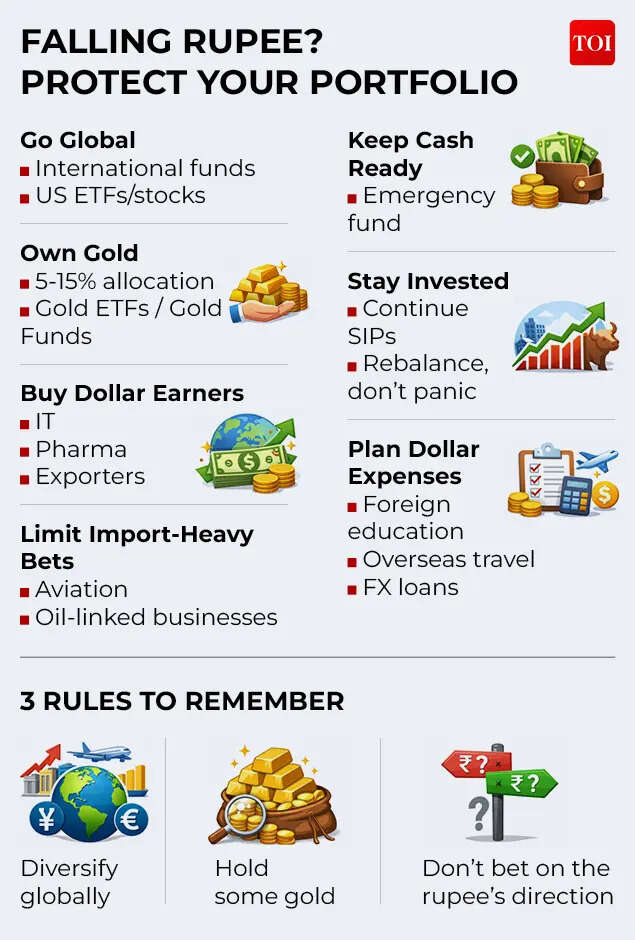
own some global assets like US stocksWhat the falling rupee does is that when it is converted back into rupees it automatically increases the value of foreign investments. Investors may consider allocating a portion of their equity exposure to international funds, ETFs or global stocks. For example, experts say US-focused funds can provide a natural currency hedge.Rohit Shah, financial planner, tells TOI that for most long-term investors, 15-25% in international assets is a reasonable range. The exact number should depend on goals (such as foreign education or retirement), risk profile, and overall portfolio size. “This allocation should be done gradually over time rather than making a big change after a sharp fall in the rupee. The idea is not to bet against India but to ensure that some portion of the money is in hard currencies and global businesses,” he told TOI.Nirav Karkera cautions: International exposure should be viewed first as diversification, and only then as currency hedge. International equities and dollar assets can benefit from rupee depreciation when translated back into rupees, but investors should remember that currency gains can be offset if the underlying asset performs poorly. So, the rupee is an important variable, but it should not become the sole reason for investment.

Export-Import Dynamics – Look for companies that benefit from rupee depreciationBe it IT services, pharmaceuticals or others – export-facing sectors become beneficiaries of the falling rupee. A significant portion of their revenues come from foreign markets and are earned in foreign exchange.On the other hand, experts say sectors facing pressure due to import dependence can be avoided. Higher import costs could impact profitability if companies cannot pursue growth.“A weaker rupee generally helps dollar-pegged assets. Foreign equity funds may also gain in rupee terms. On the other hand, many Indian companies face higher input costs on imports, which could hurt margins and sentiment. Over time, export-oriented businesses may gain competitiveness, while import-heavy sectors may struggle. Rupee weakness has been quite common over the decades; “The key is to plan around it and not try to predict every move,” says Rohit Shah.Mukesh Kumawat says when it comes to equities, export-oriented sectors like IT, pharmaceuticals and specialty chemicals may benefit from higher rupee earnings, while import-oriented sectors may face margin pressure due to rising input costs. Debt instruments, ETFs are in focusDebt instruments are not directly affected by rupee depreciation, however, a weaker rupee could contribute to higher inflation, pushing up interest rates and bond yields in the near term. Mukesh Kumawat says that this may create near-term instability in long-term debt funds.“On the other hand, foreign funds like international funds/ETFs can help investors benefit from the appreciation of foreign currencies and underlying asset performance against the rupee,” he says.Maintain Adequate Emergency SavingsA weak rupee could boost inflation by increasing the cost of imported goods, fuel and travel. Therefore, it would be wise to keep some emergency funds with you. Also, as experts have suggested – it is important to review your foreign exchange liabilities such as overseas education schemes, foreign currency loans and international travel commitments.
basic investing lessons
Analysts and experts are clear on one aspect: the falling rupee should not be seen as a single investment signal. Investors should consider that currency movements are often driven by temporary factors such as geopolitical events, oil price fluctuations, capital flows and global risk sentiment.

“If we look at the historical data of currency movements during geopolitical conflicts it is usually limited and temporary, in major conflicts since 1990, the average depreciation of the rupee during war periods was about 3 to 4% and in extreme cases like the Libyan civil war, the rupee weakened by about 10%, but eventually it recovered and over time, it has more impact on economic growth, inflation, capital flows, forex than just geopolitical events. “Will be driven by domestic macroeconomic fundamentals such as reserves and policy actions,” says. Mukesh Kumawat of Anand Rathi Wealth Limited.“Investors are suggested to avoid making investment decisions based on short-term trends and instead, are recommended to start building a strategy-based portfolio by diversifying 80:20 across equity and debt. And for equity exposure, investing in actively diversified equity funds helps to gain exposure across sectors, segments, and reduces the concentration risk associated with the performance of any one segment, and helps to ride out market cycles. Does,” he added.Experts urge investors to resist panic-driven investment decisions. Financial planner Rohit Shah says, “A very weak rupee will impact overseas education and travel costs the most, so more allocation to those goals may be required. Domestic equity returns may be muted or volatile for some time. It is a good idea to review asset allocation, stress-test your plan for flat or falling markets and check if you have enough “dry powder” in safe assets to weather the shock and deploy calmly when the opportunity arises.”Acknowledging that a move towards 100 would be psychologically important for the rupee, Nirav Karkera said this should not lead to panicked portfolio decisions.“The first step is to understand why the rupee is weakening. If the move is driven by a stronger dollar, oil prices, geopolitical risks or temporary FPI outflows, the portfolio reaction will be different from a situation where the weakness is driven by domestic macro tensions. “The reason matters more than just the rate,” Karkera tells TOI.For now, investors should focus on portfolio preparedness rather than forecasting. This, he added, means maintaining adequate liquidity, avoiding excessive concentration in long-term debt, maintaining some allocation to gold as a hedge and using international assets only where they fit into the long-term asset allocation.He advises, “Investors with known dollar expenses should not wait for the last minute. They should consider meeting those needs gradually through a planned and sequenced approach. Investors with only rupee liabilities should not rush into dollar assets as the currency is approaching a round number.”(Disclaimer: The recommendations and views given by experts on the stock market, other asset classes or personal finance management tips are their own. These opinions do not represent the views of The Times of India.)