


US tech expert in Bengaluru shocked by ‘99% score’, says he wouldn’t survive India’s exam
 As Clore passed the board, he recorded rows of names and percentages, many of them close to whole numbers. He appeared surprised when reading them aloud. “This is why I would never have made it as a student in India. I mean look at the competition,” he said in the video.He then responded to several points listed on the board, including very high percentages. Reading out the names and symbols one by one, she said, “Tanishka 99.3 per cent… leave a little for the guys. I mean Ruchi got straight 99 flat,” Clore added.Online users reacted to Tony Clore’s video and the scale of pressure and competition within the Indian education system. One user said, “Sadly, even after studying so hard, many students struggle to get high-paying jobs.”Another comment said, “It’s population-like numbers…that’s why Japan is on top when it comes to actual education.”Some users pointed to competition, saying, “Competition is the reason why there is no real growth. Every child has his own strengths and weaknesses.”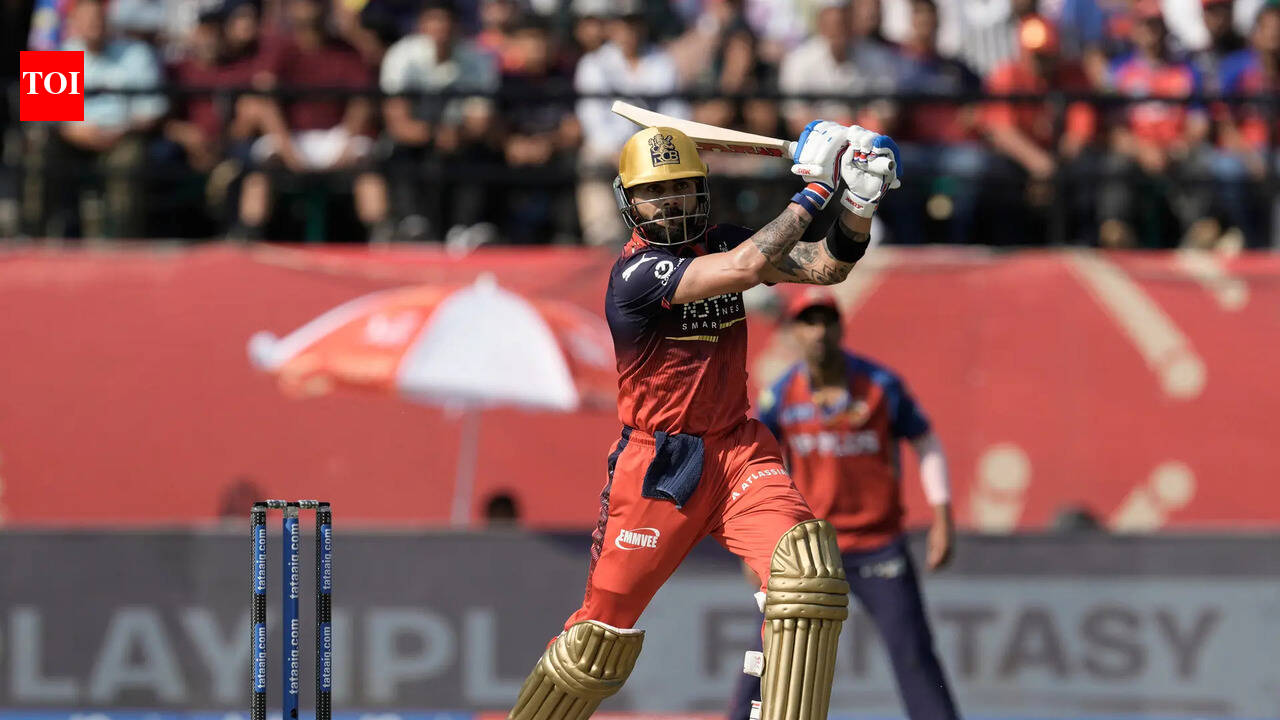
IPL 2026 rewrites the record books with historic rise of totals to over 200

Virat Kohli of Royal Challengers Bangalore (AP Photo/Ashwini Bhatia)
Indian Premier LeagueThe batting revolution has reached another peak in IPL 2026, where even a score above 200 no longer guarantees safety. Royal Challengers Bangalore scored 222/4 against Punjab Kings on Sunday, officially registering their 53rd 200-plus score in the tournament this season – the highest ever in a singles. IPL version.Highest total of more than 200 in an IPL edition53 in 202652 in 202541 in 202437 in 202318 in 2022The trend over the past few years makes this number even more staggering. IPL 2025 had previously set a record with 52 scores above 200. Earlier, IPL 2024 had seen 41 such scores, while IPL 2023 had seen 37. Go back just four years to IPL 2022, and the number was only 18. This growth perfectly reflects how dramatically T20 batting has evolved. Aggressive powerplay intent, fearless middle-order hitting and expert finishers have completely changed the definition of a “good total” in the IPL. The introduction of the impact player rule has tilted the balance towards the batsmen, allowing teams to field an extra hitter, while giving players even more freedom to attack with the first ball. What was once considered a match-winning score is now often seen as an equaliser. RCB’s innings against PBKS was another reminder of that change. Virat Kohli Laid the foundation by scoring 58 runs in 37 balls, while Devdutt Padikkal maintained the pace by scoring 45 runs in 25 balls. but he was Venkatesh Iyer Who completely changed the innings by scoring unbeaten 73 runs in just 40 balls. Even after crossing 220, RCB still could not feel completely safe as such totals are increasingly becoming chaseable in modern IPL cricket. Earlier this season, Punjab Kings chased down 265 against Delhi Capitals, which perfectly reflects the fearless batting era that has entered the league. Batsmen are now attacking from the very first ball, teams routinely score more than 10 runs per over throughout the innings and the death overs have become boundary-hit showdowns. A score of 200 is no longer extraordinary in IPL 2026. This is just the starting point of the competition.
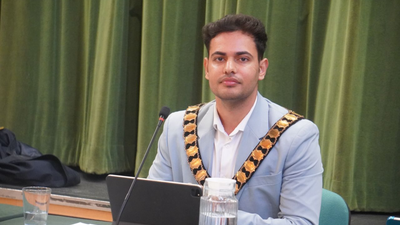
23-year-old Tushar Kumar becomes Britain’s youngest Indian-origin mayor of Borehamwood
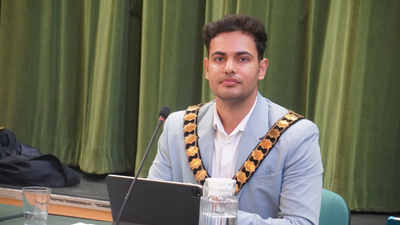 The appointment was confirmed during the council’s mayoral creation ceremony held at Fairway Hall in Borehamwood on 13 May.Tushar Kumar studied political science at King’s College London and served as deputy mayor before taking up the formal role this year. He has also been involved in local civic and community initiatives in Borehamwood.Kumar described the appointment as an “incredible honour” and said he was grateful for the support he has received during his political journey.“From studying political science at King’s College London to now serving as mayor of my favorite city, this journey has truly been surreal,” Kumar said.Kumar also thanked outgoing Mayor Dan Ozaro for his guidance and support during his tenure as Deputy Mayor.“A special thank you to outgoing Mayor Cllr Dan Ozaro for his dedicated service to our city over the past year and the guidance and support he has given me as Deputy Mayor,” he said.Linda Smith was appointed Deputy Mayor for the upcoming civic year.Kumar said he hopes to focus on community engagement, supporting local charities and encouraging more youth to participate in public service.He said, “As mayor, I want to focus on being present within the community, supporting local organizations and charities, and inspiring more young people to get involved in public service and community life.”
Indian among dead in massive Ukrainian drone attack in Russia; Zelensky calls the attack ‘justified’

New Delhi: An Indian employee was killed and three were injured in a major drone strike by Ukraine in the Moscow region on Sunday, the embassy informed.“An Indian employee lost his life and three others were injured in a drone strike in the Moscow area this morning. Embassy officials visited the site and met the injured workers in the hospital. The embassy condoles the loss of life and is working with company management and local authorities to provide necessary assistance to the workers,” a post on Twitter said.Ukrainian President Volodymyr Zelensky said Kiev’s attack on Russia was “completely justified”, coming just days after a massive Russian drone and missile attack on the Ukrainian capital that killed at least 24 people.He said, “Our reactions to Russia’s prolongation of the war and its attacks on our cities and communities are fully justified. This time, Ukrainian long-range sanctions reached the Moscow region, and we are telling the Russians clearly: their state must end its war.”Russian officials said about 600 Ukrainian drones targeted the country overnight, killing four people, in what Ukrainian President Volodymyr Zelensky described as “completely justified” retaliation for Russia’s continued attacks on Ukraine. Russia’s Defense Ministry said air defense systems destroyed 556 drones overnight, while another 30 were intercepted after daybreak, making it one of the largest Ukrainian drone attacks of the war so far. The ministry said the interception occurred in 14 Russian territories, as well as Russia-annexed Crimea off Ukraine and the Black and Azov Seas.

Chinmayi Sripada reveals how dubbing for Trisha in Surya’s ‘Karuppu’ brought back Vijay’s ‘Leo’ memories

In form of Suriya And Trisha Krishnan As the starrer ‘Karuppu’ continues its strong, blockbuster run at the global box office, singer and dubbing artiste Chinmayi Sripada has shared a very sensitive note regarding her participation in the project. Chinmayi on X (formerly Twitter) confessed that she was “really scared” of revealing that she had dubbed for Trisha, admitting that the studio session became a huge emotional trigger that brought back painful memories of the critical reaction she faced during Vijay’s ‘Leo’.
Chinmayi Sripada says she was ‘really scared’
After the audience appreciated her dubbing work, Chinmayi went to X to tell about her emotional state. “What’s weird is that I am preparing myself to say this as I was actually scared this time, to share what I dubbed Karuppu (sic),” she wrote on X (formerly Twitter).The singer said that she was worried for some time.
Chinmayi expressed concern RJ Balaji and his family
Chinmayi said that one of her biggest concerns is filmmaker RJ Balaji. He feared that his association with the project might expose him and his family to unwanted criticism. Her past experience during ‘Leo’ made Chinmayi particularly cautious. She described RJ Balaji as someone whom she respects a lot.“I have known RJ Balaji for a long time – he and his wife, are very lovely people and RJB himself, is a man whose entire life has been a story of grit, determination and a hard-working individual who works very hard to make his dreams come true. Maybe because I knew him and his family so well, I was scared for him about what pushback he would get based on the experience with Leo last time. I remember thinking of a few scenes in the film I cried a lot while dubbing – it was a big trigger, almost like everything I saw from the past, on the big screen. @RJ_Balaji I am grateful for this opportunity. Thanks for giving me the opportunity to dub for Trisha. And I hope Karuppu Sami will help me work on my home ground without any fear about what will happen next. Lord help me and others who have been banned from working for years to lift the ban. #KaruppuBlockbuster”
‘Karuppu’ stars Suriya and Trisha Krishnan
‘Karuppu’ stars Suriya and Trisha Krishnan in lead roles. The film has received tremendous support from the audience since its release. According to Sacanilc, Karuppu earned Rs 23.40 crore in India on Saturday. This marks a 51 percent increase from its opening day collection of Rs 15.50 crore. In just two days, the worldwide earning of the film has now reached Rs 66.04 crore.

Dozens arrested at Tommy Robinson march in London; Elon Musk called Britain a ‘prison island’

London saw one of its largest security operations in recent years as thousands of people gathered for far-right activist Tommy Robinson’s “Unite the Kingdom” march as well as a huge pro-Palestinian Nakba Day rally.The demonstrations sparked a £4.5 million police operation amid fears of violent clashes between rival groups.According to The Independent, the Metropolitan Police said at least 43 people were arrested for “various offences” at both events, although officials said the demonstrations were “largely without significant incident”.Police also said the investigation into several additional hate-crime allegations related to the pro-Palestinian protests was ongoing.More than 4,000 officers, supported by 660 personnel from forces outside London, were deployed across the capital.Police horses, dogs, drones, helicopters and armored vehicles were also used as officials described it as an “unprecedented” security challenge.
Elon Musk Britain was called a ‘prison island’
Reacting to the events, billionaire entrepreneur Elon Musk resumed his criticism of the UK government and free speech laws.Posting on X in response to Robinson, Musk wrote: “Thousands of British people jailed simply for social media posts or speaking out, they need to be released!”“No more prison islands!!” He added.Responding to Musk’s comments, Robinson wrote: “Thanks as always to Elon for saving free speech, for giving the world a true 360° view of everything. Without X, none of this would be possible. We will unite the States and the West.” The future belongs to patriots.”Musk has repeatedly criticized the way the UK government deals with immigration and freedom of speech issues, previously claiming that Britain risks becoming George Orwell’s “worst nightmare”.
Confederate flags, anti-Starmer slogans dominate Robinson rally
Robinson’s supporters marched through central London waving union flags and chanting slogans such as “We want Starmer out” and “Tommy, Tommy, Tommy Robinson”.Many protesters wore red “Make England Great Again” hats, while others carried wooden crosses and shouted “Christ is King”.Addressing supporters from a stage in Parliament Square, Robinson urged followers to become politically active ahead of the next UK general election in 2029.“Are you ready for the Battle of Britain?” he asked the crowd. “If we don’t send a message in our next election… we will lose our country forever.”The event also included speeches from media personality Katie Hopkins, former TV presenter Ant Middleton, actor-turned-activist Laurence Fox and former Conservative MP Andrew Bridgen.

The truth behind teenage ‘attitude’ and ‘mood swings’

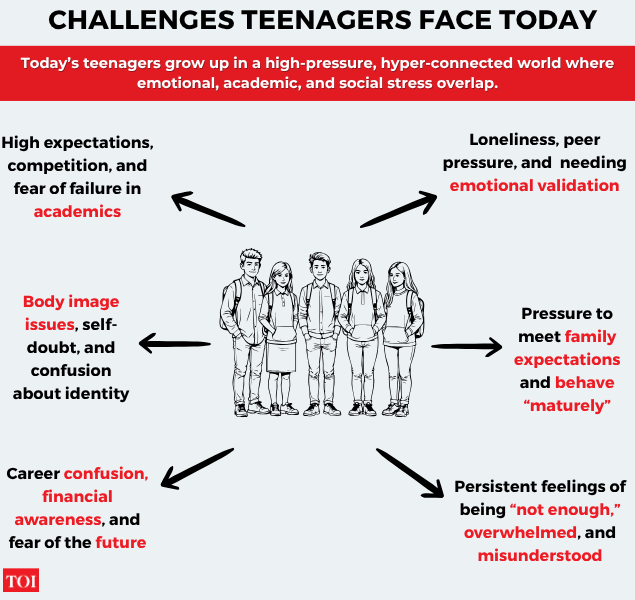
“Teenagers are dramatic.”“It’s just a phase.”“They’ll grow out of it.”Being a teenager sometimes means having your emotions questioned before they are even understood. Frustration is dismissed as “attitude”, sadness becomes “mood swings”, anger becomes “phase” and exhaustion is labelled “laziness”.Thus, for parents, teenage can often seem difficult to understand or manage as they navigate the complicated transition into adulthood. There is often little conversation about what it actually feels like to be a teenager today and what if there’s something actually wrong that no one seems to get.The key to understand here is, not every teenage reaction is serious, but not every emotional outburst is meaningless drama either. Sometimes, what adults dismiss as a “phase” may actually be stress, loneliness, anxiety, burnout, or simply the feeling of being misunderstood.As 19-year old Kritika told TOI, the disconnect often comes from how differently teenagers and adults experience pressure. “The kind of competitiveness and pressure teenagers face today has increased drastically, especially with academics, social media, and constant comparison online,” she said, adding that many struggles faced by teenagers today are “more mental and digital rather than physical or practical.”So let’s dive into why the gap between teenagers and adults comes up.
Mature or a child?
Teenagers exist in an awkward space between childhood and adulthood. They are expected to behave maturely, make decisions about their future, and take responsibility for their actions. At the same time, their emotions are frequently invalidated because they are considered “too young” to fully understand themselves.According to clinical psychologist Akshitara, co-founder of mental health-linked startup ‘That Desi Psychologist’, one of the biggest overlooked issues among teenagers today is “emotional invalidation.” She explained to TOI that many adolescents, in many cases, are navigating emotionally unavailable environments,” but are still frequently labelled “too sensitive” or accused of overreacting.
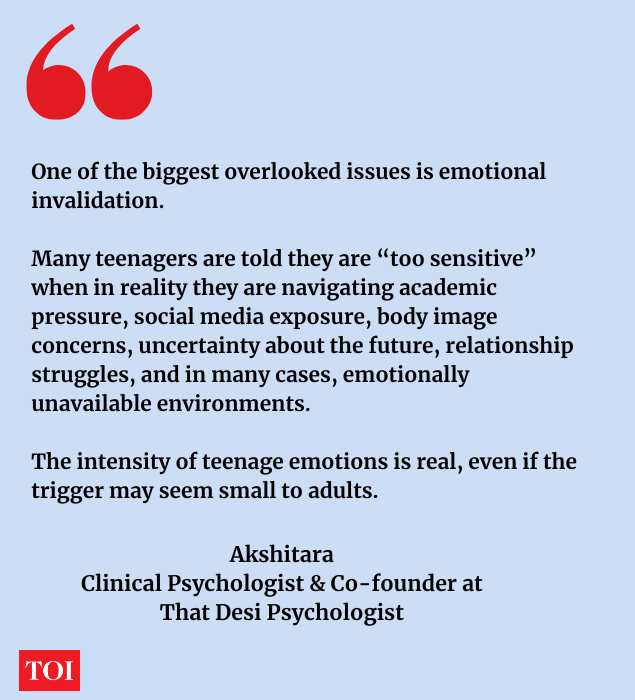
She added that teenagers often “may not always have the emotional vocabulary to explain distress,” which is why emotional struggles may appear through “irritability, withdrawal, anger, avoidance, poor academics, excessive phone use, or tantrums” instead of calm conversations adults expect.This contradiction often shapes how adults respond to teenage behaviour. Emotional reactions are dismissed more quickly because teenagers are expected to “grow out of it” rather than be understood in the moment.
‘Speaking different emotional languages’
Part of the disconnect also comes from the fact that teenagers and adults often approach emotional struggles very differently.As Kritika, 19, highlighted how generational differences often shaped conversations at her home, as she reflected on navigating the last year as teens and now stepping into the pressure-pool of adulthood.
Sometimes I was trying to explain how something affected me mentally or emotionally, while adults focused more on practical things like discipline, studies, or future consequences
Kritika, 19
Similarly, 17-year-old Dhruv told TOI that emotional conversations with adults often felt disconnected. “We say, ‘I feel overwhelmed,’ and they hear, ‘I can’t handle responsibility,’” he said, adding that “Sometimes it honestly felt like we were speaking two completely different emotional languages.”
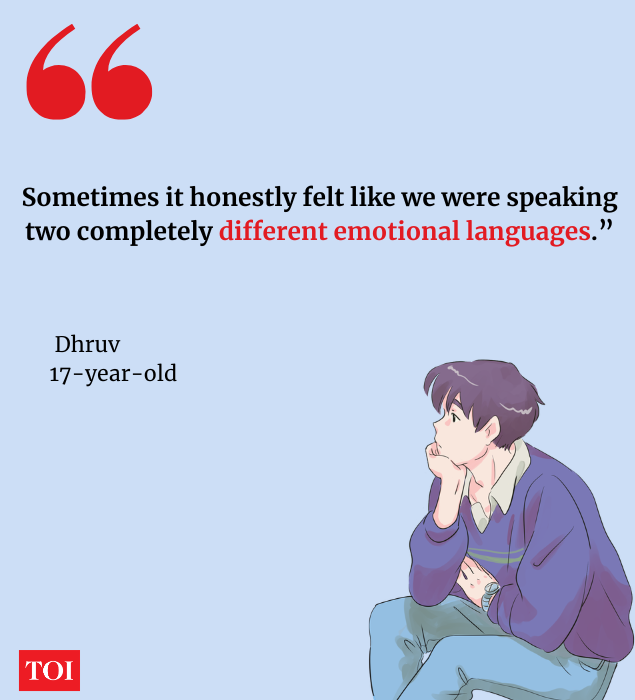
He also pointed out that younger people today are far more comfortable openly discussing mental health struggles. “Just being able to openly say ‘I’m not okay’ is already a huge shift from previous generations,” he said.However, this openness around emotions is not always easy for older generations to immediately relate to. Many adults grew up in environments where mental health conversations were rare, emotional struggles were often internalised, and vulnerability was not openly encouraged.This disconnect often becomes visible in how adults interpret teenage behaviour. When a teenager becomes withdrawn, adults may assume they are simply being rude or antisocial instead of asking whether something is bothering them. Anger is often interpreted as bad behaviour before anyone tries to understand where the frustration is coming from. Even genuine stress is sometimes minimised with phrases like “you have no real responsibilities yet” or “wait till you become an adult”.This was something 14-year-old Mana Satija related while speaking to TOI about conversations with adults often feeling one-sided. “They only tell me what I need to do. They never ask what I want to do,” she said.Part of the gap is that teenagers rarely express emotions in ways adults find easy to deal with. Emotional distress during adolescence does not always appear calm or articulate. It may show up through irritability, silence, defensiveness, emotional outbursts, declining academic performance, or sudden isolation. Because these reactions can be frustrating, adults often focus more on correcting the behaviour than understanding the emotion behind it.
Growing up in a hyper-visible digital world
Social media has intensified the teenage-adult disconnect further. Teenagers today are constantly exposed to comparison, online validation, unrealistic beauty standards, and pressure to present perfect versions of themselves. Every insecurity can feel amplified online.Dr Lalita Anand, management trustee at ‘Teenage Foundation’, a NGO working for teen welfare in Hyderabad said loneliness has quietly become one of the biggest emotional struggles among teenagers today despite constant online connectivity. “They might have a social media following, but actually each one is terribly lonely,” she told TOI, adding that many teenagers deeply want meaningful friendships and acceptance among peers but often struggle with peer pressure, bullying, fear of missing out, and fear of disappointing their parents.Akshitara also spoke on similar lines, adding how teenagers today are growing up in a “hyper-visible world” where “social comparison follows teenagers home through social media.” She explained that many adolescents feel pressure to “look perfect, achieve constantly, be socially active, emotionally mature, and successful very early in life.”However, older generations sometimes dismiss these struggles because they did not experience adolescence in the same environment.This was something Kanika Jindal, founder and director of Harmony Therapy World, validated while talking to TOI. She said that today’s teenagers are “digital natives with exposure that extends far beyond their physical vicinity,” which is fundamentally changing how they experience identity, relationships, and emotional pressure, while citing a case example of 6-year old wanting his parents to be ‘Elon Musk’.

She also pointed out that while many adolescents may have hundreds of “followers,” they often lack “true friends,” contributing to loneliness and emotional isolation despite constant online interaction. “When adults dismiss these concerns as ‘just a phase,’ it invalidates their emotions and overlooks the unique complexities of their reality,” she said.
Growing up into gender roles
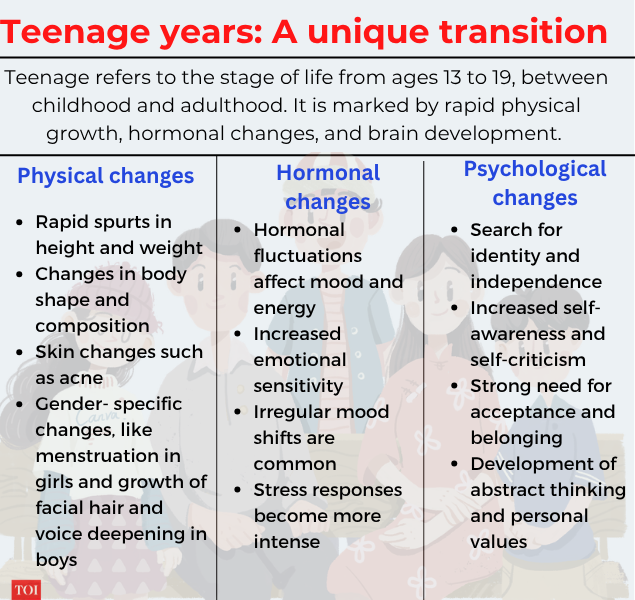
Adolescence is a stage when teenagers are trying to understand themselves as they go through a lot of physical, hormonal and emotional changes.Puberty, changing bodies, acne, weight fluctuations, voice changes, appearance-related comparisons, and growing awareness around attractiveness often make teenagers far more self-conscious than adults realise.Thus as the changes become “unique” to males and females, adolescence also becomes the stage where gender-role enforcement also becomes prominent. Teenage boys are frequently told to “man up”, suppress vulnerability, or avoid appearing emotional, while girls are often labelled “too emotional”, “dramatic”, or “over-sensitive” for expressing frustration openly.These expectations shape how teenagers communicate distress and how adults perceive it.As a young psychologist and the other co-founder of ‘That Desi Psychologist’, Chetna Arora explained to TOI how expectations around gender heavily shape how teenagers express emotions. According to her, girls are often expected to be “understanding, warm, soft, emotionally available, and nurturing,” while boys expressing anger, emotional withdrawal, or avoiding vulnerability have become socially normalised.
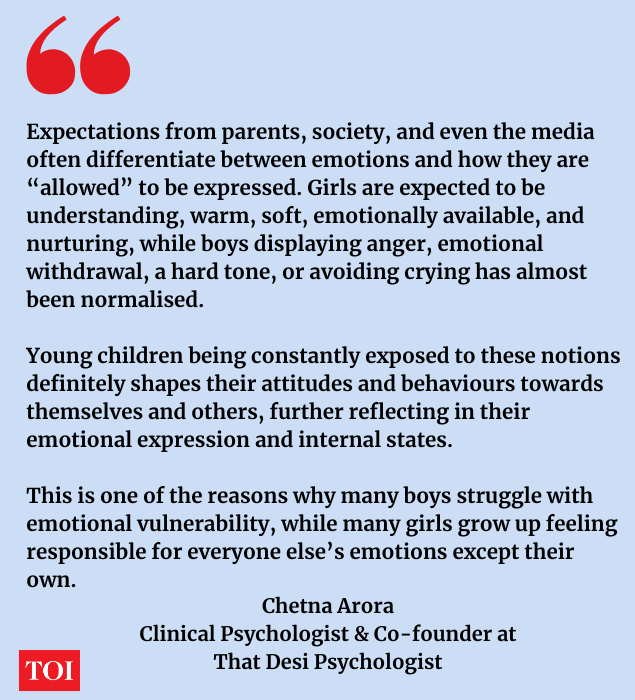
Chetna further explained that many boys grow up struggling with emotional vulnerability because sadness and fear are discouraged, while many girls gradually begin feeling emotionally responsible for everyone else around them.“Young children being constantly exposed to these notions definitely shapes their attitudes and behaviours towards themselves and others,” she said, adding that these expectations eventually begin reflecting in teenagers’ emotional expression and internal emotional states.Kanika Jindal also pointed out that phrases like telling boys to “man up” or dismissing girls as “dramatic” or “hormonal” can invalidate “developmentally appropriate responses” and contribute to long-term emotional suppression.
When emotions are repeatedly dismissed
Repeatedly invalidating teenage emotions can have consequences that extend far beyond adolescence.When young people grow up feeling unheard, they may begin believing their emotions are unimportant or “overdramatic”. Over time, this can make them less likely to openly communicate struggles, seek support, or express vulnerability.This was something 22-year-old Naveen highlighted while talking to TOI. He said that after a point, repeatedly trying to explain himself emotionally became “emotionally tiring”, adding that he eventually began handling situations on his own instead.
With so many other pressures and responsibilities going on in life, I started feeling that repeatedly talking about my emotions would not always change anything
Naveen, 22
Similarly, 27-year-old Nishu, while reflecting on her teenage years, said adolescence often comes with the pressure of navigating not just family expectations but also the wider social and political environment shaping young people’s lives. According to her, many children grow up feeling that choosing joy, passion, or individuality is “impractical” because society places constant emphasis on stability, achievement, and fitting into accepted ideas of success.
The social and political environment is a key factor that curtails a child’s potential. His/Her ability to achieve joy and choose passion often becomes like impractical subject to many.
Nishu, 27, while reflecting on lessons based on her teenage years
At the same time, she believes teenagers also carry some responsibility in trying to bridge the communication gap with adults. “It is important to believe in your own ability while also carefully assessing the situations around you,” she said, adding that while many teenagers feel the need to “break free” from their parents, the real challenge is often breaking free from the larger social thinking that quietly limits confidence, growth, and emotional understanding.However, when emotional struggles are repeatedly dismissed instead of understood, many teenagers gradually stop expressing themselves altogether. Adults who were constantly told to “stop overreacting” as teenagers may later struggle to openly discuss stress, anxiety, or emotional needs. Some develop difficulty trusting others with their feelings because they were conditioned to expect dismissal rather than understanding.At the same time, experts say another major barrier is the tendency to compare generations rather than understand changing realities.Kanika Jindal described this mindset as part of a larger “cycle of generational trauma,” where parents sometimes repeat what they themselves heard growing up without questioning its impact.Meanwhile, Chetna shared her thoughts on the “we had it tougher” mindset many teenagers hear from adults. She talked about teenagers today growing up in a far more emotionally overstimulating and hyper-connected environment. “Comparison often prevents compassion,” she said, especially when adults rely on “we had it tougher” responses.Offering his insight to parents, she added, “The goal is not to raise obedient children; the goal is to raise emotionally secure human beings.”
Listening instead of lecturing
It’s important to remember, addressing the key issues does not mean removing discipline or allowing harmful behaviour. Teenagers still require boundaries, accountability, and guidance. However, understanding emotions and correcting behaviour do not have to be opposites.Thus, the first step is listening without immediately dismissing or lecturing. Teenagers are more likely to communicate honestly when they feel they will not instantly be judged, mocked, or compared to others. Sometimes, they are not looking for solutions. They simply want reassurance that what they feel is being taken seriously.Schools and families can also play a role by encouraging healthier conversations around emotional wellbeing. Instead of treating emotional vulnerability as weakness or “bad attitude”, there needs to be greater emphasis on communication, empathy, and emotional awareness.

As Akshitara said, parents and schools need to shift from a “discipline-first approach to a curiosity-first approach.” Instead of reacting immediately to behaviour, she said adults should begin by asking: “What is this behaviour trying to communicate?”She also stressed that emotional support should not only be reserved for “serious cases” or crises. According to her, conversations around emotional literacy, coping skills, boundaries, and healthy communication need to become part of everyday environments at home and in schools.Dr Anand similarly stressed that teenagers need “time and attention” from adults rather than only instructions or criticism. According to her, parents need to “patiently listen to them, their challenges and suggest solutions” while creating environments where teenagers feel safe enough to “speak freely and confide in them.”
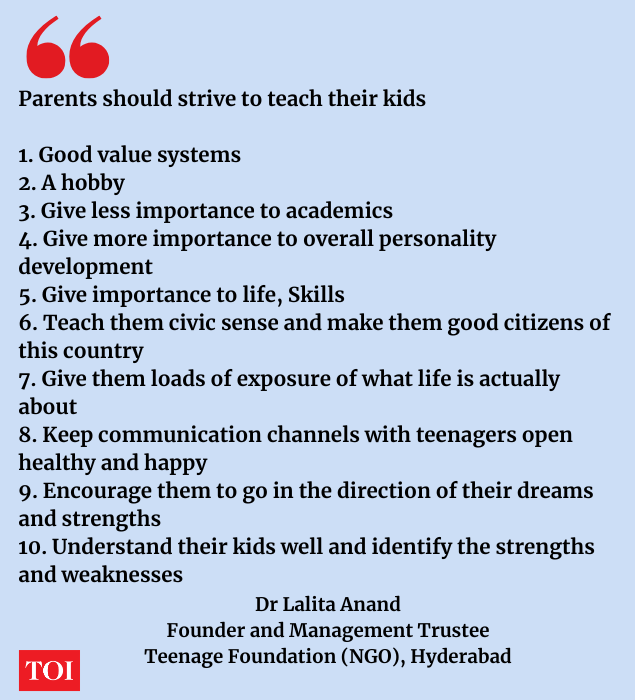
However, to reiterate, communication also requires effort from the other side. While teenagers may feel misunderstood, recognising that parents and close adults are often trying to help, even if imperfectly, can gradually make conversations easier.Like for 17-year-old Dhruv, communication with adults improved only gradually over time when he began expressing himself “more calmly instead of waiting until I was emotionally overwhelmed” and tried explaining modern pressures in ways adults could better relate to. According to him, understanding improved when “both sides keep trying instead of shutting each other down.”Adults also need to recognise that teenage struggles may not look the same as adult struggles or similar to what they experienced in their own teenage years, but that does not make them insignificant. Academic pressure, friendship conflicts, insecurity, bullying, identity confusion, and social isolation can feel deeply overwhelming during adolescence, especially when experienced for the first time.As Akshitara put it, “Some of the most distressed teens are high-achieving, quiet, funny, or well-behaved,” adding that emotional struggles can sometimes appear as “perfectionism, burnout, numbness, isolation, or silently feeling not good enough.”Thus, teenagers may not always express themselves perfectly. They may be impulsive, reactive, or emotionally inconsistent. But behind that behaviour is often someone trying to make sense of themselves while growing up in an increasingly overwhelming world.And sometimes, being heard can make more difference than being corrected.
India may need the Dutch model
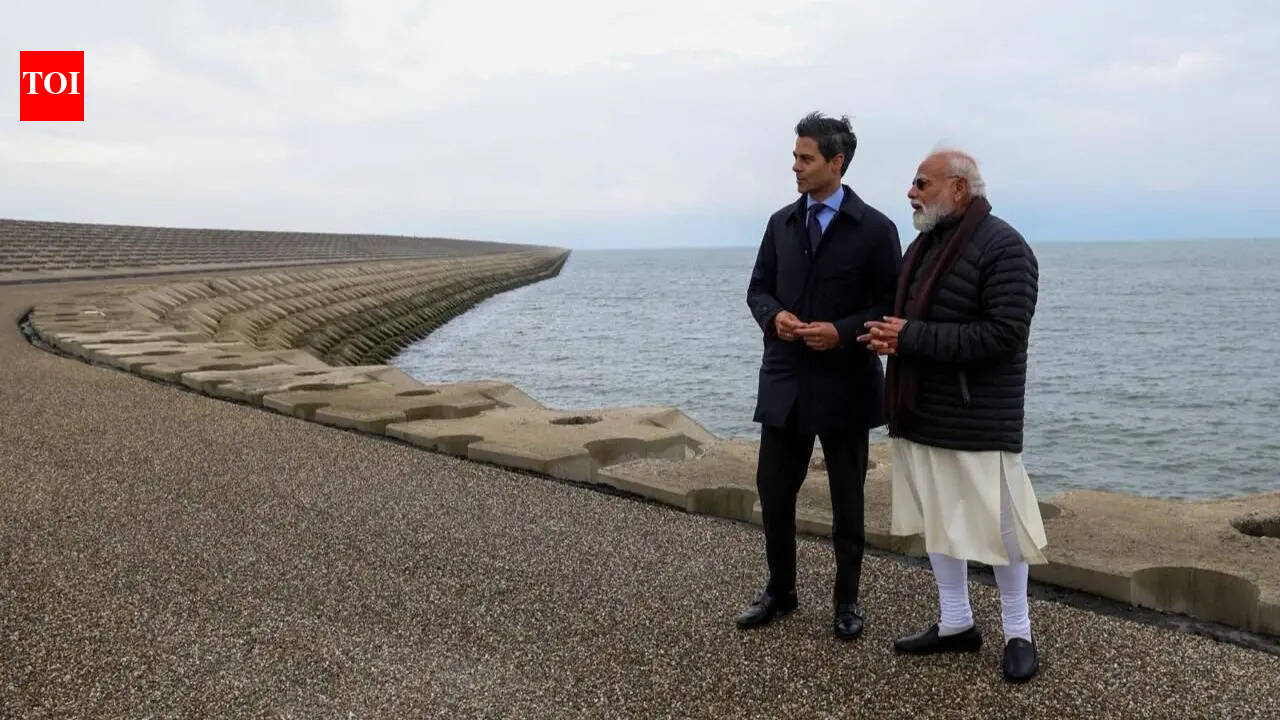
New Delhi: Prime Minister Narendra Modi’s visit to the iconic Afsluitdijk Dam in the Netherlands during his official visit has drawn attention to a less discussed but strategically important issue for India: long-term water management and climate resilience.Accompanied by Dutch Prime Minister Rob Jetton, PM Modi visited the massive barrier dam that has protected the Netherlands from floods for decades and also helps manage freshwater storage, inland waterways and renewable energy generation.This visit was not merely symbolic. According to India’s Ministry of External Affairs, the Afsluitdijk project has a direct link to Gujarat’s ambitious Kalpasar Project, a proposed mega freshwater reservoir and dam system in the Gulf of Khambhat, which has been studied for decades.In a post on Twitter, PM Modi highlighted the importance of Dutch expertise in water engineering.PM Modi said, “One area where the Netherlands has done pioneering work is water management. The entire international community can learn a lot from it. This morning I had the opportunity to visit Afsluitdijk and learn about the key features of this project. I am grateful to Prime Minister Rob Jetton for being here with me. We are committed to bringing modern technology to India, designed to aid in irrigation, flood protection and expansion of inland waterway networks.”External Affairs Ministry spokesperson Randhir Jaiswal also described the visit as an opportunity for deeper India-Dutch cooperation in climate resilience, water technology and sustainable infrastructure.“A symbol of engineering excellence and innovation! Accompanied by Netherlands Prime Minister Rob Jetton, Prime Minister Narendra Modi visited the iconic Afsluitdijk Dam, which is a symbol of Dutch excellence in water management, flood protection and freshwater storage. The visit highlighted the relevance of Dutch expertise to India’s Kalpasar project in Gujarat, which aims to create a freshwater reservoir and dam near the Gulf of Khambhat,” Jaiswal posted on Twitter.
What is Afsluitdijk?
The Afsluitdijk is one of the Netherlands’ most famous engineering projects and a central pillar of the country’s centuries-old battle against water.Originally completed about 80 years ago, the 32-kilometre-long barrier dam separates the North Sea from the IJsselmeer freshwater lake and protects large parts of the lower Netherlands from severe flooding.The structure also serves economic and environmental functions, including freshwater storage, navigation, transportation connectivity, and renewable energy generation.Now undergoing a major modernization program often referred to as “Afsluitdijk 2.0”, the project is being redesigned to withstand storms expected only once every 10,000 years.The advanced system includes reinforced locks, improved water discharge systems, fish migration corridors and renewable energy technologies involving tidal flows, freshwater-saltwater interactions, solar and wind power.Dutch authorities estimate that the modernization project will cost around €800 million.The Afsluitdijk also demonstrates how flood defense infrastructure can perform multiple functions simultaneously. In addition to protecting against rising sea levels and storm surges, the project supports inland transportation, tourism, cycling infrastructure and long-term freshwater protection.
Why is India interested?
India’s interest in Dutch water engineering is growing amid growing concerns over climate change, urban flooding, water scarcity and extreme weather events.Many Indian states, especially coastal and drought-prone areas, are facing simultaneous risks of water scarcity, salinity intrusion and flood disasters.For Gujarat, the proposed Kalpasar project represents an attempt to address multiple challenges through a single mega infrastructure system.The project envisages building a 30-km dam in the Gulf of Khambhat, which could become the world’s largest freshwater reservoir in a marine environment.The reservoir will store about 10 billion cubic meters of fresh water drawn from rivers including Narmada, Mahi, Sabarmati and Dhadar.The stored water will be used for irrigation, drinking water supply and industrial needs, especially in water-stressed areas of Saurashtra and parts of South Gujarat.The project also proposes a 10-lane transport corridor over the dam, which will reduce the travel distance between Saurashtra and South Gujarat by more than 200 kilometres.In its earlier concept, the project also included a large tidal power generation component, although that element has been removed from the revised design.
scale of Kalpasara philosophy
The Kalpasar project has been discussed in Gujarat since the 1970s and remains one of India’s most ambitious proposed water infrastructure plans.The idea was originally conceptualized in 1975 after the Gulf of Khambhat was identified as a potential site for tidal energy generation. Over time, the focus shifted more towards freshwater storage, flood control, transportation and irrigation.The revised scheme now comprises three major components.The first is the main Kalpasar Dam which connects Bhavnagar district to Bharuch district across the Gulf of Khambhat.The second is the Bhadbhut Barrage on the Narmada River near Bharuch, which aims to prevent salt water intrusion by diverting freshwater into the reservoir system.The third is a vast canal network that connects barrages and reservoirs, distributing water throughout Saurashtra.The estimated cost of the project has increased steadily over the years and is now estimated at around Rs 85,000-90,000 crore.If found technically and environmentally viable, experts estimate that construction alone could take 12 to 15 years, while the timeline for the entire project could extend up to two decades.
Why does the Dutch model matter?
The Netherlands offers India a real-world example of how large-scale water infrastructure can integrate flood defence, freshwater management, transport and renewable energy into a long-term strategy.Unlike many countries, the Dutch have centuries of experience living below sea level and dealing with the threat of frequent floods.Much of the country’s modern identity has been shaped by large engineering systems involving dams, levees, storm barriers, canals, and pumping stations.For India, especially for states vulnerable to coastal flooding and salinity intrusion, Dutch expertise may become increasingly relevant.The Kalpasar project faces major engineering, environmental and ecological challenges. Studies are still investigating issues related to marine ecosystems, sedimentation, fisheries impacts, navigation routes, and long-term environmental sustainability.Even after decades of planning, many feasibility studies remain incomplete.As of July 2019, only 25 of the 43 feasibility studies related to ecological, environmental, social and financial impacts had been completed, while several others were pending.No final environmental clearance has been given yet for the main Kalpsar Dam project.The Dutch experience in balancing environmental protection and water engineering can therefore provide valuable lessons for India as it evaluates the long-term feasibility of Kalpasar.
Climate change and the future of water infrastructure
PM Modi’s visit to Afsluitdijk also reflects a broader global shift in how governments are working towards climate resilience infrastructure.Rising sea levels, unpredictable monsoons, glacier melt, extreme rainfall and prolonged drought are forcing countries to rethink traditional water management systems.For India, the challenge is particularly complex as it faces both floods and water shortages simultaneously in different regions.Projects like Kalpasar represent efforts to build large-scale long-term water storage and climate resilience infrastructure. But they also raise difficult environmental and financial questions.The Netherlands’ approach shows that future infrastructure systems may need to combine flood protection, freshwater protection, renewable energy, transportation and ecological management rather than treating them separately.This appears to be one of the key messages behind PM Modi’s highly symbolic visit to Afsluitdijk.The visit ultimately highlighted that India’s interest in the Dutch model is not just about engineering. It is also about preparing for a future where climate resilience and water security can become central pillars of national infrastructure planning.

Ray Dalio’s one-line formula for learning faster than your competitors

Business failures teach important lessons, but simply enduring them is not enough. Ray Dalio’s “Pain + Reflection = Progress” emphasizes systematic reflection over heroic effort. Image Credit: Wikipedia
Most of us react to our business failures the same way we react to harsh weather. We take shelter, weather the storm, and hope for better results tomorrow. Our society tells us that we should dust ourselves off and move on as fast as possible. However, while it is important to be flexible, going somewhere rapidly and aimlessly is simply doing the same thing faster but with less progress. When it comes to a high-stakes decision-making environment, the least you can do is go through the pain and not learn important lessons from it.As a billionaire hedge fund manager, Ray Dalio boiled this entire philosophy down to almost a mathematical equation: Pain + Reflection = Progress. Although it may sound like a catchy slogan, the real value of this statement lies in pointing out exactly where business development fails. While most businesses have been trained to deliver the first part of this equation, the bad pitch, faulty assumption, or failed launch, what is truly extraordinary is the ability to systematically reflect on that experience to create a better process for the future.In an official outline provided at PrincipleThe pain itself does not matter. The process of struggle cannot be considered of a heroic nature; It simply becomes part of the content. The real change occurs during the “conversion phase.” The person experiences pain but abandons the reflex; In such a case, he fails to take any steps forward and spends huge amounts of effort trying to learn anything.Reflections on heroic enduranceIn the culture of many enterprises, a strange phenomenon occurs when employees begin to put even more effort into their work after making a mistake. People work overtime, email excessively, and put in even more effort to compensate for their mistakes and errors by the amount of effort spent. Dalio’s equation implies a completely different approach to solving such problems; One needs to consider how quickly he or she will learn the lesson.This shift in focus from effort to intelligence is supported by research Harvard Business School. The article points out that “near-misses” are also a goldmine of information. When teams feel safe enough to consider a disaster that was narrowly avoided, they can innovate and improve systems without paying the true cost of a complete failure.

Organizations that learn quickly from mistakes and implement changes gain significant competitive advantages, turning experiences into lasting upgrades. Image Credit: Wikimedia Commons
Once a team gets really good at reducing the time between pain and new operating models, an incredible competitive advantage is established. Suppose there are two organizations and both make the same mistake. One rewrites its internal workbook in forty-eight hours, while the other organization says, “We’re going to try harder.” It doesn’t take long before the first company starts leaving the other company in the dust. This is where the competitive advantage lies – not in avoiding mistakes, but in upgrading as quickly as possible.To create a mechanical process for developmentThe best thing about this theory is that it is very easy to implement in practice. Besides, you don’t need to have an intense emotional experience every time you reflect on your mistakes. Instead, all you need is fifteen minutes and complete transparency about what happened and what can be improved.This process of “looping” information back into the organization is the primary engine behind Dalio’s success. He argues that the human default after failure is usually either denial or self-blame, neither of which leads to progress. However, structure creates progress. By asking what perception failed or what signal was missed, you remove the ego from the situation and focus solely on reality.This can be done only by changing behavior in some way. This may create a new checklist or change the current approval process. In short, it all depends on how the individual decides to put their insights back into practice. This is important because, without implementing any change in his behavior, reflection remains an observation, but not a skill.In short, the equation proposed by Dalio is a hint that either you write the rules or they write you. Whatever makes you uncomfortable in your career is probably the result of having a slightly inaccurate view of reality. This indicates that there is a rule that should be changed. If you have the self-control to stop and write a new testament, you turn any experience into permanent upgrade.
External Affairs Ministry refutes criticism on press freedom, minorities in India
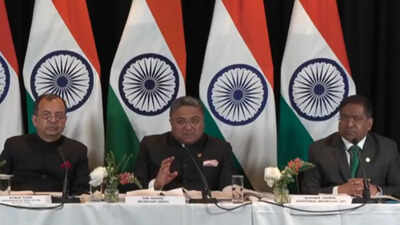
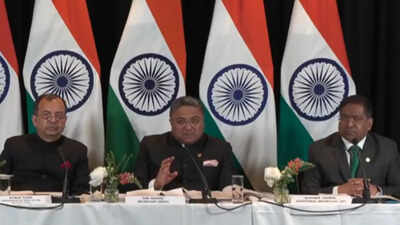
New Delhi: At a press conference in the Netherlands, Sibi George, Secretary (West), Ministry of External Affairs, strongly rejected concerns about minority rights and press freedom in India. Responding to the question, George defended India’s democratic and social structure, saying that the country’s strength lies in its diversity, religious co-existence and democratic freedom.Addressing foreign journalists and observers in The Hague, George said the concerns raised on these issues stemmed from a “lack of understanding” about India’s history, institutions and social fabric.“India is a country of 1.4 billion people, the most populous country in the world. A country with a civilization more than 5,000 years old. It is a diverse country,” George said, describing India as a society where many religions, cultures, languages and communities co-exist peacefully.Describing India as a “vibrant democracy”, the senior diplomat said freedom of expression and freedom of the press are deeply embedded in the country’s democratic culture.“You know how many of these there are in India? Smartphones? 900 million of them. And these are very important weapons,” he said, referring to freedom of public participation and communication in India.He said, “Everyone in the country has freedom of expression, freedom of the press. And that makes our democracy a very noisy democracy. And we are proud of that.”George highlighted India’s recent elections as an example of democratic participation and said more than 90 percent of voters voted. “This is the beauty of India. It is a vibrant democracy,” he said.The External Affairs Ministry official also countered criticism regarding minorities in India and argued that religious and linguistic communities continue to flourish in the country.He said, “When we became independent, the minority population in India was 11%. Now it is more than 20. Name a country where the minority population has increased. You will not find this anywhere else but India.”Pointing to India’s long history of hosting and protecting diverse religions, George said Hinduism, Buddhism, Jainism and Sikhism all originated and flourished in India. He also noted the historical presence of Jewish, Christian and Muslim communities in the country.He said, “Judaism was in India for more than 2,500 years, co-existing continuously. India is one of the few countries where the Jewish population never faced persecution.”On Christianity, George said that “Christianity came to India soon after the resurrection of Jesus Christ” and that the religion “came to India long before it came to Europe”.Speaking about Islam, he said, “Islam came to India during the time of Prophet Muhammad and flourished in India.”He repeatedly described India’s multicultural coexistence as “the beauty of India”, arguing that persecuted communities from different parts of the world have historically found refuge in the country.George also highlighted the linguistic diversity of India and said that all the major languages are continuing to flourish. “There are 22 official languages. If you take an Indian currency, there are 22 languages written on it,” he said.Linking India’s democratic structure to its economic rise, the diplomat said the country has achieved sustained development without compromising democratic principles.“Today we are the largest, fastest growing major economy in the world. An increase of 8% in the last 25 years. And how did we achieve it? Without compromising our democratic principles,” he said.George said, “We did not use violence to eliminate poverty. We adopted the democratic process to eliminate poverty.”Concluding his remarks, George invited critics and foreign observers to visit India and experience first-hand its diversity and democratic environment.He said, “So I would invite you to come to India and see for yourself how India lives, how prosperous its economy is, what a vibrant democracy it is.”