China’s ‘imaginary names’ mischievous, India says. india news

India says China's 'fictitious names' are mischievous

New Delhi: In yet another exercise by China to rename places in Arunachal Pradesh, India has categorically rejected “any mischievous attempt by the Chinese side to give fictitious names to places forming part of the territory of India”. The Ministry of External Affairs (MEA) said in a statement that such actions affect the ongoing efforts to stabilize and normalize India-China relations. The government further said that China should avoid steps that bring negativity in relations. Beijing has given Chinese names to 23 places in Arunachal, the sixth exercise in the last 10 years to consolidate its claim over the Indian state of Zangnan. External Affairs Ministry spokesperson Randhir Jaiswal said, “Such efforts by China to make false claims and create baseless narratives cannot change the indisputable reality that these places and territories, including Arunachal Pradesh, were, are and will always be an integral and inalienable part of India.” India’s reaction comes after reports from Beijing that China has established a new county in its Xinjiang province, apparently to boost security along the narrow Wakhan Corridor to prevent infiltration of Uyghur separatist militants. The county, named Senling, is located near the Karakoram mountain range and close to the borders of Pakistan-occupied Kashmir and Afghanistan, underscoring its strategic importance, a PTI report said. It is the third new county established by China in Xinjiang, the Muslim-majority Uyghur region, in more than a year. India had last year lodged a protest with China over the creation of Hein and Hekang counties, saying parts of their jurisdiction fall in Ladakh. China has renamed places in Arunachal Pradesh five times in the past – in 2017, 2021, 2023, 2024 and 2025. On the previous occasion – in 2025 – India had described the practice as absurd and said that creative naming would not change the indisputable reality that Arunachal Pradesh remains an integral and inseparable part of India. China claims not just Tawang in Arunachal but the entire state and says it is part of South Tibet, while the Tibetan government-in-exile believes that Arunachal Pradesh is part of India. China cites examples such as the location of the second most important Tibetan Buddhist monastery in Tawang and the birth of the sixth Dalai Lama to support its claim.

Source link

Amarnath Yatra from 3rd July to 28th August, registration starts from 15th April. india news

Amarnath Yatra from 3rd July to 28th August, registration starts from 15th April

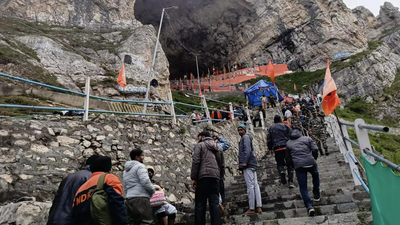
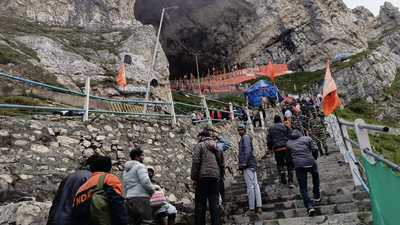
Jammu: The annual pilgrimage to the Amarnath cave shrine will begin on July 3 and will last for 57 days, ending on Raksha Bandhan on August 28.“Pilgrims in the age group of 13 to 70 years can travel. Registrations will start from April 15… Registered pilgrims will get group accident insurance, with the sum insured increased to Rs 10 lakh per person,” Lieutenant Governor Manoj Sinha said at a press conference on Sunday.The registration facility will be available at 554 branches of J&K Bank, PNB, SBI and Yes Bank across the country. The first puja to be performed to seek the blessings of Lord Shiva will be held on Jyeshtha Purnima on June 29.

Source link

Stalin attacks Center on ‘women’s quota’ issue; Election promises increased in Tamil Nadu. india news

Stalin attacks Center on 'women's quota' issue; Election promises increased in Tamil Nadu

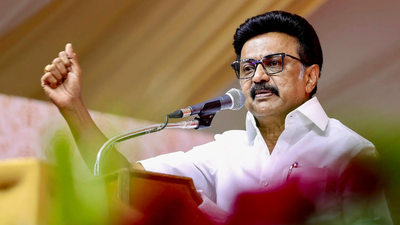
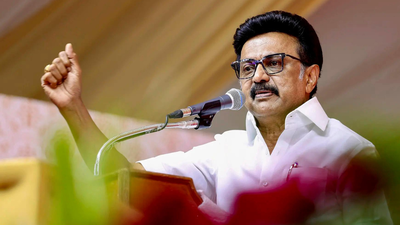
New Delhi: Chief Minister mk stalin On Sunday she accused the BJP-led central government of trying to reduce Tamil Nadu’s political representation under the pretext of proposed women’s reservation, as she addressed an election rally in Paramakudi and sharpened her campaign promises ahead of the polls.Accusing the southern states of “betrayal”, Stalin said the Center wants to punish regions like Tamil Nadu, which have successfully implemented population control measures and have contributed significantly to national development. He stressed that democratic forces across the country would oppose the move.“Does AIADMK chief Palaniswami have the courage to protest and raise questions about this injustice?” Stalin targeted the opposition and questioned its stand on the issue.The chief minister also outlined a series of welfare measures, promising to increase the number of buses under the fare-free travel scheme for women if the DMK returns to power, which he described as a “Dravidian model 2.0” government.Highlighting the impact of existing schemes, Stalin said that under the free bus travel initiative, women took more than 935 crore journeys in 1,800 days. He described the DMK manifesto as an “election superstar” and reiterated the promise of Rs 8,000 coupons for the purchase of home appliances.On the welfare of fishermen, he said seaweed farming would be encouraged and, without directly naming Sri Lanka, urged the central government to take back Katchatheevu.Earlier in the day, Stalin took a morning walk in Paramakudi, interacting with residents and seeking their support as the election campaign intensifies in the state.

Source link

​India played a balanced diplomatic role amid West Asia crisis: Rajnath Singh. india news

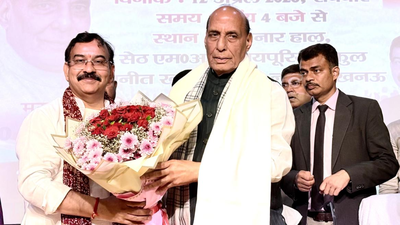
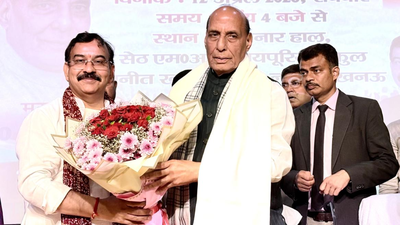
​पश्चिम एशिया संकट के बीच भारत ने निभाई संतुलित कूटनीतिक भूमिका: राजनाथ सिंहHis comments came hours after marathon talks in Pakistan between the US and Iran failed to reach an agreement.Addressing a ‘public dialogue programme’ in Lucknow, Singh focused on the situation in West Asia, and pointed to the growing conflict dynamics between the United States and Israel on the one hand and Iran on the other. He said the attacks on US-linked military bases in the Gulf countries reflect the seriousness of the crisis and the uncertainty associated with it.

Watch

On the West Asia conflict, Rajnath warned, “Don’t assume that it is over.”

Singh underlined the country’s diplomatic maturity, saying, “In such a complex situation, if any country has acted in a truly balanced manner, it is India.”He emphasized that India has managed to maintain cordial relations with both Washington and Tehran, a factor that has helped safeguard its strategic and economic interests.Referring to the maritime challenges in the Gulf region, especially around the Strait of Hormuz, Singh said Indian oil tankers have continued operations despite the tensions, which shows the effectiveness of India’s diplomatic engagement.The Defense Minister also linked this balanced foreign policy to domestic stability, citing how India avoided serious disruptions during the global LPG energy crisis. While many countries faced huge price hikes and shortages, Singh said India managed the situation without allowing significant rise in prices.“Prices rose across the world, but we ensured that the burden on Indian citizens was reduced,” he said, crediting timely government intervention and strategic decisions.Singh acknowledged that uncertainty remains over West Asia and there is no clear timeline for the crisis to end.“Even in the face of uncertainty, India is playing the expected role of a mature and responsible nation,” he said, adding that such balanced diplomacy is not an accident but the result of years of consistent commitment and credibility building on the global stage.

Source link

West Bengal elections: Mamata Banerjee alleges BJP ‘threatening’ TMC candidates to gain majority India News

West Bengal elections: Mamata Banerjee alleges BJP 'threatening' TMC candidates to gain majority

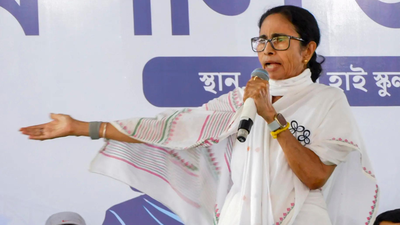
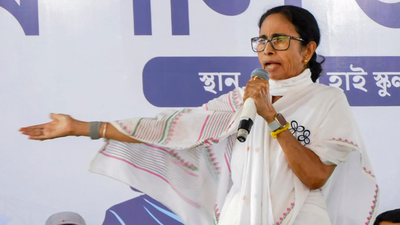
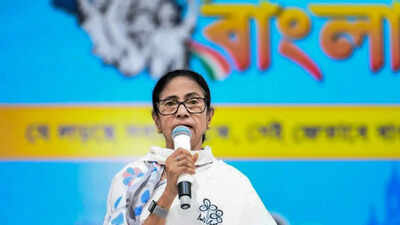
Chief Minister of West Bengal Mamata Banerjee alleged on Sunday that the Bharatiya Janata Party was threatening All India Trinamool Congress candidates, including state ministers, to secure its support if they fell short of the majority after the assembly elections.He also claimed that the Center is planning a delimitation exercise to trifurcate West Bengal, with parts of the state likely to be merged into Bihar or Odisha, which he said will create difficulties for Bengali residents.Addressing election rallies at Asansol in West Bardhaman, Chhatna and Onda in Bankura district and Khandagosh in East Bardhaman, Banerjee said, “The BJP is threatening TMC candidates, including state ministers, seeking their support if they fall short of the majority mark after the assembly elections.”“The BJP is planning to bring a delimitation bill to divide West Bengal into three parts. It may merge parts of West Bengal with Bihar or Odisha and commit atrocities on Bengalis there,” he was quoted as saying by PTI.Banerjee alleged that the BJP had made a deal worth Rs 1,000 crore to remove the All India Trinamool Congress from power in the state.His comments come in the context of a viral video of Humayun Kabir in which he was allegedly heard claiming links with BJP leaders including Suvendu Adhikari and alleging receipt of Rs 200 crore as advance from a Rs 1,000 crore scheme to split minority votes and defeat TMC.TMC has demanded an investigation into the matter, while BJP and Aam Janata Unnayan Party have rejected the video as AI-generated.“They (BJP) have made a deal worth Rs 1,000 crore to remove TMC from power in West Bengal,” he said. He also accused the BJP of bribing voters before the elections and described the Special Intensive Revision (SIR) of voter lists as the “biggest scam in the country” in recent times.He said, “SIR is the biggest scam the country has seen in recent times. Everyone in the world knows that your government will fall in 2026. We will then dismantle all the anti-people laws brought by your government.” “BJP bribes voters before elections. But they forget their promises soon after polling is over. This is what was seen in Bihar elections.”Banerjee further alleged that the BJP would attempt to influence the voting process and urged voters to remain alert and monitor the voting machines.Banerjee said, “Be cautious about voting machines. BJP has planned slow voting and slow counting. Foil all their plans.”He also alleged that the BJP was planning to give “spicy tea and sweets” to people to “loot votes”.

Source link

The first life-size statue of Swami Vivekananda unveiled in the United States. india news

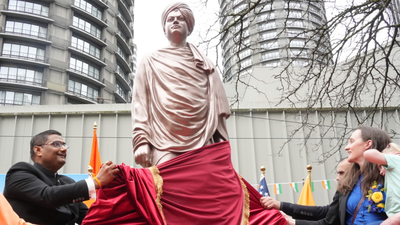
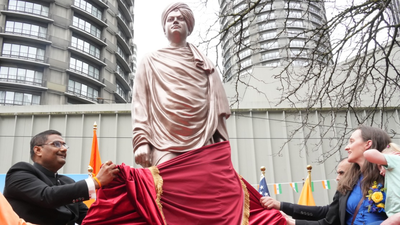
संयुक्त राज्य अमेरिका में स्वामी विवेकानन्द की पहली आदमकद प्रतिमा का अनावरण किया गयाInstallation of a monument to the revered 19th-century spiritual leader, visited by approximately 400,000 people daily, in a public space in the heart of downtown Seattle. The statue was jointly unveiled by Seattle Mayor Katie Wilson and India’s Consul General in San Francisco Prakash Gupta. The ceremony was attended by a wide range of elected representatives and community members, including the mayors of Kent, Auburn, Tukwila, Normandie Park and Kirkland, as well as city council members from Bellevue, Bothell, DuPont and Redmond. Officials described it as a “historic and first-of-its-kind initiative”, which was also witnessed by members of the local Indian-American diaspora in large numbers.

Seattle’s inclusive spirit and ties to India

Mayor Wilson highlighted that the installation reflects Seattle’s “inclusive spirit” and underscores its commitment to cultural diversity and global partnerships. He stressed the importance of placing the statue of Swami Vivekananda in one of the most vibrant and innovative regions of America, a hub known for its globally connected technology and innovation ecosystem.This location includes landmarks such as Amazon Headquarters, the Seattle Convention Center, and the Seattle Center Monorail.

ICCR’s gift strengthens cultural diplomacy

The statue was gifted to the city of Seattle by the Indian Council for Cultural Relations (ICCR), marking an important milestone in India’s cultural diplomacy outreach. Officials said the gesture recognizes Seattle’s multicultural character and is in line with ICCR’s broader efforts to promote people-to-people ties between India and the US.The unveiling coincided with the celebration of ICCR Day, which underlines the organization’s mission to use arts and culture as a bridge across continents.

Vivekananda’s global legacy lives on

Swami Vivekananda, who introduced the Western world to the philosophies of Vedanta and Yoga more than a century ago, continues to influence generations globally. The installation in Seattle adds to a growing number of international commemorations honoring his legacy and philosophy, particularly in cities that host vibrant Indian diaspora communities.

the artist behind the statue

The bronze monument was created by renowned Indian sculptor Naresh Kumar Kumawat, whose artistic portfolio includes over 600 installations in over 80 countries. Known for capturing the cultural depth and spiritual traditions of India, Kumawat’s works serve as a visual expression of the country’s heritage in the global landscape.

Pacific Northwest: A New Cultural Bridge

The unveiling underlines the emergence of the Pacific Northwest as a promising hub for India-US cultural engagement. Driven by its large Indian-origin population and dynamic technology ecosystem, Seattle is rapidly establishing itself as a gateway for exchange, collaboration and artistic initiatives that complement the two countries’ strategic partnerships in areas such as technology, defense and trade.

Source link

From welfare to dependency? How Tamil Nadu got trapped in the trap of freebies. india news

From welfare to dependency? How did Tamil Nadu fall into the trap of freebies?

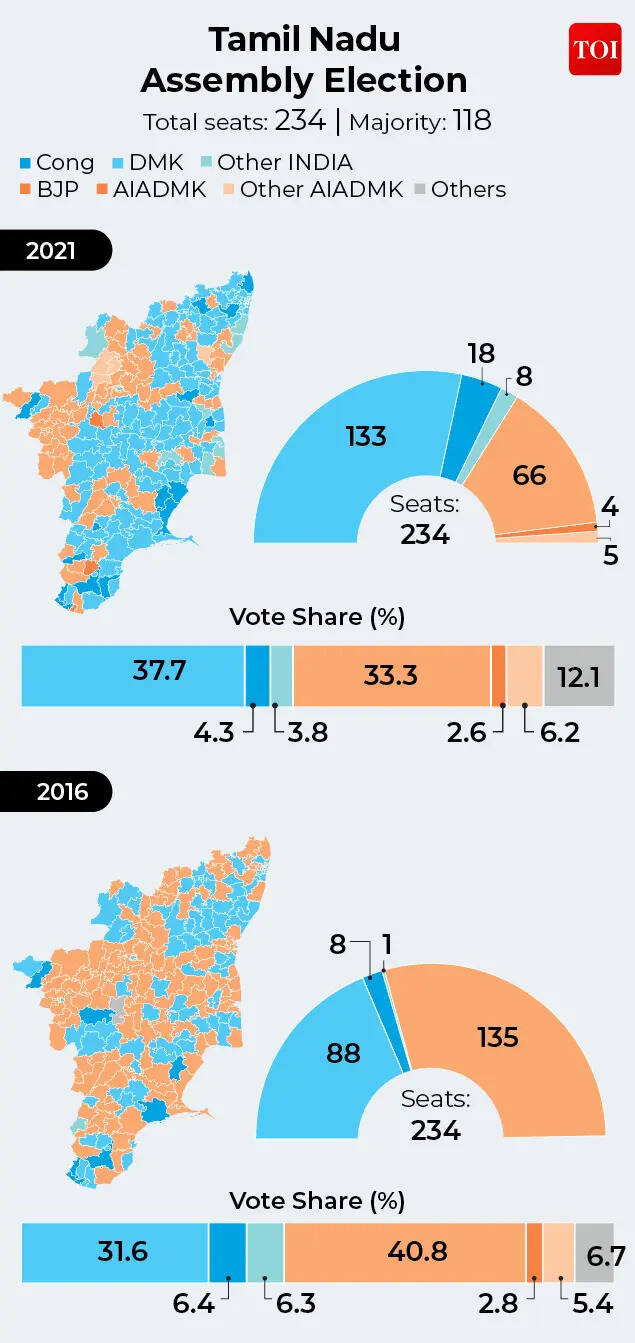
New Delhi: Election campaigns across India are increasingly being defined by what parties promise to deliver and while the “freebie culture” is taking hold in other states, it started here Tamil Nadu. Across the state, parties are once again making promises of cash transfers, subsidized services and household goods, each trying to outdo the other. This is the season of manifesto releases and high-decibel campaigning, where the language of welfare dominates every rally and road show.For many voters influenced by decades of Dravidian politics, such promises are not extravagant gifts but part of the normal grammar of governance.

Watch

How Stalin, EPS, Vijay are outdoing each other on free stuff and one party is opposing it. I witness

What sets Tamil Nadu apart is not just the scale of its welfare but also the depth of its political memory. From early interventions in food and education to more visible, consumption-oriented schemes, successive governments have created an expectation that the state should play an active role in everyday life.What is changing is not just the scale of welfare but also its form, earlier schemes focused on items like television, mixers and grinders are now giving way to direct cash transfers and other similar schemes.

Tamil Nadu - Assembly Elections

Therefore, this contest is less about excess and more about continuity, which shows how deeply embedded this model is in the political imagination of Tamil Nadu.Similarly, what is unfolding in 2026 is not just a contest of promises, but a contest within boundaries that no major party is willing or able to recreate.

How welfare became the norm

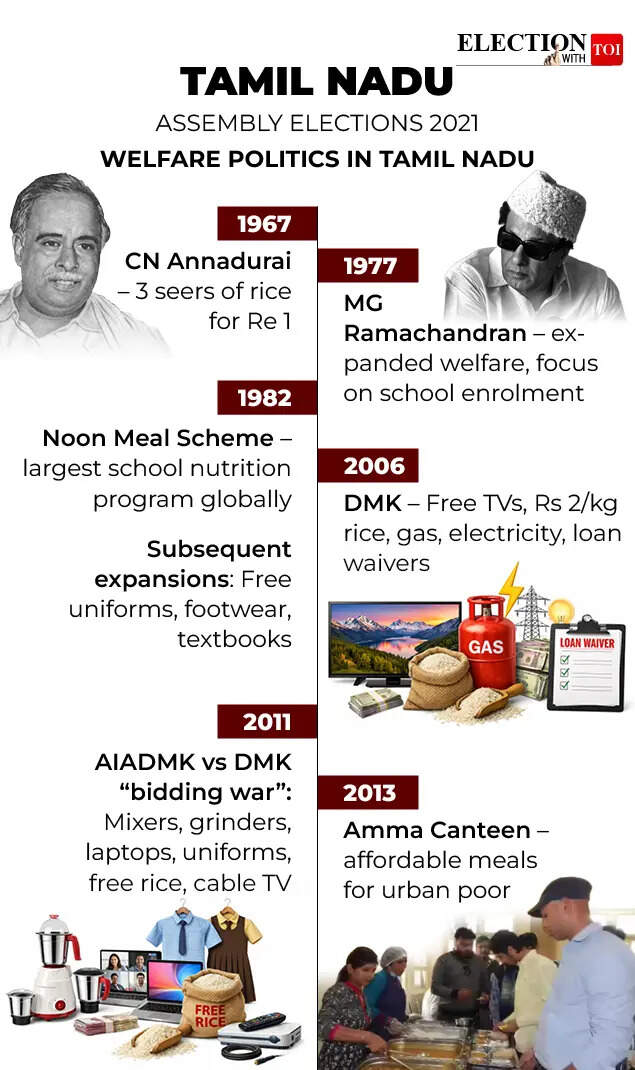
The story begins not with extremes, but with intention. Under MG Ramachandran, welfare was incorporated into governance as a tool of legitimacy. His most enduring intervention, the expansion of the Nutritious Meal Scheme, ensured mass cooked midday meals for school children, leading to significant increases in enrollment and retention. At the same time, access to subsidized rice was expanded through the public distribution system, and schemes such as free school uniforms and textbooks strengthened access to basic education. These were designed not as discretionary benefits but as fundamental state responsibilities, especially for poor families.

era of free

It was under J Jayalalithaa that Kalyana gained a sharper political edge and a more visible form. Their governments launched a series of consumer-oriented schemes that made state support immediate and tangible: free color televisions for homes, mixers, grinders and electric fans for women beneficiaries, and laptops for students aimed at bridging the digital divide. Additionally, the Amma brand of subsidized services, including the famous Amma canteens offering food at low prices, as well as Amma salt, water and pharmacies, drives well-being in everyday consumption. These initiatives did more than provide material aid; They reshaped voters’ experience of the state, turning welfare into something to be seen, used and remembered.Thereafter the competition was not on whether welfare should be provided or not, but on how much and how effectively it should be provided. alternative between DMK And AIADMK did not disrupt this model; This strengthened it. Each government inherited and added to the expectations set by its predecessor. By the time MK Stalin took over, the model had evolved again. There was a push towards more targeted schemes and direct transfers, particularly for women and students, improving rather than reversing what had come before.Neither DMK nor Edappadi K in the opposition. The AIADMK, led by Palaniswami, can credibly campaign on reducing welfare. Criticism, when it comes, focuses on incompetence or corruption rather than principle.

Will the model survive?

Tamil Nadu’s welfare model remains fiscally sustainable, based on a strong economy, most parties would say. The state has one of India’s strongest industrial bases, is a leader in electronics manufacturing and has seen steady growth in recent years, outpacing the national average. By standard measures, it is not in fiscal crisis. Debt has declined from its peak to about 26% of GSDP, and the fiscal deficit is projected to return closer to the 3% target. Strong self-tax revenues and relatively low borrowing costs reinforce this picture. Social outcomes also support the case: welfare programs have improved education, especially among women, and strengthened workforce participation.

era of free

Still, caution remains. Tamil Nadu’s debt remains high in absolute terms, and welfare expenditure continues to expand. Interest payments are taking up an increasing share of revenues, while losses remain high. Critics have warned that a continued increase in pledges risks making the fiscal situation tighter. Even within government estimates, large-scale cash schemes can impose significant recurring costs. Well-being itself may not be sustainable, but the accumulation of commitments is eroding flexibility. The debate is less about the immediate crisis and more about how long the balance can last.

a contest with no exit

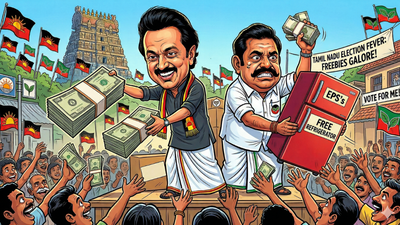
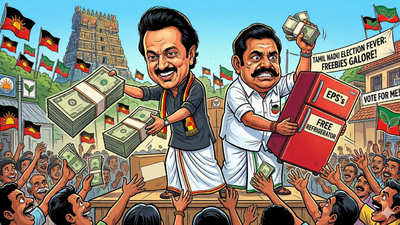
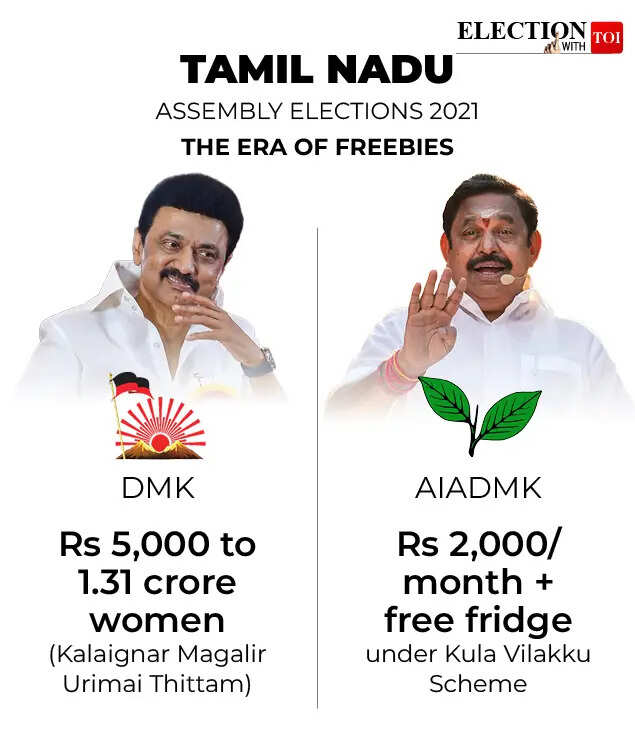
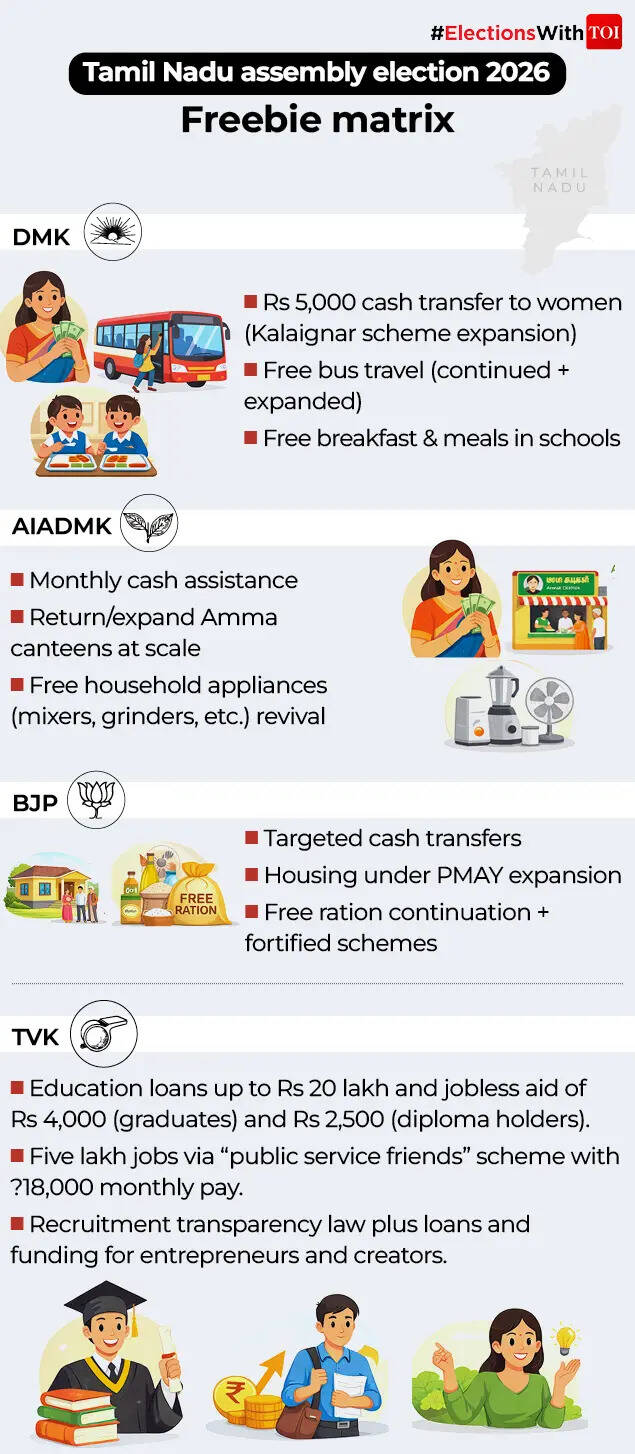
No major party in Tamil Nadu now campaigns against Kalyan. Instead, the competition is one of scale and distribution. The 2026 manifesto reflects this logic. The DMK has proposed a household coupon of Rs 8,000 and extended financial assistance to women along with continuation of subsidies and services. The AIADMK has responded with its sweeping promises, including direct cash transfers, free appliances including refrigerators and fuel assistance. Many of these are echoes of previous plans, showing how deeply embedded this model has become.

freebie matrix

Political exchanges have turned into a familiar cycle. Edappadi K. Palaniswami has criticized MK Stalin’s proposals as ineffective while promising more direct cash support. The DMK, in turn, defends its approach as targeted welfare with developmental outcomes. Behind the rhetoric, both sides operate within the same limits: Withholding benefits carries political risk. Competition is no longer about whether welfare is provided or not, but about how clearly and efficiently it can be provided.

voter logic

Efforts to challenge this structure have gained limited momentum. Seaman has openly rejected the language of freebies, arguing for dignity and self-reliance over state subsidies. Yet their status remains outside the mainstream. even VictoryThose who initially based their politics around welfare rather than gifts have offered benefits that mirror established parties.This reflects a deeper reality. Tamil Nadu’s electorate is not passive, but shaped by decades of policy that have made welfare both tangible and credible. Programs ranging from education to nutrition are often targeted and linked to real outcomes. For many voters, these distinctions are less ideological than practical. Well-being is evaluated in terms of credibility and accessibility rather than intent. Whether aid comes in the form of subsidies, services or direct transfers often matters less than whether it arrives on time and reaches the intended household. This creates a feedback loop in which parties are judged not for delivering benefits, but for delivering them efficiently. In that sense, electoral competition strengthens the system, even as it appears to counter it.

What is the way forward?

The emergence of new actors before 2026 increases the likelihood of such change. Seeman and Vijay have pointed towards a politics of respect and self-reliance in different ways. His rhetoric indicates discomfort with the ever-expanding welfare state, suggesting that dependency may have its costs.As a result, potential disruptors also face a dilemma. To oppose welfare altogether is to risk marginalization; To accept this is to become part of the same competitive cycle. So far, the latter trend has prevailed. So the challenge they offer is indirect, provoking the conversation rather than subverting it.The real test is not whether parties can move away from welfare, but whether they can sustain it without closing off their future options. For now, Tamil Nadu’s development has allowed this balance to be maintained, masking the trade-offs underlying it. But this balance rests on assumptions that cannot last forever.Tamil Nadu has not so much fallen into the trap of freebies as it has created a system that works until it doesn’t work. The uncertainty lies in what breaks first: the economics that sustain it, or the politics that demand it.

Source link

‘Sikkim Sundari’: Indian Army launches first border village radio station. india news

'Sikkim Sundari': Indian Army launches first border village radio station

Indian ArmyTrishakti Corps has launched Sikkim’s first border village community radio station, “Sikkim Sundari”. Officials said the move is aimed at improving communication and access to information in remote high-altitude areas.According to the Defense PRO, the station will broadcast local news, weather updates and information on government schemes, and will also serve as a platform to promote local culture and encourage youth participation.This will provide opportunities for local youth to develop communication skills and participate in community engagement.“This initiative will help connect communities, amplify local voices and support development in remote areas,” a senior Army officer was quoted as saying by PTI.The radio station was inaugurated in the presence of senior officers of Trishakti Corps, representatives of the civil administration and members of the local community.Meanwhile, Additional Director General, Border Roads (East), Jitendra Prasad visited the landslide-affected area in Taramchu in North Sikkim to review the ground situation.According to the Defense PRO, he assessed the damage and interacted with Border Roads Organization personnel deployed at the site. As ANI reported, he also reviewed the ongoing restoration work and directed officials to expedite efforts to reopen the route as soon as possible.During the visit, Prasad inspected the progress of work and reiterated the organisation’s focus on restoring and maintaining connectivity in the region, noting the importance of road connectivity for local communities and access to border areas.

Source link

‘To divide West Bengal’: Mamata claims Center is trying to ‘divide the state into three’ through delimitation. india news

'To divide West Bengal': Mamata claims Center trying to 'divide the state into three' through delimitation

New Delhi: West Bengal Chief Minister Mamata Banerjee on Sunday accused the Center of carrying out the delimitation exercise to divide the state into three parts.Addressing election rallies in Chhatna and Onda in West Bengal’s Bankura district, Mamata said parts of West Bengal could be merged into Bihar and Odisha, and Bengalis living in those areas would face difficulties as a result.

Watch

Bhawanipur fight: Is Mamata Banerjee’s bastion under pressure from SIR?

Mamata said, “BJP is planning to bring a delimitation bill to divide West Bengal into three parts. It can merge some parts of West Bengal with Bihar or Odisha and commit atrocities on Bengalis there.”Mamata also alleged that the BJP has made a deal worth Rs 1,000 crore to remove the Trinamool Congress from power in the state.He made an apparent reference to a viral video of Aam Janata Unnayan Party chief Humayun Kabir, in whom he was reportedly heard saying that he was in close touch with BJP leaders, including Suvendu Adhikari, to remove Mamata from power and that he had received Rs 200 crore as advance payment for a Rs 1,000 crore deal to split minority votes to defeat TMC.“They (BJP) have made a deal worth Rs 1,000 crore to remove TMC from power in West Bengal,” the party supremo said.He also alleged that the central forces deployed in the state for the upcoming elections were “insulting” women in the name of searches.The CM also claimed that he was not allowed to hold the rally despite space being available, while immediate approval was given for Prime Minister Narendra Modi’s gathering.He also accused the BJP of bribing voters before the elections and called the Special Intensive Revision (SIR) of voter lists the “biggest scam in the country” in recent times.He said, “SIR is the biggest scam the country has seen in recent times. Everyone in the world knows that your government will fall in 2026. We will then repeal all the anti-people laws brought by your government.”He said, “BJP bribes voters before elections. But soon after the voting is over, they forget their promises. This was seen in the Bihar elections,” Mamata said.The TMC chief further alleged that the BJP would try to manipulate the voting process to win the elections and urged people to remain alert and keep an eye on the voting machines.Banerjee said, “Be cautious about voting machines. BJP has planned slow voting and slow counting. Foil all their plans.”He also alleged that the BJP was planning to give “spicy tea and sweets” to people to “loot votes”.“They are planning to give you intoxicating tea and sweets, after eating which you will fall asleep and they will loot your votes… be careful,” he said.He also questioned the BJP’s election promise of filling vacant posts in government departments and asked, “What happened to his (Modi’s) promise of giving 2 crore jobs to the youth?”

Source link

Bihar: The game of power continues between JD (U) and BJP for the post of Chief Minister, Nitish made a compromise in 1 way. india news

Bihar: As Nitish packs his bags at 1 Anne Marg, power play is going on between JDU and BJP for the post of CM.

New Delhi: Months after a high-stakes assembly election, politics is once again heating up in Bihar following Chief Minister Nitish Kumar’s decision to resign from the top post to run for a Rajya Sabha seat.According to reports, Nitish may submit his resignation from the post of CM on April 14 and vacate his official residence.Janata Dal (United) working president Sanjay Kumar Jha said that the process of formation of the new government in Bihar will start after April 13.“I think it will be implemented after April 13. But for more details you should talk to people who are in the state government,” Jha said.JDU leader Vijay Kumar Chaudhary said, “The new chief minister will be elected on the recommendation by NDA MLAs.” BJP“The BJP has an important role in the formation of the new government. It has its own process in these matters. Once it comes forward with its plan, necessary things will happen,” he said.Meanwhile, many BJP leaders including Deputy Chief Minister Samrat Chaudhary also reached Nitish’s residence. Chaudhary is among the possible names who could replace Nitish Kumar as Bihar CM.Another BJP leader to visit the chief minister’s residence was Lakhendra Paswan, and his visit fueled speculation in a section of the media that the party may push for a Dalit leader.Union Minister Shivraj Singh Chauhan has been appointed as the central observer for the election of BJP legislature party leader.‘We need young public servants’Meanwhile, JDU workers have put up posters all over Patna demanding Nitish Kumar’s son Nishant to take the post of Chief Minister.The posters put up early in the morning by “Nitish servants” urged Nishant Kumar to step into active politics, describing him as a “youth leader” and calling on him to “come out of the shadows”.The posters read, “We neither need bulldozers, nor riots or unrest in Bihar. We need a young public servant… now is the time for him to come out of the shadows.”Although there is speculation that Nishant Kumar may take up the role of Deputy Chief Minister, no official announcement has been made yet.According to news agency PTI, party sources admitted that there was a misunderstanding among workers regarding the role of Jha and some other close associates of Nitish in the recent developments.He said, “Yesterday, when the Chief Minister went to the JD(U) office in Delhi, many party workers insisted that even after he steps down, the top post should not be given to the BJP. The views have been shown by all media outlets and, to an extent, reflect the prevailing sentiment here in the party.”“In Nishant (Nitish Kumar’s son, who recently joined the party), we have a young leader who is capable of replacing his father. However, we also know that our leader is unlikely to push for his son. But, at least, we should emphasize all the benefits that the BJP is currently enjoying, including posts like two deputy CMs, Assembly Speaker and the important home portfolio,” he said.“The BJP, on its part, is acting with arrogance. Look at the alacrity with which it nominated Harivansh Narayan Singh to the Rajya Sabha, days after denying him a third consecutive term,” JD(U) sources said.Tejashwi raised the flag of conspiracyMeanwhile, RJD national working president Tejashwi Yadav claimed that JDU president Nitish Kumar was stepping down under “pressure” from his own party colleagues who were “intimidated or cajoled” by ally BJP.Speaking to reporters on the sidelines of an RJD function, Tejashwi said, “I claim that the deal to remove Nitish Kumar was made long ago by some bigwigs of JDU. It was not made public because it could have backfired during the assembly elections.”He alleged, “It is nonsense to say that Nitish Kumar, who is not in good physical and mental health, is stepping down on his own will. Just remember the scenes in Delhi. The way Sanjay Jha stopped him from interacting with the media in the national capital is proof of how much humiliation and pressure the seasoned leader is facing.”He further said that the JDU leaders who are behind this conspiracy have either been misled by the BJP or are living in fear of ED and CBI, which have become weapons of the ruling party at the Centre.Nitish took oath as a Rajya Sabha member in a brief ceremony at the Parliament House in New Delhi. Rajya Sabha Chairman CP Radhakrishnan administered the oath in his chamber.

Source link