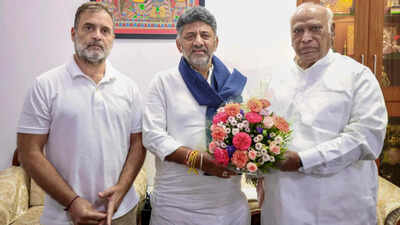
Karnataka ‘drama’ not over yet? Siddaramaiah, Shivkumar in Delhi, Congress mulling next step. india news

Karnataka 'drama' not over yet? Siddaramaiah, Shivkumar in Delhi, Congress mulling next step

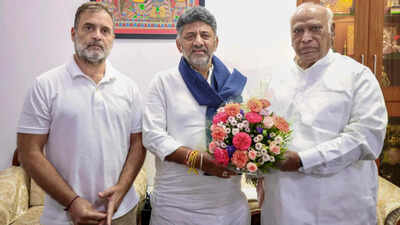
New Delhi: It appears that the dust and fury surrounding the change of power in Karnataka has not settled with Siddaramaiah’s resignation as chief minister as he and Deputy CM DK Shivakumar, who is expected to replace Sidda soon, are set to meet Congress state in-charge Randeep Surjewala in the national capital.Both the leaders will also meet Leader of Opposition in Lok Sabha Rahul Gandhi and Congress Parliamentary Party President Sonia Gandhi and party chief Mallikarjun Kharge during the day.According to sources, the meeting mainly focused on finalizing Rajya Sabha candidates, Legislative Council (MLC) nominations and a possible cabinet reshuffle before the swearing-in of the new government. Sources further indicated that many ministers from the Siddaramaiah cabinet are unlikely to find a place in the possible DK Shivakumar-led cabinet. The party leadership is also considering the appointment of four deputy chief ministers to maintain social and regional balance in the new government.A day after announcing that he would step down as chief minister to pave way for Shivakumar as per the rotational formula agreed upon after his 2023 victory, Siddaramaiah expressed his desire to stay in Bengaluru instead of going to the Rajya Sabha, which was part of the offer made by the party high command.Siddaramaiah’s move to “partially agree” with top officials, despite being adamant on his point of not going to the capital for national politics, largely suggests that development could turn out to be a complex quagmire.On Friday, Siddaramaiah, Shivkumar and Surjewala will hold discussions with the top leadership of the party. Rajya Sabha candidates, MLC candidates and cabinet reshuffle will be the top priority during the meeting. Many ministers of the Siddaramaiah cabinet are unlikely to get a place in the DK Shivakumar-led cabinet. Congress sources told news agency ANI that four deputy CMs may be appointed to maintain social and regional balance in the government.

Karnataka timeline.

Karnataka Chief Minister ‘Drama’ Timeline

At a press conference on Thursday, the 77-year-old publicly confirmed that he had “politely” declined the party high command’s offer of a “national role” through a Rajya Sabha nomination, so that he could “remain active in state politics”. He has been chief minister for a little over three years, having been sworn in for his second term on May 20, 2023.As per plan, Siddaramaiah held a breakfast meeting with his cabinet colleagues, including his deputy and unofficial CM-in-waiting DK Shivakumar, at his official residence before submitting his resignation. What followed were hugs, tears and apologies.

Siddaramaiah (1)

Siddaramaiah’s comments in press brief

Before a large crowd gathered, Shivakumar held a closed-door meeting with the outgoing CM, hugged him and even touched his feet.For nearly two hours, ministers hovered around Siddaramaiah and explained the reason for his decision to resign after five decades in active politics. He told his colleagues, “I have no regrets. I am resigning with all my heart.”Sources said he informally mentioned that Shivakumar would take over as per the wishes of the party leadership. However, during the farewell press conference, Siddaramaiah avoided questions about his successor, while Shivakumar sat next to him, smiling during the conversation. He said, “Whatever the legislature party and the high command decide will be the chief minister.”The Congress high command is expected to call a CLP meeting in Bengaluru after Governor Thaawarchand Gehlot accepts Siddaramaiah’s resignation, possibly on Friday. The outgoing CM reached Lok Bhawan at around 3 pm to submit his resignation. Since the Governor was out of the city, he submitted his resignation to the Special Secretary of Lok Bhavan, which was accepted on Friday morning.

Source link

‘Crazy love’: Benjamin Netanyahu cites India’s support for Israel even as the world declares it ‘illegitimate’ india news

'Crazy love': Benjamin Netanyahu cites India's support while the world calls Israel 'illegal'
Israeli PM Benjamin Netanyahu

New Delhi: Israeli Prime Minister benjamin netanyahu He once again focused on the cordial India-Israel ties early Friday, saying Israel gets “mad love” from India at a time when, according to him, much of the world wants to “delegitimize” the Jewish state.Addressing an event, the Israeli PM said, “We have a unique relationship with a huge power called India. There is support for Israel in India.”“We face decriminalization in most parts of the world – but not in India,” Netanyahu said.“There is absolutely crazy love for Israel in India, really crazy. I think I have more followers in India than anywhere else,” he said.Earlier during the time of Prime Minister Narendra ModiDuring his visit to Israel in February, Netanyahu also shared a personal anecdote involving his wife Sara and an Indian restaurant in Tel Aviv.Addressing a joint press conference with PM Modi, Netanyahu had said: “I have to say at the end of this visit that I am indebted to India – I don’t know if I told you this, Narendra – but I owe a huge personal debt to India. You see, when I first met Sara, I think our first or second date was in an Indian restaurant in Tel Aviv.”His latest comments come months after PM Modi’s visit to Israel, during which the two leaders were seen sharing warm relations.

Source link

‘Something to please Delhi boss’: Sonam Wangchuk on Ladakh Lt Governor’s warning over ‘honorary cockroach’ comment | india news

'To please some Delhi boss': Sonam Wangchuk on Ladakh Lt Governor's warning over 'honorary cockroach' comment
Sonam Wangchuk (PTI Photo)

New Delhi: Worker Sonam Wangchuk The Congress on Thursday doubled its support for the CPI(M) Janata Party (CJP) and rejected Ladakh Lieutenant Governor VK Saxena’s claim that he was unsure about the origins of the online movement. Wangchuk also questioned the LG’s publicizing of their recent meeting and said the tone of Saxena’s social media posts was in stark contrast to the cordial discussions he and his wife had with her.Recalling the meeting, Wangchuk said he was surprised by the message conveyed through Saxena’s post on X, which he described as a friendly and constructive discussion.He said, “I thought it was probably to please some boss somewhere in Delhi, who had instructed me to call and say such things, but there was no meeting like that, there was only a tweet.”The academic said he decided not to respond immediately and waited for several days before addressing the matter publicly.He said he deliberately avoided reacting to what he described as “childish behavior” and responded only after the comments were published by several newspapers.The exchange followed a post by Saxena on Tuesday after he met Wangchuk and his wife, HIAL co-founder Gitanjali J Angmo. In the post, the lieutenant governor said he had cautioned the activist against “weaving a misleading and provocative narrative” and claimed that Wangchuk had admitted that comparing Ladakh to Manipur was an “error of judgment.”Saxena also said that Wangchuk was unsure about the origins of the Cockroach Janata Party and had agreed to study the motivations of its founders before reconsidering his position if necessary.Rejecting those claims, Wangchuk said the meeting took place over tea and lasted for about an hour, in what he described as a warm and cordial atmosphere.“LG Ladakh invited us for a meeting over a cup of tea. We spent about an hour in a cordial and friendly atmosphere discussing his initiative, our work and possibilities of cooperation,” Wangchuk told news agency PTI.According to him, the Lieutenant Governor did talk about comparing Ladakh with Manipur and supporting the cockroach Janata Party, but no warning or reprimand was given during the discussion.“An hour after we left, we were surprised, and not a very pleasant one, to see that he had tweeted as if he had condemned us or cautioned us,” he said.Wangchuk also refuted Saxena’s claim that he had made the Manipur comparison a mistake.He said, “I don’t think it’s an error in my judgment. I still stand by it completely.” He also said that he had merely commented that using the example “could have been avoided” in these circumstances.“An avoidable error is very different from an error of judgment,” Wangchuk said.He also rejected suggestions that he had distanced himself from the cockroach Janata Party. According to Wangchuk, Saxena had described the movement as influenced by foreign powers and external funding sources, claims he neither accepted nor supported.He insisted, “I never said I was unsure about the origins and that I would reconsider my stance.”Wangchuk said the lieutenant governor had described the movement as “unfortunate” and accused it of being linked to organizations such as the Soros Foundation as well as countries including Pakistan and Bangladesh.He said, “Inwardly I was laughing at the story that he was telling to a person who was in jail under the NSA. You’re giving the same story to the person to whom it all happened,” he said.The Magsaysay Award winner reiterated his support for the online movement and described himself as a fan of its campaign.He said, “I’m a big fan of the Cockroach Party and I will remain so… I stand by what I said, I’m an honorary cockroach and I support it.”Wangchuk said that he had only expressed his willingness to review any evidence presented regarding the group’s origins and that such openness should not be interpreted as a withdrawal of support.In a direct appeal to the movement’s founder Abhijit Dipke, whom he called the ‘cockroach-in-chief’, Wangchuk said, “I am formally asking Mr Dipke to give me the figures.”Dipke, who founded the satirical social media platform that later grew into an online movement, has previously denied allegations of substantial foreign support. He shared audience data on X, claiming that more than 94 percent of the group’s followers are from India and rejected suggestions that its support base is dominated by foreign or Pakistani users.Wangchuk said making such data public would help resolve the debate.He commented, “If it is an Indian youth initiative with foreign followers, I become an even bigger fan and supporter… Even if 70 per cent are from India and the rest are spread across many countries, it at least makes India the world leader in constructive protest.”In his first post, Saxena said both sides had agreed that an “atmosphere of positivity” should prevail in Ladakh and cautioned that the protests seen in the Union Territory last year could harm tourism and economic activities.The exchange came soon after discussions between representatives of Ladakh and a sub-committee of the Home Ministry. In previous interviews, Wangchuk had expressed concern that Ladakh risked moving towards a division similar to Manipur, though he later said recent talks had helped improve the atmosphere.

Source link

Karnataka leadership change: Siddaramahundi falls silent but stands by son. india news

Mysore: Shock. silence. Sad faces hover around the television screens. Siddharmanhundi – home ground of the outgoing Chief Minister of Karnataka Siddaramaiah On Thursday, after the news of his resignation came in a small village 25 km from Mysuru, there was a wave of mourning.Many residents flew to Bengaluru on Wednesday to stand with him. The villagers remained hopeful till the end. By Thursday afternoon, suspense was replaced by sadness.Ahead of the 2008 assembly elections, delimitation had pushed Siddaramaiah to a political crossroads. Chamundeshwari – a seat he had represented five times and lost twice – was divided, forcing him to choose between the old Garh and the newly created Varuna. Barely two years ago, he had won in Chamundeshwari by 257 votes.A few days later, at a meeting packed with supporters in Mysuru, Siddaramaiah broke down in tears while announcing that he would be shifted to his village Varuna. That emotional turn struck a deep chord with Siddaramahundi residents, many of whom still speak of him less as a two-time CM and more as “one among us”.Neighbor Anand said, “We are in shock. Siddaramaiah has done a lot to develop this village and Varuna. We are also worried about the fate of the work.” Siddaramaiah had inaugurated projects worth over Rs 324 crore during Varuna’s visit in March.Residents remembered his approachability and down-to-earth style. Villager Anjaneya said, “Senior people call him by his name. He has not changed even after becoming CM twice.” Varuna’s decision to remain an MLA instead of seeking a Rajya Sabha seat brought some relief to the villagers. “This is a small relief for us,” Anjaneya said.

Source link

Center may use Indian Air Force aircraft to fly NEET paper for re-exam to be held on June 21 India News

Center may use Indian Air Force planes to fly NEET paper for June 21 re-exam
Image used for representative purposes

New Delhi: To prevent paper leaks in NEET-UG, the Center is actively exploring the use of IAF aircraft to transport question papers for the June 21 re-examination, as part of a comprehensive “whole of government” security strategy involving the Home Ministry, central agencies and state police networks, reports Manas Gohain.The proposal was discussed at a high-level meeting on Thursday led by Defense Minister Rajnath Singh and attended by Education Minister Dharmendra Pradhan, Communications Minister Jyotiraditya Scindia, senior PMO officials, NTA DG Abhishek Singh and top bureaucrats from several ministries. According to Education Ministry sources, the government is considering deploying the Indian Air Force only for transport logistics “due to time constraints and does not want to take any risks this time”.Sources stressed that no final decision has been taken yet and the proposal will be placed before PM Narendra Modi before any formal approval.However, the move acknowledges the ever-evolving tactics used by those determined to leak entrance exam papers for prestigious seats in medical colleges and the importance of the government to ensure the integrity of the upcoming NEET. “The approach this time is that each vulnerable point in the examination chain should be secured with maximum redundancies and supervision. The government is leaving no stone unturned,” a source said.Sources said that if the Indian Air Force’s plan is implemented, its aircraft will deliver exam papers for the upcoming NEET to select locations in the state, such as Lucknow, Agra and Gorakhpur and Varanasi in UP; Patna and Darbhanga in Bihar; Kolkata and Bagdogra in Bengal. From then on, state agencies will handle the work of delivering the papers to the districts and keeping them in safe custody and transporting them to the examination centres. At present, the delivery of papers is done by the Department of Posts.Officials said the meeting took a detailed review of the entire examination cycle – from the panel of paper setters and printing protocols to the transport routes, storage facilities, distribution network and last-mile security arrangements at the examination centres.Apart from exploring the use of the Indian Air Force, deeper coordination with the Home Ministry and state home departments for safe movement and monitoring of question papers was also discussed. Sources said the district administration and police units are likely to be more closely integrated into the transportation and custody chain.The Prime Minister is understood to be personally monitoring preparations for the June 21 re-examination and is being regularly briefed on operational and security measures related to the examination process, officials said. NEET-UG 2026 was canceled on May 12 following allegations of question paper leak. CBI has arrested 13 people from different cities.

Source link

Out-of-pocket spending on health care still high: National Health Accounts india news

New Delhi: Despite a steep decline over the past decade, Indians are still spending more out of pocket on health care than people in many neighboring and developing countries, according to the National Health Accounts (NHA) Estimates 2022-23 released by the Health Ministry.The report’s international comparison of out-of-pocket expenditure (OOPE) showed that India’s per capita expenditure out of personal pocket in 2022 was $121 international dollars (PPP), ranking the country 64th globally. Data show that despite the expansion of public health care schemes and insurance coverage, families in India continue to bear a large portion of the treatment costs themselves. In neighboring countries, the OOPE burden was 85 international dollars in Pakistan, 180 in Nepal, 130 in Bangladesh and 246 international dollars in Sri Lanka.

Articles (63)

However, the report points to a major long-term improvement within India. Out-of-pocket expenditure as a share of total health expenditure declined sharply from 64.2% in 2013-14 to 43.4% in 2022-23. Government officials attributed the decline to rising public health expenditure, expansion of Ayushman Bharat PM-JAY, free medicine schemes, wider access to primary health services through Jan Aushadhi shops and Ayushman Arogya Mandirs.Government health expenditure has almost tripled in the last decade, from Rs 1.3 lakh crore in 2013-14 to Rs 3.8 lakh crore in 2022-23, the report showed. Health economists say that despite recent reforms, India’s health care financing system remains largely dependent on domestic spending.According to the report, drugs and pharmaceutical purchases remain the largest driver of personal health care spending in India. International comparisons also showed huge contradictions at the global level. Switzerland reported the highest per capita out-of-pocket spending in the world at 2,302 international dollars, followed by Malta at 1,729 and Singapore at 1,647.Among major developed economies, the US reported an OOPE of 1,380 international dollars, while the UK stood at 857 and Canada at 1,038.At the low end of the global ranking, Kiribati recorded the world’s lowest OOPE at just 2 international dollars, followed by Tuvalu and Solomon Islands at 4 international dollars each.Public health experts say low out-of-pocket spending is considered a leading indicator of strong public health care systems because it reduces the risk of families falling into poverty due to medical expenses.

Source link

UN to posthumously honor two Indian peacekeepers today; Chief Guterres will also honor Major Abhilasha Barak. india news

UN to posthumously honor two Indian peacekeepers today; Chief Guterres will also honor Major Abhilasha Barak

New Delhi: The United Nations will posthumously honor two Indian peacekeepers for making the supreme sacrifice in the line of duty on Friday on the International UN Peacekeeping Day.Lance Havildar Harbhajan Singh, who served with the United Nations Organization for Stabilization Mission in the Democratic Republic of the Congo (MONUSCO), and Naib Subedar Sujit Kumar Pradhan, posted with the United Nations Mission in South Sudan (UNMISS), will be posthumously awarded the prestigious Dag Hammarskjöld Medal by UN Secretary-General Antonio Guterres.Guterres will also present the 2025 Military Gender Advocate of the Year Award to Major Abhilasha Barak of India for her extraordinary contribution towards women’s empowerment and gender sensitization during her deployment with the United Nations Interim Force in Lebanon. Widely recognized as the first woman combat helicopter pilot of the Indian Army, Major Baraka is currently serving in Lebanon as the Commander of the Women Engagement Team (FET) under UNIFIL.Major Barak will be the third Indian recipient of this prestigious honor after Major Suman Gawani and Major Radhika Sen, who were honored for their commendable work while serving in UN peacekeeping missions.Nearly 180 Indian peacekeepers have made the supreme sacrifice while serving under the UN flag, the highest number ever from any troop contributing country.India is the second largest contributor to UN peacekeeping forces, with over 4,200 military and police personnel – including 155 women – currently serving in UN peacekeeping operations in missions in Abyei, Cyprus, Democratic Republic of the Congo, Lebanon, Somalia, South Sudan and Western Sahara. Currently, more than 50,000 civilian, military and police peacekeepers are serving under the United Nations flag in peacekeeping missions in some of the world’s most complex environments.

Source link

There is no point in leaving voluntarily, Amit Shah calls Bangladesh illegal. india news

Gandhinagar: BJP Union Home Minister said Bengal government will not press charges against Bangladeshis living illegally in the state, if they decide to return voluntarily Amit Shah It said on Thursday the Centre’s commitment to detect, detain and deport illegal immigrants from the country.“Today, newspapers are saying that illegal immigrants are returning voluntarily. The Bengal government has created detention centres. But we all want those who have entered illegally to go back voluntarily. If they do, the state government will not register any case against them. Instead, it will help them return,” Shah said, accusing the previous Mamata Banerjee-led Trinamool Congress government of allowing uncontrolled infiltration into West Bengal.“Hopefully, most of the people will leave before the operation to identify infiltrators begins. Our government is committed to expel every infiltrator from the country,” Shah said during a public event in Sonipur in Gujarat’s Gandhinagar district.Shah said the BJP had promised during its assembly election campaign in West Bengal that if people voted for the party, fencing would be installed on the India-Bangladesh border.Congratulating Bengal CM Suvendu Adhikari, Shah said the new state government has handed over 600 hectares of land to the BSF for border fencing within seven days of assuming charge. He also transferred 121 hectares of land in the strategically important Siliguri Corridor – or ‘chicken neck’ in north Bengal, which connects the north-east to the rest of India – to the central government.Shah said that PM Narendra Modi had constituted a high-powered committee to investigate the reasons behind the “unnatural demographic changes”. The panel will submit its report within a year.“The committee will study the circumstances and suggest solutions, including whether a legal framework is needed to address illegal immigrants,” Shah said.The Home Minister said Modi has extended Gujarat’s development model across India in the last 12 years and claimed that the BJP has ruled almost 80% of the country’s geographical area. He said, “From Gangasagar in Uttarakhand to Gangasagar in Bengal, BJP has influence in the Ganga region.”Shah also paid tribute to Veer Savarkar on his birth anniversary and described him as a patriot whose contribution to India’s freedom struggle did not need any official recognition.

Source link

Cyprus’s desire to buy BrahMos, Kamikaze drones from India has worried Turkey. india news

Cyprus's desire to buy BrahMos, Kamikaze drones from India has Turkey worried

New Delhi: Cyprus has shown keen desire to purchase Brahmos Cruise missiles and unmanned aerial vehicles from India. The recent visit of Cyprus President Nicos Christodoulides to New Delhi has set the stage for this possible takeover. However, the possibility of Cyprus acquiring BrahMos missiles has already raised alarm bells in Turkish strategic and security circles.Apart from BrahMos, Cyprus is also interested in purchasing kamikaze drones like India’s Nagastra-1 and Skystriker. If these defense deals are finalized, the agreements would be a major strategic blow to Turkish President Recep Tayyip Erdogan, given Ankara’s decades-long occupation of Northern Cyprus. If the deal is signed, it will also mark the first deployment of Indian-made weapons systems in the Eastern Mediterranean.Turkey’s move to secretly send hundreds of drones to Pakistan during the height of the India-Pakistan conflict in May 2025 and its repeated controversial comments on Kashmir on various platforms had already created a rift between New Delhi and Ankara.Defense analysts in Ankara fear that deploying these supersonic missiles or kamikaze drones in the Mediterranean Sea could fundamentally alter the regional military balance and threaten Turkey’s security.Countries around the world have already seen how India used BrahMos missiles to destroy key military targets of Pakistan during the conflict in May. Some reports claim that the potential BrahMos purchase for Cyprus would be made under the EU’s SAFE program as part of a defense package of approximately 1.2 billion euros allocated to the Greek Cypriot administration.During Christodoulides’ visit, PM Modi and the President welcomed the conclusion of the Roadmap for Bilateral Defense Cooperation (2026-2031) between the Defense Ministries. They underlined the potential for significant cooperation in the defense sector and also welcomed the signing of a technical arrangement for the establishment of official coordination and cooperation on Search and Rescue (SAR) matters.“These will provide an institutional framework to promote defense industrial cooperation and technology partnership, build on the momentum of the India-EU Defense and Security Partnership signed on January 27, 2026, as well as facilitate exchanges, training and capacity building.

Source link

Tribal people demand stop of tiger safari, eviction from forests of South India. india news

Tribals demand stop of tiger safari, eviction from forests of South India

TOI correspondent from London: Save the tiger. Sell ​​the forest. Destroy people. to stop. Tribal communities from Karnataka, Kerala and forests spread across the country Tamil Nadu There has been a pushback against wildlife tourism and tiger reserve expansion, accusing forest officials and conservation groups of turning ancestral homelands into a commercial safari “spectacle”, while indigenous families are evicted and forced into marginalization.More than 35 tribal villages under the Nagarhole Adivasi Jamma Pale Hakku Sthapana Samiti of Kodagu and Mysuru in the forest region of Karnataka, about 220 km southwest of Bengaluru, on Thursday issued a joint “Nagarhole Declaration” demanding an immediate stop to all transfers from the forests, saying none were voluntary.The announcement came after a marathon community dialogue held at Balekavu village inside the Nagarhole forests from May 5 to 7, where tribal activists from Wayanad in northern Kerala, the Muthanga Wildlife Area near the Kerala-Karnataka border, the Sathyamangalam tiger landscape in western Tamil Nadu and the Mudumalai Reserve in the Nilgiris gathered to form a common front in the Western Ghats tiger belt.Their charge was clear: forests once visited, hunted, worshiped and buried by indigenous communities are being fenced, branded and monetized through tiger safaris and conservation projects without the forest dwellers’ consent.The manifesto accused the forest department and the National Tiger Conservation Authority of usurping customary land and turning it into a “commercial spectacle”. It says, “What the forest bureaucracy calls core areas or critical tiger habitat is our ancestral land, our sacred space.”It says the Forest Rights Act of 2006, designed to address historical injustice against forest communities, has failed to protect them on the ground. Instead, “the injustice continues” through safari jeeps driving on lands where “our ancestors walked and are buried”, through conservation schemes imposed on villages and through generations trapped in bonded labor on tea and coffee plantations.“It is unconscionable that in states like Karnataka, Kerala and Tamil Nadu that proclaim themselves as champions of social justice, thousands of tribal families remain trapped in conditions that can only honestly be described as slavery,” the manifesto said.The document portrays the conservation fight in historical contexts, arguing that the violence unleashed under colonial forest laws never ended after independence, but only “put on a green uniform under the mask of conservation”.Tribal people alleged that notifications declaring national parks and tiger reserves were put forward without following legal procedures. He demanded that the ancestral areas be recognized as “Scheduled Areas” under the Constitution, giving stronger self-governance rights to tribal communities.The declaration claimed that forest and tourism departments in the three states have “no legitimate authority” to operate, license or commercialize wildlife safaris on traditional tribal lands without the informed consent of village councils. It demanded immediate suspension of all safari operations until such consent was obtained.The sharpest words were aimed at wildlife NGOs supporting a fortress-style conservation model. “Conservation that requires us, the indigenous people, to be evicted from the land is not conservation. This is colonization,” the declaration said.Activists said the fight over forests is no longer just about wildlife conservation. It is about whether ancient indigenous footprints will survive under the tire tracks of rapidly expanding safari tourism. Jenu Kuruba activist JK Thimma said, “We are the first people of this land. We are not encroachers.” “There is no conflict between us and the animals in the forest.”The declaration said that the rights guaranteed under the Forest Rights Act – which recognizes forest dwellers as custodians of forest resources – have allegedly been ignored, rendering many tribal communities “constitutionally invisible”.

Source link