India launches first hydrogen train: Green revolution in rail transport india news

India's first hydrogen train gets green signal from Railway Board

The Railway Ministry on Tuesday approved the operation of India’s first hydrogen-powered 10-coach DEMU train between Jind and Sonipat under the Northern Railway zone.As per PTI report, the train will run at a maximum speed of 75 kmph and will use hydrogen fuel cells instead of diesel or conventional electric traction to generate power.With a total power output of 1,200 kW, the train will operate on Distributed Power Rolling Stock (DPRS) technology, where power is distributed across the coaches rather than concentrated in a single locomotive.Security clearance and compliance still ongoingThe ministry’s approval came after technical clearance from the Research Design and Standards Organization and safety testing by the Commissioner of Railway Safety (CCRS).As quoted by PTI, the sanction letter sent to the General Manager of Northern Railway has been directed to comply with all safety, maintenance and operational conditions prescribed by RDSO, CCRS and other statutory authorities including Petroleum and Explosives Safety Organization (PESO).The letter further added, “Various sensors (leak detectors, flame detectors etc.) provided at hydrogen production, storage and distribution facilities on the ground are prone to failure due to dust accumulation. Necessary schedule for regular clearing of failed operations will be ensured.Officials clarified that the approval does not mean immediate start of operations, as several compliance and verification steps are still pending.diesel locomotive to pull train for maintenanceAccording to officials, the hydrogen train will operate only on the Jind-Sonipat section, while maintenance facilities have been set up at Shakurbasti in Delhi.For maintenance movements, the hydrogen system will be shut down and the train will be pulled in a “dead position” using a diesel locomotive.The ministry has also mandated special training and competency certification for staff handling hydrogen fueling and onboard operations.

Source link

PM Modi: Amidst the scorching heat, PM Modi urges citizens to stay hydrated and take care of animals India News

'Keep yourself hydrated': PM Modi explains precautions amid heat wave, urges not to forget animals, birds
PM Modi (Image credit: ANI)

Prime Minister Narendra Modi On Wednesday, citizens were urged to exercise caution amid rising temperatures and worsening heat wave conditions in many parts of the country.In a series of posts on social media, PM Modi Appealed to people to stay hydrated, carry water with them while going out and help those affected by the scorching heat.He wrote, “The temperature is continuously rising in different parts of the country and along with it, many difficulties caused by heat in daily life are also increasing. I urge all my fellow citizens to be as careful as possible.”This comment has come from the Prime Minister India Meteorological Department (imd) warned that heat wave to severe heat wave conditions are likely to continue over large parts of central and northwest India for the next few days.Prime Minister cautioned against ignoring heat-related symptomsPM Modi also urged citizens not to ignore symptoms such as dizziness, nausea and fatigue, warning that extreme heat can lead to heatstroke if left untreated.“If anyone around you suddenly feels faint, weak or looks unwell, immediately take him to a cool and shady place. Give him water, ORS or other fluids to give relief to the body. Children, elderly and people working in the sun are the most affected during this scorching heat. If it is not taken care of in time, this condition can turn into a serious problem like heat stroke. At such a time, your alertness and care can save someone’s life.He also appealed to people to check elderly family members, keep them hydrated and avoid the afternoon heat.“Whenever possible, be sure to call your parents, grandparents, and other loved ones to check on them.”The Prime Minister encouraged citizens to keep water for birds and animals outside homes and shops, saying, “In these difficult days, let us take care of each other with utmost sensitivity and compassion.”IMD has issued severe heat warning for Delhi-NCRIMD has issued a two-day extreme heat warning for the Delhi-NCR region, with the maximum temperature likely to reach 45 degrees Celsius on Wednesday.However, some relief is expected this weekend as thunderstorms and rain may occur over parts of Delhi-NCR from May 29.Severe heat conditions persist in many statesSevere heat conditions persisted in many parts of Vidarbha and Chhattisgarh, while extreme heat was also observed in isolated areas of eastern Uttar Pradesh and eastern Madhya Pradesh.Heat wave conditions were also recorded in parts of Uttarakhand, Haryana, Rajasthan, Bihar, Odisha, Telangana and coastal Andhra Pradesh.

Source link

Election Commission of India: ‘ECI did not act outside its statutory powers’: Supreme Court upholds Election Commission’s SIR process in Bihar, Bengal and other states | india news

'ECI did not act outside its statutory powers': Supreme Court upholds Election Commission's SIR process in Bihar, Bengal and other states

New Delhi: The Supreme Court on Wednesday said that Election Commission of India (ECI) did not “act outside its statutory powers” while conducting the Special In-depth Review (SIR), ruling that the exercise cannot be termed “ultra vires merely because it is different from the normal vetting process”.According to Live Law, the Supreme Court ruled, “The SIR meets proportionality and is clearly not excessive. It was established with the constitutional objective of restoring the accuracy of the electoral rolls. The measures adopted by the ECI cannot be considered disproportionate.”Terming the controversial roll revision as “legally valid”, the apex court said the Election Commission has not violated the Representation of the People Act (RPA) by ordering special intensive revision of the Bihar voter list as such an exercise ensures the purity of the voter list and helps in free and fair elections.A bench led by Chief Justice of India Surya Kant and Justice Joymalya Bagchi delivered the verdict on Wednesday after reserving the verdict in January this year after an extensive hearing in the case.However, the Supreme Court said that the election body cannot determine the citizenship of a voter. The court said that the determination of citizenship by the Election Commission for inclusion in the electoral roll is not final as it has to be scrutinized by the Central Government after giving adequate opportunity to the doubtful voter removed from the electoral roll.Meanwhile, the top court asked the Election Commission to send within four weeks the names of persons who were removed from the voter list due to doubtful citizenship to the Union Home Ministry, which will carry out the detailed process to determine their citizenship.The petitions challenged the legality of the Special Intensive Review (SIR) exercise conducted by the ECI, arguing that the process went beyond the powers given to the election body under Article 326 of the Constitution, the Representation of the People Act, 1950 and the rules made thereunder.Read this also Pre-SIR exercise finds logical discrepancies in 20% of mapped voters in PunjabThe controversy largely centered on the ECI’s stipulation that voters whose names did not appear in the 2002 voter list or, in some states, the 2003 voter list would have to prove ancestral connection to the person whose name appears in those electoral records.The petitioners had argued before the top court that this situation threatens to disenfranchise genuine voters, especially those from marginalized and migrant communities, who often lack documentary evidence to trace their lineage to the old voter list.During the hearing, the Supreme Court had issued interim directions aimed at improving transparency and reducing hardship for voters affected by the SIR practice in several states and union territories.The polling body had initially listed 11 documents for verification. However, the apex court later directed that Aadhaar also be accepted as an additional document for the SIR process.Most of the petitions were filed after the ECI started the SIR exercise in Bihar in June last year.The amendment process was later extended to several other states and union territories, including West Bengal, Kerala and Tamil Nadu.Defending the process before the top court, the ECI had said the amendment was necessary to maintain the purity of the voter list and prevent duplication or inclusion of ineligible voters.After hearing all the parties in detail, the bench headed by CJI Surya Kant had reserved its decision on January 29.Read this also Sir: AP Chief Electoral Officer seeks cooperation of political parties for clean, accurate voter list

Source link

NEET paper leak: CBI arrests two more accused, 13 in custody so far. india news

NEET UG 2026 paper leak allegation surfaced by Rajasthan whistleblower after viral PDF matches

PTI Image

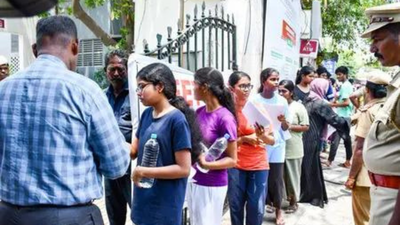
New Delhi: The Central Bureau of Investigation (CBI) has arrested a doctor from Latur and a faculty member of a coaching center in the NEET-UG 2026 exam paper leak case, taking the total number of persons arrested to 13.The arrested medical professional has been identified as Dr Manoj Shirure, who allegedly played a key role in facilitating the leaked chemistry questions for three students, including the son of a coaching center owner.According to investigators, Dr Shirure obtained these questions through PV Kulkarni, another accused in the case.The second person, Tejas Harshadkumar Shah, works as a physics faculty member at Dr. Abhang Prabhu Medical Academy (APMA), a premier coaching institute in Pune. Shah reportedly received the leaked physics questions for the high-stakes medical entrance exam from Manisha Havildar, who is already in custody.The federal agency registered the case on May 12, 2026, following a written complaint by the Department of Higher Education under the Education Ministry.Soon after taking over the case, the CBI formed special teams and launched a massive nationwide crackdown. So far, massive search operations have been conducted at 49 locations, resulting in the seizure of laptops, mobile phones and several incriminating documents.The investigation, which spans multiple cities including Delhi, Jaipur, Gurugram, Nashik, Pune, Latur and Ahilyanagar, has successfully traced the real source of the leaked Physics, Chemistry and Biology questions that were circulated ahead of the exam. CBI officials said multiple special teams are working together to unearth the entire chain of conspiracy, and detailed forensic analysis of all seized digital evidence is currently underway to ensure a comprehensive and professional investigation.

Source link

Delhi government to launch CBDC-based smart ration distribution system for greater transparency and consumer choice india news

Delhi government to launch CBDC-based smart ration distribution system for greater transparency and consumer choice

New Delhi: In a major welfare-oriented decision aimed at expanding food security coverage in the national capital, the Delhi Cabinet has approved a proposal to increase the annual income eligibility limit for ration cards under the Public Distribution System (PDS) from Rs 1.2 lakh to Rs 2.5 lakh.The decision is expected to benefit lakhs of families across Delhi who were earlier excluded due to low income limits, a release said.Speaking on the Cabinet decision, Food and Supplies Minister Manjinder Singh Sirsa said that the Delhi government under CM Rekha Gupta is also working towards implementing a CBDC (Central Bank Digital Currency) enabled ration distribution mechanism.Under this system, financial assistance for ration will be deposited directly into the accounts of the beneficiaries, allowing them to purchase ration as per requirement through digital currency at ration shops.“This will increase transparency and eliminate mismanagement in the system,” Sirsa said.The minister said the proposed CBDC-based model will be gradually implemented at ration shops and integrated with banking systems, including private banks, in the future. The initiative aims to ensure efficient delivery of benefits, reduce leakages and empower beneficiaries to access food supplies with greater flexibility and dignity.CBDC in the PDS system refers to the use of central bank digital currency to deliver food subsidy benefits to beneficiaries, instead of relying only on physical food grain distribution through Fair Price Shops (FPS) or unrestricted cash transfers to bank accounts. CBDC is a digital form of sovereign currency issued by the Reserve Bank of India and has the same legal status as physical currency.Under the proposed CBDC-based PDS model, the government will calculate the subsidy equivalent to the entitled food grain and transfer the amount to the CBDC wallet of the beneficiary. Beneficiaries will be able to purchase ration from authorized FPS shops after authentication through Aadhaar/e-POS system, wherein all transactions will be digitally recorded and adjusted for greater accountability.The CBDC-enabled PDS model is expected to make the system more transparent, portable and citizen-friendly, the release said. This mechanism will provide beneficiaries greater flexibility in choosing authorized outlets, real-time visibility of subsidy eligibility and transaction history and a robust grievance redressal framework through digitally traceable records.This model is also expected to reduce disputes at FPS levels, strengthen audit trails, improve monitoring of subsidy utilization and simplify reconciliation processes.CM Rekha Gupta had earlier talked about increasing the income limit for ration card eligibility in Delhi.To benefit more and more low-income families, the income eligibility limit has been increased from Rs 1 lakh to Rs 1.2 lakh and now to Rs 2.5 lakh.“Earlier, the income eligibility for a ration card was very low. Today, even an annual income of Rs 1 lakh is below the minimum wage level for a family. Keeping this in mind, the Rekha Gupta-led Delhi government has increased the income limit to Rs 2.5 lakh so that more eligible families can avail subsidized ration under the PDS system,” Sirsa said.“The Delhi government under the leadership of Chief Minister Rekha Gupta is also working towards implementing a CBDC (Central Bank Digital Currency)-enabled ration distribution mechanism,” he said.He said, “Under this system, financial assistance for ration will be deposited directly into the accounts of the beneficiaries, enabling them to purchase ration as per requirement through digital currency at ration shops. This will increase transparency and eliminate mismanagement in the system.”

Source link

Ugandan returnee quarantined in Bengaluru amid Ebola alert; No case has been confirmed yet. india news

Ugandan returnee quarantined in Bengaluru amid Ebola alert; No cases have been confirmed yet

New Delhi: A traveler who recently traveled from Uganda has been quarantined at a government hospital in Bengaluru after complaining of mild body ache, prompting heightened surveillance by the Center amid the Ebola outbreak in parts of Africa.The Union Ministry of Health and Family Welfare on Wednesday said the man has been admitted to the state-run Epidemic Diseases Hospital in Bengaluru for observation and further evaluation. Officials said the man is otherwise healthy and stable except for mild body pain.A sample has been collected and sent to the National Institute of Virology for laboratory testing, the results of which are still awaited.The ministry stressed that there is no case ebola virus disease This has been confirmed so far in India.“In view of the recent Ebola virus outbreak in parts of Africa, the Government of India is closely monitoring the emerging Ebola virus disease situation,” the ministry said in a statement.Health officials said the Centre, in coordination with the Karnataka government and other concerned agencies, is keeping a close watch and all necessary public health protocols are being followed in line with World Health Organization guidelines.The government said screening and surveillance measures are continuing at designated points of entry and in the public health system as part of preparedness efforts.The ministry also urged citizens not to panic or spread misinformation and advised people to rely only on official sources for updates related to the Ebola situation.

Source link

Karnataka CM discussion: DKS, Siddaramaiah to meet over breakfast on Thursday. india news

Karnataka CM discussion: DKS, Siddaramaiah to meet over breakfast on Thursday

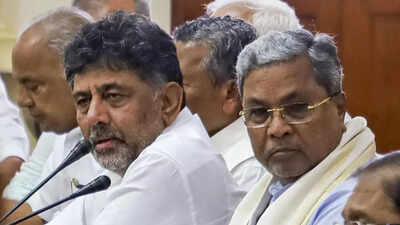
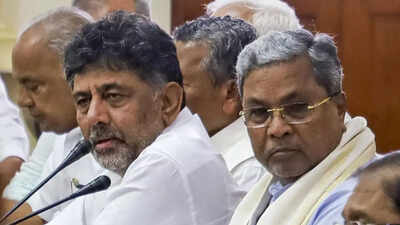
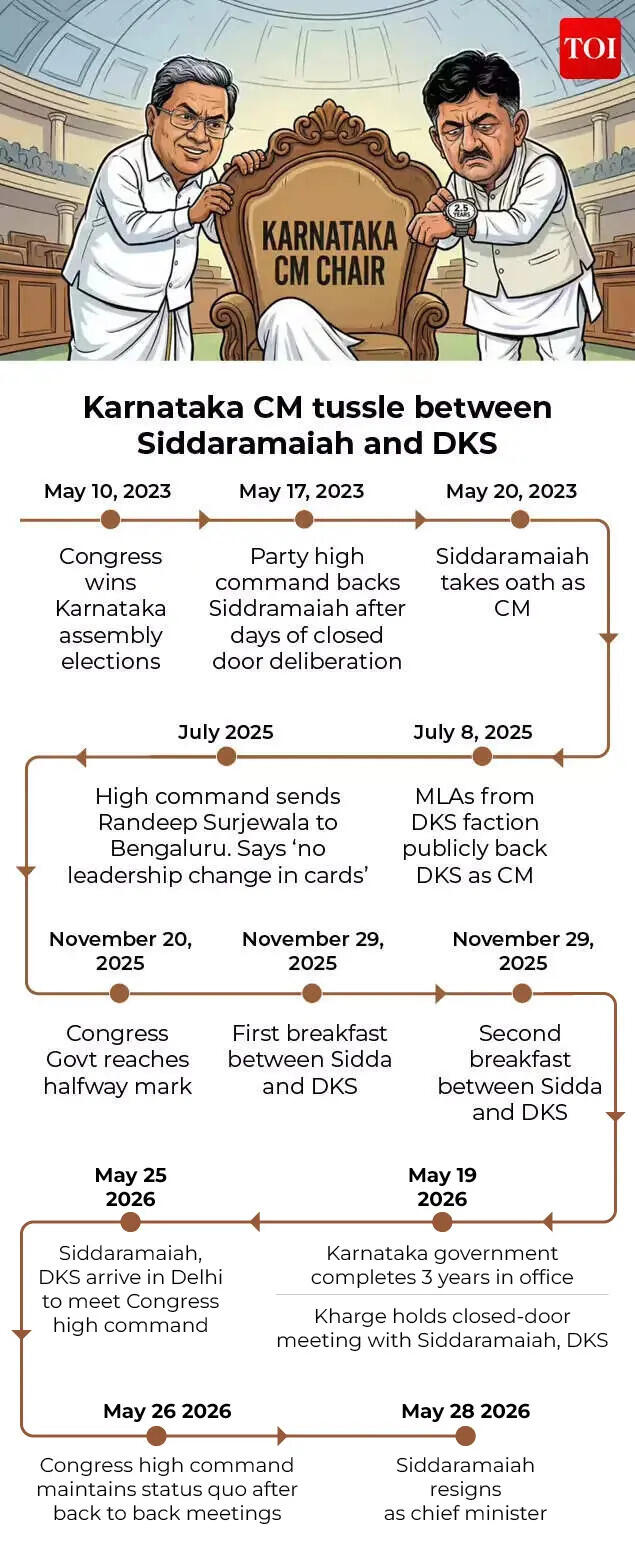
New Delhi: Amid growing speculation about possible leadership change in Karnataka, Deputy Chief Minister… DK Shivakumar Scheduled to attend the breakfast meeting called by the Chief Minister Siddaramaiah At 9 am on Thursday at Kaveri, the CM’s official residence in Bengaluru.The meeting comes a day after intense discussions between the Karnataka leadership and the Congress high command in Delhi, intensifying discussions over a possible change in the state’s top post.According to party sources, Siddaramaiah and Shivakumar met Congress president Mallikarjun Kharge, opposition leaders Rahul Gandhi, KC Venugopal and Karnataka in-charge Randeep Surjewala separately for over six hours on Tuesday.Sources told TOI that Rahul Gandhi is understood to have asked Siddaramaiah to consider playing a national role in the party and respond within a week. The Congress leadership is also believed to have discussed a possible Rajya Sabha seat for the Karnataka Chief Minister as part of the leadership change plan.Speaking to reporters after the meetings in Delhi, KC Venugopal dismissed reports of leadership change and said the discussion was limited to the upcoming Rajya Sabha and Legislative Council elections. He termed these reports as “speculation”.However, party insiders said Siddaramaiah conveyed that he had no ambitions in national politics, although Rahul Gandhi was keen to bring in the experienced OBC leader at the national level to strengthen the party organisation.The latest development is being seen as a major breakthrough for Shivakumar, who has long maintained that he was promised a rotational chief ministerial arrangement when the Congress formed the government in Karnataka after the 2023 assembly elections.Sources also said Siddaramaiah sought time to consult loyalists before taking a final decision. After returning from Delhi, the discussion is expected to continue in Bengaluru also.The Congress leadership is understood to be working towards a negotiated transition to avoid internal instability like the crisis seen in Rajasthan during the party’s previous rule.

Source link

Karnataka switch? Congress offered Rajya Sabha seat to CM Siddaramaiah. india news

Karnataka switch? Congress has offered Rajya Sabha seat to CM Siddaramaiah

Bengaluru/New Delhi: The Congress leadership is eyeing a change of power in Karnataka amid indications that CM Siddaramaiah has been offered a respectable rehabilitation, possibly including a Rajya Sabha seat, as part of a smooth leadership transition in the state.On a day when Siddaramaiah and his deputy and contender for his post DK Shivakumar met the Congress leadership of Mallikarjun Kharge, Rahul Gandhi, KC Venugopal and state in-charge Randeep Surjewala for six hours, Rahul is understood to have asked Siddaramaiah during the one-on-one meeting to consider playing a national role in the party. They have been asked to reply within a week.Venugopal – speaking to reporters along with the CM and Deputy CM – dismissed talk of discussions about leadership change as “speculation”, and said the meetings were limited to the upcoming RS and Legislative Council elections. Party insiders said Siddaramaiah told Rahul that he had no ambition to enter national politics, but Rahul insisted that he wanted experienced OBC leaders in his team to strengthen the Congress nationally. Rahul had so far resisted the idea of ​​replacing Siddaramaiah, even as others among top party leaders believed a change of leadership could help the Congress.Also read: Congress says no tussle between Siddaramaiah, DKS for Karnataka CM postParty insiders said Siddaramaiah sought time to consult his loyalists before taking the decision. During the discussion, he is understood to have indicated that he would rather step down than face Rahul, who had supported him for the CM post twice in his career despite being seen as an outsider within the Congress. Rahul’s rethink marks the moment Shivakumar had been waiting for for the last six months. He had always said that he was promised a rotational tenure at the time of formation of the government. When Congress won the state elections in 2023 by defeating BJP, Shivakumar was the party chief.Sources said there were discussions in Siddaramaiah’s camp on whether he should register his protest by refusing to resign or by quitting the post and rejecting any national role.If Siddaramaiah agrees to move to the Rajya Sabha, it could lead to a change in the post of Leader of the Opposition, which is currently held by Congress chief Mallikarjun Kharge. Rahul’s team also discussed giving place to Sidda’s son in the cabinet. The Congress president is due to get another Rajya Sabha term next month, and many consider Siddaramaiah a strong possibility as leader of the opposition to help the Congress with the OBC votebase.According to sources, Rahul’s team also discussed a possible cabinet berth for Siddaramaiah’s son Yathindra as part of the talks.The possibility of shifting the 77-year-old leader to the Rajya Sabha has gained momentum ahead of the elections for four Upper House seats from Karnataka in June. Congress is confident of winning at least three seats.It remains to be seen whether the CM tacitly agrees to Shivakumar replacing him or puts up resistance which could open the way for a third candidate as a compromise. The Siddaramaiah camp said he was still the overwhelming choice of the legislature party and submitted a list of 108 signatures to underline his superiority.After the AICC deliberations, Siddaramaiah met loyal ministers and MLAs at the Delhi residence of his senior minister KG George. He is expected to hold another round of consultations in Bengaluru on Wednesday before deciding his future course of action.Also read: Karnataka ministers and candidates confused after talks in DelhiA senior leader pointed out that a “cabinet reshuffle” in the state, as demanded by Siddaramaiah, was not discussed in AICC meetings – indicating that the CM’s retention was not guaranteed.Party insiders said that the Congress leadership wanted to avoid a “Rajasthan-like crisis”, and hence, preferred a negotiated change rather than a tense resolution.Congress insiders have recently argued that any change will happen only with Siddaramaiah’s consent, as the party takes into account his seniority as well as the fact that he is a senior OBC leader whose social engineering gives political leverage to the party. A senior state leader said the party would have to consider the possible consequences of ousting Siddaramaiah, whose Kuruba community has a statewide presence and has the potential to damage the Congress.

Source link

Government panel to investigate ‘demographic change’ india news

Government panel to investigate 'demographic change'

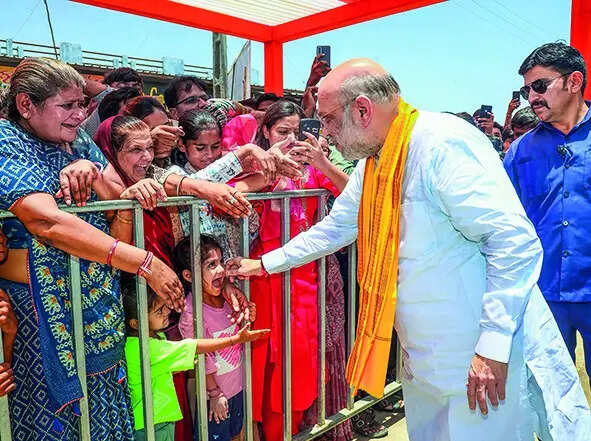
New Delhi: Following PM Modi’s announcement in last year’s Independence Day speech, the government on Monday constituted a high-level committee to scientifically examine the nature, causes and impact of demographic changes across the country, including illegal immigration as well as abnormal population shifts at the level of religious and social communities, and recommend policy, administrative and legal framework to address the problem in a time-bound manner.The High Level Committee on Demographic Change (HLCDC), headed by retired Supreme Court judge Prakash Prabhakar Naolekar, has been formed amid an intensified campaign by the BJP governments in Assam, West Bengal and other states to curb illegal immigration, which they see as a conspiracy to bring about demographic change and drive out all infiltrators.Announcing the panel on Tuesday, Shah said on X, “Unnatural demographic changes caused by illegal immigration and other factors are a serious challenge to the present and future of any country… This is not only linked to our sovereignty, but also to national security, law and order, profound changes in the social structure and protection of tribal groups.” The panel was given one year to submit the final report. This follows the recent particularly intensive revision of voter lists by the Election Commission, including in the border state of Bengal, which led to the deletion of lakhs of ‘absentee’ and ‘other’ voters – their details are already in the public domain.The HLCDC – tasked with recommending a permanent operational system for legal, fair and timely identification, detention and deportation of illegal immigrants in the country – comes at a time when the BJP is in power in Assam, Tripura and Bengal.Sharing that Census Commissioner Mrityunjay Kumar Narayan, retired IAS officer Durga Shankar Mishra, former IPS officer Balaji Srivastava and economist Shamika Ravi will be members of the committee, Shah said it will “comprehensively assess the demographic changes occurring across India due to illegal immigration and other unnatural causes, analyze the patterns of abnormal population shifts at the level of religious and social communities and present a planned and time-bound solution for the same.” Will do”.The panel, which will be under the Home Ministry), has been given one year to submit its final report.Assam Chief Minister Himanta Biswa Sarma has launched an aggressive campaign against the infiltrators and publicly vowed to push them back into Bangladesh. The newly elected BJP government in Bengal has got into work fast, with CM Suvendu Adhikari deciding to provide land to complete the fencing work on the border with Bangladesh.Informing the panel, the MHA said some areas are witnessing demographic changes that are not attributable to normal fertility or mortality trends but are emerging due to “external abnormal factors such as illegal immigration, irregular population dynamics and administrative laxity”.

Source link

Dera chief Ram Rahim came out on parole for 30 days, this is his 16th parole since 2020. india news

Dera chief Ram Rahim comes out on parole for 30 days, this is his 16th parole since 2020

Chandigarh/Rohtak: Haryana government has given parole for 30 more days to Gurmeet Ram Rahim Singh. Dera Sacha Sauda Pramukh had to serve 20 years in prison for raping two female students. Tuesday’s release was his 16th parole since 2020 and his second after a 40-day parole from January 5 this year. Ram Rahim, convicted by a special CBI court in Panchkula in 2017 and jailed since August that year, has spent more than 400 days out of jail since he left custody for the first time on a day off in October 2020. He came out of Rohtak’s Sunaria Jail at around 6.30 am and left for the Dera headquarters in Sirsa in a convoy of eight luxury vehicles. He is scheduled to return to jail on June 24. Sources said that after the approval of the District Magistrate, the authorities approved his stay in Sirsa. The Dera spokesperson said the sect chief has been released “as per his legal rights”. Under jail rules, convicts can avail parole for up to 10 weeks annually. Time spent outside prison on parole is added to the sentence period and is not counted as time spent in prison. Convicts sentenced to more than 10 years are also entitled to three weeks leave annually, which counts towards the sentence served. Combined, parole and furlough can keep a convict out of jail for up to 98 days a year, although such relief depends on a number of approvals and discretion exercised by authorities. He was also convicted in the murders of former Dera manager Ranjit Singh and journalist Ram Chander Chhatrapati, although he was later acquitted in both cases by the Punjab and Haryana High Court.

Source link