Government may use IAF aircraft to transport question papers for NEET re-exam: Report india news

Government may use Air Force aircraft to transport question papers for NEET re-exam: Report

New Delhi: The Center is considering the possibility of using the Indian Air Force to transport the NEET-UG paper to ensure foolproof conduct of the re-exam on June 21, news agency PTI reported citing sources.This comes after a high-level meeting chaired by Defense Minister Rajnath Singh. Interestingly, Education Minister Dharmendra Pradhan and Communications Minister Jyotiraditya Scindia also attended the meeting.The meeting focused on the entire examination process, from setting and printing of question papers to transportation and security arrangements.“Ministers and senior officials discussed whether IAF aircraft could be used to transport NEET-UG exam papers,” sources told PTI.“However, no final decision has been taken yet and the option will be placed before Prime Minister Narendra Modi for final consideration,” he said.Meanwhile, Prime Minister Narendra Modi is also believed to be personally monitoring the preparations for the June 21 re-examination, and is being updated on every detail related to the exam process.The National Eligibility cum Entrance Test (Undergraduate), or NEET-UG, was conducted on May 3 across 551 Indian cities and 14 overseas centres. Around 23 lakh candidates had registered for the examination conducted by NTA.According to NTA, information about the alleged malpractice was received on the evening of May 7, four days after the examination was conducted.The NTA said the inputs were shared with central agencies the next morning for “independent verification and necessary action”.NTA had canceled NEET-UG on May 12 amid allegations of paper leak. The exam has been scheduled again on June 21.The CBI registered the case based on a written complaint by the Department of Higher Education under the Education Ministry.The Central Investigation Agency formed special teams to investigate the case, conducted searches across the country and made prompt arrests.So far, 13 accused have been arrested in the case from Delhi, Jaipur, Gurugram, Nashik, Pune, Latur and Ahilyanagar.The investigation conducted so far has revealed the real source of the question paper leak, the CBI had earlier said.

Source link

Siddaramaiah’s resignation, Shivakumar’s top post decided: Will Congress’ ‘drama’ end in Karnataka or will it continue as before? | india news

Siddaramaiah resigns as Karnataka Chief Minister, DK Shivakumar likely to take charge

Siddaramaiah is out, Shivakumar’s time has come

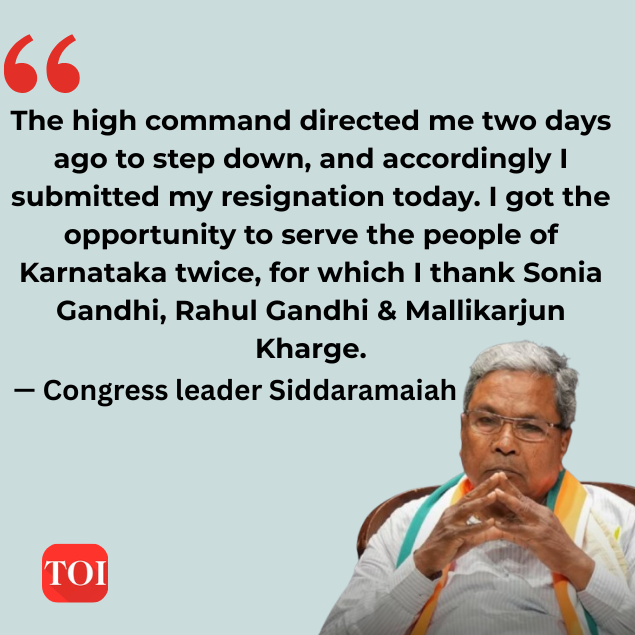
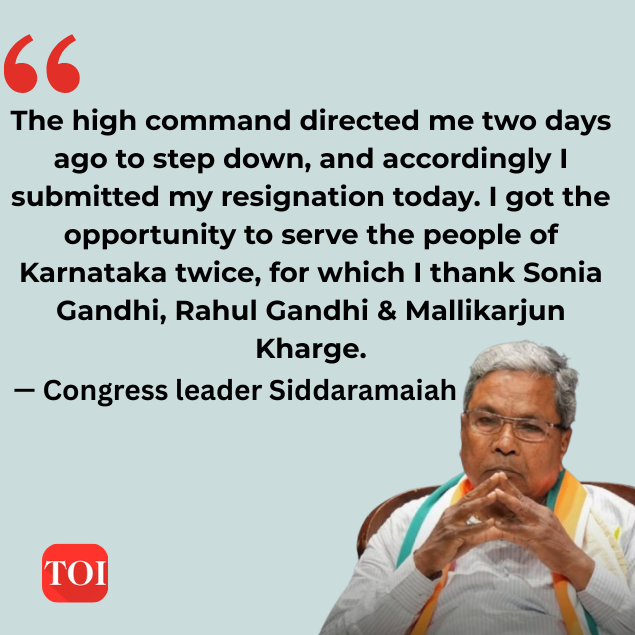
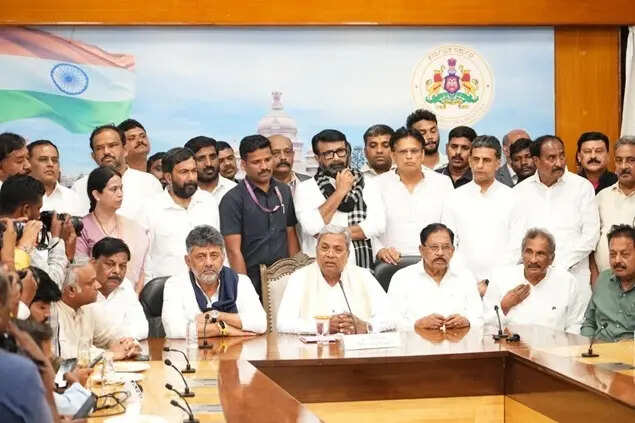
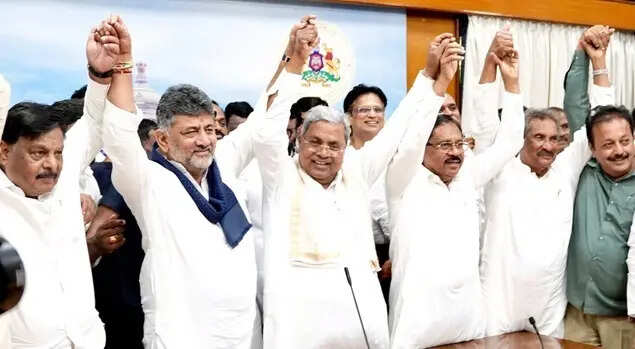
The process of change of power in Karnataka has finally started. Siddaramaiah has resigned from the post of Chief Minister, taking the first formal step towards the much-awaited change of power in the state.Standing shoulder to shoulder with DK shivkumar And Karnataka Home Minister G Parameshwara In a major show of unity, Siddaramaiah announced his resignation on Thursday, ending months of speculation over a change of leadership in the state. Announcing his resignation, Siddaramaiah said he was stepping down after the Congress high command directed him to do so two days ago.

Siddaramaiah (1)

What did Siddaramaiah say while announcing his resignation?

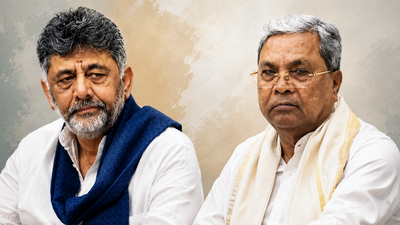
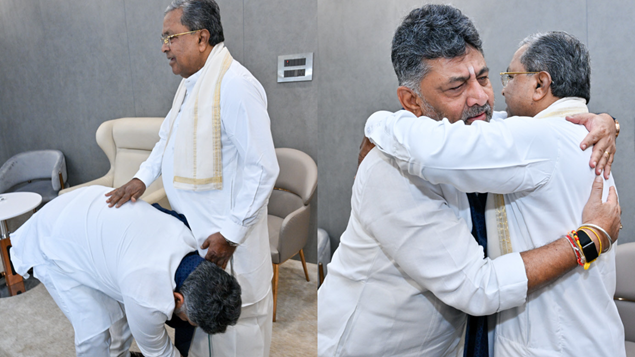
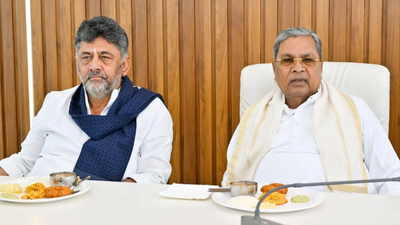
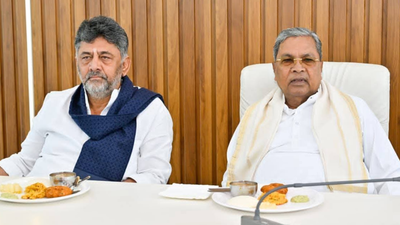
DK Shivakumar is set to get the top post eventually, unless Siddaramaiah and his supporters have a “last-minute surprise comeback plan”.In the breakfast meeting called by the Chief Minister before leaving the post, both the leaders gave a good display of cordiality by hugging each other. Shivakumar touched Siddaramaiah’s feet to seek the blessings of the senior leader. So far all is good.

Images (34)

Bonhomie at the breakfast meeting

But the big question is, has the Congress ‘drama’ finally ended in Karnataka? Or will the struggle for power continue in Karnataka? Rajasthan Where did Congress lose power to BJP in 2023 amid infighting between Ashok Gehlot and Sachin Pilot camps?

the bumpy road to armistice

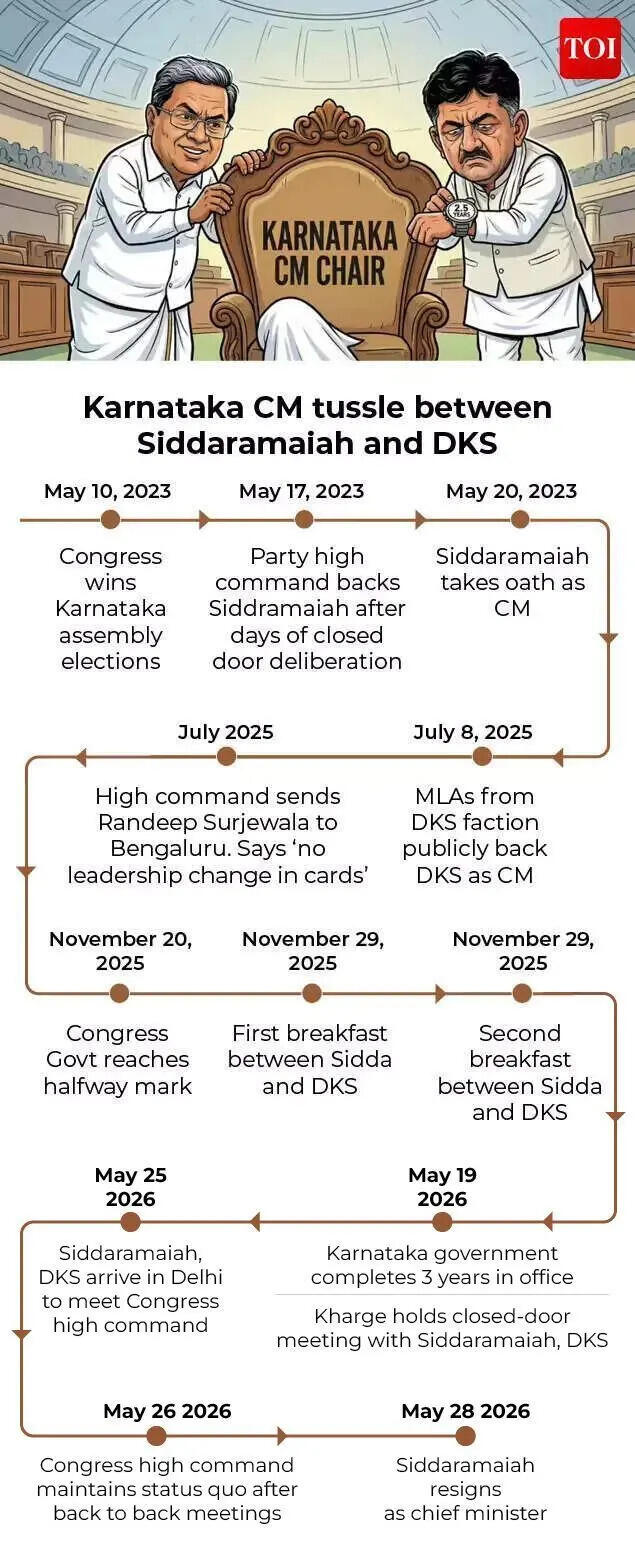
The fact that the process of this ceasefire agreement has been full of ups and downs may cause considerable concern to the central leadership of the Congress. The power struggle between Siddaramaiah and Shivakumar hangs over the Congress government like the sword of Damocles, ever since the party’s landslide victory in the 2023 assembly elections.DK Shivakumar, who played a key role in the 2023 election victory as state Congress president, wanted the chief minister’s chair from the beginning. However, Siddaramaiah, armed with immense governance experience and having the support of a clear majority of newly elected MLAs, was in no mood to accept defeat. After an intense post-result standoff, during which Shivakumar aggressively remained in touch, a compromise was eventually reached. Shivkumar bowed down and accepted the post of Deputy CM.

1000082772.

Karnataka power struggle: timeline

This was armistice agreement number 1. Siddaramaiah got the throne and Shivakumar made a compromise.However, this initial ceasefire did absolutely nothing to end factional fighting. While Shivakumar’s supporters left no opportunity to claim that a strict 2.5-year rotational system was in place, Siddaramaiah’s supporters contested the claim with all their might. In fact, Siddaramaiah himself has repeatedly and publicly said on several occasions that he will complete his five-year term.All the while, the Congress high command looked the other way, choosing to allow these fundamental differences to fester until they inevitably reached a tipping point.And that turning point came when Siddaramaiah completed his two and a half year tenure as Chief Minister. The simmering tensions came to the fore again. Shivakumar made the idea of ​​rotational CM public for the first time and targeted Siddaramaiah for reneging on the deal. He did not take names directly but the message was loud and clear. After this, there was an open war of words between the two leaders, due to which the Congress leadership had to face embarrassment.Shivakumar started the duel on X with a cryptic message: “Word power is world power. The greatest power in the world is to keep your word. Be it a judge, the President or anyone else including me, everyone has to obey. The power of words is world power.”Siddaramaiah immediately reacted and used the same words to target his deputy. “A word is not power unless it makes the world better for the people. The mandate given by the people of Karnataka is not a moment, but a responsibility that lasts for five full years. The Congress Party, including me, is speaking for our people with compassion, consistency and courage. Siddaramaiah wrote on Twitter, ‘Our word for Karnataka is not a slogan, it means the world to us.Siddaramaiah then listed out the promises he had fulfilled in his two terms as chief minister, leading to an open social media “war of words” between the two top leaders of the state.And this brings us to compromise number 2. This time Shivakumar has benefited and Siddaramaiah has had to compromise. But even though the transition process has formally begun, there are signs that the outgoing chief minister has not completely given up the fight.Siddaramaiah had reportedly insisted on calling a Congress Legislature Party (CLP) meeting to formally choose his successor, which was widely seen within the party as an attempt to slow down Shivakumar’s rise.There was also talk in Congress circles that formal CLP elections could potentially project Karnataka Home Minister G Parameshwara as a compromise candidate, especially if a section of MLAs mobilizes behind the senior Dalit leader. Such a development will not only prevent Shivakumar’s rise, but will also give Siddaramaiah an opportunity to take credit from the Congress for facilitating Karnataka’s first Dalit Chief Minister.

HJZ0wvmaEAIXBdV

DK Shivakumar, Siddaramaiah and G Parameshwara

Central to the Siddaramaiah camp’s argument was the claim that the outgoing chief minister enjoyed overwhelming support within the legislature party. Congress leaders familiar with the discussions indicated that Siddaramaiah had submitted the list of 108 MLAs to underline his political strength within the party.Siddaramaiah may have agreed to step down, but he is too politically influential within the Karnataka Congress to be easily sidelined. Perhaps this remains the biggest challenge for the Congress high command.Sandeep Shastri, political commentator and vice-president of Nitte University, believes that the Congress delayed the change perhaps more than it should have.“I have been saying for the last six months that change in Karnataka is not a question of ‘if’ but a question of ‘when’,” Shastri said. He argued that if the Congress had worked only on the two-and-a-half-year target, it could have avoided the tension and uncertainty of the last few months.Shastri also suggested that despite stepping down, Siddaramaiah was unlikely to disappear completely from Karnataka politics. “He will remain an important power center in Karnataka and the new chief minister will have to deal with that,” he said.According to Shastri, Shivakumar finally got the post he was promised, but managing the internal dynamics of the Congress and balancing competing interests within the party will remain his biggest challenge going forward.

show of unity

In a huge show of unity, standing shoulder to shoulder with DK Shivakumar and Karnataka Home Minister G Parameshwara, Siddaramaiah announced his resignation.

However, political commentator Professor Harish Ramaswamy argued that the Congress high command would have acted at the right time to ensure a smooth transition.Ramaswamy said, “The current developments in Karnataka are a timely step taken by the Congress high command, which benefits from the generational change in the party.”He also rejected speculations that the change could weaken the Congress government or automatically benefit the BJP. “Although there may be some deviations, the transition is likely to be smooth,” he said. He said Shivakumar may emerge as a more “innovative” chief minister than many expected.

Rajasthan experience of Congress

The problem for the Congress is that Siddaramaiah is not only a mass leader with a strong support base in the state, but he is also the party’s biggest OBC face in Karnataka. If Siddaramaiah decides to be careless, it could harm Congress’s prospects in the 2028 assembly elections.The Congress will remain cautious over the election results in Rajasthan due to the prolonged leadership battle between its two state stalwarts ahead of the 2023 assembly elections. The crisis there was similar in many ways. Sachin Pilot, as the then Rajasthan Congress chief, had played a key role in the party’s victory in 2018 and was expected to be rewarded with the chief minister’s post. But Ashok Gehlot had both administrative experience and the support of a large section of MLAs. The Congress, as it did in Karnataka in 2023, supported the senior leader and Pilot was asked to wait.After a long wait, Pilot rebelled along with his supporters and a bitter public war broke out between the two camps as the Congress high command struggled to contain the crisis. Reports at the time revealed that Shivkumar and Priyanka Gandhi played a key role in ensuring that Pilot did not leave the party. Pilot then, like Shivakumar now, may have lacked numbers among the MLAs, but he was too important politically for the Congress to ignore.But unlike Pilot, Shivakumar eventually managed to garner the support of the Congress high command, in which Priyanka Gandhi reportedly played a key role. Eventually Congress lost power in Rajasthan and Pilot is still waiting for a bigger role in the state.The Congress high command will hope that the transition in Karnataka is smooth and that the ceasefire lasts till the next assembly elections in 2028.

Challenge ahead…

There were indications that Rahul Gandhi had long been reluctant to replace Siddaramaiah despite pressure from sections within the party who believed a change of leadership could benefit the Congress politically. According to reports, Siddaramaiah told Rahul Gandhi that he has no ambition to enter national politics. However, Rahul is understood to have stressed that he wants the experienced OBC leader to play a bigger role at the national level and strengthen the Congress at the national level.There is a possibility that Siddaramaiah may eventually be sent to the Rajya Sabha. Such a move could potentially bring changes at the national level as well, with many within the party seeing Siddaramaiah as a potential contender for Leader of the Opposition in the Rajya Sabha as the Congress looks to strengthen its OBC reach at the national level.Thus, the challenge for Congress is not just to change the Chief Minister. It is also about maintaining harmony between the two power centres, balancing caste equations and regional loyalties and ensuring that the roadmap for the 2028 election battle in Karnataka does not remain bumpy.

Source link

Cockroach Janata Party: A meme that’s trying to be serious – 4 mistakes keeping it in the shade india news

Cockroach Janata Party: A meme trying to be serious - 4 mistakes keeping it in the shade

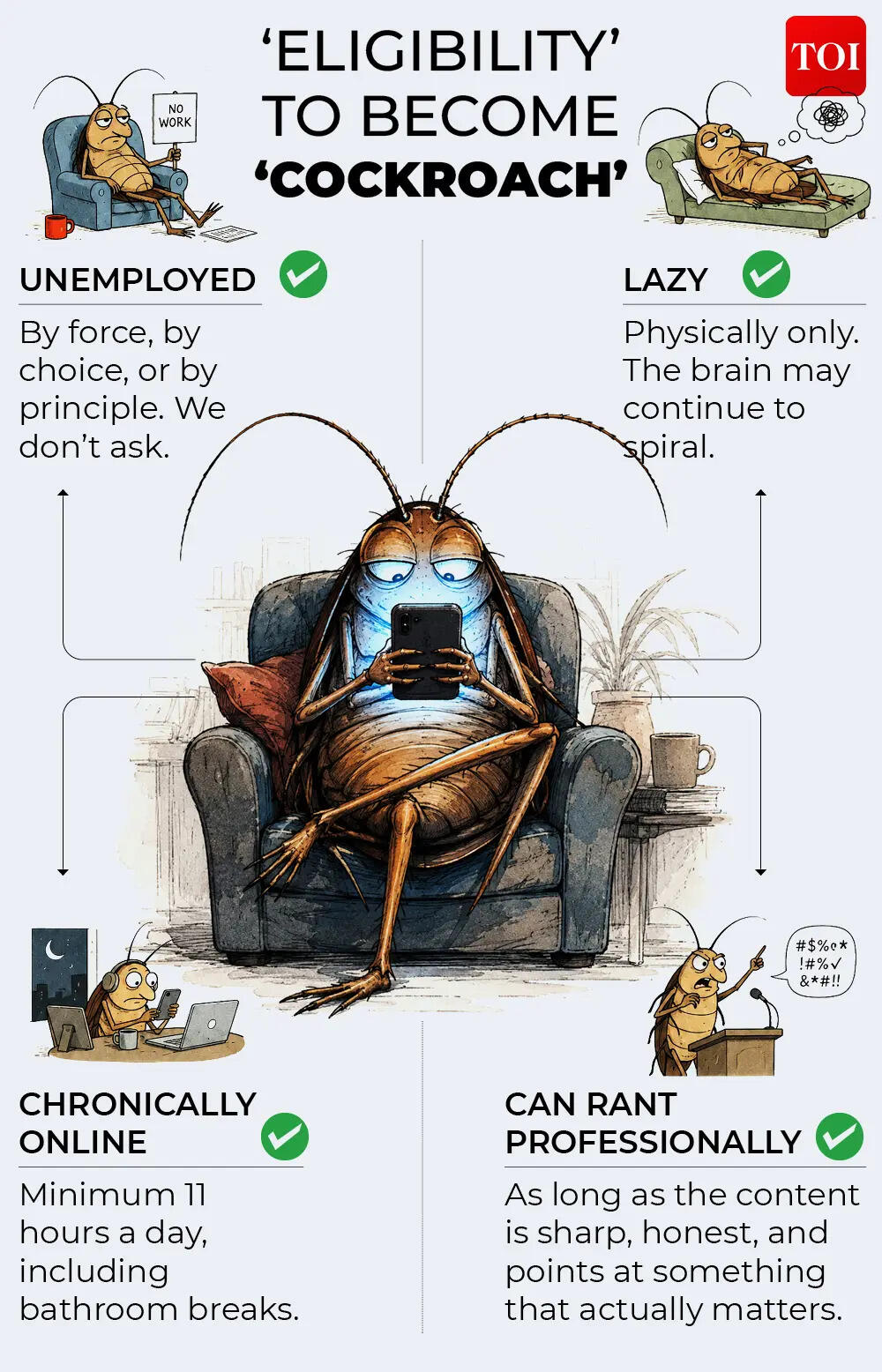
Cockroach Janata Party on 16 May 2026 (CJP) was launched as a satirical political group on social media, sparked by widely misquoted remarks by Chief Justice of India Surya Kant.

cockroach eligibility

His comments went viral out of context, morphing into a viral line about “unemployed youth being like cockroaches,” which quickly became a rallying cry for a generation already struggling with jobs, cost of living, and perceived elitism in power.

From meme to mass movement

CJP began life as a cheeky “party” with a cheeky online manifesto declaring it to be “the voice of the lazy and unemployed,” but its timing and aesthetic—rough-cut graphics, dark humor, and razor-sharp Gen-Z memes—struck a chord.Within five days of its launch, CJP’s Instagram account garnered over 21 million followers, far more than Congress’s 13 million followers and BJP’s 9 million followers.Its X account reached over 200,000 followers before it was blocked in India, while founder Abhijit Dupke’s personalInternational media outlets immediately presented the event as a digital-age protest movement, and described it as a “frustrated and disillusioned” expression of India’s youth, who are grappling with record-high unemployment, rising education-loan burdens and a feeling that traditional politics ignores their concerns.The CJP brands itself as an anti-establishment, “roach-squad” movement that mocks the self-seriousness of mainstream parties while channeling genuine discontent – ​​unemployment, credit inflation, and a sense that “the system is stacked against the average young person.”

How did BJP react?

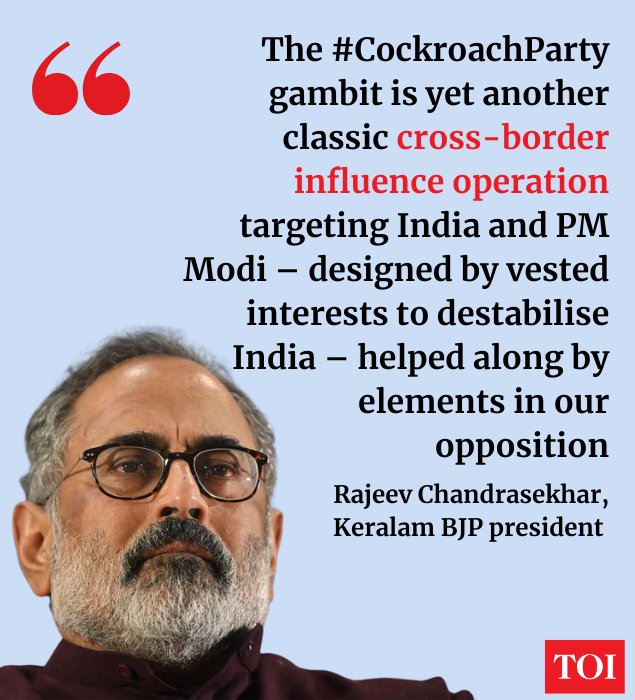
Domestically, the BJP responded with a hostile, conspiratorial narrative, labeling the CJP a “cross-border influence operation” aimed at destabilizing India’s institutions.Senior leaders, including several BJP MPs and Rajya Sabha members, floated the idea of ​​an official inquiry into the movement, accusing it of being linked to external actors and “shadow” networks.Kerala BJP president Rajiv Chandrasekhar argued that the party was being “helped by elements opposed to us” to target both the Modi government and India.

BJP's reaction

Meanwhile, Union Minister Sukant Majumdar alleged that almost half of the organisation’s social media support was from Pakistan and less than 10% from India.Speaking to reporters, Majumdar claimed, “49 percent of the followers of ‘Cockroach Janata Party’ on social media are from Pakistan.”Union Minister Kiren Rijiju also added to the controversy through a post on Instagram. In one post he wrote: “I pity those who look for followers on social media from Pakistan and the George Soros gang.”The digital pressure intensified when Ax blocked CJP’s official account in India.The platform’s actions triggered a separate reaction, with critics accusing the government of using legal tools to mute a satirical outlet that, while being inflammatory, largely operated within the bounds of online political parody.

Awkward dance of opposition

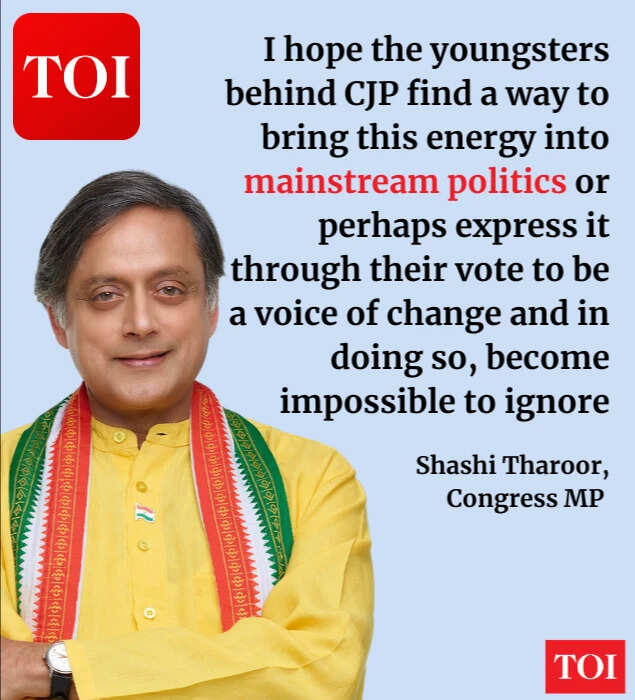
Opposition parties took a more subtle, damage-control-plus-opportunity approach.Prominent leaders of the Congress, Trinamool Congress (TMC) and Samajwadi Party (SP) publicly joined the CJP in mockery, posting memes and cheeky membership cards, while they used the moment to criticize the BJP’s job-creation record and youth-policy failures.Congress MP Shashi TharoorThe self-described “member” of the CJP praised the movement’s ability to tap into youth frustration, but also warned that the energy should be channeled into real-world politics.

Shashi Tharoor

In a widely shared thread, Tharoor wrote that he was “incredibly astonished by the rise of the #CockroachJantaParty”, noting that it reflects the real disillusionment among young Indians who feel “discounted, ridiculed and ignored” by the establishment. Yet he urged them to “bring this energy into mainstream politics or at least into their vote”, arguing that the only way to become “impossible to ignore” is through organized participation, not mere viral symbolism.Many opposition commentators have supported him, suggesting that if traditional parties fail to listen to the same grievances that the CJP raises, they risk losing another generation to apathy or to the next online movement.

How to turn ‘reel’ rebellion into real change?

At the grassroots level, the CJP remains entirely virtual – a meme-driven, Instagram-centric collective with no registered structure, no candidates, and no formal engagement with the electoral machinery.Its over 21 million Instagram following, thousands of memorable posts, and an ecosystem of fan-run Yet the question remains whether such a satirical “reel” movement can survive – or transfer its momentum into the real world.Political analyst Sajjan Kumar said, “An online viral movement requires a trustworthy face as the anchor, a set of concrete issues that cater to the frustrations and concerns of different sections of the people, and a willingness to take the initiative to set up a concrete organization to translate online solidarity into tangible political action.”As of now, the CJP has no manifesto beyond parody, no policy options, and no clear roadmap for electoral or civic participation; Its strength lies in criticism, not in governance.

4 sticking points

For a movement claiming to represent disillusioned youth waiting for change, the gap between meme culture and actual political change is dangerously wide.Lack of formal structure, no stability plan, weak response to allegations of foreign influence, vague political participation stance, and sensitivity to opposition tools – may prevent CJP from becoming anything more than a viral moment.“First and foremost, the CJP must clearly declare what it wants. Merely reactive mode in a jocular tone will not take them very far. Second, the leader must come out in the open and make clear that the party stands with everyone, irrespective of their ideological leanings, so as to avoid being dismissed as being partisan and working for anti-BJP organisations. Here, she must make clear her stand on the opposition parties in general and the Indian National Congress in particular. Should. Ultimately, transparency on the issue of funding and narrative arc is a prerequisite to gain popular legitimacy,” Kumar said.

  1. Lack of formal organizational structure: CJP remains an unregistered satire group rather than a legitimate political party. While this works for memes, it loses credibility when the movement tries to be serious. Without formal registration, legal status or a clear leadership hierarchy beyond Abhijit Dip, the movement cannot convert online support into real political power or policy influence.
  2. Overreliance on virility without sustainability plan: The movement gained 22 million Instagram followers in five days, but there is no clear roadmap for maintaining engagement beyond meme culture. Comments from political analysts suggest that CJP’s popularity reflects “the growing resentment of Generation Z”, but lacks mechanisms to convert frustration into organized action.
  3. Ambiguous stance on genuine political participation: CJP describes itself as “India’s most honest political party for lazy people” and is also planning a “virtual Gen-Z conference”. This dichotomy – being both proudly lazy and politically active – creates confusion about whether the movement seeks real political change or remains content as online protest theater.
  4. Underestimating the instrumentalization of the opposition: Shashi Tharoor’s call to “bring this energy to mainstream politics” shows how opposition parties view the CJP as a tool rather than a genuine movement. The quick “joining” of TMC, Congress and AAP politicians shows that the movement is running the risk of becoming a pawn of the anti-BJP strategies of the established parties rather than maintaining independent credibility.

For traditional parties, however, the CJP serves as both a warning and an invitation: a reminder that youth anger is no longer confined to occasional rallies or election-time sloganeering, but is now a 24/7 digital force that can siphon money from official accounts, mobilize millions, and, if mishandled, embarrass the state on the global stage.Some supporters have drawn comparisons to AAP, but Kumar points out: “The Anna Hazare-led anti-corruption movement may have a strong online component, but it began on the ground by uniting the middle class, civil society and professionals around the issue of widespread corruption that informs all established political parties.”“However, the CJP lacks all the elements: a credible anchor, a willingness to stay on the ground, a broad disconnect with all established political parties and putting forward an anchor issue that could bring unity to the people, especially Gen-Z, despite the existing political embeddedness.”

A call of caution for Gen Z

The explosive online popularity of the Cockroach Janata Party, coupled with its complete inability to translate digital virality into real-world political impact, serves as a warning to the ambitious, disaffected Gen Z.Giving likes on social media, turning your WhatsApp display picture into a cockroach meme, and using AI to create hilarious content that draws out deep despair is not enough.Boots on the ground are required.If CJP has any chance of becoming a real political force, its supporters will have to come out of their comfortable rooms and take to the streets. As Congress MP Shashi Tharoor said, youth must “bring this energy into mainstream politics” or express it through voting for it to become “impossible to ignore”.Protests, demonstrations and grassroots conversations with a population that is not online-savvy are absolutely necessary. India’s unemployed youth represent a huge demographic that cannot be reached through memes alone.Rural voters, older generations and working-class families who aren’t scrolling through Instagram won’t be swayed by viral hashtags alone.For Gen Z seeking real change, the lesson is clear: digital activism must be combined with physical presence.The future of the movement depends on whether supporters can evolve from virtual boasting to real-world organizing, from cozy rooms to crowded streets, from choice to legitimate political pressure.

Source link

The ‘Always Married’ Trap: Reasons why she can’t get away from it. india news

The 'Forever Suhagan' Trap: Reasons She Can't Get Away With It

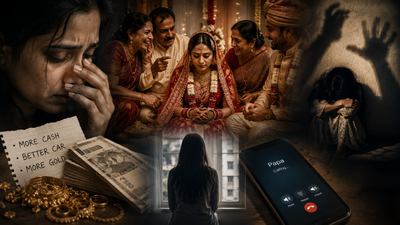
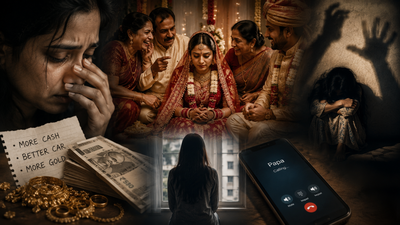
“Our girl is gone… no voice comes out of her mouth… she remains scared,” Tvisha Sharma’s relatives joke as the newlywed waits for her husband after the “kanyadaan”. It’s the kind of familiar “girly” humor heard at countless Indian weddings – a performative assurance to the groom’s family that their daughter is soft-spoken, accommodating and, above all, not troublesome. Tvisha smiles and plays along. Little did they know that these words would come back to haunt them months later, when the silence they had laughed at became permanent. Samarth Singh wanted more cash. Hrithik Nagar was not happy with the car and cash he already got, so he wanted a better car and more cash. Ompal also wanted more cash. Ankur Chaudhary was not happy with bullets, cash and gold, he wanted more.Tvisha, Deepika, Pushpendri, Kajal and thousands of other women allegedly died at the hands of men who wanted marriage more than a partner. At least, that’s what his family and the FIR claim. And the one thing that remained common in all these cases was the constant abuse and cries for help.So why do so many women stay in marriages they fear? Why do families continue to negotiate with violent families instead of breaking up? At what point does “adjustment” become abandonment? And why, even now, are women expected to survive marriage so long only for someone else to eventually decide they’re worth saving?

anatomy of a dowry death

Dowry deaths are often reported as the final act – a woman found hanged, burnt, poisoned or dead under “suspicious circumstances”. But experts say the real violence begins long before death.“It starts with emotional abuse, financial pressure and social isolation within the marriage,” says Aditi Verma, a lawyer who has handled many dowry and domestic violence cases. “Soon after marriage, trivial demands start coming from the husband and in-laws. Violence gradually escalates through cycles of oppression, reconciliation, and renewed abuse.According to Verma, this pattern is troubling in all cases, regardless of class or education. Women are controlled, monitored and constantly criticized. In many cases, in-laws impose strict behavioral expectations and also humiliate the woman for failing to meet them.Sometimes the abuse becomes extremely personal. In the case of Twisha Sharma, the allegations made by her family and included in the investigation show that allegations were made against her regarding her character and alleged extramarital affairs.“What is particularly disturbing is how normalized abuse has become in the marital home. Women are repeatedly asked to adjust, compromise or keep quiet in order to protect the family’s reputation,” Verma says.This normalization often delays intervention until violence has escalated irreversibly.

asks for help before dying

Hours before her death, Deepika Nagar called her father crying and told him that she was being assaulted again over dowry demands. Her family went to her marital home in hopes of calming the situation. Later that night, he received another call: Deepika had reportedly fallen from the terrace.19 year old Pushpendri Devi had also called home before she died.According to his family, he told his father, “Papa, they will kill me.”Before he could reach her, she was dead.and then he came Kajal Chaudhary – The SWAT commando was allegedly murdered by her husband with a dumbbell earlier this year.“I am killing your sister,” the deceased’s brother recalled saying over the phone as Kajal screamed in the background. The call got disconnected after some time.Tvisha Sharma was also reportedly contacting her family about the ill-treatment she faced before her death.What connects these women is not just the allegation of dowry harassment, but the fact that they attempted to be informed about the danger before the fatal moment arrived. Parents were informed. Relatives intervened. The families tried mediation. But the abuse continued.Lawyer Aditi Verma says that these warning signs are common in dowry death cases.“Before death, there are often warning signs such as repeated distress calls to parents, prior complaints, threats of suicide, prior attempts to leave, unexplained injuries, or statements such as ‘They won’t let me live in peace,'” she says.The tragedy, she says, is that these signs are often treated as routine marital conflict rather than indicators of escalating violence.

-

why women live

The question that arises after almost every dowry murder is very simple – why didn’t she go away?But experts say women often stay in abusive marriages, not because they fail to recognize the violence, but because leaving comes with its own social punishment.“One of the most heartbreaking patterns is when women understand the abuse, know the legal remedies available to them, and yet return because they feel they have nowhere else to go,” Verma says.The sentence that sticks most in his mind is painfully familiar: “I know it’s wrong, but if I leave, everyone will blame me, not him.”Dr Sapere Rohit, consultant psychiatrist at Sparsh Hospital, Bengaluru, says that “hope” inside abusive marriages often survives through temporary affection, forgiveness and promises of change.“Many women believe things will get better because marriage in India is deeply linked to family honour, children and social acceptance,” he says. “They are taught that relationships can be repaired with patience and sacrifice.”That emotional conditioning begins long before the abuse.Women are socialized to secure a marriage, tolerate discomfort, and prioritize family stability over personal safety. Parents, often unknowingly, reinforce that expectation.“Yes, many parents unknowingly put pressure on daughters to stay in unsafe marriages,” says Rohit. “Advice such as ‘adjust’, ‘every marriage has problems’, or ‘think about the children’ are often given with concern rather than harmful intent. However, this can leave women feeling unsupported and trapped.”

That pressure cuts across the classroom.

Tvisha Sharma was educated, professionally accomplished and socially distinguished. Deepika Nagar came from a financially strong family. Yet the two reportedly remained in a marriage their families say had already become abusive.“Even highly educated and financially independent women continue to suffer abuse due to emotional conditioning, fear of stigma, concerns about children or pressure to maintain the marriage at all costs,” says Verma.Divided by class, united by abuseOne of the most prevalent myths about dowry violence is that it pertains only to rural or economically marginal areas.The cases of Twisha, Deepika and others complicate that notion.Tvisha’s marriage took place in a legally prestigious family of Bhopal. Her husband was a lawyer, her mother-in-law a retired district judge. Deepika’s marriage represents upward social mobility among economically stable families. In these cases the alleged abuse arose not from social invisibility, but from an environment associated with status, education, and respect.“As a lawyer, I have noticed that abuse today is not always visible in the traditional sense,” says Verma. “In many educated and economically stable families, the violence is psychological – isolation, threats, manipulation, surveillance and sustained emotional degradation.”Rohit says the emotional cost of being considered a “good wife” in India is very high.“Many women are expected to prioritize family stability over their own emotional well-being,” she says. “Society often praises women for enduring suffering rather than encouraging healthy relationships.”Over time, that conditioning reshapes women’s understanding of abuse.“Continued abuse often makes them feel guilty, inadequate, or responsible for the breakdown of the relationship, even if they are the victims,” ​​Verma says.

What do the statistics tell?

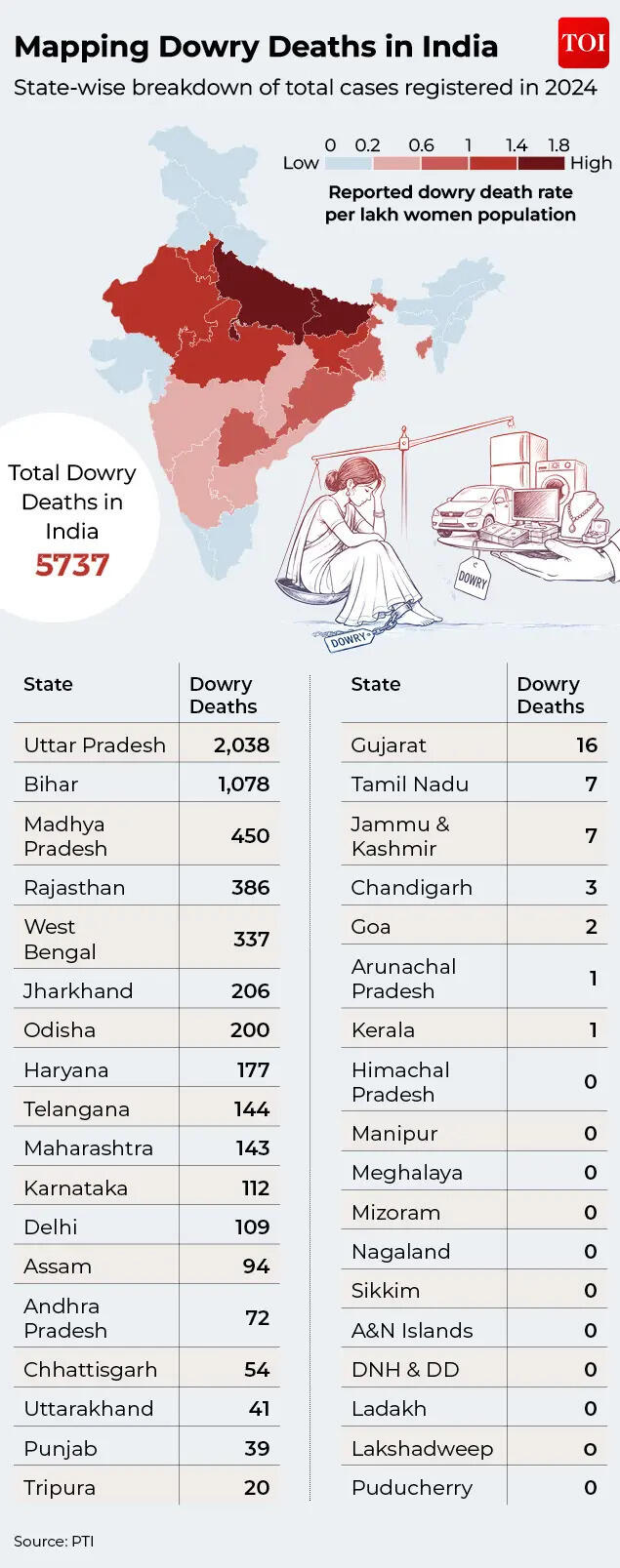
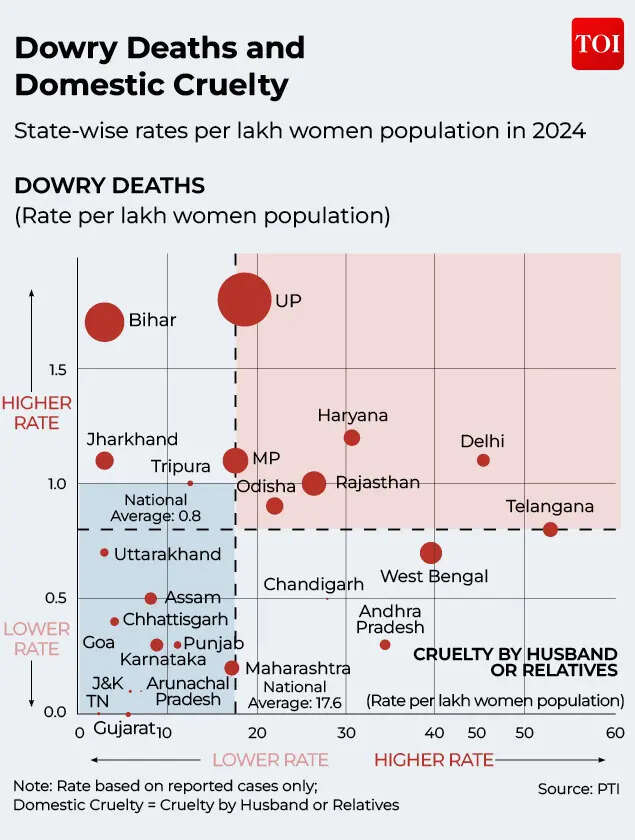
The scale of the crisis extends far beyond individual cases.According to NCRB’s Crime in India 2024 report, India recorded 5,737 dowry deaths last year – an average of about 16 women every day.Uttar Pradesh reported the highest number of cases at 2,038, followed by Bihar at 1,078. Madhya Pradesh reported 450 cases, Rajasthan 386 and West Bengal 337. Among metropolitan cities, Delhi recorded the highest number of cases at 111.But the numbers reveal much more than prevalence. They highlight the persistence of dowry in changing social realities.Dowry did not end with urbanization. Dowry did not end with education. Economic mobility did not eliminate dowry. Instead, dowry adapted itself to aspiration and situation.The demands became more expensive.

-

waiting to be rescued

What the statistics don’t fully capture is the emotional makeup of these marriages – the waiting, the bargaining, the hope that things will improve before they turn fatal.Women wait to change husbands. Families wait for the tension to end. Parents wait for the “right time” to intervene more forcefully. Society waits until violence becomes impossible to deny.And by then it is often too late.“Many women continue to stay in abusive marriages, not because they don’t recognize the abuse,” Verma says, “but because they fear being blamed for leaving the marriage more than the violence itself.”Perhaps that’s what makes these deaths particularly horrifying: Most of these women did not die quietly. He said. He warned. He asked for help. But somewhere between social standing, family honor, fear of stigma, and the endless pressure to “adjust,” their warnings became assimilated into the normal rhythms of marriage – until it became impossible to escape. A few days before her death, Tvisha Sharma reportedly summarized that entrapment in a message that would later sound like a warning against the institution:“I’m stuck brother. Just don’t get stuck.”

Source link

FSSAI tightens food safety rules for gram flour, seafood and seed oil. india news

FSSAI tightens food safety rules for gram flour, seafood and seed oil

New Delhi: From gram flour and edible oils to shrimp and cold-pressed seed oils, India’s food regulator is tightening safety standards across a wide range of food items consumed daily in households amid growing concerns over contamination, adulteration and chemical residues.Food Safety and Standards Authority of India (FSSAI) has issued revised and draft rules covering heavy metals, toxins, antibiotic residues and quality standards for both commonly used food items and emerging food products.Under the revised rules to come into effect from December 1, 2026, FSSAI has expanded the lead and cadmium-related contamination standards to also include pulses, including pulse flour and packaged mixes like besan.The regulator has also updated the limits for aflatoxins – toxins produced by certain fungi – in oils, oilseeds and ready-to-eat oilseed products. It has additionally revised the testing criteria for arsenic in fish oil and updated the standards for safrole, a naturally occurring substance found in foods and beverages containing nutmeg and mace.In another significant change, amid growing global concern over antimicrobial residues entering the food chain, FSSAI has introduced residue limits for antibiotics such as trimethoprim and oxolinic acid in seafood products including shrimp, prawn and fish products.Monita Gehlot, a dietician at AIIMS Delhi, said strict contamination standards were important as chronic exposure to heavy metals like lead, arsenic and cadmium can increase the risk of kidney damage, neurological disorders and cancer over time. He said expanding surveillance from pulses to pulse flour is important as products like gram flour are now widely used in packaged snacks, ready-to-cook foods and home cooking.Gehlot also warned that if antibiotic residues persist in seafood for long periods of time, it could lead to antimicrobial resistance, allergies and reduced effectiveness of life-saving drugs.In a separate draft notification, FSSAI has proposed quality and safety standards for underutilized edible oils made from chilli, tomato, melon and okra seeds as demand for cold-pressed oils, seed-based snacks and plant-based nutrition products is increasing.The proposed norms require these oils to be kept free from adulteration, harmful impurities, rancidity and mineral oil contamination, while limits are also set for moisture, acidity and metal content.According to experts, the popularity of cold-pressed and specialty seed oils has grown rapidly in urban India, but regulation has not kept pace with market growth, leading to concerns over adulteration, misleading labeling and inconsistent nutritional quality.The draft rules also include edible seeds such as watermelon, cucumber, pumpkin, sunflower, sesame and flax sold in raw, roasted or salted form, which are required to be cleaned and free from insects, fungus and visible contamination before sale.FSSAI has invited public comments for 60 days before finalizing the draft rules.

Source link

Haifa Port: A strategic maritime link for India amid Middle East tensions india news

Why has Israel's Haifa port become important for India's trade and strategic ambitions?
Haifa Airport (Image Source: ANI)

As tensions continue to escalate across the Middle East, Haifa port is being seen as a vital link in India’s growing strategic and economic engagement with the region.Located in a natural, protected bay in northeastern Israel, the Port of Haifa is one of Israel’s three major international ports and handles the transportation of goods, cargo, and tourists.Officially opened in 1933, the port has the capacity to handle approximately 30 million tons of cargo annually, including 1.5 million TEU (twenty-foot equivalent units) shipping containers.Why does Haifa Port matter to India?In 2023, industrialist Gautam Adani meets Israeli Prime Minister Benjamin Netanyahu during the official handover ceremony of Haifa Port. Adani Group. A consortium of Adani Ports and Special Economic Zone (APSEZ) and Israel’s Gadot Group won the bid to privatize Haifa Port for US$1.18 billion, with Adani Group holding a 70 percent stake in the consortium.The acquisition was widely seen as one of India’s most significant foreign infrastructure investments and a major strategic move in West Asia.Despite the uncertainty, operations at the port are reportedly continuing uninterrupted, highlighting its importance not only to Israel’s economy, but also to India’s long-term connectivity and trade ambitions.In March 2026, Adani Group said in a statement that its Haifa port in Israel is completely safe and in working order amid the escalating military conflict in Iran. Adani Ports and Special Economic Zone said all port assets and infrastructure are completely safe.Major exports between India and IsraelAccording to the Indian Embassy in Israel, while bilateral trade has traditionally been dominated by diamonds, petroleum products and chemicals, cooperation in sectors such as electronic machinery, high-tech products, communication systems and medical devices has been growing in recent years.India also remains a major focus country for Israel’s trade expansion efforts.1. India’s major export to IsraelThese include pearls and precious stones, automotive diesel, chemicals and mineral products, machinery and electrical equipment, plastics, textiles and apparel, base metals, transport equipment and agricultural products.2. Israel’s main export to IndiaThis includes diamonds and precious stones, chemicals and fertilizers, machinery and electrical equipment, petroleum oils, defence-related products and transport equipment.Could further escalation of tensions affect Israel’s trade with India? For India, stability in the Middle East is directly linked to trade, energy security and regional connectivity.Haifa Port is also expected to become one of the most important hubs in the India-Middle East-Europe Economic Corridor (IMEC).Under the proposed corridor, goods from Indian ports would travel by sea to the UAE and then travel through a railway network in West Asia before reaching Haifa, creating a faster trade route connecting India to Europe.Any prolonged conflict in the region could disrupt shipping routes, impact maritime movements and slow down IMEC-related strategic projects.linked to india through historyIn 1918, Indian cavalry soldiers fought in the Battle of Haifa during World War I and helped liberate the city from Ottoman control.Haifa is strategically important because of its port and railway connections. Its capture would allow the Allied forces to maintain supply routes while continuing their advance deeper into Ottoman territory.India also celebrates Haifa Day on 23 September every year to honor the Indian soldiers who participated in the war.Statues and monuments associated with Indian cavalry regiments exist in both countries, while Indian Army units tracing the lineage of those regiments continue to preserve the memory of the battle.

Source link

From Deputy to CM: After Siddaramaiah’s departure, Congress’ trouble-shooter DK Shivakumar finally got Karnataka’s top post. india news

From Deputy to CM: After Siddaramaiah's departure, Congress' trouble-shooter DK Shivakumar finally gets Karnataka's top post

DK Shivakumar Finally ready to take charge as Chief Minister of Karnataka Siddaramaiah His resignation from the top post on Thursday was the culmination of the decades-long political journey of the Congress leader, who emerged as the party’s trusted troubleshooter and mass leader in the state.After the two leaders visited Lok Bhavan earlier in the day, DK Shivakumar’s supporters celebrated by distributing sweets outside his Bengaluru residence.In Kalaburagi, Indian Youth Congress members performed a special puja at the Sri Sharan Basaveshwara Temple and demanded that Karnataka minister Priyank Kharge be appointed deputy chief minister if Shivakumar holds the top post.

The rise and rise of DKS

From student politics in Bengaluru to becoming one of the most powerful organizers of the Congress party in Karnataka, DK Shivakumar has built a political career defined by flexibility, loyalty to the party high command and an unmatched reputation as a trouble-shooter.Known as a mass leader with keen organizational skills, Shivakumar began his political journey at the age of just 18 when he joined the National Students Union of India (NSUI), the student wing of the Congress. Between 1981 and 1983, he served as the president of the Bengaluru district unit of NSUI while studying at Rama Narayana Chellaram College, Bengaluru. He later joined the Youth Congress and became the general secretary of its Karnataka unit.His entry into electoral politics was absolutely easy. In 1985, the Congress fielded young Shivakumar against veteran Janata Dal leader and future Prime Minister HD Deve Gowda in the Sathanur assembly constituency. Although he lost, Shivakumar attracted attention by putting up a tough fight against one of the tallest leaders of Karnataka.Two years later, in 1987, he was elected to the Bengaluru Rural District Panchayat from Sathanur. In 1989, he won his first assembly election from Sathanur on a Congress ticket, beginning a winning streak that cemented his position as one of the party’s strongest leaders in old Mysore.

Rise of DKS within Congress

Shivakumar’s rise within the Congress was rapid in the early 1990s. He played a key role in bringing the S Bangarappa-led government to power in Karnataka and was rewarded with a ministerial berth. As Jail Minister, he became one of the youngest ministers in the state cabinet.Even setbacks failed to stop his political rise. Denied a Congress ticket in the 1994 assembly elections, Shivakumar contested the election as a rebel candidate and won, underscoring his independent political strength and grassroots support.By 1999, Shivakumar had emerged as an influential strategist within the Karnataka Congress. He supported SM Krishna during his rise in the party and played a major role in the Congress campaign that won the assembly elections with 139 seats. Shivakumar organized a large campaign during the campaign and was credited with garnering support across the state. He won the Sathanur seat for the third consecutive time and was inducted into the cabinet as Cooperation Minister.Over the years, Shivakumar held several key portfolios, including urban development and energy. As Chairman of the State Planning Board and Cabinet sub-committees, she pioneered youth empowerment and women-centric initiatives such as Rajiv Yuva Shakti and Stree Shakti.His reputation as the crisis manager of the Congress Party continued to grow. Be it protecting MLAs during times of political instability or negotiating delicate alliances, Shivakumar has time and again proved his importance to the Congress leadership. In 2004, after the Congress-JD(S) alliance came to power in Karnataka, he played an important role in the internal negotiations despite not getting a place in the cabinet.Shivakumar also developed a reputation for rivaling the Deve Gowda family politically. In 1999, he defeated Deve Gowda’s son HD Kumaraswamy in Sathanur, despite the national stature of the JD(S) patron after his tenure as Prime Minister.

time of disputes

However, his political journey was not without controversies. In August 2017, the Income Tax Department had raided properties belonging to him. In September 2019, Shivakumar was arrested by the Enforcement Directorate in an alleged money laundering case, spending several weeks in jail before being granted bail. The episode triggered a massive show of support from Congress workers, further cementing his image as a leader who had weathered political and legal storms.

DKS revives Congress in Karnataka

Soon after his release, the Congress leadership reiterated its confidence in him. On March 11, 2020, Sonia Gandhi appointed Shivakumar as the President of the Karnataka Pradesh Congress Committee (KPCC), and tasked him with rebuilding the party in the state where it was struggling against the BJP.Shivakumar threw himself into reviving the organisation, by running an aggressive campaign coupled with grassroots mobilisation. Along with senior Congress leader Siddaramaiah, he led the party’s campaign in the 2023 Karnataka Assembly elections. The Congress registered a decisive victory and ended the BJP’s rule in the only southern state it ruled.The victory also intensified speculation about the chief ministerial post, with Shivakumar emerging as one of the strongest contenders due to his organizational role and electoral success. Although Siddaramaiah was ultimately selected as Chief Minister, Shivakumar was named Deputy CM – a recognition of both his political clout and his years of loyalty to the Congress.For many within the party, the appointment is the culmination of the decades-long journey of a leader who evolved from a student activist to the Congress party’s trouble-shooter in Karnataka politics.

Source link

Trauma Care Access: Supreme Court of India declared the right to access trauma care as constitutional. india news

India gets constitutional right to trauma care; Supreme Court orders sweeping changes in nationwide emergency response
India gets constitutional right to trauma care; Supreme Court orders improvement in nationwide emergency response (Image credit: ANI)

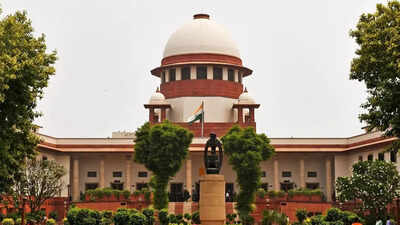
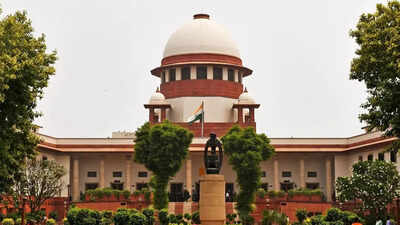
Mumbai/New Delhi: In a landmark judgment with far-reaching implications for motorists, hospitals and emergency responders, the Supreme Court has recognized access to trauma care as an integral part of the right to life under Article 21 of the Constitution and ordered a timely overhaul of India’s fragmented emergency care system.Order passed in SaveLife Foundation and Ors. The Union of India on May 26, among others, could reshape the way accident and trauma victims are treated across the country – from the moment of injury to definitive hospital care.The court’s directions are binding on all 36 states and union territories and cover the entire spectrum of trauma, including not just road accidents but also falls, burns, drowning, industrial accidents, fires, explosions and disaster-related injuries.For millions of Indian motorists – especially in dense urban areas like Mumbai and across Maharashtra, where traffic congestion and delays in emergency response remain a constant concern – this decision could prove to be game-changing.According to the NCRB data cited before the court, around 4.67 lakh accidental deaths are recorded annually in India. Road accidents alone cause approximately 1.77 lakh deaths every year. These figures become even more troubling when viewed against long-standing evidence that many of these deaths are preventable.The Law Commission’s 2019 report had earlier concluded that nearly half of road accident deaths could be averted by timely medical intervention, while the 2021 Niti Aayog-AIIMS Emergency and Injury Care Report found that delays in emergency care contribute to at least 30% of trauma-related deaths.Despite this burden, India had no unified and enforceable trauma-care architecture. The responses of 34 states and union territories placed before the court revealed a patchwork system marked by multiple emergency numbers, disparate ambulance standards, inadequate trauma registries and inconsistent implementation of existing central schemes.It was this systemic gap that prompted SaveLife Foundation to approach the apex court in October 2024, seeking recognition of trauma care as a constitutional right and stronger implementation of the existing emergency framework.A bench of Justices JK Maheshwari and Atul S Chandurkar stopped short of creating an entirely new statutory regime, but issued broad directions to translate the policy framework into enforceable obligations.Perhaps the most visible change for citizens will be the integration of multiple emergency helplines into a single national number 112 within three months. Numbers like 100, 101, 102, 108, 1033 and 1091 are to be integrated technically and operationally with large-scale media awareness campaigns.The court has also ordered states to set up physical and digital grievance redressal systems for good Samaritans – citizens who help trauma victims at accident sites. Although protected under Section 134A of the Motor Vehicles Act and Good Samaritan rules, many spectators remain afraid of police questioning or legal implications.For road users, ambulance improvements could be equally important. All registered ambulances – public and private – must adhere to the National Ambulance Code, install GPS or vehicle tracking systems and integrate with helpline 112. States have been directed to conduct structured audits covering response time, equipment, quality of care and patient outcomes.The order also addresses a long-recognized shortage of trained emergency personnel. States will have to adopt the standardized emergency medical technician curriculum notified by the National Commission for Allied and Health Care Professions within three months.Another major reform is the creation of state stroke registries linked to a coordinated national registry. Health experts have long argued that India’s inability to systematically record trauma cases has hindered policy planning and resource allocation.The court directed states to grade and designate public and private hospitals according to trauma-care capacity. Importantly, this classification is no longer limited to national highways alone, but extends to state highways, district roads and urban and suburban areas – an important provision for cities like Mumbai where severe trauma cases often occur away from highway corridors.Equally important is the effort to implement the Centre’s cashless treatment scheme for road accident victims – PM Rahat. States have been given eight weeks to complete hospital designation and related digital systems. The court made it clear that failure to implement the scheme would be a violation of the Motor Vehicles Act.The Supreme Court has maintained constant monitoring of the case. Copies of the order are to be sent to the Chief Secretaries of all States and Union Territories, who will have to submit action taken reports within the specified timelines. The case is expected to come back before the court after four months for further directions.Piyush Tiwari, founder of SaveLife Foundation, called the verdict a watershed moment for public health and constitutional rights and said it ensures that no citizen should be denied timely emergency care after suffering a traumatic injury.For India – where stroke remains a silent public-health crisis and where survival often depends on opportunity, geography and affordability – this decision signals a shift from policy aspiration to constitutional promise.

Source link

Karnataka Chief Minister likely to step down; DKS, Siddaramaiah Bonhomme: What happened in the main breakfast meeting? | india news

Karnataka Chief Minister likely to step down; DKS, Siddaramaiah Bonhomme: What happened in the main breakfast meeting?

New Delhi: Chief Minister of Karnataka Siddaramaiah Met Deputy CM on Thursday DK Shivakumar At breakfast at his official residence ‘Kaveri’, where several state cabinet ministers were also present. During the meeting, Siddaramaiah reportedly informed his ministers that he would step down from the post, clearing the way for DK Shivakumar and ending the months-long tussle over the top chair.Shivakumar, as his successor, warmly hugged the Chief Minister upon his arrival. He then touched Siddaramaiah’s feet and took his blessings, giving rise to speculations about the expected handover.

Siddaramaiah’s resignation, Shivakumar’s promotion

After the meeting, ministers confirmed that Siddaramaiah has formally announced his decision to step down during the day and DK Shivakumar is set to take charge as the next chief minister.“The Chief Minister will resign at 3 o’clock. CM Siddaramaiah said that we will make DK Shivakumar the new CM. He will become the CM,” HK Patil told reporters after the meeting at Siddaramaiah’s official residence ‘Kaveri’.As ministers and MLAs started leaving the residence after the breakfast meeting, Karnataka minister Ishwar Khandre said the Governor had already been informed about Siddaramaiah’s decision.“The Governor has been informed. Siddaramaiah will meet him at 3 pm. I attended the meeting. We all thanked the Chief Minister for guiding us for so many years. He will talk to you himself. He has already called a press conference and will explain everything to you,” Khandre told reporters in Bengaluru.Video | Bengaluru: Ministers and MLAs leave from Karnataka CM Siddaramaiah’s residence after breakfast meeting.Minister Ishwar Khandre says, “The Governor has been informed. Siddaramaiah will meet him at 3 pm. I attended the meeting. We all thanked the Chief Minister…” pic.twitter.com/r9ekTRcu4A– Press Trust of India (@PTI_News) 28 May 2026There were also indications that Siddaramaiah may travel to New Delhi to seek approval from the Congress high command on the selection of deputy chief ministers in the new government.

Siddaramaiah informed ministers about his resignation

The breakfast meeting at Siddaramaiah’s residence became the focal point of Karnataka politics as senior ministers gathered amid growing speculation over Congress leadership change.According to the leaders present in the meeting, Siddaramaiah informed his cabinet colleagues about his decision to step down from the post of Chief Minister. This announcement came soon after the completion of three years of the Congress government’s tenure.Senior ministers including Priyank Kharge, KJ George, MB Patil, Ramalinga Reddy and HK Patil attended the meeting, while security around the residence was tightened in anticipation of major political developments.

Shivkumar points towards Siddaramaiah

Deputy Chief Minister and Karnataka Congress president DK Shivakumar arrived at the residence along with several cabinet ministers and senior Congress leaders considered close to Siddaramaiah.In a moment that immediately took on political significance, Siddaramaiah warmly welcomed Shivakumar before touching the chief minister’s feet as a mark of respect. Later both the leaders hugged in front of party colleagues and ministers.Photographs of the conversation were released by the offices of both the leaders and later shared on social media by Karnataka Congress.Sharing the pictures, Karnataka Congress wrote, “That day, this day, forever… Unity is our strength! Public service is our eternal commitment!”The post was widely seen as an attempt by the party to display unity at a time of change within the Karnataka government.

State Home Minister hints at CM’s resignation

Ahead of the meeting, Karnataka Home Minister G Parameshwara said Siddaramaiah had invited ministers for breakfast to thank cabinet colleagues before stepping down.Responding to a question on whether Siddaramaiah could enter national politics or the Rajya Sabha after resigning, Parameshwara said any such decision would depend on the Congress leadership.“That’s it now, this decision has to be taken by the high command. So, at this point of time, I don’t know whether he was offered any post in Delhi or not. It is up to the high command,” he said.

Celebration has started outside Shivakumar’s residence

As news of Siddaramaiah’s decision spread, celebrations broke out outside DK Shivakumar’s residence in Bengaluru, where supporters distributed sweets in hopes of him becoming the chief minister.Amidst the increasing political turmoil, Shivakumar’s brother former MP DK Suresh also reached the residence.In Kalaburagi, Indian Youth Congress workers performed a special puja at the Sri Sharan Basaveshwara Temple, demanding that Karnataka minister Priyank Kharge be appointed deputy chief minister if Shivakumar holds the top post.


Source link

Government health expenditure tripled in decade, domestic medical burden fell. india news

Government health expenditure triples in decade, domestic medical burden falls

New Delhi: Government expenditure on health care in India has almost tripled in the last decade, while the amount spent directly by households on treatment out of pocket has declined sharply, according to the latest National Health Accounts (NHA) estimates released by the Union Health Ministry.The report showed that government health expenditure (GHE) is expected to increase from ₹1.30 lakh crore in 2013-14 to ₹3.85 lakh crore in 2022-23, indicating a large increase in public investment in healthcare.Government health expenditure as a share of GDP increased from 1.15% to 1.43% during this period, while its share in total health expenditure increased from 28.6% to 43.7%.One of the biggest changes highlighted in the report was the decline in out-of-pocket expenditure (OOPE) – the money that families spend directly on medicines, hospitalization and treatment. OOPE as a share in total health expenditure to decline from 64.2% in 2013-14 to 43.4% in 2022-23.The ministry said the decline reflects better access to public health services and financial security schemes, including the expansion of more than 1.8 lakh Ayushman Arogya Mandirs that provide free medicines, diagnostics and primary health care close to communities.The report also cited findings of the NSO’s 80th round of survey, which showed a decline in household medical expenditure, including zero average out-of-pocket expenditure for outpatient care at public health facilities.Officials said medicines and health supplements remain the largest contributors to domestic medical expenses. To reduce this burden, the government expanded free medicine schemes and increased access to low-cost medicines through Jan Aushadhi Kendras, Amrit Pharmacies and price control measures.Government spending on health care got an additional boost, rising to 1.84% of GDP in 2021-22 to support emergency response measures and the nationwide vaccination programme.The report also revealed that government expenditure on primary health care more than doubled from ₹0.5 lakh crore in 2013-14 to ₹1.4 lakh crore in 2022-23, while per capita government health expenditure increased from ₹1,042 to ₹2,786.Social security expenditure on health care, including Ayushman Bharat PM-JAY and government-funded insurance schemes, increased from 6% to 9.9% of total health expenditure during the decade.

Source link