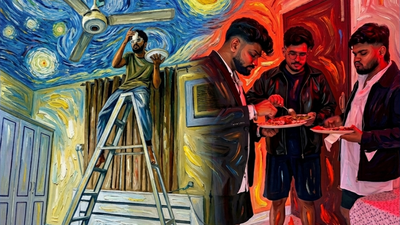
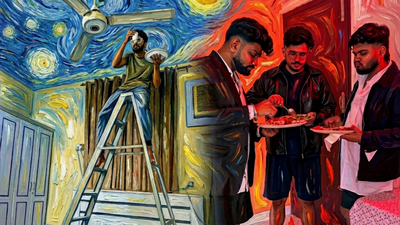
What does it mean to have free will in 2026?Why are young people across the world filming themselves eating lunch on ladders, rearranging their homes into fake hotel suites, or doing completely irrational everyday activities simply because they can?And how did a 19th-century philosopher who believed human beings were never truly free become strangely relevant to a generation raised by algorithms, lockdowns, surveillance and social media?Across social media, thousands of young users are posting videos under captions such as “POV: You suddenly realise you have free will”. The intent is to carry out the daily mundane activities in deliberately impractical but harmless waysVideos of people climbing the maintenance ladder while having lunch just to finish the meal in the air or other laying out buffets of the same meal just to recreate a wedding vibe have become a well-participated trend.What looks like unserious internet humour has almost become an emotional reaction to a world that feels increasingly controlled by economics, technology, politics and invisible systems.In a time when algorithms predict behaviour, governments shape consumption habits during crises and social media constantly influences thought patterns, free will is no longer viewed as a stable philosophical truth. For the new generation, it has become a feeling, a performance and, in many ways, a vibe.
From philosophy to TikTok rebellion
Long before social media transformed rebellion into short-form content, German philosopher Friedrich Nietzsche had already questioned whether free will existed at all.In his 1886 work Beyond Good and Evil, Nietzsche argued that human beings do not make choices in the pure, independent way they imagine. Instead, he believed people are shaped by instincts, conditioning, emotions, physiology and social structures that operate beneath conscious awareness. According to Nietzsche, free will was less a spiritual truth and more a psychological sensation.“The will is not only a complex of feeling and thinking, but it is above all an emotion, and in fact the emotion of the command,” Nietzsche wrote.In simple terms, Nietzsche believed people experience freedom when one desire inside them defeats another. A person feels powerful not because they escaped cause and effect, but because they managed to overpower competing impulses within themselves.That framework unexpectedly mirrors the current internet trend.A person eating lunch on a ladder is not operating outside social conditioning. Rather, they are experiencing the thrill of temporarily defeating the instinct to behave normally. The action itself may be meaningless, but the feeling attached to it is emotionally real.
A generation shaped by crises and control
This modern obsession with “performative autonomy” is emerging at a time when many young people feel their actual control over life has sharply decreased.The Covid-19 pandemic left a lasting psychological mark on an entire generation. Lockdowns suddenly restricted movement, social gatherings and everyday behaviour. Basic actions such as travelling, meeting friends, or simply being outside became matters of public regulation. As trainee clinical psychologist Yukta Sharma puts it, “Free will feels less like “I can do anything I want” and more like: “With all the limitations that the world is placing on me, what are things that I can still choose to do happily and not feel guilty or ashamed or wrong about doing and find satisfaction and joy, without offending anybody in?”,” as she adds that these were the very things that shaped the generation’s response to the Covid-19 lockdown.And while many accepted these measures as necessary for public health, Suyog Shetti, 26, recalls resisting social pressure during the Covid pandemic.“I think people still have free will,” Shetti maintains. “People’s own fear and self-consciousness are what hold their free will back. Like during Covid, I didn’t take the vaccine. Although everyone was telling me to, I felt some scam was happening and thought the whole situation was a tool being used to push the vaccine on us.”
Pop culture and collapse of certainty
Popular culture has started reflecting this anxiety in increasingly direct ways.Indian comedian Kenny Sebastian has repeatedly explored the absurdity of human behaviour through observational comedy. His routines often focus on how people unconsciously follow social scripts in relationships, public spaces and daily interactions.Fantasy-comedy series Good Omens also explores similar philosophical territory. Based on the novel by Neil Gaiman and Terry Pratchett, the show questions whether human beings genuinely possess agency or merely act within systems controlled by larger cosmic structures. Throughout the story, characters constantly struggle between obedience, fear and moral independence.Meanwhile, neuroscientist and author Sam Harris has become one of the most influential contemporary voices arguing that free will does not exist at all.Harris believes human thoughts arise from prior neurological and environmental causes that individuals never consciously chose. According to his framework, understanding the illusion of free will can actually become liberating. Instead of obsessively blaming themselves for every impulse, mistake or emotional reaction, people can develop greater self-awareness and compassion.For many young adults overwhelmed by the constant self-improvement culture, this perspective feels strangely comforting.The modern economy constantly tells people they are fully responsible for their success, productivity and happiness. At the same time, those same individuals are navigating unstable job markets, impossible housing costs, digital addiction and algorithmic manipulation. The contradiction creates emotional exhaustion.As a result, the idea that “free will is limited” no longer sounds depressing to many young people. Instead, it feels realistic.
What young people think free will means today
That realism becomes clearer when listening to how young adults themselves describe freedom.
The pragmatic view
For 26-year-old Kamal Mishra, free will exists, but only within practical limitations.“Free will is not absolute independence, but maximum ownership of one’s choices,” Mishra explains. “Free will is like having your own shop, where you are not bound by anyone else’s control, order, or dependency and you make your own decisions. But yes, you will have to open that shop to earn a living.”Mishra’s comparison reflects a broader generational compromise. Young adults may desire independence, but they also recognise that survival still depends on participating in economic systems they cannot fully escape.
The sceptical view
Others are far more sceptical.Aanshi Kanaujia, 25, believes modern information culture has deeply compromised individual thought.“I believe free will is a golden cage,” she says. “Most of our will is influenced by people, and rarely do individuals have their own mind. Yes, it is polarised to a great extent, especially in this era of unstoppable information consumption, where our will and thinking are systematically borrowed from someone else. Yes, there are some doing their own mind, but that’s not a big number. The question is: Is your thought of free will truly yours?”Her argument reflects growing concerns around algorithmic influence.Social media platforms increasingly curate what users watch, buy, believe and discuss. Recommendation systems shape political opinions, aesthetics, humour and even emotional reactions. As these systems become more sophisticated, distinguishing personal desire from manufactured preference becomes increasingly difficult.
The fatalist view
For some, this has produced outright fatalism.“Free will does not exist; it’s just an illusion,” says 26-year-old Sumant Singh. “Everything depends entirely on the situation, and that same situation decides our will. Overall, nothing is ‘free.’ My thoughts might sound a bit extreme, but I feel this is the ultimate reality.”Singh’s view reflects a generation raised amid repeated crises.Many people currently in their mid-to-late twenties entered adulthood during economic uncertainty, climate anxiety, political polarisation and a global pandemic. The belief that individuals fully control their destinies feels increasingly disconnected from lived reality.
The restrained view
Yet not everyone believes freedom has disappeared entirely.Some young adults argue that free will survives in smaller forms.Chirag Thakur, 27, describes free will as the pause between impulse and action.“I think free will is like any other power or impulse that you have, which is often restrained by your mind which is, of course, a necessity,” Thakur states. “Without the mind as the charioteer, it would be like an aimless chariot, which can be chaotic and quickly turn into a disaster. In any ‘free will’ decision, the pause that makes you think about whether to do it or not is the real free will. And of course, this can change with changes in region, society, and circumstances.”His interpretation aligns closely with modern mindfulness practices, where awareness itself becomes a form of agency.Rather than viewing freedom as unlimited action, many younger people now define it as conscious interruption. In a world designed to trigger instant reactions, the ability to stop, reflect and resist impulse feels increasingly valuable.
The structuralist view
At the same time, conversations around free will are also becoming deeply political.Srabastee Biswas, 25, argues that freedom is unevenly distributed and shaped heavily by class, gender and social privilege.“Free will is not absolute, total independence,” Biswas argues. “It is more like what one creates out of the given resources and only where access is allowed to choose for themselves. If we take a feminist point of view, that space has never been equal. Gender roles, safety concerns, and economic gaps, especially for women and marginalized people, have always created a narrower lane of acceptable choices.”Biswas believes recent years have exposed just how fragile autonomy can be.“When we look at our generation, we’ve witnessed massive backtracks of individual rights, from the stripping away of bodily autonomy and reproductive freedom to economic crises and a massive surge in digital surveillance. This reveals how incredibly fragile it truly is. When the state deprives people of basic rights and autonomy, so-called free will becomes a luxury accessible only to the privileged class. For many of us, practicing free will isn’t just picking what we want, it’s questioning the central belief of what we were told to want.”Her comments reflect a broader shift in how younger generations discuss freedom.For previous generations, free will was often framed as personal ambition or individual achievement. For many Gen Z adults, however, freedom is increasingly understood through systems of power. Access to safety, money, healthcare, privacy and rights now determines how much autonomy someone can realistically exercise.
The commercial view
The role of technology in shaping behaviour remains one of the strongest recurring concerns.Riddhi Jain, 25, believes modern consumer culture actively narrows independent thought.“We don’t move by free will,” Jain reflects. “In my opinion, it’s like the more choices we are presented with, the more our actual free will is limited. We are not just influenced; we are rather controlled by brands and conditioned to think about things in a very specific, curated way.”Her observation reflects what psychologists often call the paradox of choice.While digital platforms offer endless options, many users ultimately end up following highly predictable patterns shaped by advertising, trends and algorithmic recommendations.Ironically, this has also made small acts of irrationality feel emotionally significant.Choosing to behave inefficiently, absurdly or unpredictably becomes a way of resisting optimisation culture. In a world obsessed with productivity, branding and measurable outcomes, doing something pointless simply because it feels amusing can feel deeply personal.
The subversive view
At the opposite end of the spectrum, some young adults believe the greatest act of autonomy today may simply be disengagement.“Our generation grew up with algorithms, lockdowns, trends, and constant chaos deciding things for us,” says 25-year-old Anurag Krishna. “So honestly, maybe real free will today is me choosing not to answer this question at all… which I almost did out of pure freedom.”That quiet refusal captures the exhaustion sitting beneath many contemporary conversations about agency.Young adults today are constantly asked to perform opinions, maintain online identities, produce content, optimise careers and remain permanently visible. In such an environment, withdrawal itself can feel rebellious.
The rise of micro-rebellions
This is precisely why the internet’s strange “free will” trend resonates so strongly.The videos are not revolutionary in any traditional political sense. Nobody is overthrowing governments by eating noodles on ladders or pretending their bedroom is a five-star resort.Yet these acts matter symbolically because they interrupt predictability.Algorithms thrive on patterns. Modern institutions thrive on compliance. Consumer economies thrive on habit. Absurd behaviour momentarily breaks those systems, even if only emotionally.In that sense, Nietzsche’s philosophy has accidentally found new life online.He believed free will was never pure freedom. It was merely the sensation of command, the emotional experience of asserting one desire over another.Today’s generation appears to have transformed that insight into cultural practice.They may fully understand that algorithms influence them, capitalism constrains them and crises shape their futures. They may even agree that absolute autonomy is impossible.But instead of responding with complete despair, many are choosing irony, absurdity and micro-rebellion.The result is a generation that no longer treats free will as a grand philosophical certainty.Instead, free will has become something smaller, stranger and more emotional.It is the pause before reacting.It is the decision to log off.It is refusing to optimise every second of existence.It is questioning inherited desires.And sometimes, it is climbing halfway up a maintenance ladder with a plate of lunch in hand simply to remind yourself that, despite everything, you can still choose to do something completely pointless.For Nietzsche, free will may have been an illusion.For Gen Z, the illusion itself has become the experience.


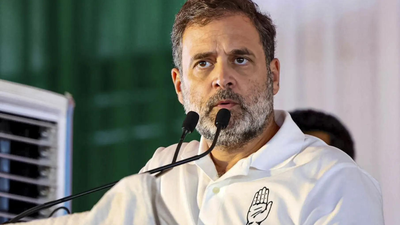
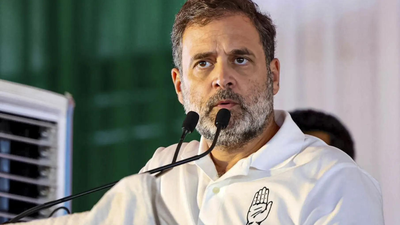 Congress President Mallikarjun Kharge said in the context of the annual “Pariksha pe charcha” that PM Narendra Modi should “discuss paper leaks”.Rahul criticized Pradhan for his alleged comment that he did not heed the recommendation of the Parliamentary Committee on Education regarding NTA. Jairam Ramesh said that Pradhan’s comments show that he is not suitable for the post of minister.Kharge said that “Amrit Kaal” is proving to be “dead period” for the students.


 Jammu and KashmirOfficials said suspected terrorists, who are believed to be active in the area, are being traced in Poonch district. The operation comes days after an infiltration attempt was foiled in Mankot area of Mendhar tehsil on May 12, in which an infiltrator was killed. Army and police teams conducted massive search operations at more than five locations across the district as part of anti-terrorism measures, officials said. Security has also been tightened in entire Poonch after the infiltrator was killed in Krishna Ghati sector near the Line of Control (LoC). Additional check posts have been set up, while vehicles are being rigorously checked. According to PTI report, officials also said that there are unconfirmed reports suggesting the possible presence of a high-profile foreign terrorist in the valley, although no official confirmation has been issued yet.
 Officials said on Saturday that the incident came to light from Mohra village of Kotranka subdivision, about 40 km from Rajouri city. Mohammad Hussain died during treatment. Those who fell ill include 8-year-old Mohammad Imran and 6-year-old Ratish Ali. He was admitted to the Community Health Centre, Kandi and later shifted to the Government Medical College and Hospital, Rajouri.“Prima facie it is a case of food poisoning,” officials said, adding that the exact cause was being investigated.
 Supreme CourtAnd the board will provide all possible support in this legal fight.The board said in a statement that it “strongly rejected the recent Madhya Pradesh High Court judgment in the Bhojshala-Kamal Maula Masjid dispute, declaring the Bhojshala-Kamal Maula Masjid complex as a Saraswati temple.”