Rajvardhan bets on Kannada cinema’s global moment with pan-Asian film. kannada movie news

Rajvardhan bets on Kannada cinema's global moment with pan-Asian film

Kannada actor Rajvardhan is the son of veteran actor Dingri NagarajHe may have found his entry into the industry, but his journey so far reflects a steady accumulation of experience – both in front of and behind the camera. After doing headline-grabbing films like Bichchugatti and Gajarama, the actor is optimistic about the trajectory of Kannada cinema and says his next project is a pan-Asian film, a vision he has been developing over the years.Regarding the ‘Pan-Asian’ concept, Rajvardhan believes that film industry Naturally evolving towards broader markets. “Kannada cinema is moving towards pan-Indian and even pan-Asian storytelling, given the kind of stories we are telling now,” he explains, pointing to narratives that are increasingly universal and supported by larger production values. He is also candid about the challenges. “We often limit our films to the Kannada market and sometimes don’t even take them to neighboring states,” he said.According to him, this hesitation arises due to limited access to networks and distribution channels. However, he believes the mindset is changing. Seeing every project as a stepping stone, Rajavardhan says, “Each film has taught me something. Last year, working as the creative head and producer of Kamal Sridevi gave me a deep insight into the creative and business sides of the industry. There are investors across the country who are willing to take our cinema global – we just need to make the right connections,” he says.

I consider myself a lifelong student of cinema. Everything I have done so far – every film, every role – has been a learning experience for me. I think my true cinematic journey begins now

Rajvardhan

A student of fine arts, Rajvardhan approaches cinema with a learning mindset. He further added, “Everything I have done so far – every film, every role – has been a learning experience. I feel my true cinematic journey begins now.” About the film he is currently working on, he says, “It has been in the works for four years. I have been preparing intensively for the last two years and have not taken up any other project since 2022.” Preparation has been rigorous, including physical training, workshops and character development. “Since it is an action-oriented film, fitness and bodybuilding have been my main focus,” he says, hinting at the scale and demands of the project.

Watch

Inside Kollywood’s 2025 crisis and uncertain future

Source link

Despite increase in allocation, SMEs in Kolhan are facing gas crisis. Ranchi News

Despite increase in allocation, SMEs in Kolhan face gas crisis

Jamshedpur: The central government has announced to increase the allocation of commercial LPG to 70% from the existing 50%, but entrepreneurs operating small and medium enterprises (SMEs) in Kolhan division are apprehensive about the regular allocation of refills.Manav Kedia, president, Singhbhum Chamber of Commerce and Industry, said, “The government had earlier increased the allocation from 20% to 50%, but the shortfall on the ground remained for a wide spectrum of small and medium industries. Despite the increase in allocation, what we are actually getting is a matter for us.”

Watch

Center hits out at PNG: LPG supply can be stopped where pipelines are available

Kedia said that due to the war-induced gas crisis the industry faced problems in getting commercial gas and currently the industry is expecting help from state holders including the state government to facilitate uninterrupted supply of gas refills.Spread over an area of ​​over 3,200 hectares with over 1,200 functional units, Adityapur Industrial Area depends heavily on commercial LPG for the necessary engineering processing, entrepreneurs said. Industrial Stability and Reforms Organization (ISRO), an organization of automobile supporting units of Adityapur industrial area, said that small units are still facing difficulty in arranging LPG cylinders.ISRO Secretary Sameer Singh said, “A handful of large industries operating in Jamshedpur, Adityapur and Chaibasa receive supplies directly from LPG companies and will benefit from the increase in allocation. Most of the subsidiaries taking LPG refills from local distributors are facing a crisis as commercial LPG supply to the distribution agency is irregular.”Industry insiders have said that many automobile accessories companies are waiting for uninterrupted supply of LPG refills to complete the pending metal work.Regional Director of Jharkhand Industrial Area Development Authority, Prem Ranjan assured cooperation to the entrepreneurs. “If the supporting operators are not getting regular LPG refills, we will hold talks with them and talk to the gas supply companies to resolve the problems,” he said.

Source link

Goat Tower: Why Illinois farmers built this 31-foot tower just for goats world News

Goat Tower: Why Illinois farmers built this 31-foot tower just for goats

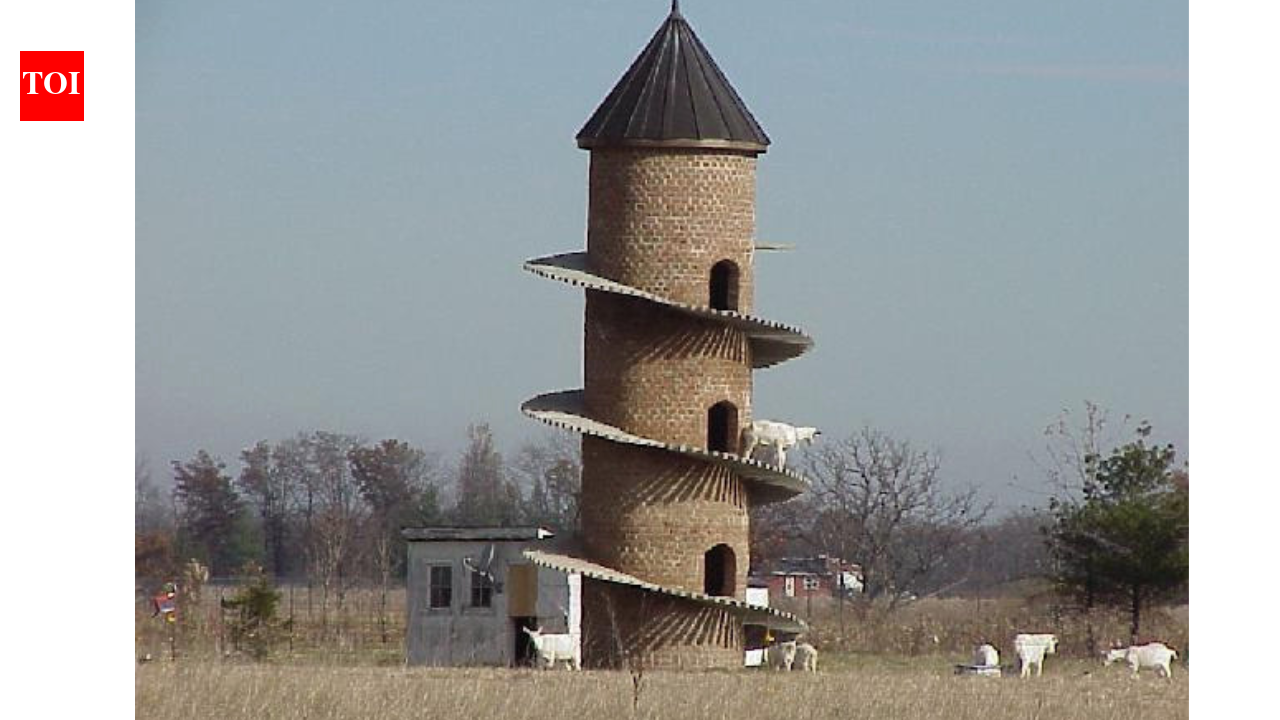
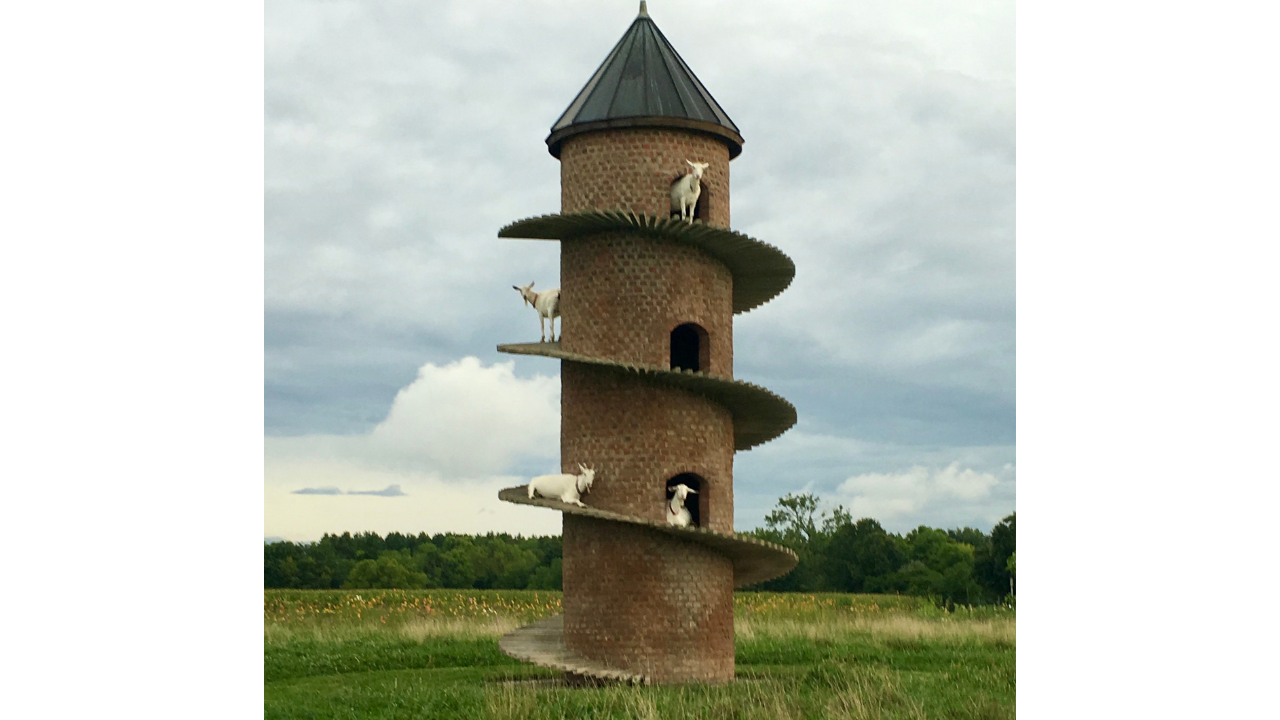
A 31-foot brick tower built just for goats stands in rural Illinois, and yes, it’s totally real. Wrapped in a spiral of narrow ramps, the structure allows goats to climb, rest, and look out over the surrounding farmland. What may seem bizarre or even absurd at first has actually garnered widespread attention online. But beyond its unusual design lies a practical purpose, incorporating animal behaviour, agricultural innovation and a touch of creativity, transforming a typical dairy setup into something much more unique.

‘Whatgoat tower

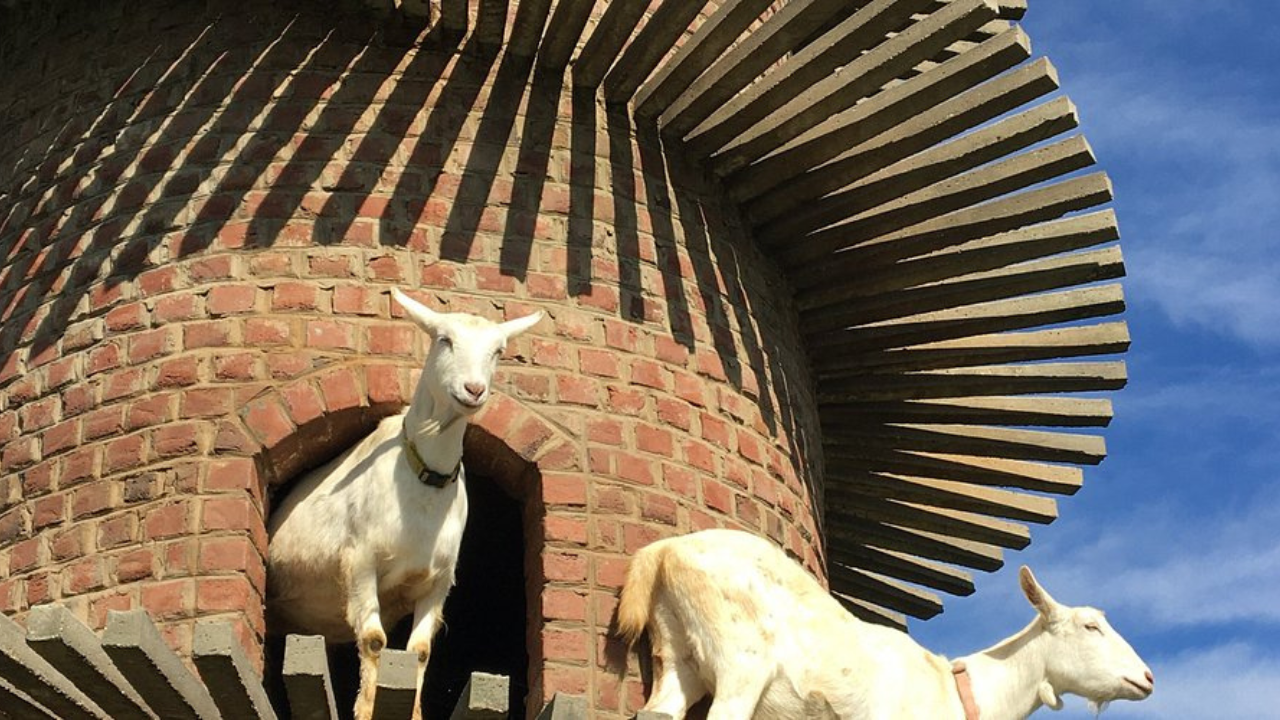
The structure, often called the “Ba-Goat Tower”, is located in Windsor, Illinois and was built by farmers David and Marcia Johnson. Standing approximately 31 feet tall, the tower is constructed from approximately 5,000 handmade bricks and has a continuous spiral path made up of hundreds of stairs.Inside, the tower is divided into several compartments where the goats can rest, while the outer spiral allows them to climb to the top. The design is both functional and visually appealing, resembling a miniature fort built not for humans, but for animals.At first glance, this idea seems completely fantastical. But goats are natural climbers. In the wild, they instinctively seek elevated ground to monitor their surroundings and remain active. Flat farmland does not provide that stimulation.By creating a vertical environment, the tower allows goats to express these natural behaviors. Animal welfare research shows that such enrichment can reduce stress, prevent boredom and limit the repetitive behavior often seen in confined livestock. What appears bizarre is, in practice, a thoughtful adaptation to animal instincts.

goat tower

More than a novelty: function meets design

While the tower serves a practical purpose, it also stands out as a piece of unconventional architecture. Its spiral design and compact height draw comparisons to famous landmarks, giving it a distinctive visual identity.Over time, it has developed into a local attraction. Tourists often stop to watch the goats roaming the ramp, turning an ordinary farm facility into an object of curiosity. In this way, the structure combines utility with tourism, helping the farm attract attention far beyond its immediate surroundings.Despite recent social media posts suggesting it is a new construction, Goat Tower is not a 2024 creation. It was originally conceived in the late 1990s, with goats introduced soon after its completion.Its online revival shows how easily old, unusual structures can find new life in the age of viral content. Taken out of context, the tower appears almost mythical, which fuels its popularity today.

goat tower

The big picture: rethinking agricultural sites

Goat Tower highlights wider changes in the way animals are cared for on farms. Rather than focus solely on efficiency, some farmers are experimenting with environments that encourage natural behavior.Such structures challenge the notion that livestock space should be purely utilitarian. Instead, they show how creativity and science can intersect, resulting in designs that benefit both animals and farmers while capturing the public imagination.

From curiosity to symbol

What started as a practical idea has become more symbolic. The tower represents a blend of ingenuity, humor and care, proving that unconventional thinking can flourish even in traditional industries like farming.Finally, the “GOAT Tower” lives up to its name, not just because it houses goats, but because it is an all-time great example of how the unexpected can work beautifully in the real world.

Source link

Google IPL 2026 Doodle celebrates the start of the Indian Premier League with live scores, upcoming matches and more

Google IPL 2026 Doodle celebrates the start of the Indian Premier League with live scores, upcoming matches and more

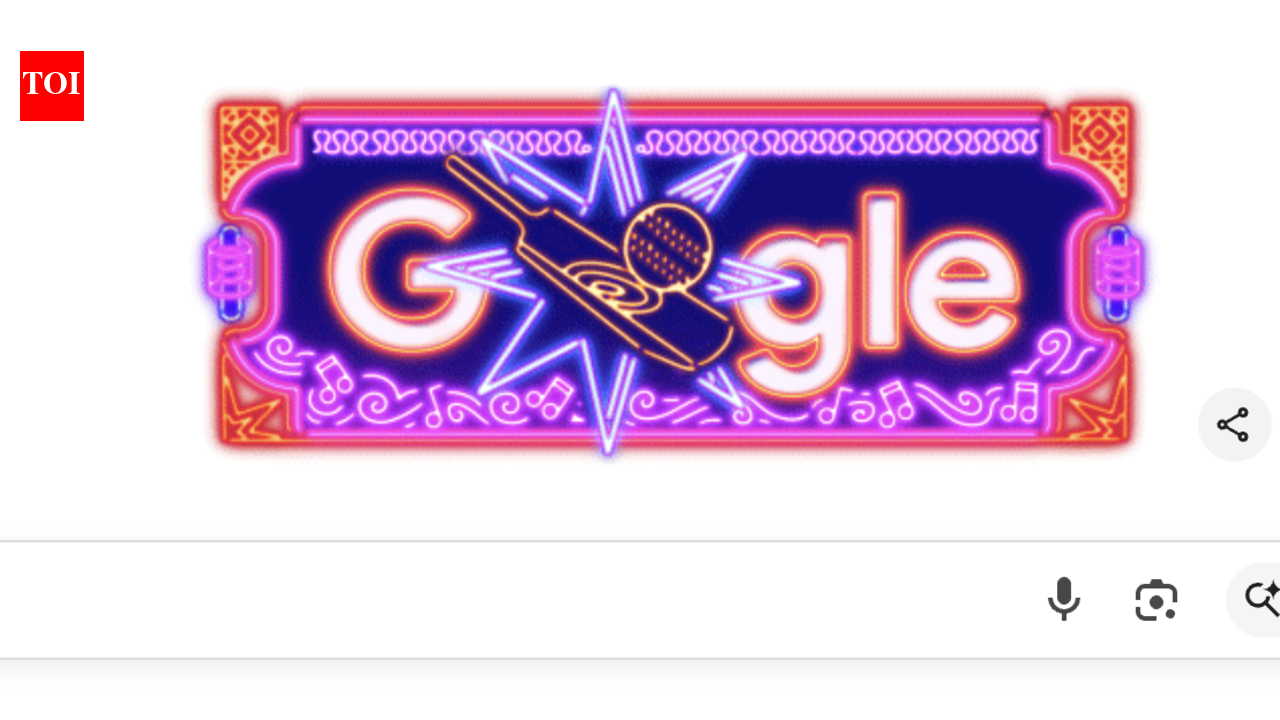
Indian Premier League 2026 starts today (28 March). Google has marked the 19th season of IPL with a vibrant and interactive doodle on its homepage. The doodle is designed in a vibrant purple neon theme. The doodle includes animated cricket highlights that include bat, ball and glowing star effects that bring the Google logo to life. In the doodle, Ji cleverly incorporates zing bells, a nod to the fast-paced nature of T20 cricket.

Google has brought interactive doodles for IPL 2026

Apart from the design, the Google Doodle for IPL 2026 offers fans more than just a visual treat. Clicking on the doodle redirects users to a dedicated IPL portal, where they can access live scores, match schedules and real-time information. Enhanced with AI-powered updates and analytics, this feature ensures that cricket lovers stay connected to every ball and boundary without leaving the search page.

Google’s role in IPL 2026

Google has come on board as a co-presenting sponsor for this year’s IPL, underscoring its commitment to blending technology with sports engagement. The doodle reflects Google’s broader effort to integrate AI-powered digital experiences into everyday life, making cricket coverage more interactive and accessible.IPL 2026 promises two months of high-octane cricket, with 84 matches scheduled between 10 teams. The opening clash between Royal Challengers Bangalore and Sunrisers Hyderabad has set the stage for what is expected to be another record-breaking season in terms of viewership and fan engagement.

Source link

San Antonio Spurs vs. Milwaukee Bucks injury report: Who’s playing, injured and questionable players, head-to-head records, team stats, and more (March 28, 2026) | nba news

San Antonio Spurs vs. Milwaukee Bucks injury report: who's playing, injured and questionable players, head-to-head records, team stats and more (March 28, 2026)
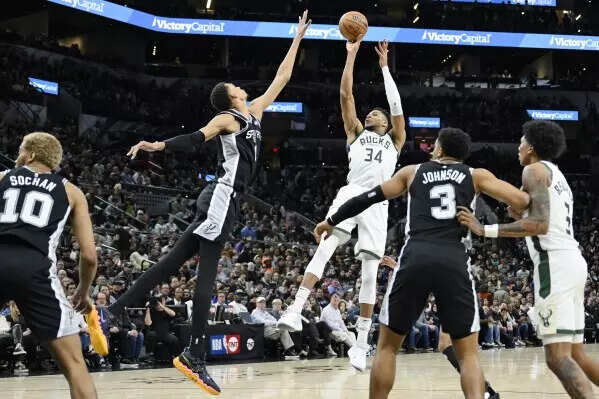
Milwaukee Bucks Damian Lillard vs. San Antonio Spurs (Image via Getty)

San Antonio Spurs Visit the Fiserv Forum 28 March 2026 With one of the best records in the league. They have been consistent on both ends and look like a complete team as the regular season heads toward its final stretch.milwaukee bucks Come into this game dealing with injuries and unstable rotation. With Giannis Antetokounmpo unavailable and several players listed as questionable, the Bucks are trying to stay competitive by adjusting their lineup on short notice.

san antonio spurs vs milwaukee bucks Injury Report (March 28, 2026)

San Antonio Spurs (55–18, first in the West)

There are very few injury concerns in San Antonio. David Jones-Garcia will miss the season after ankle surgery. The rest of the core group, including Victor Wembanyama, De’Aaron Fox, Devin Vassell, Keldon Johnson, Harrison Barnes and Stephon Cassel, are all available.No key rotation players are listed as questionable. Gregg Popovich is expected to use his usual 9-10 man rotation with no changes due to injuries.

Milwaukee Bucks (29-43)

Milwaukee is dealing with several absences. Giannis Antetokounmpo is still out with a knee injury. Kevin Porter Jr. is also unavailable.Other players remain uncertain: • Bobby Portis – Questionable (wrist) • Kyle Kuzma – Questionable (Achilles) • Myles Turner – Game Time Decision (calf) • Gary Harris – Questionable (groin)If these players don’t play, Milwaukee will rely on Ryan Rollins, Gary Trent Jr., AJ Green, Cole Anthony and possibly Turner if he gets the nod.

San Antonio Spurs vs. Milwaukee Bucks head-to-head: Spurs in control

milwaukee bucks vs san antonio spurs

Milwaukee Bucks vs. San Antonio Spurs. Image via: Darren Abbate/AP

San Antonio has won both matches this season. They beat Milwaukee 119-101 in January with balanced scoring and control of the game. In another meet, he scored 144 points in a one-sided result.In those games, the Spurs have averaged about 131 points, while Milwaukee has been in the low 110s. San Antonio also leads the all-time series 55–47.

San Antonio Spurs vs. Milwaukee Bucks Team Stats Comparison (2025-26)

metric San Antonio Spurs milwaukee bucks
Record (by end of March) 55-18 29-43
Points Per Game (PPG) 118.2 111.0
Rebounds per game (RPG) 46.6 41.1
Assists Per Game (APG) 27.1 25.9
Steals per game (SPG) 7.8 7.4
Blocks Per Game (BPG) 5.5 4.0
FG% ~50.9% ~51.3%
3-pt% ~36.7% ~38.1%

San Antonio stands out in rebounding, rim protection and transition play. Milwaukee relies more on shooting, especially from three, but hasn’t been as consistent on defense without Giannis.

San Antonio Spurs vs. Milwaukee Bucks Key Matchup Factors

Without Antetokounmpo, Milwaukee loses its main scoring option and interior defender. This gives Wembanyama more freedom near the rim, while guards like Fox and Castle can attack more easily.Milwaukee will need production from its role players. Rollins has taken on more responsibility as a scorer and playmaker. If Turner plays, his presence will help with spacing and defense. Trent Jr. and Green will have to convert open shots.San Antonio enters with a healthy roster and improved form. Milwaukee’s chances depend on how many questionable players it has available and how good its rotation is.The game is likely to be played at a fast pace, especially if Milwaukee falls behind. The result will depend on whether the Bucks can survive without their key player or the Spurs maintain their level.

Source link

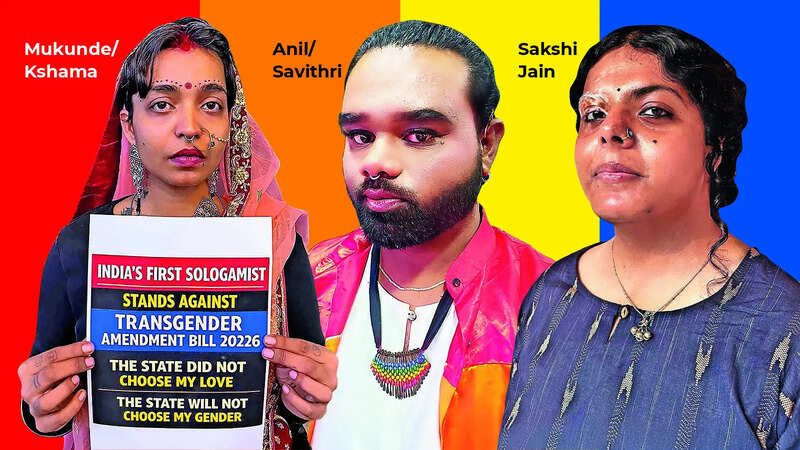
‘Will we start begging or prostitution again?’ Trans bill sparks fear, anger

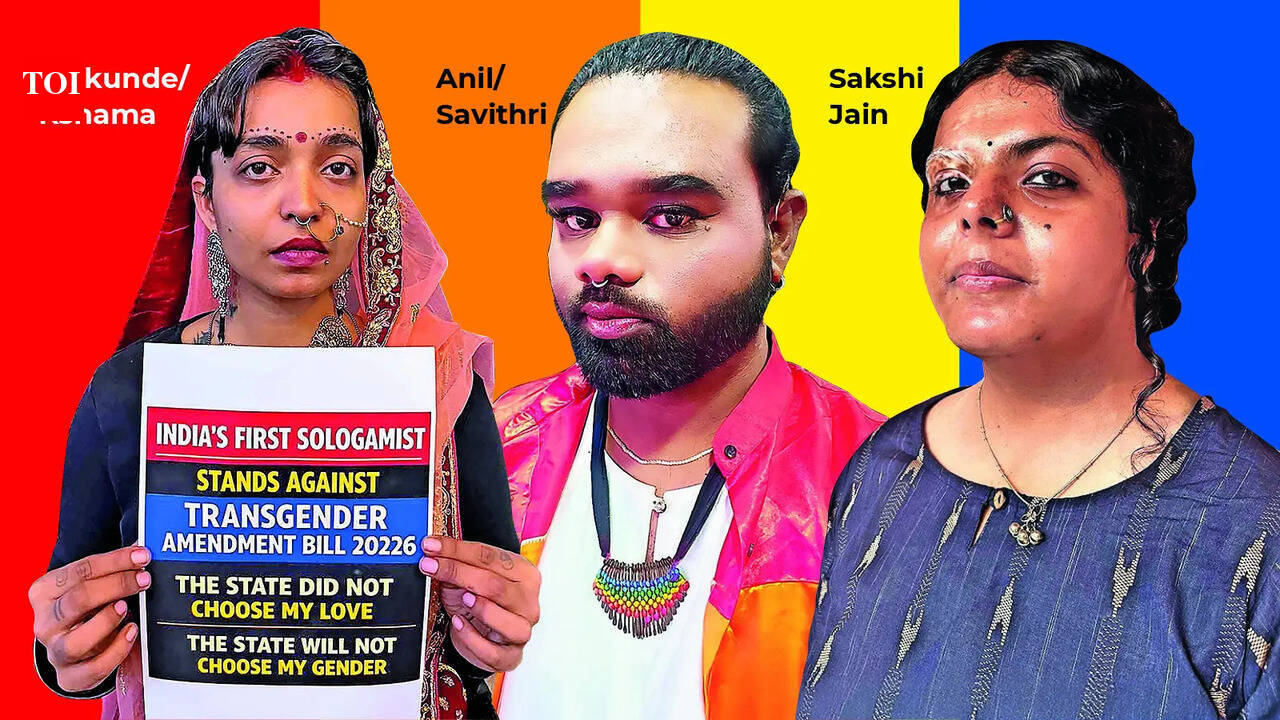
About four years ago, Kshama Bindu of Ahmedabad made headlines at the national level. Dressed in a traditional red lehenga, she looked like a perfect bride. But there was a twist: in an effort to break free from gender norms and patriarchy, she was marrying herself in the first instance of monogamy in India.
A lot has changed for Bindu, who now goes by the name Mukunde and identifies as a trans-masculine person. After suppressing his masculinity for years, he had recently decided to embrace it by mustering the courage to undergo hormone replacement therapy and planning to change his gender on his identity documents to male.

Source link

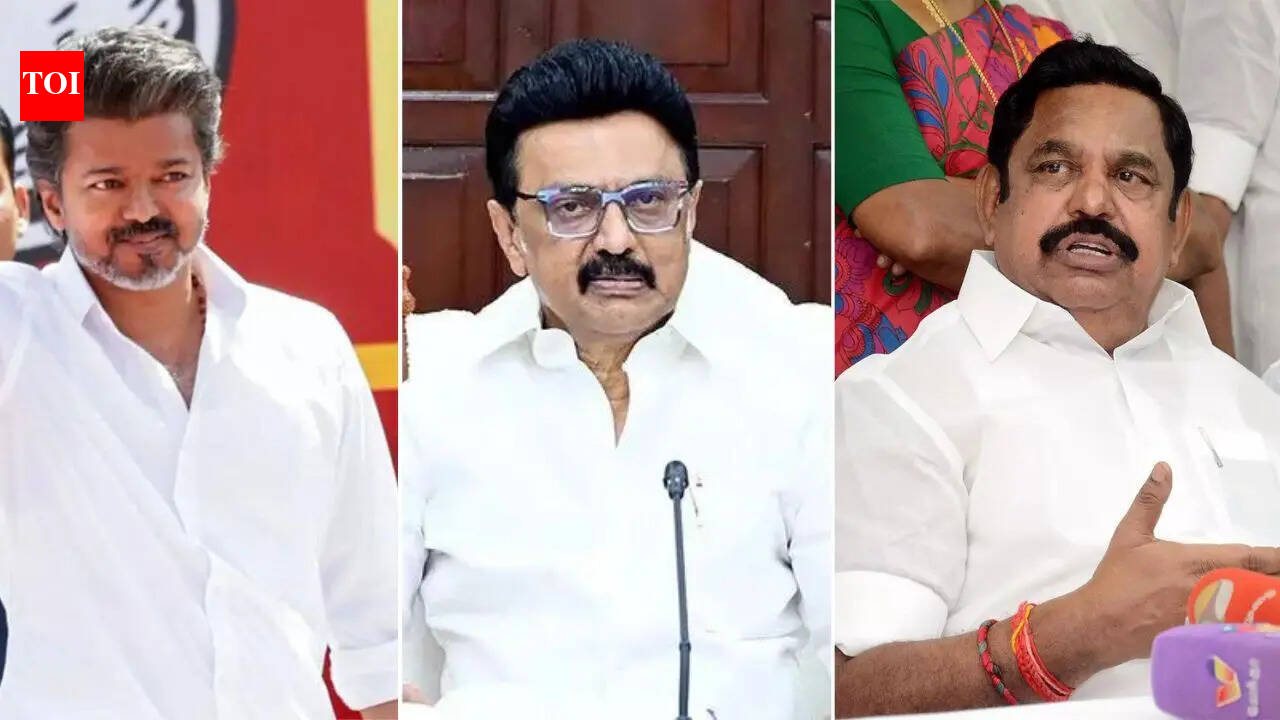
Tamil Nadu assembly election 2026 SWOT analysis: Can Stalin hold the Dravidian fortress or will Vijay’s TVK disrupt the old order? | India News

Tamil Nadu assembly election 2026 SWOT analysis: Can Stalin hold the Dravidian fortress or will Vijay’s TVK disrupt the old order?

With campaign activity picking up across Tamil Nadu, the 2026 assembly election is shaping up as a high-stakes contest that could test the durability of the state’s long-standing Dravidian political order. What was once a largely bipolar contest is now evolving into a more complex, multi-cornered fight, with new entrants and shifting voter alignments adding layers of uncertainty.At the centre of the contest is M. K. Stalin, who heads into the election seeking a renewed mandate after completing a full term in office. The ruling Dravida Munnetra Kazhagam will rely on its governance record, welfare delivery, and alliance network, but also faces anti-incumbency, economic concerns, and opposition attacks on issues such as law and order and corruption.The opposition space remains fragmented. The All India Anna Dravida Munnetra Kazhagam, led by Edappadi K. Palaniswami, is attempting a recovery after electoral setbacks, but continues to deal with internal divisions and leadership challenges following the death of J. Jayalalithaa. Its alliance with the BJP-led NDA is expected to frame the election around governance gaps and anti-incumbency.Adding a new dimension to the contest is Tamilaga Vettri Kazhagam, led by Vijay, whose entry has introduced uncertainty, particularly in urban and youth voter segments. While the extent of its electoral impact remains unclear, its presence is likely to influence vote distribution in closely contested seats.The election, therefore, is not just a contest for power but a test of whether Tamil Nadu’s traditional two-party dominance can withstand emerging political fragmentation.

A shifting electoral landscape: What’s at stake

This election carries layered stakes. For the DMK, it is about continuity, consolidation, and legacy. For the AIADMK, it is about survival and reinvention. For TVK, it is about proving credibility beyond crowds and charisma. And for smaller players like NTK, it is about converting ideological presence into electoral relevance. Unlike previous elections, where alliances and voter blocs were relatively stable, this contest is marked by overlapping voter bases and fluid loyalties. Youth voters, urban middle classes, and even sections of minority communities are showing signs of shifting preferences, making electoral outcomes harder to predict.The presence of multiple contenders also raises the possibility of split mandates in several constituencies. In such a scenario, organisational strength and booth-level efficiency could prove more decisive than headline popularity.

Snapshot of past elections: Dominance with undercurrents of change

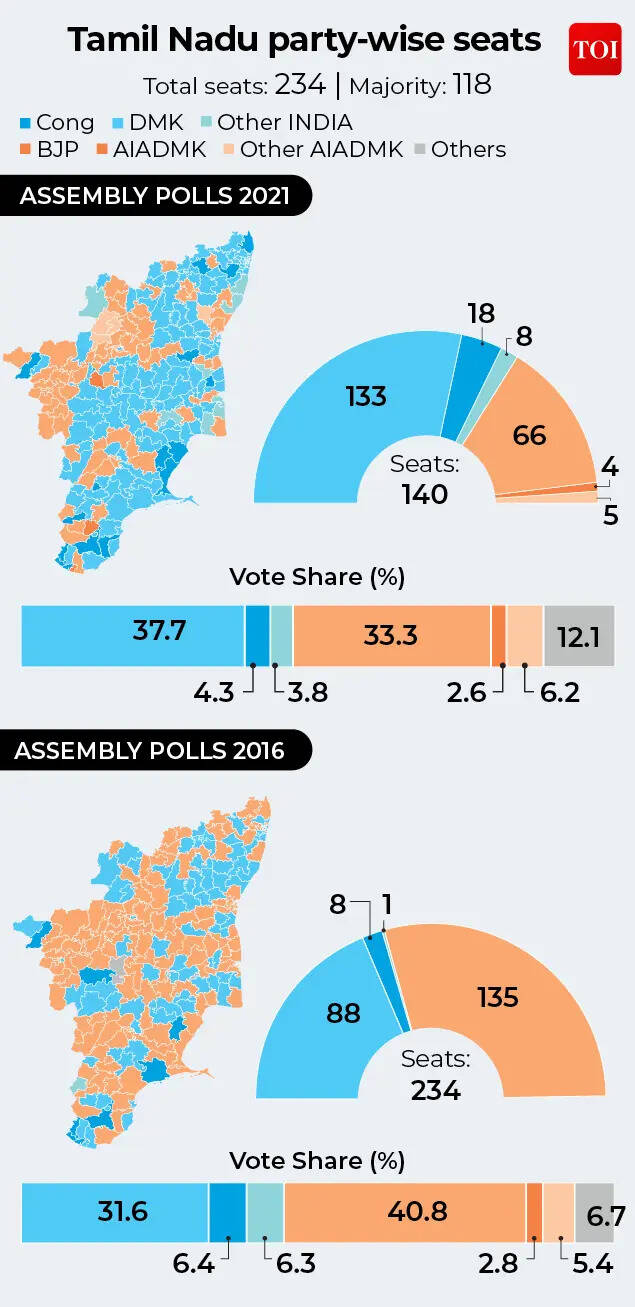
Tamil Nadu’s electoral history has long been defined by the alternating dominance of the DMK and the AIADMK, a pattern that has shaped the state’s political identity for decades. The 2021 Assembly elections continued this trend, with the DMK returning to power under M K Stalin after a decade, securing a comfortable majority along with its allies.Yet, beneath this continuity, subtle shifts have been underway. The AIADMK, despite losing power, retained a substantial vote share, indicating that its support base remains intact in several regions. At the same time, smaller players began to register incremental gains. Naam Tamizhar Katchi, for instance, expanded its vote share without converting it into seats, pointing to a growing appetite for alternatives beyond the Dravidian duopoly.
ASSEMBLY POLLS3

.

The Lok Sabha elections further reflected these trends, with the DMK-led alliance consolidating its position, even as the BJP made limited but noticeable inroads in select pockets. Urban voting behaviour, in particular, showed early signs of fragmentation, with younger voters displaying weaker attachment to traditional party loyalties.As the state approaches the 2026 Assembly elections, these undercurrents have grown sharper. The entry of new political formations, internal fractures within established parties, and evolving voter expectations suggest that while the structure of dominance remains, the ground beneath it is steadily shifting.

High-stakes contests and leadership battles

Stalin vs the challengers: a referendum on governance

At the centre of the 2026 contest stands M K Stalin, facing what is effectively a referendum on his first full term in office. Unlike previous elections driven largely by personality clashes between towering leaders, this battle is more layered — combining leadership evaluation with scrutiny of governance delivery.Stalin’s campaign is anchored in the “Dravidian model,” which blends welfare expansion with administrative reform and a strong pitch on federal rights. Schemes targeting women, education, and social security have helped build a wide beneficiary base, while infrastructure projects in urban centres aim to reinforce a development narrative. For the DMK, the election is as much about defending this governance record as it is about retaining political dominance. However, the challenge before Stalin is not from a single, unified opponent. Instead, he faces a fragmented but collectively potent opposition. The AIADMK under Edappadi K Palaniswami is attempting to channel anti-incumbency, focusing on issues such as law and order, corruption allegations, and rising living costs. At the same time, Vijay’s Tamilaga Vettri Kazhagam is targeting urban voters and youth, seeking to convert dissatisfaction into a broader anti-establishment sentiment.This multi-front challenge makes the election less about a direct face-off and more about vote distribution. Even limited erosion of the DMK’s core support — whether among urban middle classes, youth, or minority voters — could alter outcomes in closely contested seats.Ultimately, the contest around Stalin is not just about leadership, but about continuity versus disruption. A renewed mandate would cement his position and mark a rare instance of consecutive victories for the DMK, while any setback could signal that Tamil Nadu’s electorate is ready to move beyond familiar political patterns.

The Udhayanidhi factor: Heir or emerging leader?

Another key figure in this election is Udhayanidhi Stalin. His rapid rise within the DMK has made him both an asset and a point of criticism.For supporters, he represents generational change. For critics, he reinforces the narrative of dynastic politics. This election will test whether he can move beyond being seen as a political heir and establish independent electoral credibility.

Faces to watch: Fragmentation, switches and new entrants

Sasikala’s shadow over the AIADMK

V K Sasikala’s re-entry into active politics has added a crucial variable, particularly in southern Tamil Nadu. Her influence among Thevar communities continues to matter, and even a marginal vote split could impact tight contests.Her political moves also underline the unresolved leadership crisis within the AIADMK. The continued contest over J Jayalalithaa’s legacy remains central to opposition dynamics.

O Panneerselvam’s NDA shift

The induction of O Panneerselvam into the NDA reflects ongoing realignments. Once a key AIADMK leader, his shifting political trajectory mirrors the fragmentation within the party.While his presence may help consolidate certain caste-based support, questions remain about the extent of his electoral influence in the current political climate.

Vijay’s TVK: from fandom to political force

Vijay’s Tamilaga Vettri Kazhagam is perhaps the most closely watched entrant. His ability to convert fan clubs into political units gives him a unique organisational base, especially in urban and semi-urban areas.However, the real test lies in translating crowd mobilisation into votes — a challenge that has historically tripped up celebrity-driven political ventures.

What parties will campaign on

The 2026 Tamil Nadu election is expected to be fought on a layered mix of welfare politics, governance claims, identity narratives, and emerging economic anxieties. While each party enters the contest with its own framing, there is a clear overlap in the issues they will seek to own — from household economics to questions of federalism.For the ruling DMK, the campaign is likely to centre on its “Dravidian model” of governance. Under M K Stalin, the party is expected to foreground its welfare architecture — including schemes aimed at women, education, and social security — alongside its push on urban infrastructure and public service delivery. Equally central will be its political messaging around federal rights, with the DMK positioning itself as a defender of Tamil Nadu’s autonomy against what it describes as increasing centralisation. This framing, pitched as “Tamil Nadu versus Delhi,” is likely to be used to consolidate regional pride and ideological support.The AIADMK-led NDA, on the other hand, is expected to build its campaign around governance gaps and anti-incumbency. Led by Edappadi K Palaniswami, the alliance is likely to highlight concerns over law and order, allegations of corruption, and rising costs of living. Issues such as drug circulation, crimes against women, and urban civic problems — including flooding, waste management, and traffic congestion — are expected to be used to question the DMK’s administrative record. At the same time, the NDA may attempt to balance this critique with a development-oriented narrative, drawing on central government schemes and infrastructure investments to appeal to urban and middle-class voters.For Vijay’s Tamilaga Vettri Kazhagam (TVK), the campaign is likely to take a sharply anti-establishment tone. Positioned as an alternative to both the DMK and the AIADMK, TVK is expected to focus on corruption, accountability, and systemic reform. Its messaging is likely to resonate with younger voters, gig workers, and urban professionals who feel disconnected from traditional party politics. TVK may also emphasise transparency and clean governance, attempting to contrast itself with what it portrays as entrenched political structures.Meanwhile, Seeman’s Naam Tamizhar Katchi (NTK) is expected to stay rooted in its ideological core. Its campaign will likely revolve around Tamil nationalism, environmental protection, agrarian distress, and local resource rights. Issues such as water sharing, land acquisition, and ecological degradation are expected to feature prominently, particularly in rural and coastal constituencies.Across parties, economic concerns are likely to form a common thread. Inflation, employment opportunities, and household financial stress are emerging as key voter concerns, especially among the urban middle class and lower-income groups. Women voters, who have become a decisive electoral bloc, are expected to be at the centre of competing narratives — whether through welfare delivery, safety concerns, or household economics.In essence, while the DMK will seek to defend its record and ideological positioning, the opposition will attempt to convert dissatisfaction into votes, and new entrants will try to redefine the terms of the debate. The election, therefore, is set to be a contest not just of promises, but of competing political narratives about governance, identity, and the future direction of Tamil Nadu.

Campaign themes: Identity, governance and aspiration

Welfare vs economic pressure

The DMK’s campaign is expected to foreground welfare schemes — from free bus travel for women to financial assistance programmes. These initiatives have created a broad beneficiary base, particularly among women.However, rising costs of living, employment concerns, and urban civic issues could temper this advantage. The opposition is likely to frame the election as a question of economic pressure versus welfare delivery.

Law and order and governance narrative

Issues such as crime, drug circulation, and urban infrastructure gaps are expected to feature prominently. The AIADMK-led NDA is likely to target these concerns to build an anti-incumbency narrative.

Tamil identity vs national alignment

The DMK is expected to sharpen its federalism pitch, positioning itself as a defender of Tamil identity against perceived central overreach. This has historically been a powerful narrative in the state.On the other hand, the AIADMK’s alliance with the BJP introduces a contrasting framework — one that emphasises national integration and development, but also risks alienating sections sensitive to identity politics.

A SWOT analysis of key parties highlights their prospects and hurdles:

DMK-led front

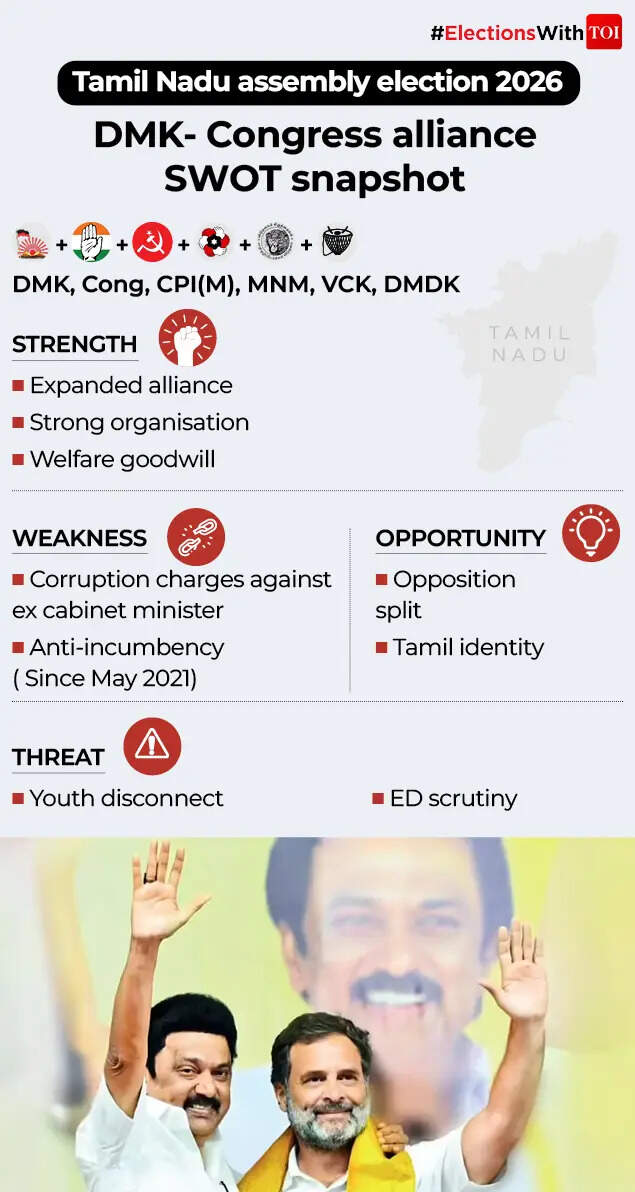
Strength: Under M K Stalin, the DMK has emerged as the most structurally stable political force in the state, combining leadership continuity with a strong organisational backbone. Its cadre-driven machinery, deeply embedded at the booth level, gives it a clear mobilisation advantage across regions. The party’s expansive alliance — spanning minorities, Dalits, Left parties and regional players — allows it to consolidate a broad social coalition and reduce vote fragmentation.The DMK’s governance pitch is anchored in welfare delivery and visible urban development. Schemes such as financial assistance for women, education initiatives, and social security programmes have built a loyal beneficiary base, while infrastructure upgrades in cities like Chennai reinforce its development narrative. Stalin’s positioning as a steady administrator and a vocal advocate of federal rights further strengthens the party’s appeal.
DMK Gfx

.

Weakness: After a full term in power, the DMK faces the weight of anti-incumbency. Concerns around rising living costs, employment stagnation, and urban civic issues — including flooding, waste management and congestion — have created pockets of dissatisfaction.The opposition has also sharpened its attack on the perception of dynastic politics, particularly around Udhayanidhi Stalin’s growing prominence. Allegations of corruption involving senior leaders and recurring law and order concerns add to the party’s vulnerabilities, even if not electorally decisive on their own.Opportunity: A fragmented opposition remains the DMK’s biggest advantage. With votes likely to be split between the AIADMK-led NDA, TVK, and NTK, the ruling front stands to benefit in closely contested constituencies.The party can also deepen its outreach among women voters through welfare schemes, while leveraging its alliance network to tailor constituency-level strategies. Its federalism plank — framing the contest as one between Tamil Nadu and central authority — continues to resonate and offers a strong ideological anchor.Threat: The rise of Vijay’s Tamilaga Vettri Kazhagam poses a direct challenge, particularly among youth, urban voters, and sections of minorities.At the same time, if the AIADMK-led NDA succeeds in consolidating anti-incumbency and presenting a unified narrative, it could tighten contests in key seats. Economic pressures, including inflation and household financial stress, also risk diluting the impact of welfare-driven politics.

AIADMK-led NDA

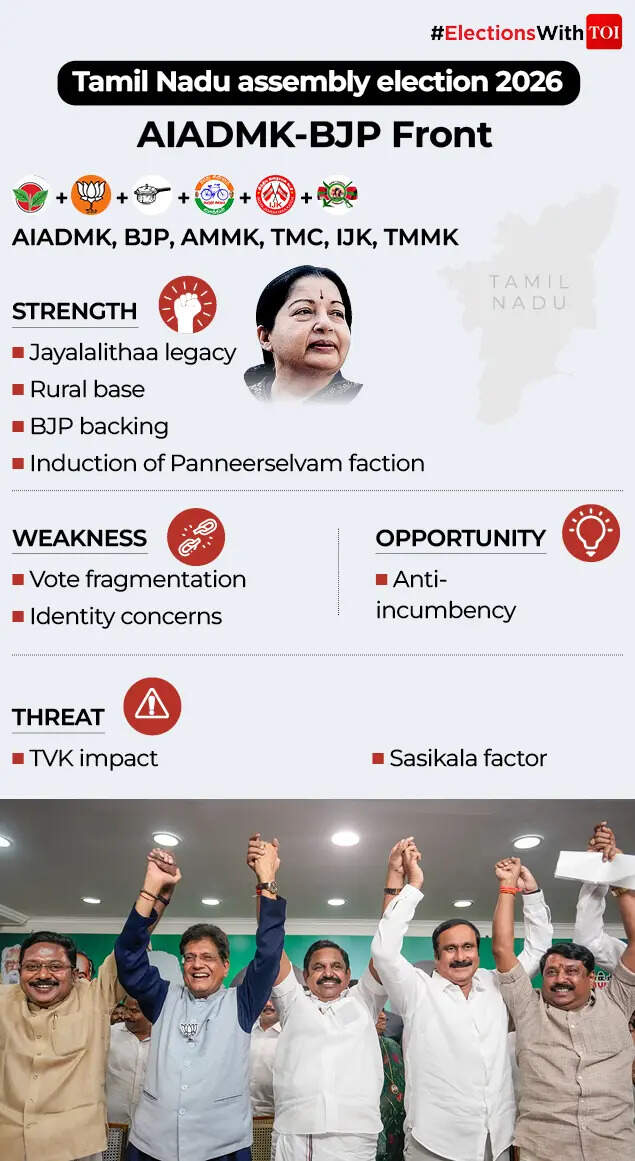
Strength: Despite recent setbacks, the AIADMK retains a residual but significant grassroots network, particularly in western and southern Tamil Nadu. Its cadre base, built over decades, continues to provide electoral depth. The enduring legacy of J Jayalalithaa still carries emotional weight among sections of voters, especially women and rural communities.Its alliance with the BJP-led NDA adds financial resources, campaign infrastructure, and a broader national narrative centred on development and governance. The front is also well-positioned to capitalise on anti-incumbency against the DMK.
AIADMK gfx

.

Weakness: The absence of a unifying, charismatic leader remains the alliance’s biggest structural challenge. While Edappadi K Palaniswami has consolidated organisational control, the party lacks the emotional connect once commanded by Jayalalithaa.Internal fragmentation — including the parallel influence of leaders like V K Sasikala and O Panneerselvam — has weakened its traditional vote base. The alliance with the BJP has also led to erosion of minority support, while its urban presence and appeal among younger voters remain limited.Opportunity: The AIADMK-led NDA’s primary opportunity lies in effectively consolidating anti-incumbency. By foregrounding issues such as law and order, corruption allegations, and rising costs, it can position itself as the principal alternative to the DMK.Strategic caste consolidation through alliance partners and renewed outreach to women voters on issues of safety and household economics could help rebuild its social coalition. It can also appeal to urban middle classes through a development-focused narrative.Threat: The emergence of TVK poses a major threat by splitting the anti-DMK vote, particularly among youth and urban voters.The continued influence of Sasikala in southern districts risks fragmenting the AIADMK’s core support base. Additionally, credibility issues arising from past corruption allegations weaken its ability to attack the DMK on similar grounds. Organisational fatigue and repeated electoral losses could further impact cadre mobilisation.

Tamilaga Vettri Kazhagam (TVK)

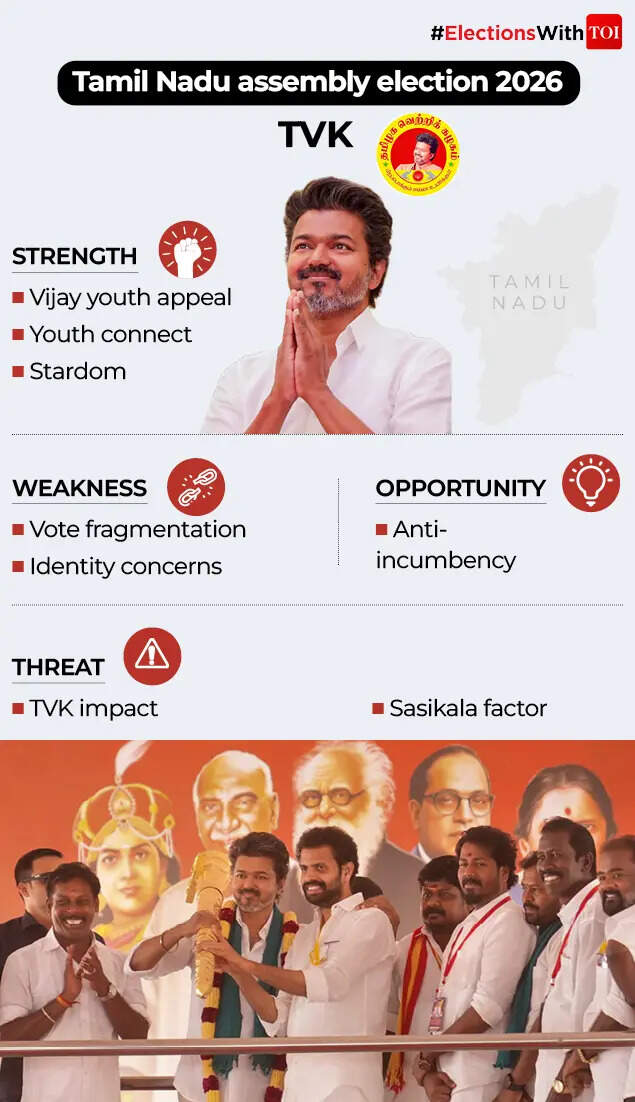
Strength: Led by Vijay, TVK’s biggest strength lies in its ability to convert celebrity appeal into political mobilisation. Its fan clubs provide a ready-made grassroots network, particularly in urban and semi-urban areas.The party has struck a chord with youth and first-time voters, positioning itself as a clean, anti-establishment alternative. Its strong digital presence and high-energy campaign style give it visibility that rivals established parties.
TVK gfx

.

Weakness: Despite its momentum, TVK lacks a tested organisational structure capable of delivering votes at the booth level. Its heavy dependence on Vijay’s personal charisma raises questions about depth and scalability.The absence of governance experience and a second line of leadership adds to scepticism among voters, particularly in rural areas. Candidate selection, largely reliant on newcomers, may also affect electoral credibility.Opportunities: The fragmentation within the AIADMK and the broader opposition space presents TVK with a significant opening. It can attract disillusioned voters seeking an alternative to both Dravidian majors.Urban centres such as Chennai, Coimbatore, and Madurai offer fertile ground, with higher youth populations and visible dissatisfaction with traditional politics. Even a modest electoral performance could establish TVK as a long-term political force.Threat: One of the biggest risks for TVK is being perceived as a “vote-cutter,” inadvertently benefiting the DMK by splitting opposition votes.There also remains a gap between crowd mobilisation and actual vote conversion. Established parties are likely to question its credibility, governance readiness, and ideological clarity. Competition with Seeman’s NTK for similar voter segments could further divide the anti-establishment vote.

The larger question: Continuity or transition?

For M K Stalin, this election is about more than just returning to power. It is about legacy — achieving what M Karunanidhi never did: winning consecutive terms.For the opposition, it is about survival, relevance, and reclaiming lost ground. For new entrants like TVK, it is about breaking into a system that has historically resisted disruption.As Tamil Nadu heads to the polls, the key question is no longer just who will win. It is whether the state’s political structure itself is beginning to change.Will the Dravidian model adapt and endure, or is this the election where new forces begin to redraw the map?The answer will shape not just the next government, but the future trajectory of Tamil Nadu politics.

Source link

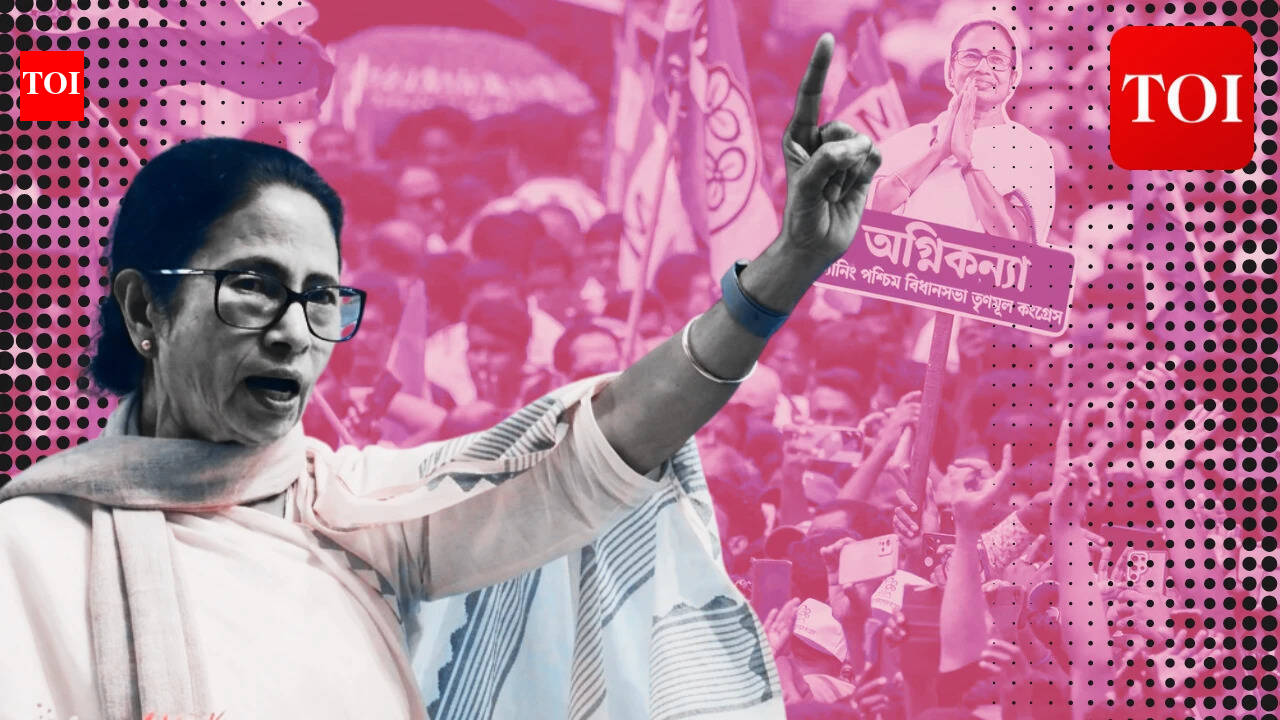
West Bengal Assembly Elections 2026: Cash, care and constant engagement: How the ‘Didi model’ is shaping Bengal’s ballot box. india news

नकद, देखभाल और निरंतर जुड़ाव: कैसे 'दीदी मॉडल' बंगाल के मतपत्र को आकार दे रहा है

Cash, care and constant engagement: How the ‘Didi model’ is shaping Bengal’s ballot box

welfare architecture of Mamata BanerjeeThe government of West Bengal has emerged as a defining feature of its governance, linking large-scale social support programs with significant political implications as the state heads towards the 2026 assembly elections.As the state prepares for the first phase of voting on April 23, the “Didi model” of governance is not only serving as flagship social welfare schemes that have redefined rural economics, but also as the ultimate political insurance for Mamata Banerjee’s enduring hold on power.

Watch

Mamata already has half of Bengal, BJP and others competing for what is left: Yashwant Deshmukh

Lakshmi resides in every house

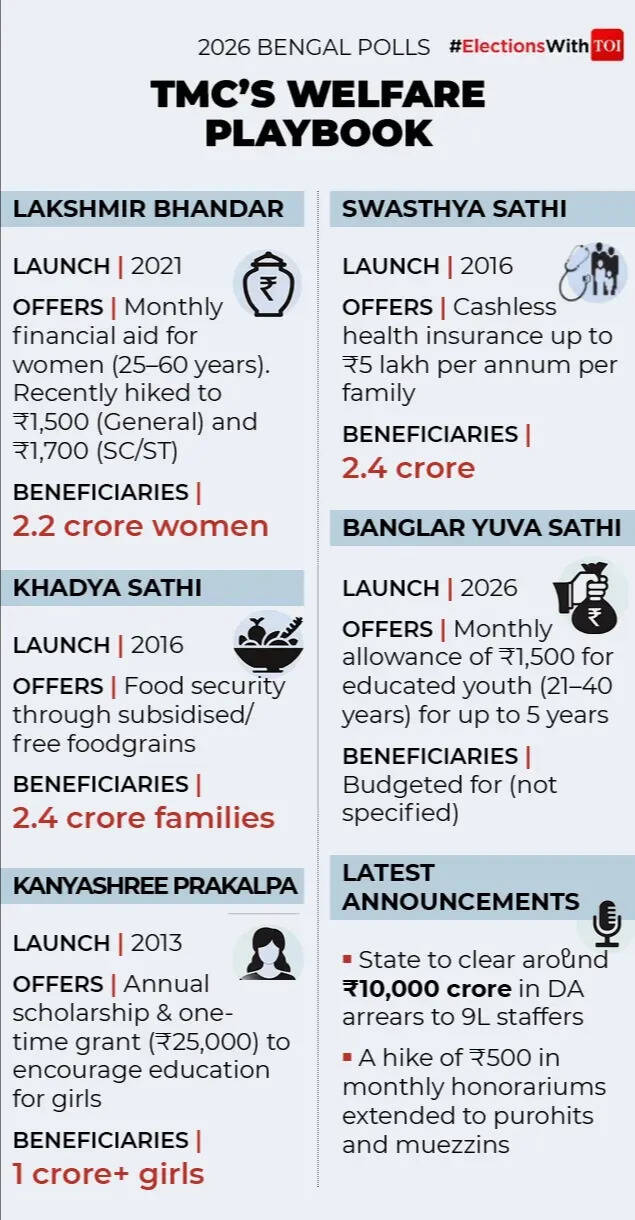
At the heart of this model is the Lakshmir Bhandar Yojana, which was launched in 2021 to provide monthly financial assistance to women aged approximately 25 to 60 years. The scheme covers all female residents of Bengal, irrespective of marital or employment status.Currently, beneficiaries receive Rs 1,000 per month, while women from Scheduled Caste and Scheduled Tribe communities get Rs 1,200. The scheme, designed to cover household expenses and improve financial security, has gained wide acceptance and is increasingly being viewed not as a “freebie” but as an economic entitlement.With the decision, this scheme has also become a major political discussion topic. All India Trinamool Congress (TMC) has promised to increase the assistance amount by Rs 500 if re-elected.However, implementation challenges remain. In a recent case in East Midnapore, around 7,000 women allegedly did not receive payments for nearly five months, prompting the Calcutta High Court to seek a report. Despite such issues, the scheme continues to expand, with around 1.25 lakh new beneficiaries added to the existing base of 2.2 crore women.

no one sleeps hungry

Food security remains another cornerstone of the state’s welfare strategy through the Food Sathi program launched in 2016. The scheme provides rice and wheat at subsidized rates of around Rs 2 per kg and currently covers around 9 crore people.Eligible beneficiaries have been classified on the basis of their ration card. This includes the “poorest of the poor”, including landless labourers, marginal farmers, rural artisans and families of widows or terminally ill persons. Families living in Below Poverty Line (BPL) or Economically Weaker Section (EWS) are also beneficiaries of this scheme.With an outlay of over Rs 1 lakh crore, it is one of the largest initiatives in the country.This is complemented by the Duare Ration Initiative, which delivers food grains directly to about 7 crore people at a cost of over Rs 1,700 crore.The state government claims that these combined efforts have helped lift nearly 1.7 crore people above the poverty line by 2023, reinforcing its narrative of inclusive growth driven by welfare spending.

Mamata's populist plans GFX

.

Cash amount for class on ‘Chhadnatola’

In education and gender empowerment, Kanyashree Prakalp remains a major programme. Launched in 2013, it provides Rs 1,000 annually to girls aged 13 to 18 who attend school and are unmarried, as well as a one-time grant of Rs 25,000 to continue education or training at the age of 18.With a cumulative enrollment of over 7 crore, the program is one of the largest conditional cash transfer schemes for girls globally and was recognized with the United Nations Public Service Award. However, challenges remain in ensuring awareness, documentation and sustained participation beyond eligibility.

health care without bill

Healthcare coverage has been expanded through the Swasthya Sathi scheme launched in 2016. It provides cashless treatment up to Rs 5 lakh per family per year and covers about 9 crore people in 2.5 crore families.It is noteworthy that smart cards are issued in the name of the female head of the family. More than 1 crore have been admitted to hospitals under this scheme, with the government spending more than Rs 13,000 crore. Although it has one of the highest coverage rates in India, at around 74.5 percent, concerns remain regarding hospital involvement, claim settlement and out-of-pocket expenses in private healthcare facilities.

unemployment cushion

Recently, the government has increased its focus on unemployment with the launch of Banglar Yuva Sathi, announced in the interim budget for 2026. The scheme provides Rs 1,500 per month to educated unemployed youth aged 21 to 40 years for five years or until employment is secured.Targeting secondary-eligible individuals not covered under other programs, it was fast-tracked with the initial payment released on March 7, 2026. With an allocation of around Rs 5,000 crore, with estimates going up to Rs 15,000 crore, it is positioned as a key intervention to address unemployment ahead of the elections.Together, these schemes form the backbone of TMC’s welfare-driven governance model combining direct benefit transfers, food security, healthcare and social empowerment. While the scale and reach of these programs have attracted both national and international attention, their long-term sustainability and implementation efficiency are under scrutiny as the political stakes in West Bengal increase.

Source link

The million-dollar cost of canceling F1 in the Middle East english movie news

Canceling F1 in the Middle East cost millions of dollars
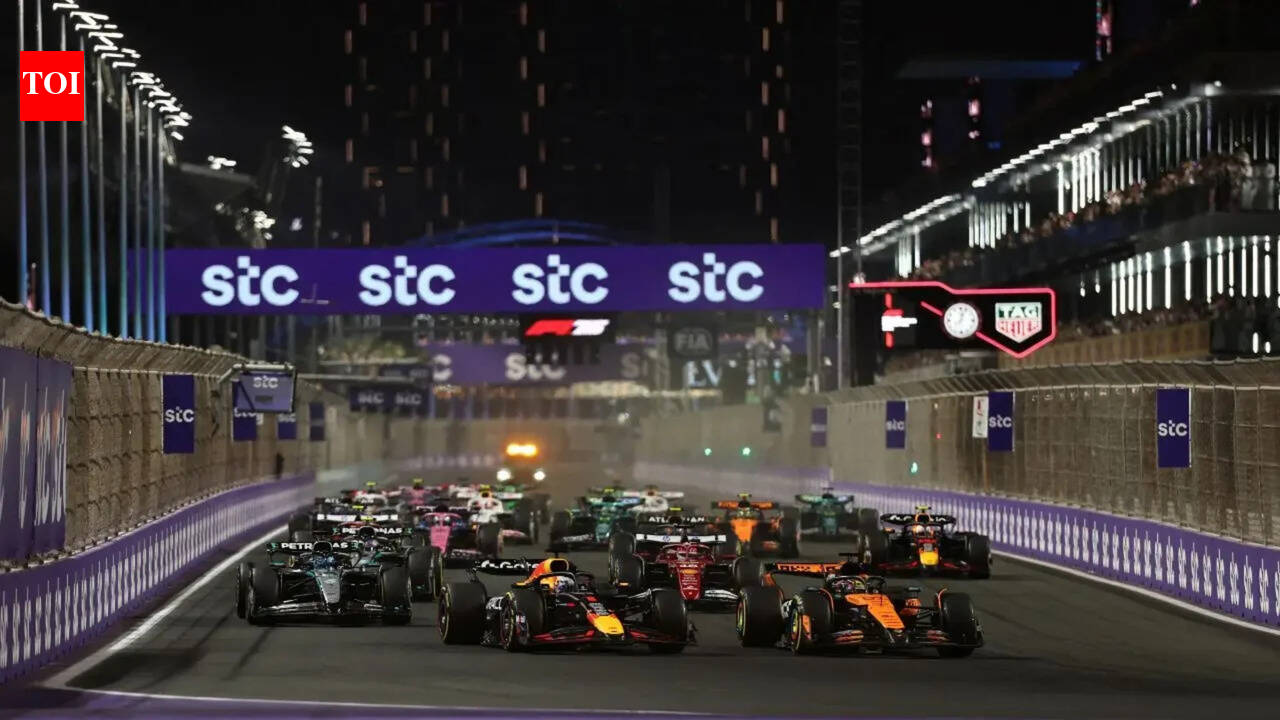
Formula 1 has canceled its Bahrain and Saudi Arabian Grands Prix due to disruption in regional airspace. While the games’ central organization suffers a financial blow, host cities suffer significant economic losses. These lucrative races, vital to local tourism and hospitality, are now on hold, costing millions in revenue and impacting global performance.

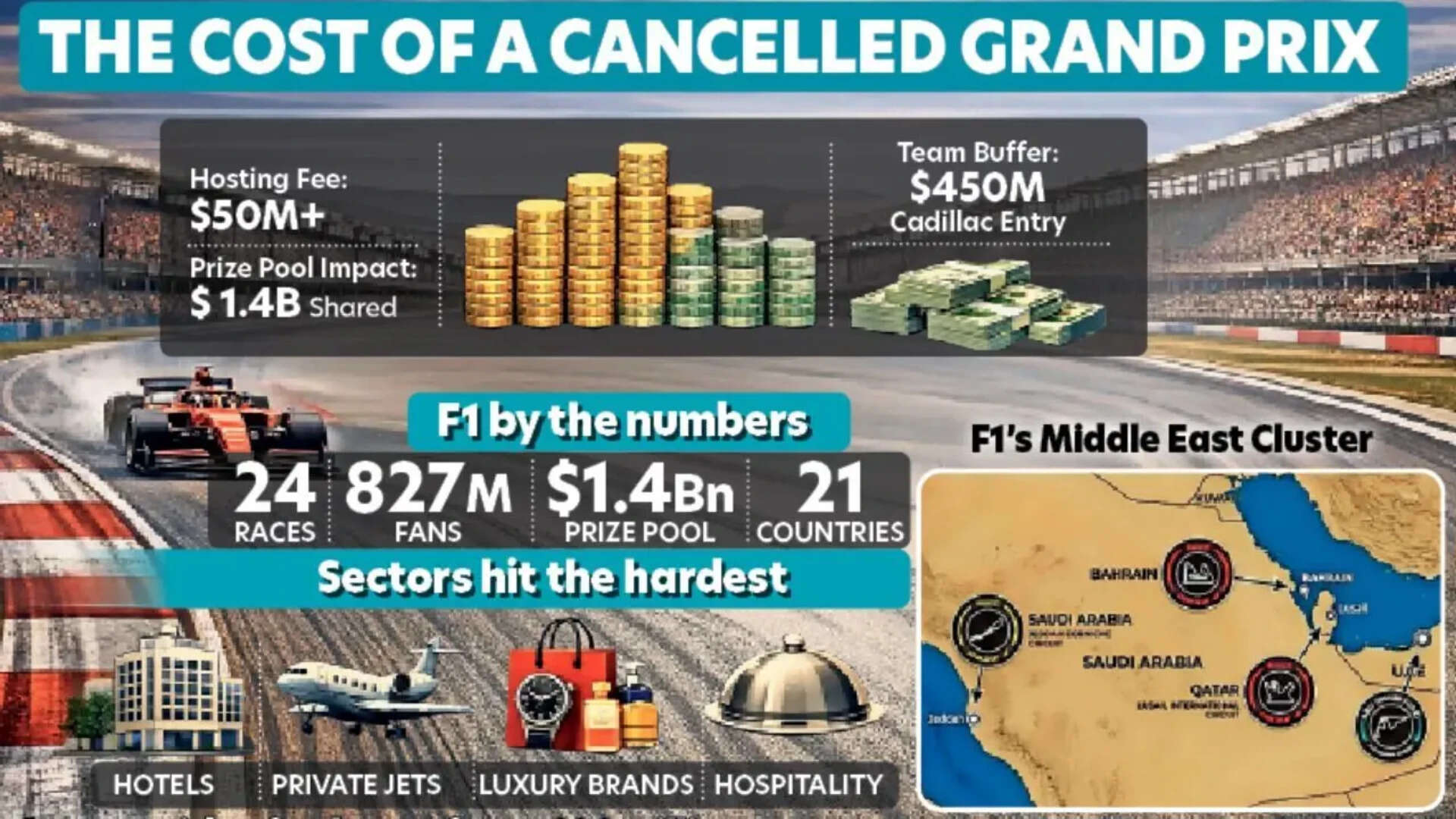
Every year, cities like Bahrain and Jeddah turn into high-flying bazaars of wealth, hosting Formula 1 races that bring in celebrities, billionaires and millions of fans. Hotels were sold out, private jets were lined up, and within days millions of dollars moved into the local economy.This time nothing like this will happen.As the ongoing war in West Asia continues to disrupt airspace and hamper travel, Formula 1 has canceled two lucrative stops: the Bahrain Grand Prix and the Saudi Arabian Grand Prix. Formula 1 announced, “While alternatives were considered, no replacement will be made in April.”The Formula One Group’s official stance remains: safety comes first. But behind this lies a more complex reality. Formula 1 today is not just a sport; It is a traveling luxury economy, moving billions of dollars across continents in a matter of days. And when a caste disappears, that wealth also disappears.cost of not racingThe first hit comes from hosting fees, a key pillar of Formula 1’s business. Bahrain and Saudi Arabia together pay about $115 million a year to stage their races, according to estimates from Guggenheim Partners and industry disclosures. When a race is cancelled, that revenue disappears.These fees flow into the Formula One Group’s central pool, which distributes approximately $1.4 billion in prize money to teams each year. Any shortfall reduces the payout.

Hosting a Grand Prix also puts cities on the global stage. Each race is not a sporting event, but a demonstration.

Mohammed Ben Sulayem, President of the FIA

The atmosphere inside the enclosure has become calm. Pointing to income from broadcast deals and sponsorships, McLaren Racing CEO Jack Brown said during the Australian Grand Prix weekend, “We’re not worried if it has a little bit of a financial impact…it will happen.”There is also a cushion. According to a Forbes report, Cadillac’s entry as the 11th Formula 1 team from 2026 comes with a fee of more than $400 million (Rs 3,330 crore). It replenishes prize money that is now divided among more teams and shared among existing organizations, giving each a one-time incentive of more than $40 million this year.The cancellation is also unlikely to strain Formula 1 relations in the region. The Bahrain Grand Prix is ​​contracted until 2036 and the Saudi Arabian Grand Prix until 2030, underlining their long-term importance.FIA President Mohammed Ben Sulayem described both races as “incredibly important” for the season, indicating this was a pause, not a pullback.

F1 Middle East canceled

where is the real lossThe real costs of canceled Formula 1 races are not borne by the teams. It is felt in the cities that host it.“The Formula 1 Grand Prix generates benefits for many sectors of the host country’s economy,” FIA President Mohammed Ben Sulayem told Finance Middle East in 2025. “While the immediate impact is strongest in hospitality and tourism, the broader economic value touches a wide range of industries.”That impact is immediate and measurable. According to Costar, in 2025, race weekend in Jeddah will boost hotel occupancy to 82.5 percent, up more than 20 percent year on year. Average room rates rose to $222, while revenue per room increased nearly 33 percent. On peak nights, occupancy reached 96.5 percent, with rates doubling in some properties.In Bahrain, the economic footprint is quite clear. The Bahrain International Circuit estimates that its Grand Prix weekend generates approximately $100 million each year.That’s why Formula 1 has become much more than a race. “Hosting a Grand Prix also puts cities on the global stage,” Ben Sulayem said. “Each race is not a sporting event, but a showcase.”A game with a fan base of over 820 millionThe cancellation comes at a time when Formula 1’s financial and cultural momentum remains strong.According to Formula 1 and industry estimates cited by Forbes, the sport’s global fan base now exceeds 820 million. A record 24 races were held in 21 countries in the 2025 season, while attendances continued to grow, with Silverstone attracting more than 500,000 people over a race weekend.For host cities, this translates into a very specific type of visitor.“These visitors generally have a higher propensity to spend,” Glenn Harwood, CEO of data analytics firm Algodriven, told Arab News. He pointed to spending in hotels, fine dining and retail.When a race is cancelled, that flow stops. The global business of Formula 1 absorbs this blow. The local economy does not.F1’s 2025 scorecard

2

Formula 1 has become much more than a race.

$3.87 billion in revenueAccording to Forbes, Formula 1 is projected to generate revenues of $3.87 billion in 2025, underscoring the scale of the sport’s global business model.827 million fansFormula 1’s global fan base grew to 827 million, up 12% year-on-year and 63% since 2018. Silverstone alone attracted 500,000 attendees over the race weekend. $630 million on screenAs Forbes reports, the F1 film increased the Formula One Group’s revenues – helping push quarterly earnings to $1 billion and deepening the sport’s cultural and commercial reach.

Source link

Fear of dog attacks: MLA urges government to identify high-risk areas. delhi news

Dog attack fears: MLA urges government to identify high-risk areas

New Delhi: BJP MLA in Delhi Assembly Harish Khurana on Friday urged the Delhi government to identify high-risk areas where dog attacks can occur and deploy dog-management teams there.He also said that aggressive dogs should be identified, especially around schools, parks and residential colonies. He claimed that dog bite cases were increasing and demanded a time-bound SOP for prompt action on citizens’ complaints.

Watch

Love, anger, fear, sympathy: How Indians view stray dogs I witness

“Incidents of stray dog ​​bites” are a “serious threat to the safety of children, elderly and women”, he said. “I request the government to take concrete steps to control the population of stray dogs, implement sterilization (ABC programme) and identify aggressive dogs,” he said.Khurana also said, “Special security plans should be implemented around schools, parks and residential colonies.”Some BJP MLAs said that the issues they raised through special mention were either answered unanswered or only partially addressed by officials of the departments concerned. Chairman Vijendra Gupta said the authorities should resolve the issues.A resolution was also passed warning former Chief Minister Arvind Kejriwal and others for contempt of the House and propagating a ‘fabricated and baseless narrative’ regarding the hanging house.Speaker Gupta said that although the House has the power to impose severe punishment, it has chosen to exercise judicial restraint by issuing a warning.

Source link