
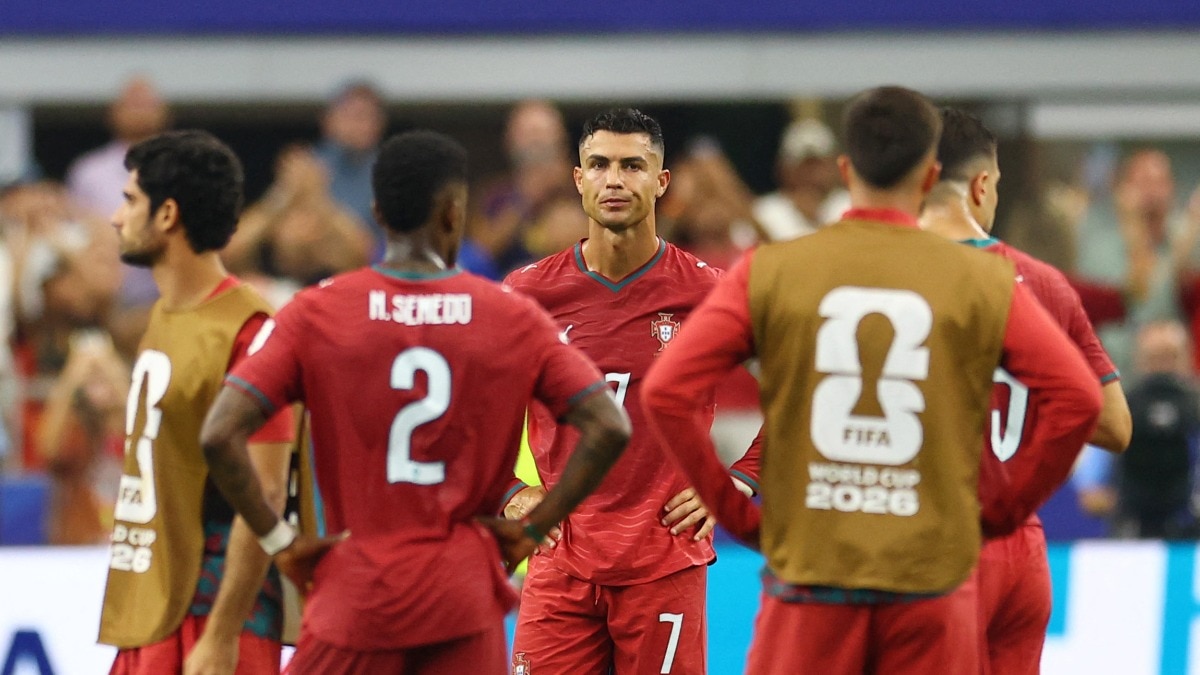

Cristiano Ronaldo lost, Spain broke Portugal’s dream of winning the FIFA World Cup
Cristiano Ronaldo stood still.
He took it all for the last time.
The scoreboard read Portugal 0, Spain 1. The Spanish festival was being celebrated all around him. The reality is that there will be no seventh FIFA World CupNo last chance to chase the trophy that had eluded him for more than two decades.
It wasn’t until those few quiet moments that the tears came.
Portugal’s FIFA World Cup 2026 campaign ended in the most brutal fashion. Mikel Merino’s stoppage-time strike sent Spain through to the quarter-finals and brought down the curtain on Ronaldo’s sixth and final appearance on football’s biggest stage.
Portugal vs Spain, FIFA World Cup: highlighted
For a player who has spent more than two decades leading Portugal to some of their greatest nights, there will be no last heroic goal, no last act of defiance and no fairytale farewell. The World Cup, a prize that forever eluded him, remained beyond his grasp.
It was hard not to feel something watching Ronaldo walk away.
It doesn’t matter whether you supported Lionel Messi, worshiped Barcelona, praised Real Madrid or spent the last month arguing that Portugal should have moved on from their captain. The rivalry suddenly seemed unimportant. Football was watching one of its defining international careers reach its inevitable conclusion.
The irony is that the criticism that Ronaldo received during this World Cup was not entirely wrong. At 41, he is no longer the unstoppable force that once destroyed the defenses of all of Europe. The acceleration has faded, the explosions have diminished and moments of brilliance come less frequently than five or seven years ago.
Yet Roberto Martínez never wavered.
The Portugal manager continued to have faith in the man who has given more to his country than anyone else, and Ronaldo repaid that faith with another tireless effort. He dropped deep to win possession, took on Spain’s centre-backs, applied pressure whenever possible and was the focal point of every Portuguese attack. This was not the Ronaldo of old, but this was a performance from a player who was not going to let his final World Cup go without a fight.
Spain finally lost its patience, Portugal
Spain looked to be the more complete side from the first whistle.
Luis de la Fuente’s men dominated possession with Rodri controlling the tempo, Pedri stringing together attacks and Dani Olmo repeatedly finding dangerous pockets between Portugal’s compact defensive lines. Mikel Oyarzabal missed the game’s clearest early chance when he headed his effort wide with only Diogo Costa to beat, but Portugal’s resistance never depended solely on their goalkeeper.
Costa was excellent, making several important saves, yet the foundation of Portugal’s defensive performance was built by the partnership in front of him. Ruben Dias and Renato Veiga produced one of their finest performances together in national colours, blocking shots, winning duels and reading Spain’s complex attacking patterns brilliantly. Time and again, the pair ensured Costa was not left open, forming the final defensive wall that frustrated Spain for more than 90 minutes.
There was another hero in Portugal’s backline.
Nuno Mendes once again accepted the toughest task on the pitch, keeping Lamine Yamal remarkably quiet for most of the contest. The teenage sensation, who has troubled some of Europe’s best defenders, found little joy against the Paris Saint-Germain full-back, whose pace, positioning and timing repeatedly snuffed out danger before it could develop.
When Mendes limped off after running at full strength to recover against Yamal, Portugal lost not only a defender but also the player who best posed Spain’s biggest threat. The balance of the competition changed little by little and Spain felt it.
It was also a reminder of why Martínez continues to have faith in Ronaldo. A trademark stepover created space for a shot that forced Unai Simon into action, while the latter headed wide of Pedro Neto’s teasing cross across the six-yard box. The instincts were still there, even if the explosiveness that had made him one of football’s most dangerous forwards was inevitably beginning to fade.
Portugal’s problem wasn’t that Ronaldo looked finished.
It was that a lot still depended on him.
As the second half progressed, the Portugal captain repeatedly ventured into his own half in search of possession, only to find that Spain were already on the defensive before he could launch another attack. On one occasion, he collected the ball near the halfway line with acres of space forward, only to look up and find hardly any runners willing to stretch Spain’s backline.
It felt almost effortless. For more than two decades, Ronaldo was conditioned to carry the Portuguese whenever he needed him. Even now, in what would be his final World Cup appearance, he continued to try to pull them forward.
Portugal’s defensive wall held until stoppage time.
With six minutes added on, the Spain substitutes finally got their act together to achieve the breakthrough Roberto Martínez had spent the entire evening trying to prevent. Portugal were out on a quickly taken free-kick before they were fully organised. Fabian Ruiz played an incisive pass to Ferran Torres, whose clever first-time lay-off split the Portuguese defence.
The space between Dias and Veiga became visible for the first time all evening.
Marino recognized it immediately. The midfielder burst into that narrow gap, timed his run perfectly and fired his finish into the bottom-left corner beyond Costa. After more than 90 minutes of discipline, concentration and defensive excellence, Portugal had made up for the one mistake Spain had spent the whole night looking for.
A farewell, and questions for the future of Portugal
The goal clearly shook Ronaldo.
The signs of disappointment were increasing during the second half. Again and again, the Portugal captain dropped into midfield and even into his own half to look for possession, only to find that Spain had fallen back into a defensive position before any meaningful counterattack could be launched. On one occasion, he received the ball deep inside Portugal’s half, with acres of space ahead, but when he looked up there were hardly any runners ahead of him.
At the age of 41, Ronaldo is no longer the player who is expected to create a complete attack through pace and constant movement. But the experience has given him something equally valuable: an instinct for recognizing when a game is slipping. His frequent gestures, visible frustration and constant search for the ball suggest a player trying to solve tactical problems that perhaps should never have been his responsibility.
This is where the uncomfortable questions begin for Roberto Martínez.
One has to respect a legend, and then know when the team needs to grow beyond one.
Portugal were in desperate need of fresh legs capable of stretching Spain’s defense during the closing stages. Yet Gonalo Ramos, arguably the country’s most natural penalty-box striker and the man who announced himself to the world with a World Cup knockout hat-trick after replacing Ronaldo four years ago, never left the bench. Martínez made all five other substitutions, leaving Ronaldo to play the full 90 minutes, while Portugal’s attack became increasingly weak.
The Spaniard may now find his future under scrutiny.
Martínez arrived with a reputation as a coach who could not turn Belgium’s golden generation into champions despite inheriting one of the finest collections of talent in world football. Portugal handed them another notable generation with the likes of Bruno Fernandes, Bernardo Silva, Vitinha, Rafael Leao, Nuno Mendes, Diogo Costa and Goncalo Ramos.
Yet this World Cup has often felt like a team reacting rather than directing, living rather than believing. Portugal remained organised, disciplined and difficult to beat, but they rarely looked like a side with the tactical imagination to make the most of one of Europe’s deepest squads.
When the final whistle blew, Ronaldo stood motionless, before the emotions finally became impossible to suppress.
Tears came.
Perhaps for the first time in years, there was little room left for the endless Ronaldo-versus-Messi debate, the Real Madrid-versus-Barcelona argument or the constant discussion about whether Portugal should have advanced sooner. It was one of football’s defining careers, which felt like its final international chapter.
Ronaldo left Portugal with over 140 international goals, the most in men’s football history, and made over 220 appearances, more than any other male international footballer. He led Portugal to their greatest ever triumph by winning Euro 2016, lifting the UEFA Nations League title, rewriting countless international scoring records and giving his country moments that generations of Portuguese supporters will never forget.
The World Cup trophy, an honor that always eluded him, will always be absent from an otherwise extraordinary collection.
Maybe that was never the end written for him.
More importantly, perhaps Ronaldo’s final World Cup showed him something he had not always been able to believe.
Portugal will no longer have to depend solely on him.
Nuno Mendes declared himself one of the world’s finest full-backs before his evening was ended by injury. Diogo Costa reaffirmed his place among elite goalkeepers. Renato Veiga looked every inch Pepe’s successor in the center of defence. Bruno Fernandes, Vitinha, Rafael Leao and Gonalo Ramos are players around whom Portugal can build the next era.
No one will ever reach the heights that Ronaldo achieved in the famous red shirt.
No one will have to do it.
He gave absolutely everything to international football. He carried Portugal on his shoulders for the better part of two decades, delivering unforgettable nights, impossible goals and moments that changed the history of football in his country.
As Ronaldo walked away from the World Cup in tears, perhaps he could finally do something he had rarely been allowed to do during his extraordinary career.
Rest.
Portugal’s future is ready to stand on its own.
The World Cup was not written into Cristiano Ronaldo’s story.
Everything else was there.
FIFA World Cup | fifa world cup schedule | fifa world cup points table | football news
– ends