


Pakistani man pleads guilty to human trafficking in US, charged $40,000 to bring people on ‘donkey route’ for film work

A Pakistani man pleaded guilty in the US to leading an international human trafficking organisation.
A Sialkot man pleaded guilty in a US court to leading an international human trafficking conspiracy that involved shell companies, fake visas and a ‘dinky’ route through Ecuador, Cuba, Colombia and then through the southern border into the US. Abbas Ali Haider, 49, was extradited from Mexico to the US in July 2025 to face charges here. After pleading guilty, he will be sentenced on July 30. Haider faces a minimum prison sentence of three years and a maximum of 10 years.$40,000 to bring illegal Pakistanis to AmericaAccording to court documents, Haider operated two fake film production companies – Diamond TV World Productions and Multimedia Advertising Limited. Both these fake companies were shown to be based in Pakistan but by using these companies he brought Pakistani citizens to America illegally. These people presented themselves as employees of Haider’s film companies traveling for film work. They were allowed to enter Latin American countries through fake visas but their final destination was the US through the Mexican border.“From approximately September 2019 to September 2023, Haider fraudulently obtained visas for Pakistani nationals to travel to Ecuador, Cuba and Colombia under the guise of legitimate business travel, while their actual destination was always the southern US border. Posing as employees of Haider’s fake companies traveling to work in films, Pakistani nationals were recruited into Latin America and the Caribbean countries. Haider’s network then led them to the US-Mexico border, from where they illegally entered California, Texas and Arizona. For this, Haider charged each individual up to $40,000,” the Justice Department said.America is sending illegal foreigners sitting in PakistanHaider used his fake film companies to sign contracts with film companies in Ecuador, Cuba and Colombia. He then sponsored visas for Pakistani nationals who were to work for Haider’s companies, under the guise that they were working on a joint filming project in Latin America. Haider provided Pakistani nationals with fake documents that showed they worked for his companies, which he used at ports of entry in Panama, Brazil and Colombia. Haider trained the aliens to say they worked in the film industry to deceive and thwart Customs and Border officers. Haider’s network of smugglers helped Pakistani nationals travel to the US-Mexico border, from where they illegally crossed into California, Texas and Arizona.Haider traveled from Pakistan to Mexico in late 2024 and was arrested in Mexico in January 2025 at the request of the US government.
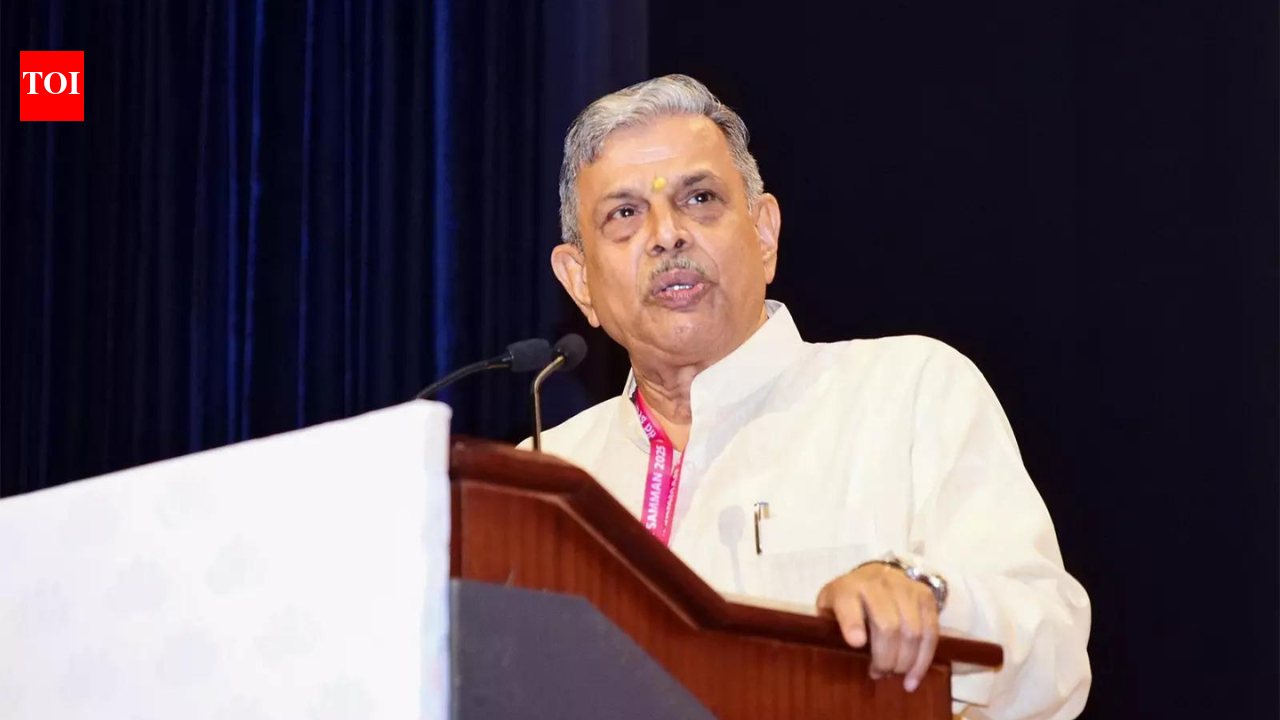
From Nagpur to Stanford: RSS steps into global testing grounds. india news
New Delhi: When a senior RSS functionary enters the policy-tech circuit of Stanford and the strategic think-tank ecosystem of Washington – places where it has long faced scrutiny – the move reads less as routine outreach and more as a calibrated effort to counter the global narrative.It is in this light that RSS General Secretary Dattatreya Hosabale’s visit to America and Germany in April, as the Sangh celebrated its centenary, needs to be seen. American academic circles, particularly the Ivy League ecosystem, have offered some sharp criticisms of the RSS and Hindutva. Against this backdrop, Hosabale’s itinerary unfolded: an address at the Stanford-affiliated THRIVE 2026 in Silicon Valley, a policy engagement at the Hudson Institute on April 23, an interaction with the Indian diaspora and an interview with NPR.At the Hudson Institute, Hosabale directly addressed the battle of perception. “This propaganda has been going on for decades. They have portrayed the RSS as a Hindu supremacist organisation, anti-minority, anti-women,” he said. In another conversation he said, “All these years, the RSS was working quietly… now we thought it was better to reach out. Our words should also become messages.”The Stanford leg – Thrive 2026 – was presented differently, aimed at a global technology and academic audience. There, Hosabale leaned towards civilizational and moral themes. “We are all part of the same source of energy… one planet, one family, one shared future,” he said, calling for science and technology to be guided by an ethical framework.More direct political expression occurred in an NPR interview conducted in Washington. “We are not establishing a Hindu nation afresh,” he said.Sustained academic and student-led criticism of the Sangh and Hindutva in America is important. The Columbia University-based publication The Morningside Post (March 24, 2021) described RSS-linked networks as linked to “ethnofascist paramilitary groups”, a 2020 paper in SAGE Journals (Sliding from Majoritarianism to Fascism: Educating India under the Modi Regime, Bhatti and Sundar) associated the RSS with a “semi-fascist” ideological project aimed at establishing a Hindu Rashtra. described as a “navel relationship”, while the 2021 Dismantling Global Hindutva conference – supported by several Ivy League departments – framed Hindutva as a political ideology separate from Hinduism and warned about its global implications, triggering a backlash from Indian groups.Joining forces with leading German policy institutions such as the Stiftung Wissenschaft und Politik, Konrad-Adenauer-Stiftung and members of Berlin’s Abgeordnetenhaus, Hosabale said, “The RSS’s vision for the next 100 years is to contribute to the building of sustainable societies at every level, from families to societies and environmental responsibility, based on shared universal values.”This outreach also signals a change in the communication strategy of the RSS. According to an association insider, “from an organization that historically relied on grassroots work and limited global expression,” it is now trying to “engage directly with international opinion-makers.”

‘Will not be tolerated’: Starmer warns Iran as UK investigates foreign influence amid rising anti-Semitic attacks
 Speaking at a high-level summit in Downing Street with leaders from politics, police, education, business and the arts, Starmer said the government was working to “rapidly legislate” to counter “deadly threats” and rising anti-Semitism in the country, Sky News reported.
The ‘foreign state’ angle is under investigation
Starmer confirmed that security agencies are investigating whether a foreign state may be behind or influence some of the recent incidents targeting Jewish communities.“One aspect of the investigation is whether there is a foreign state behind some of these incidents,” he said, adding that “all possibilities are being examined”.He warned: “Our message to Iran, or any other country that might try to incite violence, hatred or division in society, is that it will not be tolerated.”
Security has been tightened after the attacks in London
Starmer’s warning comes after two Jewish men were stabbed to death in Golders Green, north London, last week in what police have declared a terrorism-related incident. The victims suffered serious injuries and are being treated in hospital.In a separate incident on the same day, another attempted murder was reported in Southwark, while counter-terrorism officers are also investigating a suspected arson attack at a former synagogue in Whitechapel.Previous attacks included the targeting of ambulances belonging to Jewish emergency volunteers and suspected arson at community memorial sites,
Government will strengthen anti-insurgency framework
Earlier, Starmer had said that anti-Semitism in Britain was “growing, real and dangerous” and was not limited to any one source.“Islamists, the far-right and the far-left all target Jewish communities,” he said, stressing the need for a coordinated national response.He also announced an additional £1.5 million of funding to improve community cohesion and increase protection for Jewish communities in high-risk areas.The UK PM also indicated that new anti-terrorism legislation is being drafted to allow the government to take stronger action against state-linked threats. This may include powers to impose sanctions on organizations accused of supporting or sponsoring violence in foreign countries.The move follows renewed demands from sections of the Jewish community for sanctions on Iran’s Islamic Revolutionary Guard Corps (IRGC), which Western governments have long accused of sponsoring terrorism.
Increasing pressure on government’s response
The summit comes amid growing criticism from Jewish community leaders, who say the government has been too slow to take action against anti-Semitism. Starmer faced protests during a recent visit to Golders Green.Despite this, he reiterated that the government has a “clear vision” about the scale of the challenge and is committed to countering extremism “in all its forms” through a national cohesion strategy.

Aphids are born pregnant: The strange science behind their rapid reproduction

It may seem strange to think that aphids produce their offspring when they are already pregnant, but in reality, this is not an uncommon occurrence among insects. Aphids have been able to adapt a reproductive process that allows them to produce offspring very quickly without any form of courtship. Many different types of aphids reproduce in a process called parthenogenesis. In this, the development of offspring takes place inside the body of the female, where the babies live in eggs. The term “telescoping generations” refers to a form of reproduction that proves to be highly beneficial in terms of expanding the number of individuals within a species. The research field of rapid reproduction is currently growing, making this information on aphids particularly useful.
How are aphids born pregnant?
The notion that aphids begin their lives pregnant is not exaggerated but a true biological phenomenon. Female aphids can reproduce through parthenogenesis, meaning that males play no role in their reproductive processes.Female aphids do not lay eggs but give birth to their young directly. According to the National Library of Medicine, embryos complete their development within the mother’s ovaries one after another in assembly line fashion. These developing embryos contain third generation developing embryos like Russian dolls. This means that an aphid carries several generations of its offspring.
What is Parthenogenesis in Aphids and Why is it Important
The process of parthenogenesis in aphids explains their ability to increase their numbers very rapidly. This is because sexual intercourse is not a prerequisite for reproduction. This is one of the biggest advantages of this species. According to Animal Diversity, asexual reproduction allows aphids to increase their population very quickly. Some aphids can produce as many as eighty offspring per week and fifteen generations in a year.
Why do aphids grow so fast in nature?
The rapid multiplication of aphids is attributed to the unique physical structure of aphids. This is because new generations are generated before the previous generation is complete.According to Animal Diversity, within the Aphididae family, also known as aphids or plant lice, there are 24 subfamilies, 510 genera and 5109 species. Aphids are very small insects that live in large colonies and feed on plant sap. When conditions are favorable, aphids multiply significantly within a few days. It is because of this increase in population size that aphids are usually numerous on plants.
How does aphid reproduction affect plants and agriculture?
According to the National Library of Medicine, aphids induce ordered and patterned plant growth, not cancer, by injecting unknown signals into plant cells. Furthermore, they can also repair wounds inflicted by hunters or intervening scientists. Again, aphids inject unknown signals into plant cells surrounding the wound, causing plant growth that heals the wound. This explains why aphids are one of the most troublesome insects for farmers around the world.
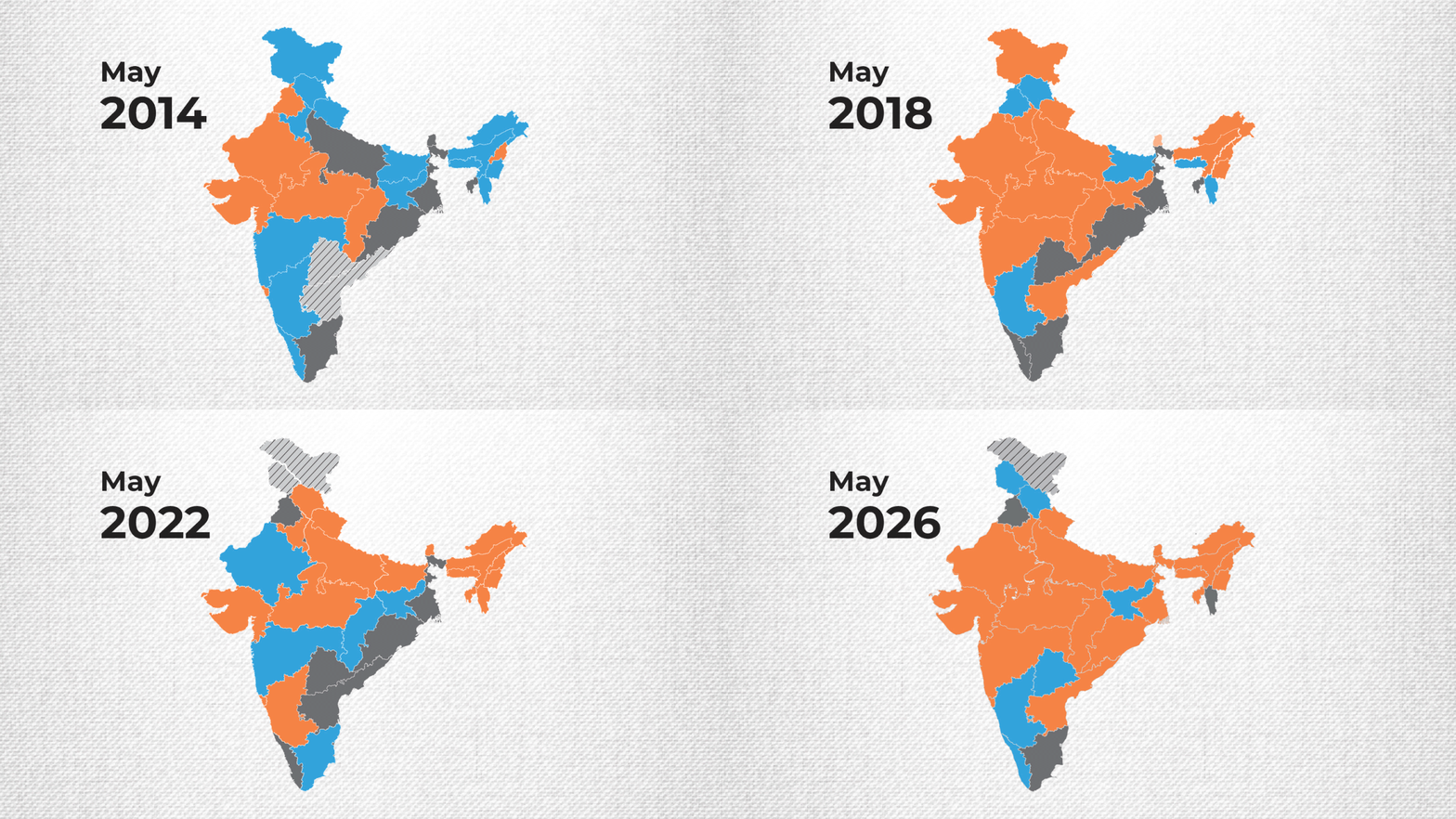
BJP’s Bharat Jodo Yatra: From 7 to 22 states, how did BJP create the political map of India?
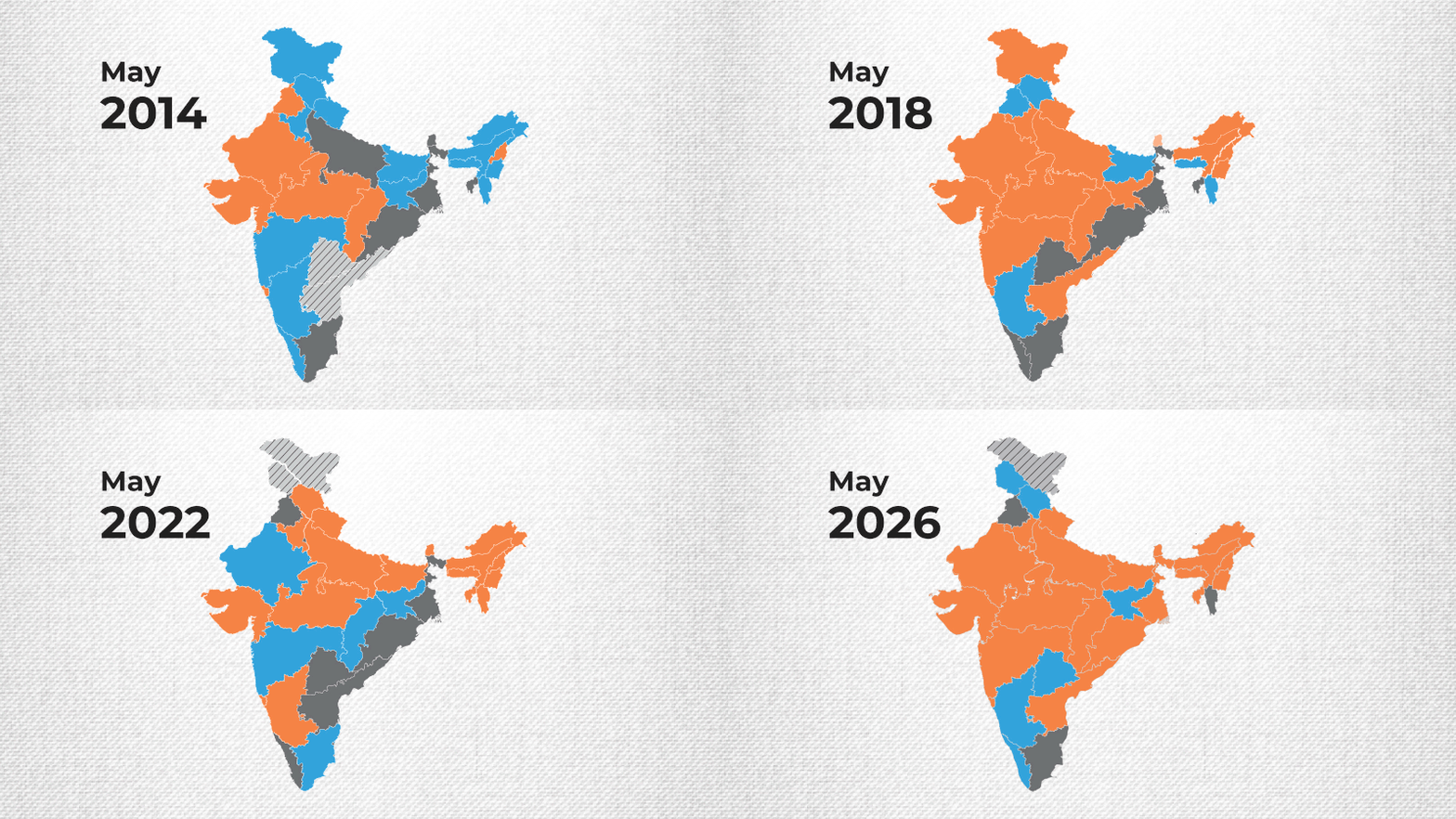
From only 7 in 2014, BJP has been adding states one after another to reach 22 in 2026. Over the same period, Congress and allies have fallen from 14 to 6, while regional and other parties have fallen from 7 to 3.
The change is so pronounced that it can be seen geographically: you can now drive from India’s border with China in the northeast to the border with Pakistan in the west without leaving BJP-NDA territory.

Former village head shot in Kaushambi, motive unclear. prayagraj news

Prayagraj: : On Monday, two unidentified bike-borne assailants shot a former village head near his house in Alamchand village of Sandipanghat police station area of Kaushambi.The incident happened when Manoj Kumar (50) Went out for a walk in the morning.On receiving the information, Kaushambi SP and senior police officers including forensic experts reached the spot and conducted investigation. The seriously injured former village head was admitted to SRN Hospital in Prayagraj.A senior official said the motive behind the attack was not yet known. Three police teams have been formed to solve the case. Police are scanning CCTV footage to identify the attackers and acting on some clues.Kumar was the head of Alamchand village from 2010 to 2015. Police are investigating from all angles including old political rivalries, if any. An FIR has been registered under relevant sections.

Shyamaupti danced with pain for Phool Pishi O Edward. bengali movie news

There are moments on a film set that never make it to the screen – but live on in the hearts of those who made them. For actor Shyamaupti Mudali, one such memory Fool Pishi O Edward It is imprinted not only in his mind, but literally in his feet.This was the order of climbing the roof early in the morning. The unit had assembled before dawn – costumes ready, choreography set, anticipation in the air. director Nandita Roy And Shiboprasad Mukherjee They were already present, watching silently as the rehearsal began.

For Shyamaupti, the physical reality of shooting was harsh. The floor of the terrace was freezing beneath his bare feet. “It felt like I was going to start bleeding,” she recalls. And in some ways, it did – the constant friction of dancing on the rough surface caused her skin to peel, causing light bleeding. But what might have been remembered as an inconvenience – or even an ordeal – turned into something else entirely. Because precautions were taken right after each take. There Roy was, calling him aside, giving him a cup of hot tea to warm him up, gently tending to his injured legs from the spray. There were crew members hovering with shawls, shoes, and calm instructions — “Put your foot this way,” “Try it this way.” It was an ecosystem of meditation, where the actor was never alone in his struggle. “I was surrounded by so much love,” she says, adding, “I didn’t feel any pain.”

That warmth extended far beyond physical comfort. What stuck with her deeply was the emotional reinforcement – the unspoken but powerful language of appreciation. After one shot, a look and a nod from the director duo was all it took.She thinks, “When an actor is appreciated after a shot, the energy to perform increases.” “I felt that way constantly throughout this movie – that a good shot was being done, it was being appreciated, and I could give the next shot even better.”In an industry that is often defined by long working hours and invisible pressures, Shyamaupti’s experience continues Fool Pishi O Edward Not only the perfection of the shot, but also the warmth behind it comes across.

‘I am their next target’: Raghav Chadha accuses AAP-led Punjab government of ‘vengeance politics’; Meeting with President Murmu. india news
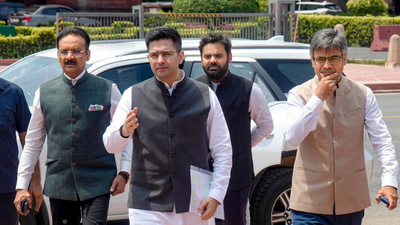
New Delhi: Rajya Sabha member Raghav Chaddha launched a scathing attack on his former party on Tuesday Aam Aadmi PartyAlleged misuse of Punjab’s state machinery to target MPs who recently switched sides Bharatiya Janata Party.Chadha, who was part of a delegation that met Draupadi MurmuAccused the AAP-led Punjab government of indulging in “politics of vendetta” against dissenting leaders.Chadha said, “After the Aam Aadmi Party merged with the Bharatiya Janata Party, the Punjab government and the Aam Aadmi Party, motivated by a spirit of revenge and retribution, have allegedly engaged in vendetta politics. They have used the state machinery of Punjab to target those MPs who expressed dissent while exercising their constitutional rights and decided to leave the Aam Aadmi Party. We presented all these developments to the Honorable President of India today and directly conveyed our concerns.” Got it done.”He further alleged selective targeting through multiple agencies. He said, “I would just like to say… those who themselves go to Rajghat and call for Satyagraha at Mahatma Gandhi’s memorial are today using the machinery of Punjab to selectively target us through vigilance investigation, Delhi Police and even the Pollution Board. It is important for the public to know this, and especially the people of Punjab should be made aware of all these incidents.”Another Rajya Sabha member and AAP rebel, Sandeep PathakSaid that the delegation had demanded constitutional safeguards during the meeting with the President. “We apprised the President of the current situation and he assured us of protection under the Constitution,” Pathak said.Meanwhile, Punjab Chief Minister… Bhagwant MaanThe AAP MLAs were recently traveling to Delhi to meet the President over the issue of seven Rajya Sabha MPs joining the BJP, setting the stage for a political confrontation between the two parties.

Who will be the CM of West Bengal? BJP government on 9 May; Suvendu Adhikari, Dilip Ghosh top contenders. india news

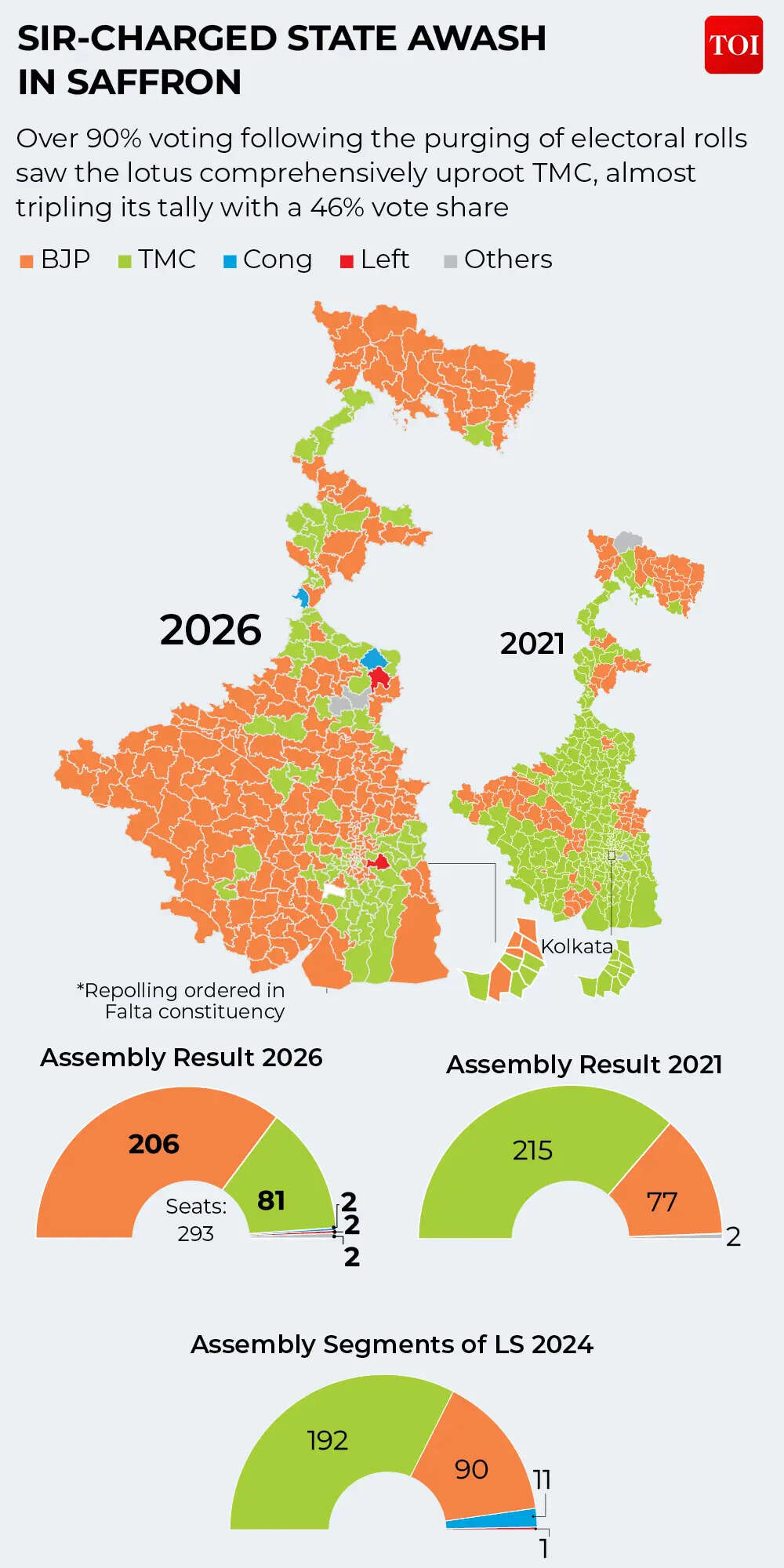
In a sweeping and symbolic mandate, the BJP came to power in West Bengal on Monday, winning 206 seats, securing more than two-thirds majority and ending the 15-year rule of the Trinamool Congress.Chief Minister identified the measure of victory Mamata BanerjeeWith BJP’s defeat to Suvendu Adhikari in Bhabanipur having put the party firmly in position to stake claim to form the government, the focus has now shifted to who will be chosen as the next Chief Minister of the state.As the BJP easily crossed the halfway mark in the 294-member assembly and is set to come to power for the first time in the state, the decisive decision not only signals a change in leadership but also a structural political shift, with the party expected to announce its chief ministerial face soon.BJP sources said the name of the chief minister will be decided in a meeting between PM Modi, Amit Shah and Nitin Nabin, with the party’s top leadership also expected to consider inputs from central observers and state leaders. After the final decision is taken, the party can also consider appointing the Deputy Chief Minister.Samik Bhattacharya said that the swearing-in ceremony of the new Chief Minister will be held on May 9.
Who are the main contenders for the next CM of Bengal?
Suvendu Adhikari
Suvendu Adhikari, who retained the Nandigram seat and defeated Chief Minister Mamata Banerjee in Bhawanipur, emerged as a key figure in the BJP’s campaign. Responding to a question on whether he would be the party’s chief ministerial candidate, Adhikari said, “There is no change in me… I am not power hungry.”
.
Adhikari started his political career with the Congress, becoming a councilor in Kanthi Municipality in 1995. He joined Trinamool Congress in 1998 and was elected from Contai South in 2006.He played a role in the land movement in Nandigram in 2007 against the chemical hub proposed by the Left Front government. This movement contributed to bringing Trinamool Congress to power in the state. He entered Parliament from Tamluk in 2009 and retained the seat in 2014.In 2016, he returned to state politics, winning from Nandigram on a Trinamool Congress ticket and joining the state cabinet. He left the party in December 2020 and joined BJP.He became the leader of opposition in West Bengal after defeating Banerjee in Nandigram in the 2021 assembly elections.
Dilip Ghosh
After BJP’s victory in West Bengal Assembly elections, Dilip Ghosh won from Kharagpur Sadar Assembly constituency.“The people of Kharagpur Sadar assembly constituency have reposed confidence in me…the public has a lot of expectations from the party as they have voted for us in huge numbers,” Ghosh was quoted as saying by ANI.

.
He secured a total of 89,885 votes and defeated Trinamool Congress candidate Pradeep Sarkar by a margin of 30,506 votes.Ghosh, a former state BJP president, is associated with the Rashtriya Swayamsevak Sangh. He was elected from Kharagpur Sadar in the 2016 assembly elections and led the party’s campaign in the state during the 2019 general elections, when the BJP secured 40.7 per cent vote share in West Bengal.
Samik Bhattacharya
BJP state president Samik Bhattacharya is also a major contender. They are seen as having organizational experience with a focus on booth management, election strategy and cadre mobilization. His approach emphasizes on strengthening the party structure, in line with the BJP’s long-term plans in the state.
Roopa Ganguly
Former Rajya Sabha MP and actor Roopa Ganguly won the Sonarpur South assembly constituency by 1,28,970 votes, defeating TMC candidate Arundhati Maitra by a margin of 35,782 votes.Ganguly is also being discussed in the context of leadership. Their electoral victories and public profile contribute to the party’s reach, including among urban voters.
Agnimitra Paul
Agnimitra Paul retained Asansol South Assembly constituency in West Bengal, defeating Trinamool Congress candidate Tapas Banerjee by 40,839 votes.Paul, who is also the vice-president of the BJP’s West Bengal unit, is among the prominent leaders of the party in the state. Their victory margin reflects their position in the constituency.As an MLA and party spokesperson, she has been active in public outreach and media engagement, including on women-related issues. His role is part of the party’s efforts to introduce a new leadership base in the state.
Swapan Dasgupta
Swapan Dasgupta won the Rashbehari assembly constituency with 74,123 votes, defeating Trinamool Congress candidate Debashish Kumar by a margin of 20,865 votes.Dasgupta, who holds a doctorate in philosophy from the School of Oriental and African Studies, University of London, is a former Rajya Sabha MP.In the last assembly elections, he had contested from Tarakeswar, where he lost to TMC candidate Ramendu Singhrai by 7,484 votes.
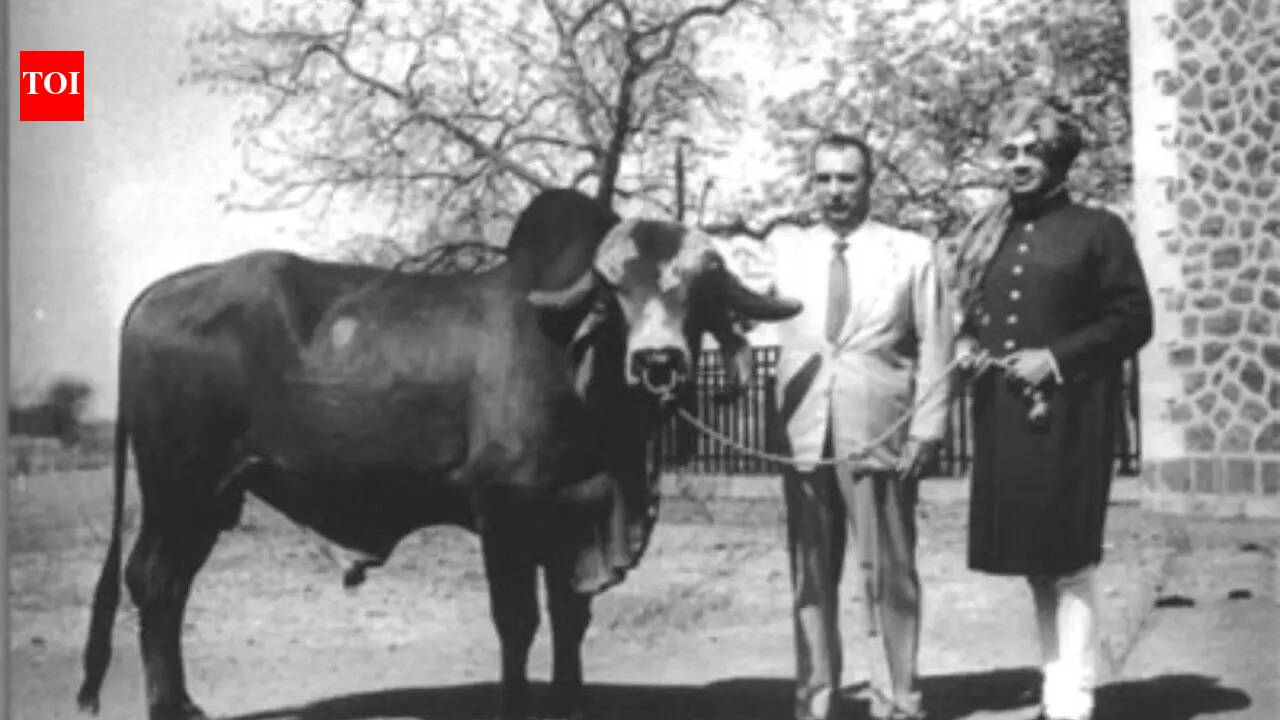
Gujarat Krishna Bull: Meet Krishna: a bull from Gujarat credited with producing 80% of Brazil’s milk production since 1960.
A jingle from the 90s said, “Doodh hai adamav, peesha kar karte hai everyday glass full”, in which most of the people of India drank milk like fine wine in different combinations. Dairy and especially milk has an important history in the Indian subcontinent, not only in terms of consumption but also production. It is the world’s largest milk producer, contributing about 24% to 25% of global milk production.Along with maintaining its excellent dairy production system, India has also helped other countries in their dairy sectors. The earliest example of this comes in the form of a bull that traveled from Gujarat, India to Brazil.
Krishna : Bull
According to the BBC, it was the year 1958 when Brazilian cattle trader Celso Garcia Cid sent cowboy Ildefonso dos Santos to India with the aim of finding a bull that could increase Brazil’s livestock.Sid was looking at pictures when his eyes fell on a calf named Krishna. His coat was red and white and his horns hung downwards. The cattle dealer immediately ordered the purchase of the strong bull, which arrived in the country two years later.During that time, the shepherd described Krishna as “a giant of a man”. He said, “Nothing can be inferred from what has been said about this animal – it is a giant creature.”However, instead of being purchased, Krishna was gifted to the cowboys by Krishna Kumarsinhji Bhavsinhji, the Maharaja of Bhavnagar and the first Indian Governor of Madras.
Indian bull behind Brazilian milk production
Krishna’s arrival proved extremely beneficial to Brazilian cattle and dairy. They brought about a genetic revolution in the country’s cattle market and now, their lineage makes up 80% of Brazil’s milk production.In India, Krishna helped increase the value of the Gir breed, which is now considered one of the most valuable breeds in the bovine embryo market. In recent years, this breed almost became extinct in the country due to failed crossbreeding attempts and the government sought help from Brazil to import this breed back to India.According to Guilherme Sachetim, the shepherd’s grandson, the Krishnas were a turning point in the history of livestock farming in Brazil. “They renewed the bloodline of the national dairy cattle at a time when inbreeding was holding back productivity,” he said.Not just Krishna, it is believed that the Maharaja of Bhavnagar visited the shepherd’s farm in Sertanopolis and before his death, left all his cows to him, thereby deepening the friendship that is remembered even today.
Where is Krishna now?
Krishna was much more than a bull. She left a legacy of her own in Brazil, changing the future of the country with healthy milk. After she died, Sid placed her body in a glass coffin and preserved it in the farmhouse, where it remains to this day. A sign that someone had pressed between Krishna’s toes read: “Want to meet Gir? Keep an eye on me!” Additionally, Krishna also received tribute to the country’s White Revolution, with his image appearing on stamps and coins.Today, a strong Brazilian Gir can produce up to 20 liters of milk per day. This is ten times more than the original cattle brought into the country nearly a century ago.