

India A vs Sri Lanka A: Vaibhav Suryavanshi ignored Virat’s advice. Virat spent many years ignoring him too
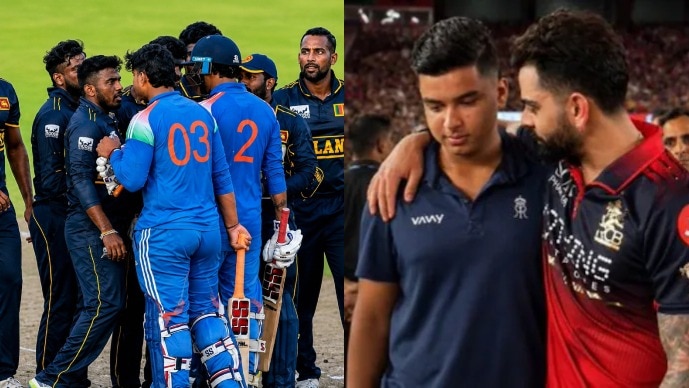
Two weeks ago in Ahmedabad, Virat Kohli placed his hand on Vaibhav Suryavanshi’s shoulder and said something that the 15-year-old will have to remember throughout his career.
“Don’t pay attention to who is saying what or how they are saying it.” Suryavanshi later said that the moment seemed like a dream, it did not seem as if it was actually Virat Kohli. That the man used to talk to him like an elder brother. He preserved the words in the same way as you preserve something precious.
He forgot them on Monday.
In Dambulla, Suryavanshi made his comeback in circumstances already surrounded by controversy after India A’s defeat to Sri Lanka A in the Super Over. He was walking with Suryansh Shedge wearing gloves, with his head bowed. Then one of the Sri Lanka A fielders – Vishen Halambage, clapping, talking – said something. And the 15-year-old, who recently faced Jasprit Bumrah in front of 50,000 people, decided that his work was not done yet. He pushed Halmbej with his left hand Before Niroshan Dickwella steps in to separate them.
This lasted for a few seconds. This will be discussed for many days.
What happened in Dambulla?
The match itself had become a powder keg. India A and Sri Lanka A were tied at 265 runs, due to a no-ball dispute players from both teams had to return to the field after their departure, and Tilak Verma spent a lot of time in front of the umpires Finally, before the super over was played. By the time Mathulan’s yorker ended India A’s chase, the nerves had already worn off.
Suryavanshi had scored five runs in two balls in the super over. It wasn’t enough, and not out of willingness to try. As the hosts celebrated, he and Shaz began hiking. What happened next was brief but ugly: Halambase’s words, Suryavanshi’s reaction, a push, and then the cool head, Dickwella, Sri Lanka A captain Sahan Arachige, all taking it apart. What was a very bad ending to an entertaining match.
not the first time
In fact, it’s a familiar script, at least on the field, in the heat of competition. In December 2025, during India’s chase of 348 in the Under-19 Asia Cup final in Dubai, Suryavanshi scored 26 runs in 10 balls before Pakistan fast bowler Ali Raza dismissed him and celebrated with some sharp words. Suryavanshi did not go just like that. He turned, gestured, made his point. It went viral. Even then people talked about it for many days.
Two events months apart don’t define a character. Away from the field, Suryavanshi has consistently been the picture of decency – touching Sunil Gavaskar’s feet during IPL 2026, getting Kohli to autograph his Rajasthan Royals cap and wearing the orange cap in matches whenever he is not wearing it. The boy who pushed Halambaj on Monday is no different from the boy who bowed before Gavaskar. He’s the same person, at 15, still learning which version of himself to be at which moment.
These two incidents indicate something more specific and more understandable: that when Suryavanshi is in the field and the needle goes in, he reacts. In kind, immediately, without much calculation. That’s different from being an angry young man.
Should we evaluate him?
It is worth remembering that Kohli was not always the man to dispense wisdom on the outfield in Ahmedabad. In his early years, he was likely to be at the center of a flashpoint even when he was at the crease. He slurred, he gestured, he felt every dismissal and every lightness on his face. The words of the cricket boards were calm. The coaches intervened. At that time aggression seemed like a liability.
What changed was not the fire. It never left. What changed was the direction of its burning.
Kohli has learned over the years and through tough experience to put every last drop of that intensity into his batting and his fitness rather than into tussles with opposition fielders. Felt hungry. Flammability became an unrelenting refusal to be second-best. By the time he was telling a 15-year-old boy in Ahmedabad to ignore the noise, he knew exactly how difficult it was to follow that instruction – because he himself had failed at it repeatedly before getting it right.
Federer’s arc is almost identical. The Swiss who became synonymous with grace and calmness – the man they called the most beautiful player the game had ever seen, spent his adolescence breaking rackets and yelling at linesmen. His own coach Peter Carter was disappointed with his nature. Federer eventually came to understand that anger is energy, and energy can be redirected. This beautiful champion was built on an angry child who slowly learned what to do with himself.
Suryavanshi is not that angry child. But he is an extremely competitive individual, who has let provocation get the better of him on two occasions. This is a narrow accusation, and far more forgivable.
big picture
At the age of 15, while most of his peers are worried about board exams, Suryavanshi is facing Bumrah and Archer and Cummins in packed stadiums. He has already done what most cricketers never do: the fastest IPL century by an Indian, the Orange Cap, 776 runs at a strike rate of 237. He is living impossibly fast.
The incidents in Dubai and Dambulla are not a cause for concern. They are, if anything, evidence that the engine is running hot, which is exactly where you want it for a batsman like him. The task now is the same as it was for Kohli, as it was for Federer: not to cool the engine, but to learn to run it.
He already has the best possible advice. He had heard it two weeks ago, in Ahmedabad, from someone who had once needed it himself.
The runs are already here. The rest will follow.
– ends