
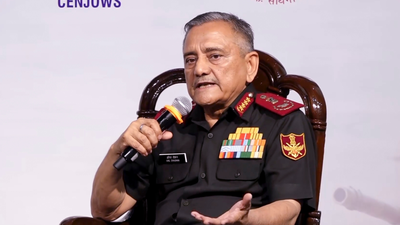

Rajnath; Moving forward with speed and consensus for staging: CDS
New Delhi: Defense Minister encouraged defense scientists to accelerate research and development work -Rajnath Singh “Tomorrow’s battlefield will reward those who can reduce the time between an idea, a prototype and operational deployment,” Thursday said.Addressing the Defense Strategic Dialogue Kalam and Kavach 3.0 in a video message here, Rajnath said, “The strength of a nation will depend on how fast its defense forces, laboratories and industries think and act”, underscoring the importance of self-reliance and jointness to secure strategic autonomy and be future-ready for emerging security challenges.“National security demands our preparedness, flexibility, innovation and strategic confidence,” he said.Rajnath described self-reliance as not only an economic goal but also a strategic necessity and said a nation that remains overly dependent on others for critical defense capabilities remains vulnerable in times of crisis.In the presence of Italian and Armenian envoys at the event, Minister of State for Defense Sanjay Seth told the foreign delegates that India strongly believes that global security and progress is strengthened through cooperation, trust and shared innovation. He said India’s defense exports, which were just Rs 686 crore a decade ago, have today reached a record high of Rs 38,424 crore. He said annual defense production has touched an all-time high of Rs 1.54 lakh crore in the financial year 2025-26 and reaffirmed the government’s resolve to achieve the target of defense exports of Rs 50,000 crore and defense production of Rs 3 lakh crore by 2029-30.CDS General Anil Chauhan said this while talking about Operation Sindoor in a special session in the program. indian armed forces The surge dominated metrics on all four days of the conflict.On the ‘JAI’ (Jointness, Aatmanirbharta and Innovation) triad, the CDS said as far as planned remediation is concerned, efforts in this direction have been made with “scale and pace” as India is 10-15 years behind other countries, which have already implemented such structures. “These joint structures that we are trying to create will be one of the most transformational reforms that India is undertaking...Our model was a little different. Some people had to bring laws, it was a top-down approach. I tried to work with consensus. The consensus was taking everyone along,” he said.