‘US wanted to kill the crew’: Surviving sailor of sunken Iranian warship tells horror story – watch video

'US wanted to kill the crew': Surviving sailor of sunken Iranian warship tells horror story - watch video

The surviving sailor of the Iranian warship IRIS Dena has described the horrific US attack that sank his warship in the Indian Ocean near Sri Lanka last month, killing 104 crew members. The injured sailor, identified as Hamed Momeneh, claimed that the Americans intended to “kill the crew”, adding that no warning was given before the attack.“It was about 3:00 to 3:30 in the morning when we were suddenly attacked – this attack was completely against international maritime laws. This was not a war zone, and we had no warning. The attack was made by a submarine without any warning. When the first torpedo hit, all the personnel were at their posts, and fortunately we had no casualties at that time. There were 104 crew members on board, and no one abandoned ship. Everyone stuck to their guns until the end,” the sailor told Tasnim news and was quoted by the Iranian Embassy.He said, “If their aim was only to damage the ship, they could have targeted other parts, but the main aim was to kill the crew. Nevertheless, we stood firm till the end. For us, Dena was like the soil of Iran, and there was no point in abandoning it. The forces remained with the ship till 11 pm, after which they were forced to swim some distance in the sea to reach areas near the Sri Lankan coast.”IRIS Dena was hit by a MK-48 torpedo launched from a US submarine on 4 March about 40 nautical miles off the coast of Sri Lanka near Galle. It was sailing in international waters after participating in India’s multinational naval exercise MILAN. 104 crew members were killed in the incident; 87 bodies were recovered and 32 sailors were rescued.

Source link

The Bengal test: Can Mamata hold, or will BJP crack the bastion? | India News

The Bengal test: Can Mamata hold, or will BJP crack the bastion?
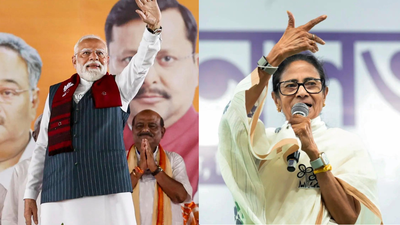
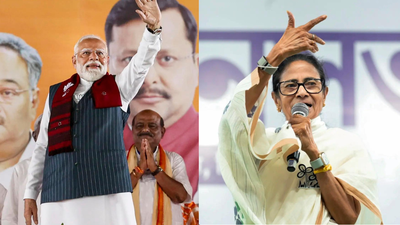
PM Modi and Bengal CM Mamata Banerjee (R)

NEW DELHI: Will West Bengal once again subscribe to Mamata Banerjee’s pitch and emotional appeal built around the formula of ‘maa, mati, manush’? The ever-resilient and energised Bharatiya Janata Party in the state is eyeing her seat of power, hoping to breach the walls of the Bengal bastion after over 15 years of Mamata’s strong rule.The Congress factor, however, despite a decades-long drought, could still prove crucial in shaping the road to Kolkata’s throne.Much like the Congress, the Left, once dominant under towering leader Jyoti Basu in Bengal, is now fighting to regain its lost ground from zero.

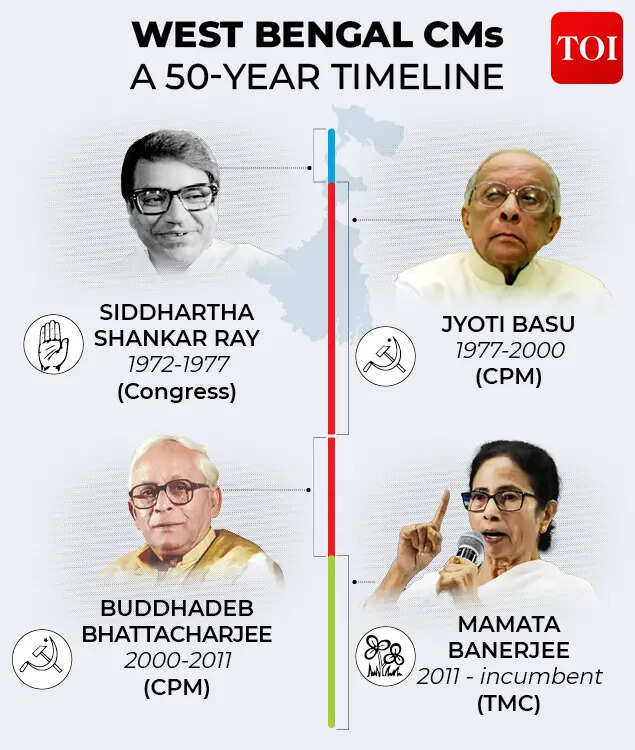
west bengal CMs timeline

April 23 and April 29 have been set as polling dates, with “Banglar manush” voting in two phases across all 294 seats. Counting and results are scheduled for May 4, alongside elections in three other states and a Union Territory.The buzz around Bengal remains upbeat, as the country’s second-largest Assembly run by a woman chief minister from the Trinamool Congress, has posed a formidable challenge to rivals ever since her dramatic rise in state politics.The battle for the Kolkata throne is largely seen as a bipolar TMC vs BJP contest, with Mamata Banerjee as the lone woman challenger locked in a direct and fiery face-off with the BJP’s top leadership amid Bengal’s election fever.Meanwhile, multiple players, the Congress, the Left, and Humayun Kabir’s AJUP, which is in an electoral marriage with Asaduddin Owaisi’s AIMIM, are vying to shape a third front.The BJP has stepped up its game following its major embarrassment in Parliament, where a united opposition defeated its proposed women’s quota and delimitation bill in Lok Sabha. The saffron party, led by Prime Minister Narendra Modi and home minister Amit Shah, launched a blistering attack on parties such as the Congress, TMC, DMK, and SP.In Bengal, PM Modi held several rallies, seeking to frame Mamata Banerjee’s TMC as an “anti-women” party in a strong bid to woo women voters, urging them not to back Mamata this time, but to hand over the baton of power to a potential debutant BJP.

Faultlines beneath the campaign

This time, the backdrop of elections carries the heavy baggage of riots, violence, social harmony concerns, and law and order questions.

-

The uncomfortable episodes of Sandeshkhali, Murshidabad, RG Kar Medical College and Hospital, constant allegations of facilitating infiltration, and most recently Malda could haunt Mamata’s continuance, and prove bankable assets for rivals like BJP, Congress, Left, and others.

What happened in last elections?

Last time when West Bengal went to assembly polls in 2021, BJP’s ‘Chanakya’ Amit Shah, in his strident voice, set the target of “200 paar” in a 294-seat House in a state with no BJP legacy.The long political history of West Bengal, stretching back to the East India Company era, had little trace of BJP’s presence. Yet, the saffron party, strong at the Centre but historically absent in the state, pushed hard with wide campaigns.

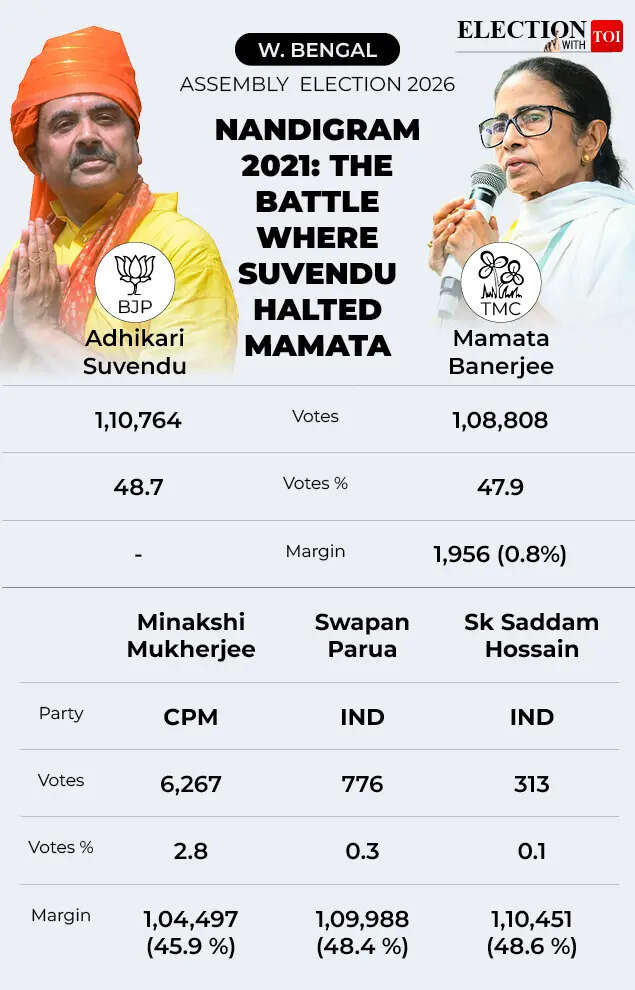
Nandigram 2021- The battle where Suvendu halted Mamata

With key commanders of BJP brigade, PM Narendra Modi and Amit Shah, leading numerous rallies, it managed to crack Mamata’s citadel, winning 77 seats and emerging as a formidable opposition for the first time, overtaking Left and Congress.Mamata’s rise had earlier dismantled the long-standing Left dominance and pushed Congress to the margins. The BJP’s emergence not only made it the prime challenger but also dealt a blow to an already weakened Left-Congress space.

Will this time be a shift?

Is there trouble in paradise for Mamata? Her 2021 victory was followed by a wave of post-poll violence, reinforcing Bengal’s long-standing association with electoral unrest.According to EC data, around 1,300 incidents of violence took place across the state after the 2021 polls. Beyond post-poll unrest, the state has seen episodes like Murshidabad violence, the RG Kar rape case, and Sandeshkhali unrest—among other disturbing chapters in the last five years under Mamata’s rule.These incidents could sway voters and push them towards alternatives in the hope of a different governance trajectory.And a clear, formidable challenger has been steadily building — BJP.

High-stakes contest

A state as politically significant as West Bengal carries sky-high stakes. BJP, in its now familiar expansion mode, continues to deepen its footprint across the country, with Bengal remaining one of its most ambitious targets.For TMC, however, Bengal is its core and only stronghold. Led by Mamata Banerjee, it remains one of the strongest forces countering BJP’s national dominance.Eclipsing TMC in Bengal would be a major strategic win for BJP.The Congress, broadly aligned with the Left Front, is also attempting to regain relevance. However, after recent setbacks like Bihar, where it secured just a fraction of the seats it contested, it remains a distant third in what is largely a bipolar contest.The Left, once dominant, continues to fight for space, keeping alive a long but fading legacy.

BJP’s infiltration pitch on Mamata

BJP has sharpened its attack on Mamata over alleged infiltration, citing Bengal’s long international border with Bangladesh.Amit Shah has accused the Mamata government of enabling “demographic change” in the state.In a January rally ahead of polls, Prime Minister Narendra Modiechoed the same line, calling for “asli poribortan,” stating: “In many areas of Bengal, demography has changed due to infiltration. TMC’s hooliganism and threat politics will stop soon.”The PM added, “Riots are happening in Malda, Murshidabad, and other parts of Bengal due to infiltration.”He also coined the slogan: “Paltano darkar, chai BJP sarkar.”

RG Kar case

The TMC rule suffered yet another blot in 2024 when a junior doctor was brutally raped inside the campus of RG Kar Medical College and Hospital in Kolkata.The incident triggered massive protests, directly questioning the authority of Mamata Banerjee. It raised serious concerns over safety, security, and administrative accountability.BJP, stepping up its attack ahead of elections, fielded the victim’s mother from Panihati, symbolically amplifying the issue against the ruling dispensation.

Sandeshkhali

The same year, Sandeshkhali, a remote riverine area, emerged as a major political flashpoint following allegations of land grab, sexual violence, and intimidation against women, with accusations centred around Sheikh Shahjahan.The issue triggered statewide protests, a fierce political confrontation between TMC and BJP, and multiple investigations.It also brought national attention to governance concerns in the Sundarbans region, highlighting allegations of localised power networks, law enforcement gaps, and the vulnerability of women in remote areas.

Murshidabad violence

Law and order concerns resurfaced in 2025 when violence erupted in Murshidabad during protests against the Waqf Amendment Act, spiralling into widespread clashes and communal unrest.The violence led to deaths, injuries, and displacement, with security forces deployed to restore order.

SWOT analysis: Party-wise

TMC: Welfare strength vs governance pressure

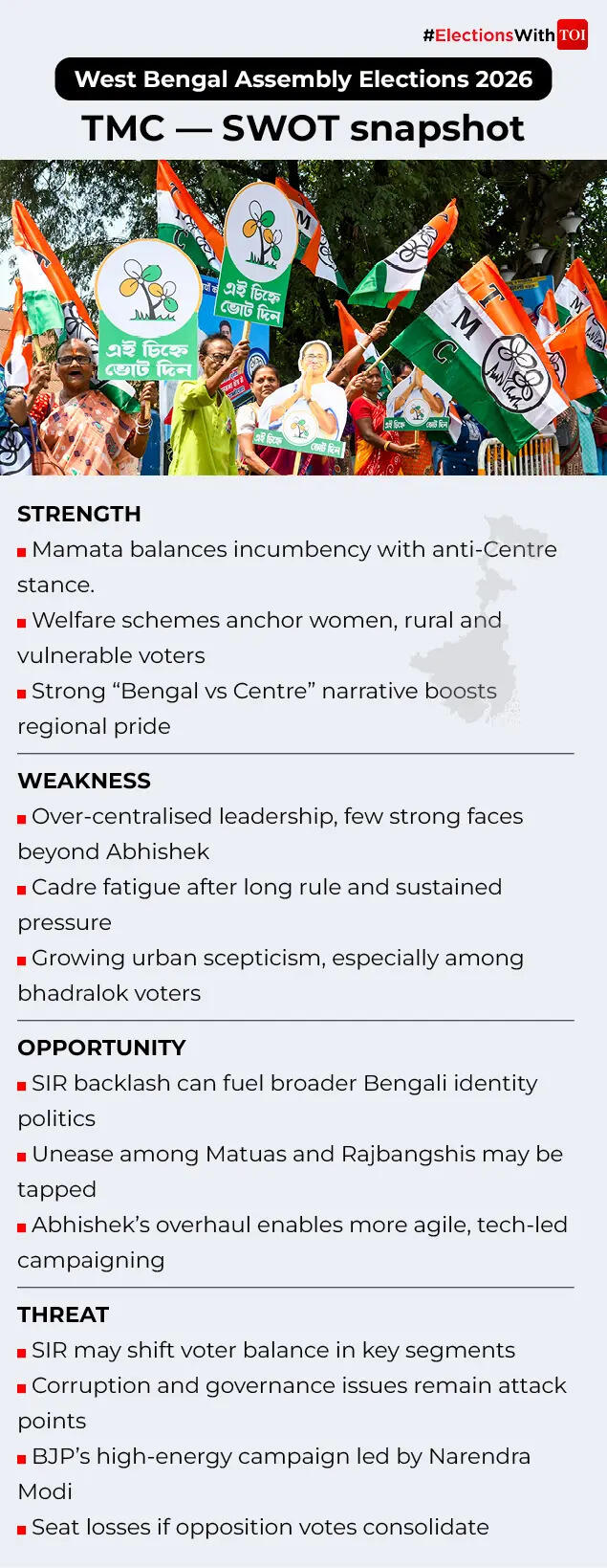
The TMC enters the election as the dominant force, backed by strong grassroots networks and welfare delivery, but it faces mounting anti-incumbency and growing scrutiny over governance. Mamata Banerjee’s long-held influence in state politics is now being challenged by an aggressive BJP campaign, with top leaders such as PM Narendra Modi, Amit Shah, and Rajnath Singh launching direct attacks on her 15-year rule, highlighting issues like rising violence, law and order concerns, migration, infiltration, and alleged demographic change.

TMC swot

Meanwhile, the Trinamool Congress is also facing criticism from multiple quarters, including INDIA bloc partners like the Congress and the Left, even as it seeks to retain its formidable grip on power in Bengal.

Strengths

  • Mamata continues to enjoy a strong grassroots connect, reinforcing the party’s electoral appeal across regions.
  • The party maintains a robust booth-level organisation that ensures effective mobilisation in both rural and urban areas.
  • Its extensive welfare schemes have created a loyal support base among women and economically weaker sections.
  • Consolidation of minority votes continues to act as a major electoral advantage.

Weaknesses

  • Anti-incumbency sentiment has been building after more than 15 years in power.
  • Repeated allegations of corruption and governance issues have affected the party’s credibility.
  • Internal factionalism and concentration of leadership have created organisational strains.
  • The narrative of political violence and clashes has hurt the party’s public image.

Opportunities

  • A fragmented opposition allows the party to retain its dominant position.
  • The Bengali identity narrative provides a counter to BJP’s perceived outsider image.
  • Welfare beneficiaries offer scope for expanding and consolidating a loyal voter base.
  • Strategic candidate reshuffles can help address local dissatisfaction and anti-incumbency.

Threats

  • The growing organisational and electoral push of BJP poses a significant challenge.
  • Increasing political polarisation risks cutting into established vote banks.
  • Electoral controversies and concerns around voter trust could impact outcomes.
  • Urban centres and border districts are emerging as highly competitive battlegrounds.

BJP: Momentum vs local gaps

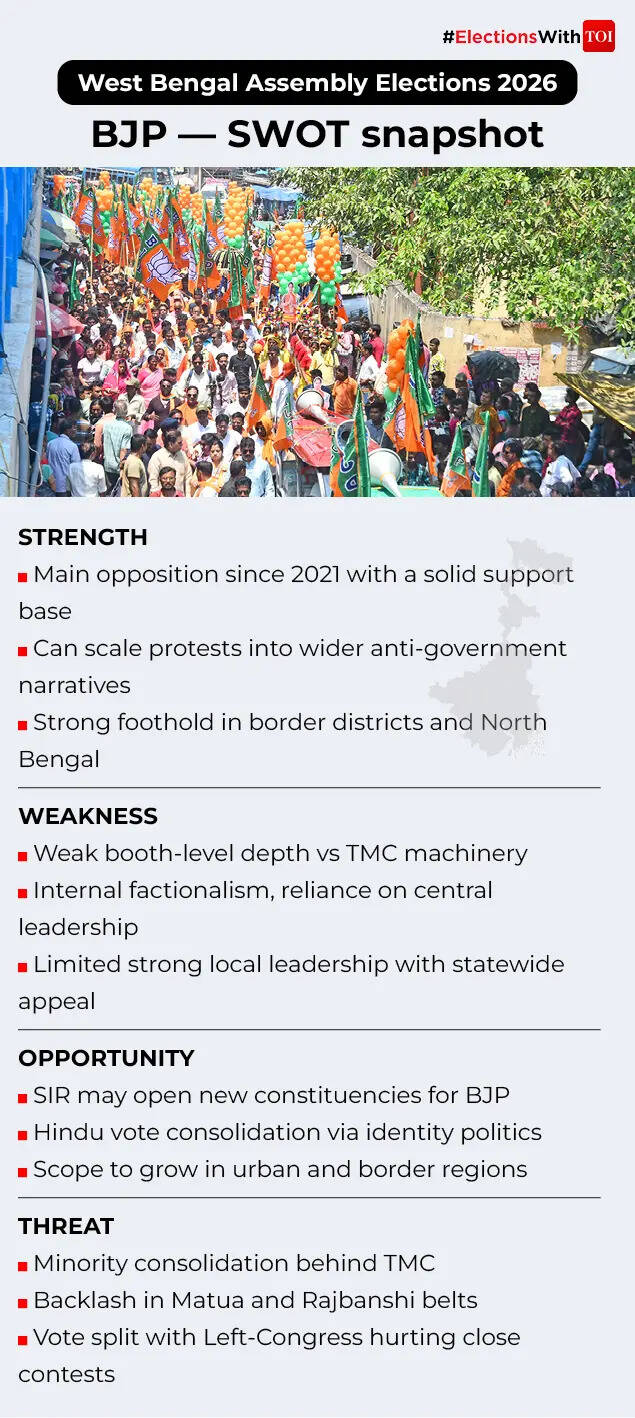
BJP has emerged as the principal challenger, combining national leadership with rapid organisational growth, though local limitations remain.

-

Strengths

  • The leadership of Narendra Modi provides strong national appeal and voter traction.
  • The party has significantly expanded its organisational base since 2019, filling the vacuum left by the Left.
  • Its clear ideological positioning has enabled consolidation of a sizeable section of Hindu voters.
  • A high-intensity campaign machinery ensures strong visibility and outreach during elections.

Weaknesses

  • The absence of a strong and widely accepted chief ministerial face weakens its local positioning.
  • The perception of being an outsider party continues to affect its acceptance among Bengali voters.
  • Internal factionalism, especially between old cadre and new entrants, creates organisational friction.
  • Its grassroots penetration, particularly in rural areas, remains weaker than that of TMC.

Opportunities

  • Anti-incumbency against TMC provides a clear opening for electoral gains.
  • The party has scope to expand its appeal among women and welfare beneficiaries.
  • Consolidation of anti-TMC votes can significantly strengthen its electoral prospects.
  • National issues such as identity and security can be leveraged to mobilise voters.

Threats

  • A backlash driven by Bengali identity politics could limit its growth.
  • TMC’s welfare ecosystem may blunt the impact of anti-incumbency.
  • Excessive polarisation risks alienating swing voters.
  • Congress and Left could divide opposition votes and reduce BJP’s advantage.

Congress: Relevance vs revival challenge

The Congress, now facing its longest stretch out of power in the state, last formed a government several decades ago, going back to the twentieth century. In the first three decades after independence, the party commanded strong influence in West Bengal, led by legacy figures such as Bidhan Chandra Roy, the state’s first chief minister.However, the party was eventually swept aside by the CPI(M)-led Left Front under the towering leadership of Jyoti Basu, whose dominance continued for decades until it was unseated by Mamata Banerjee in 2011. The rise of Mamata’s TMC further pushed Congress to the margins, and in the last election, the BJP delivered another blow, reducing the party to zero representation in the Assembly.

-

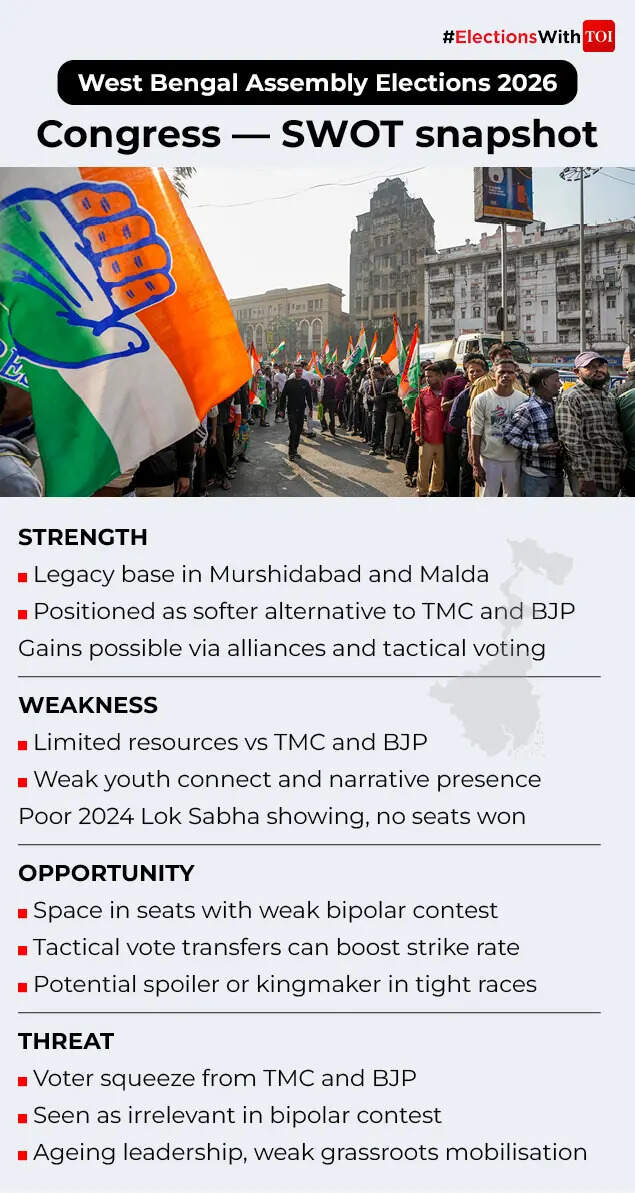
Struggling on multiple fronts, the Congress enters this election with little to lose and everything to gain.

Strengths

  • Congress retains pockets of historical influence in districts like Malda and Murshidabad, which still offer electoral openings.
  • Its legacy brand and national presence continue to provide a base level of voter recognition and credibility.
  • The party maintains some acceptability among minority voters in select constituencies.
  • Its centrist positioning appeals to voters seeking an alternative to both TMC and BJP.

Weaknesses

  • Organisational decline has significantly reduced its electoral competitiveness in recent years.
  • The absence of strong and credible state-level leadership limits its ability to mount an effective challenge.
  • Continuous cadre erosion to TMC and BJP has weakened its grassroots network.
  • It struggles to remain relevant in a largely bipolar political narrative.

Opportunities

  • There is scope to attract voters disillusioned with both TMC and BJP.
  • Targeted campaigning in traditional strongholds could help convert residual support into seats.
  • A softer, moderate political positioning may appeal to voters fatigued by polarisation.
  • Strategic candidate selection could improve performance in closely contested constituencies.

Threats

  • The bipolar contest between TMC and BJP continues to squeeze Congress’s political space.
  • Vote splitting with other opposition players could further damage its prospects.
  • Ongoing cadre migration risks deepening organisational weakness.
  • There is a growing risk of long-term political marginalisation without electoral gains.

Left: Legacy erosion vs survival fight

The Left ruled West Bengal for decades, with the CPM’s dominance taking shape under the leadership of Jyoti Basu. The Marxist force dismantled the Congress’s long-held grip on power in the state.

-

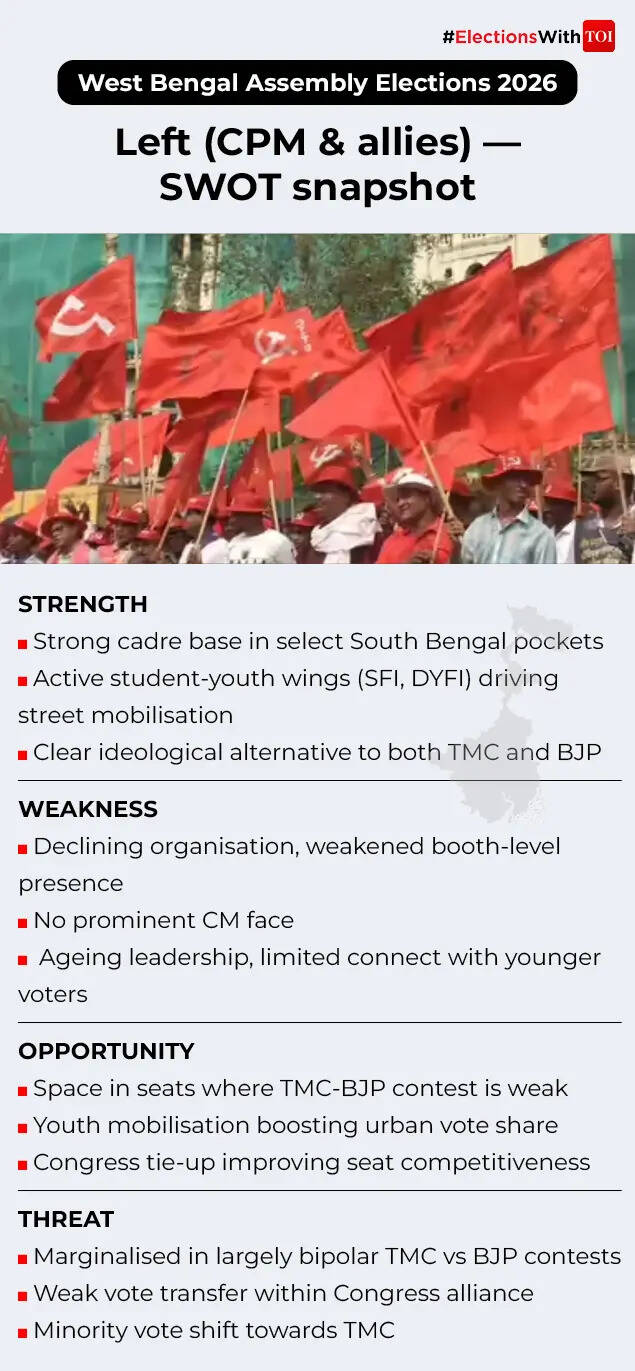
However, with Mamata Banerjee’s rise to the Kolkata throne, the Left suffered a major setback, gradually losing its electoral footprint. The BJP’s emergence as the second-strongest force in the last elections, behind the incumbent lady, pushed the CPM and its allies further into political insignificance.

Strengths

  • The Left retains a strong ideological base and a committed core cadre despite electoral setbacks.
  • Its historical governance legacy under leaders like Jyoti Basu still resonates with older voter segments.
  • The party maintains organisational discipline in select pockets.
  • It appeals to voters seeking a clear ideological alternative to both TMC and BJP.

Weaknesses

  • The Left has faced a steep electoral decline, with minimal recent success in the state.
  • A shrinking voter base and ageing leadership have limited its mass appeal.
  • Cadre erosion to rival parties has weakened its ground strength.
  • It struggles to connect with younger voters in the current political landscape.

Opportunities

  • There is space to rebuild by mobilising grassroots movements and issue-based politics.
  • Discontent with both TMC and BJP could create openings in select constituencies.
  • Re-engaging youth and student wings could help revive its organisational base.
  • Focused campaigning in traditional bastions may yield incremental gains.

Threats

  • The dominance of TMC and BJP leaves little room for a third force to expand.
  • Continued decline risks pushing the party into political irrelevance.
  • Internal stagnation and lack of reinvention may hinder revival efforts.
  • Fragmentation of opposition votes could further reduce its electoral impact.

Source link

IPL 2026: Sanjiv Goenka reaches out to Arya after PBKS beats LSG, Preity Zinta gets engaged with Pant | cricket news

IPL 2026: Sanjiv Goenka reaches out to Arya after PBKS beats LSG, Preity Zinta gets engaged with Pant
Sanjeev Goenka with Priyansh Arya, Preity Zinta with Rishabh Pant

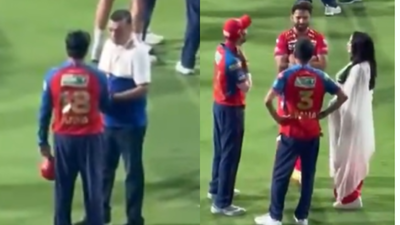
Sanjeev Goenka of Lucknow Super Giants and Preity Zinta The Punjab Kings remain two of the most visible franchise owners in the IPL, who are regularly seen following their teams closely from the stands. His latest appearance came during Sunday night’s clash at the PCA Stadium in Mullanpur, where PBKS dominated LSG and post-match footage saw both owners interacting with the players. Goenka, who has often been seen actively engaging with his team management and captains over the past few years, including his earlier and recent discussions with KL Rahul. Rishabh PantHe was once again in the headlines after LSG’s defeat. After the 54-run defeat, he was seen talking to Punjab Kings’ in-form batsman Priyansh Arya, who had devastated the bowling attack with a brilliant inning of 93 runs off just 37 balls. Meanwhile, LSG captain Rishabh Pant was involved in a separate conversation with PBKS co-owner Preity Zinta. In which he was also present in a small group Yuzvendra Chahal And Shashank SinghWhen she exchanged words with Zinta in a casual setting after the match. On the field, Punjab Kings put in a stellar performance to continue their strong start to the season. They recorded their fifth win in six matches and moved back to the top of the table. Priyansh Arya’s explosive innings set the tone, Cooper Connolly provided valuable support, and late contributions from Shashank Singh and Marcus Stoinis took PBKS to a mammoth total of 254. In contrast, LSG had no reply on goal. Struggling for rhythm and consistency this season, they slipped to their third consecutive defeat. The heavy 54-run defeat exposed their existing issues, with the team now needing quick changes to arrest the decline and rebuild the momentum.

Source link

केदारनाथ धाम: फूलों से सजने लगा बाबा केदार का धाम, उत्सव डोली आज पहुंचेगी गौरीकुंड, 22 को खुलेंगे कपाट – चारधाम यात्रा 2026 केदारनाथ धाम फूलों से सजा शुरू, गौरीकुंड पहुंचेगी औपचारिक पालकी

संवाद न्यूज एजेंसी, रुद्रप्रयाग

द्वारा प्रकाशित: अलका त्यागी

अद्यतन सोम, 20 अप्रैल 2026 10:04 पूर्वाह्न IST

चारधाम यात्रा 2026: केदारनाथ मंदिर के दरवाजे 22 अप्रैल को श्रद्धालुओं के लिए खोले जाएंगे. इससे पहले धाम को सजाने का काम शुरू हो गया है.


चारधाम यात्रा 2026 शुरू, केदारनाथ धाम को फूलों से सजाया गया, पालकी गौरीकुंड पहुंचेगी

सजने लगा बाबा केदार का धाम
– फोटो : संवाद न्यूज एजेंसी


विस्तार

बाबा केदार के धाम की यात्रा को लेकर तैयारियां तेज हो गई हैं। पूरे केदारपुरी क्षेत्र को फूलों से सजाया जा रहा है। रविवार को फाटा में रात्रि विश्राम के बाद बाबा की पंचमुखी उत्सव विग्रह डोली आज गौरीकुंड पहुंचेगी। ट्रॉली अपने निर्धारित पड़ावों से केदारनाथ धाम की ओर बढ़ रही है. पूरे रास्ते भक्तों में काफी उत्साह देखने को मिल रहा है.


गौरीकुंड में डोली के स्वागत की तैयारियां भी पूरी कर ली गई हैं. वहीं कल 21 अप्रैल को केदारनाथ की पंच मुखी उत्सव डोली धाम पहुंचेगी. जिसके बाद 22 अप्रैल को सुबह 8 बजे निर्धारित लग्न के अनुसार आम श्रद्धालुओं के लिए दरवाजे खोल दिए जाएंगे. केदार सभा के वरिष्ठ सदस्य पंडित उमेश चंद्र पोस्ती ने बताया कि यात्रा से संबंधित सभी व्यवस्थाएं लगभग पूरी कर ली गई हैं।

चारधाम यात्रा: संचालन के लिए 12 सदस्यीय सेल गठित, एसपी ट्रैफिक लोकजीत सिंह लगातार दूसरे वर्ष प्रभारी नियुक्त


Source link

“He would have killed me” – Andrew Tate Misfits boxing star Dean The Great was charged with brutal assault after his cheap shot left the doctor bleeding. international sports news

Din the Great (via Getty)

A doctor has spoken out after a shocking incident involving Misfits boxing champion Deen The Great went viral online. The doctor reportedly suffered serious facial injuries in the fight. Images and videos shared on social media showed swelling and damage.The injured man later posted a video. He explained about his condition and the pain he is going through. He claimed that the punch came unexpectedly and he did not get a chance to defend himself. The incident has raised concerns about security and accountability, especially when trained fighters are involved in public disputes. Many users are now debating whether legal action Should be taken.

Doctor describes injuries and claims surprise attack

The therapist detailed his injuries in a video shared online. He said the damage to his face was real and serious. He said he is currently suffering from a broken nose, facial fractures and a broken tooth. He also revealed that he needed stitches and was still in pain while speaking. According to him, one of his eyes is almost completely closed and he is having difficulty seeing clearly. Even basic activities like trying to open the eyes are difficult and painful, he said.He further said that he was not behaving aggressively during the encounter. He said he was sober and even told the boxer that he worked as a therapist. He claimed that the punch came suddenly, without warning, and startled him. Because of this, he did not react or counter-attack. He emphasized that it would have been dangerous to face a trained boxer in such a situation, and believed that the outcome could have been much worse.The doctor also addressed online criticism. Some people raised questions as to why he did not defend himself. In response, he told that he was not ready. He said he did not expect violence. He stressed that the boxer’s professional training has made the punch extremely powerful. He also hinted at the possibility of taking legal action but acknowledged that financial limitations might make it difficult.Meanwhile, Crip Mac also talked about his experience with Deen in a separate interview. He acknowledged that he had been ostracized during their exchange. He praised Deen’s punching ability and said that once he landed a hit, he immediately felt the impact and knew he was going down. He acknowledged that trained boxers are highly skilled and dangerous in close combat situations.

Source link

Iran US ceasefire: ‘Not intending to negotiate at any cost’: Iran rules out second round of US talks as ceasefire deadline nears

'Not intending to negotiate at any cost': Iran rules out second round of US talks as ceasefire deadline approaches
Iran’s Foreign Ministry spokesman Esmail Baqai

Just two days before the ceasefire deadline expired, Iran hardened its stance on talks with the United States, saying that keeping the door open to talks does not mean negotiating at any cost.The announcement came at a time when US President Donald Trump said on Sunday that a US delegation would travel to Islamabad on Monday for fresh talks with Iran, state media Tasnim news agency reported. “We are offering a very fair and reasonable deal, and I hope they will accept it, because if they don’t, the United States will destroy every single power plant and every single bridge in Iran. Mr. Good Man will be no more!” He added.Foreign Ministry spokesman Esmail Baqai said on Monday that “Tehran currently has no plans for the next round of talks.” Despite this, Iran has not completely refused diplomacy. Ebrahim Azizi, head of the Iranian parliament’s national security committee, said in an interview with Al Jazeera, as quoted by ANI, that engagement with Washington would depend entirely on national priorities. He said that “Iran acts based on national interests” and is ready to do whatever is necessary to “safeguard the country’s interests and security.”Azizi stressed that continued dialogue is not without limits, saying, “It does not mean negotiating at any cost”. He stressed that Iran has defined red lines that “must be followed” and that sending a delegation to Islamabad would depend on receiving a “constructive response” and “positive signals” from the United States.Describing Tehran’s approach, Azizi said diplomacy is closely linked to its military stance. “We see the current talks as a continuation of the battlefield and we see nothing more than a battlefield in this,” he said. He said the talks would only be meaningful “if it delivers achievements that maintain the battlefield”, warning that this would not be the case “if the Americans intend to turn it into an area of ​​extreme demands based on their bullying approach.”He also pointed to key conditions for any progress, noting that “the issue of Lebanon has been very important to us” and that “the release of frozen assets” remains a priority. Azizi warned that any move “contrary to the interests of the resistance front” would signal Iran’s rejection of the conditions and would have consequences.US-Iran ceasefire talks held in Islamabad on 11 April ended without any agreement. discussion, mediation by PakistanIt lasted for about 21 hours but failed to achieve success. The standoff centered on disagreements over the Strait of Hormuz and Iran’s nuclear program.Iranian state outlets said the US naval blockade of Iranian ports remains a central problem, with Tehran arguing it amounts to collective punishment.

Source link

‘More than Rs 100 crore not disclosed’: Madras High Court flags ‘irregularities’ in Vijay’s election affidavit. india news

'More than Rs 100 crore not disclosed': Madras High Court flags 'irregularities' in Vijay's election affidavit

New Delhi: A blow to actor-turned-politician Vijay, who is leading TVK’s political debut in the Tamil Nadu elections. Madras High Court On Monday, a petition seeking an income tax probe into his asset declarations was accepted.While hearing the case, the court found irregularities of more than Rs 100 crore in the oral affidavit and issued a notice in the case.“This is an irregularity. More than Rs 100 crore has not been disclosed,” the court orally remarked, according to Live Law.A division bench of Chief Justice SA Dharmadhikari and Justice G Arul Murugan issued notice to Vijay along with the Director General of Income Tax (Investigation). Election Commission of India (ECI), and Returning Officer for Perambur and Tiruchirappalli (East) constituencies.The petitioner has alleged that the disappearance of high value assets is a clear case of suppression of property, which raises serious concerns with regard to beneficial ownership, routing of funds and concealment of material details. It is further argued that such discrepancy between the declarations cannot be attributed to clerical error or guesswork. According to the petition, the only reasonable conclusion is that either one of the affidavits is false or the related corporate filings are false, requiring a thorough investigation in either scenario.If such irregularities are ultimately established, the consequences could be serious. Any proven concealment or false declaration in the election affidavit may invite criminal proceedings under applicable laws, potentially leading to fine or imprisonment, and may result in disqualification from contesting elections under the Representation of the People Act, 1951. Additionally, discrepancies involving undeclared assets can trigger action by income tax authorities, including fines and possible prosecution for tax violations.

Source link

पैन कार्ड मामले में आजम खान और अब्दुल्ला आजम को झटका…सेशन कोर्ट ने खारिज की अपील

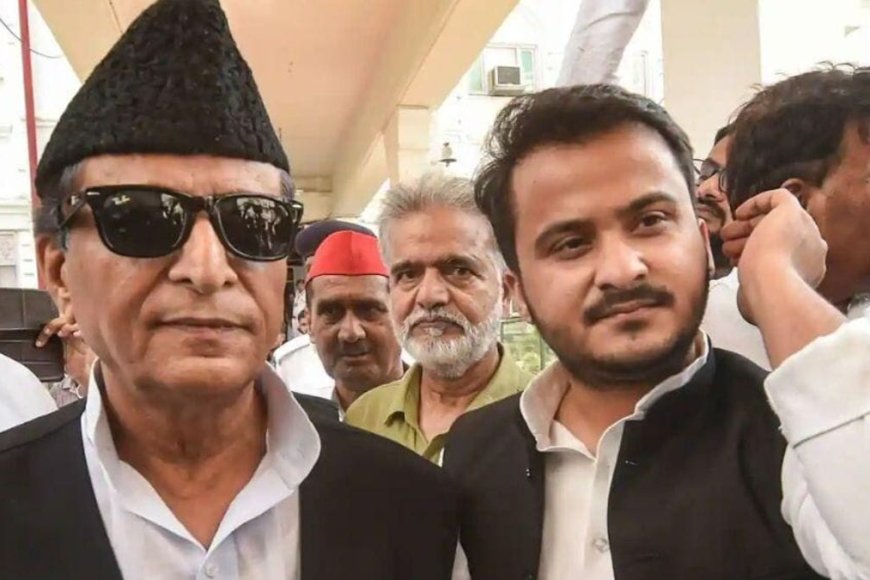
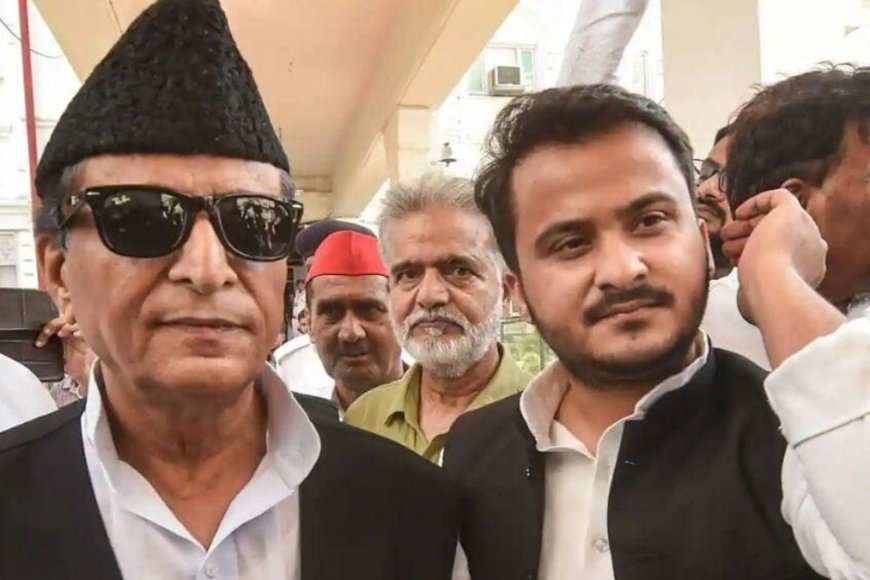
समाजवादी पार्टी के वरिष्ठ नेता आजम खान और उनके बेटे अब्दुल्ला आजम खान को दो पैन कार्ड मामले में बड़ा झटका लगा है. सेशन कोर्ट ने उनकी अपील खारिज कर दी है. इससे पहले निचली अदालत ने दोनों को दोषी पाया था और सजा सुनाई थी. इस फैसले के बाद उनकी कानूनी मुश्किलें और बढ़ गई हैं. कोर्ट का यह फैसला राज्य की राजनीति में भी अहम माना जा रहा है.

निचली अदालत की सज़ा बरकरार है
जानकारी के मुताबिक निचली अदालत ने इस मामले में आजम खान और उनके बेटे को दोषी करार देते हुए 7-7 साल की सजा सुनाई थी. साथ ही दोनों पर 50-50 हजार रुपये का जुर्माना भी लगाया गया. इस फैसले को चुनौती देते हुए दोनों ने सेशन कोर्ट में अपील दायर की थी, लेकिन अब कोर्ट ने उनकी याचिका खारिज कर दी है.

दो पैन कार्ड मामलों में दोषी ठहराया गया
यह मामला दो पैन कार्ड बनाने से जुड़ा है, जिसमें आरोप लगाया गया था कि नियमों का उल्लंघन कर अलग-अलग दस्तावेजों के आधार पर पैन कार्ड बनाए गए. इसी आधार पर कोर्ट ने दोनों को दोषी पाया था. इस मामले की सुनवाई के बाद कोर्ट ने सख्त फैसला सुनाया.

अपील खारिज होने से बढ़ी मुश्किलें
सेशन कोर्ट से अपील खारिज होने के बाद दोनों की सजा बरकरार रहेगी. इससे उनके सामने कानूनी चुनौतियां और बढ़ गई हैं. हालाँकि, आगे की कानूनी प्रक्रिया के तहत उच्च न्यायालय जाने का विकल्प अभी भी खुला है।

राजनीतिक असर भी संभव
इस फैसले का राजनीतिक असर भी देखने को मिल सकता है. आजम खान की गिनती उत्तर प्रदेश की राजनीति के बड़े नेताओं में होती है. ऐसे में उनके और उनके बेटे के खिलाफ यह फैसला भविष्य में राजनीतिक समीकरणों पर असर डाल सकता है. फिलहाल इस मामले को लेकर राजनीतिक गलियारों में चर्चा तेज हो गई है.

Source link

Orissa High Court: Orissa High Court raises security concerns over British era school building in Cuttack

Orissa High Court raises security concerns over British-era school building in Cuttack

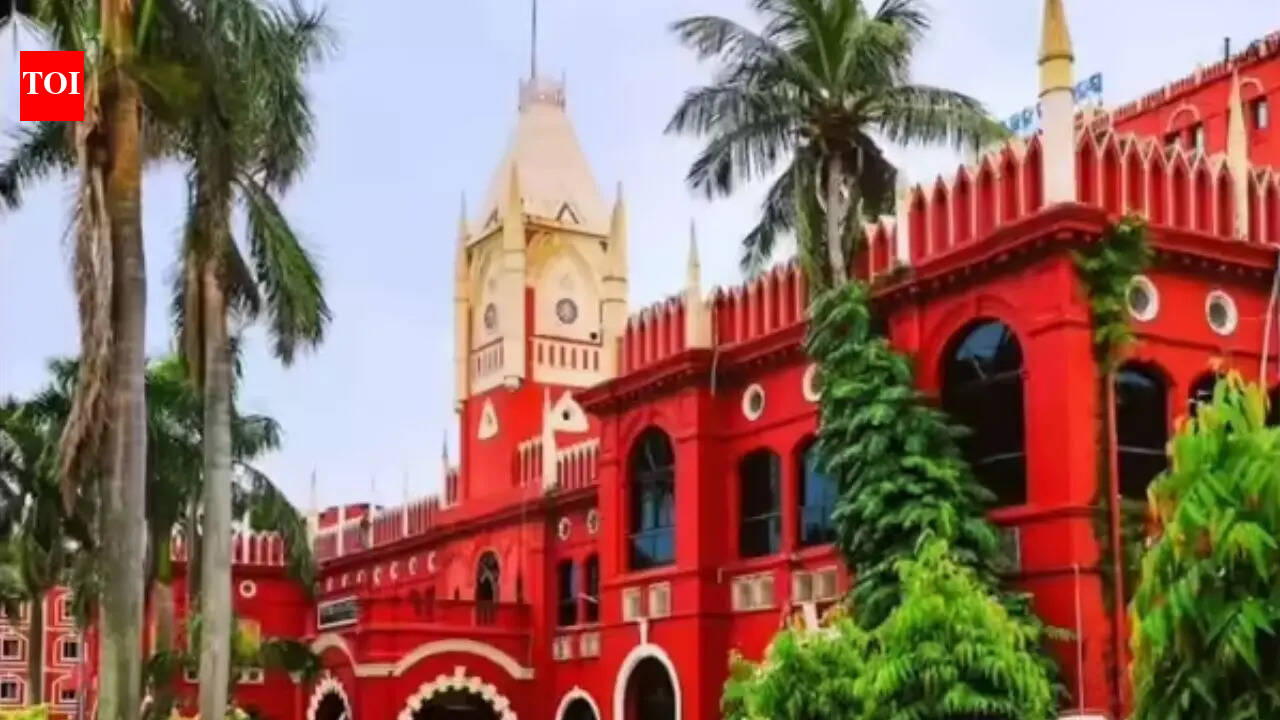
Cuttack: The Orissa High Court has expressed serious concern over the condition of a British-era building in Mission Road, Cuttack, which currently houses St. Xavier’s School since January this year.A division bench of Justices KR Mohapatra and V. Narasimha took up the issue after examining a report submitted by the Cuttack district administration on April 16 following earlier directions to inspect the safety conditions of all schools in the city.“The report reveals a shocking situation,” the bench said. Considering that till now 48 schools have been inspected. This especially marked the position of St. Xavier School at Mission Road, Buxi Bazaar said the institution was functioning in an “almost dilapidated building” without a structural stability report.The court recorded the assurance of Additional District Magistrate Kamaljeet Dash that necessary steps would be taken to ensure the safety of students, teaching and non-teaching staff. “If necessary, alternative arrangements will be made in consultation with the school management,” the ADM assured. Taking note of this, the bench directed the authorities to submit the action taken report by May 4. The next hearing of the case will be on May 7.The building, a 143-year-old structure and an example of Indo-European architecture, has been a subject of concern for a long time. Built as a residence by Civil Surgeon Dr. WD Stewart in 1883, the building was later donated to the Baptist Mission in 1887 for educational purposes and became Christ Collegiate School in 1950.Official records show that as early as 20 February 2016, the Public Works Department warned that the structure was in a dangerously dilapidated condition and could collapse at any time. The school was later shifted to a nearby facility in 2019.Despite this, the building was reopened after reported repairs and St. Xavier’s School started functioning there from January 23, 2026.The issue of conservation versus security has also been in focus. In 2019, a PIL filed by lawyer Shivshankar Mohanty sought to declare the structure a heritage building under the Orissa Municipal Corporation Act, citing its architectural and historical importance. The High Court had then directed the civic body to take action on the petition.

Source link

Royal Academy of Music: UK: Royal Academy of Music faces backlash over new plan to ban private school students World News

UK: Royal Academy of Music faces criticism over new plan to ban private school students
Private school students are not included in the UK Royal Academy scheme, which provides funded training to five state-educated musicians/Image: Getty Images

The UK-based Royal Academy of Music has sparked debate after introducing a scheme that limits access to state-educated students, raising concerns that some less affluent private school pupils are being left out, according to The Times (UK).The Academy, established in 1822, is offering a fully funded foundation year for musicians aged 18 to 20. The course is aimed at those who are seen as under-represented, particularly students who have missed out on music training due to the long-term decline in provision in state schools.Only five students will be selected each year, with the program starting in July. Those selected will receive personal tuition, academic guidance, group training and assistance with university applications.The eligibility rule has been questioned by school leaders, who say background cannot be assessed solely by what type of school a student attends. Philip Britton said, “There are a lot of less affluent people in independent schools and a lot of privileged people in government schools.” He pointed out that some schools, including Bolton School, provide full fee support to families earning less than £20,000.Richard Jones, head of Bryanston School in Dorset, described the approach as “naïve” and said it risked reinforcing perceptions about private education. He said many independent schools have students on scholarships and said applications must be assessed individually.The academy has defended its position. Its principal, Jonathan Freeman-Attwood, said the focus is on students who “desperately need and deserve” support, particularly those who do not have adequate access to training but show strong potential.Funding for the first three years comes from the Clore Duffield Foundation. Its president, Vivian Duffield, said the program aims to give talented young musicians the time, training and guidance they need to move forward.The academy said students from independent schools are already more likely to have access to structured music education. It also highlighted its extensive work, supporting over 500 young people each year and providing £5.8 million of financial support to students last year.

Source link