


CSK’s Anshul Kamboj has a tough night in Lucknow, joins Yash Dayal in unwanted IPL record books
 Chennai Super Kings Bowlers in IPL history.Kamboj gave away 63 runs in just 2.4 overs during CSK’s seven-wicket defeat. This is now the second most expensive spell bowled by a CSK bowler in the IPL.Most runs given by a CSK bowler in an IPL innings:
- 0/65 (3) – Khaleel Ahmed vs RCB, Bengaluru, 2025
- 0/63 (2.4) – Anshul Kamboj vs LSG, Lucknow, 2026
- 0/62 (4) – Lungi Ngidi vs MI, Delhi, 2021
- 2/61 (4) – Shardul Thakur vs RCB, Bengaluru, 2024
- 0/60 (4) – Simarjeet Singh vs GT, Ahmedabad, 2024
Kamboj also became the second bowler in IPL history to concede more than 60 runs while bowling three or less overs in a match. The only other bowler in the list is Khaleel Ahmed, who had figures of 0/65 against RCB in Bengaluru in 2025. Kamboj is the first bowler to hit four sixes in an over twice in an IPL match.The LSG batsmen took apart the CSK pace bowlers throughout the chase. Out of the 16 balls he bowled, 11 were hit by a four or a six. This means that 68.75 percent of his balls ended in the boundary. Kamboj hit eight sixes in an innings and equaled the IPL record for most sixes in an innings by a bowler with Yash Dayal against KKR in Ahmedabad in 2023. Of all IPL spells of at least two overs, only Washington Sundar had the worst boundary percentage. Sundar hit 10 fours in 12 balls during his 1/46 spell in two overs against DC in 2024, with 83.33 per cent of his balls hitting boundaries.The toughest moment for Kamboj came in the 17th over when nicholas puran Hit four consecutive sixes for LSG to complete the chase.

Bangladesh officers undergoing training in Pak as Dhaka moves from Mussoorie to Lahore

For many years, the Indian hill station of Mussoorie served as a mid-career training school for Bangladeshi civil servants, a symbol of close and stable relations between the two neighbours. But due to strain in relations, expired agreements and visa hurdles, Dhaka has replaced Mussoorie with Lahore.Twelve Bangladeshi bureaucrats are undergoing training (4-21 May) at the Civil Services Academy in Lahore – the first such structured program between Bangladesh and Pakistan to strengthen cooperation in a range of sectors since Sheikh Hasina stepped down as Prime Minister.However, many in Dhaka believe the situation may be changing, with officials visiting both India and Pakistan for training programmes, as Dhaka and New Delhi look to re-establish their ties.Until 2024, Bangladeshi officers traveled to the Lal Bahadur Shastri National Academy of Administration in Mussoorie for training. The arrangement began under the Hasina government in 2014 through a memorandum of understanding between Bangladesh’s Ministry of Public Administration and the Delhi-based National Center for Good Governance, ministry officials said.He said the second MoU was signed on February 9, 2019 and the third on April 30, 2024 in Dhaka. The last agreement was valid for one year.According to NCGG’s website, between 2019 and 2024, NCGG trained 1,019 Bangladeshi civil servants in field administration under its Capacity Building Program (CBP). But the total number of Bangladeshi officials, including trained civil servants, is about 2,500. Apart from Bangladesh, officials from countries like Maldives, Myanmar, Cambodia, Gambia, Sri Lanka, Tanzania and Kenya have also participated in CBP.Bangladesh ministry officials said one additional secretary and 11 joint secretaries are undergoing training. The Government of Pakistan is bearing the entire cost of training of the officers. There is no financial involvement of Bangladesh Government in this journey. A notification from the ministry said the officers will have to submit a report upon returning home after the training.

I would not advise my children to live or study in America

German Chancellor Friedrich Merz said Friday he would advise his children against living or studying in the United States at this time, citing a rapidly changing social climate and limited opportunities even for the highly educated.The comments highlight tensions between the US and its European allies under President Donald Trump, as disputes over trade, the war in Ukraine and now Iran have put the NATO alliance under strain. Merz said last month that America was being humiliated in the Iran war, which angered Trump. A few days later, Washington announced a partial troop withdrawal from Germany.Speaking to a youth audience at a Catholic conference in Wurzburg, Merz said people are prone to thinking in “disaster mode” about the state of the world and urged Germans to feel more optimistic about their country’s potential.“I firmly believe that there are few countries in the world that offer as great opportunities as Germany, especially for young people,” he said.“I would not recommend that my children today go to America, get their education there and work there, because a social environment has suddenly developed there,” said Merz, a 70-year-old father of three.“Today, even the most educated people in America have great difficulty finding a job.”

Monsoon likely to reach Kerala on May 26: IMD

New Delhi: Monsoon is likely to arrive in Kerala on May 26, the IMD said on Friday, predicting an early start of the rainy season in India. Monsoon generally reaches Kerala on June 1, taking a period of seven days.“This year, the southwest (summer) monsoon is likely to establish over Kerala on May 26 with a model error of ±4 days,” the weather department said, noting that the operational forecast of its onset date over Kerala during the last 21 years (2005-2025) had proved correct except in 2015. Early or late arrival has no impact on the overall monsoon performance or distribution.Last year, the monsoon reached Kerala eight days earlier, on May 24.IMD forecasts ‘below normal’ rainfall this year amid threat of El NinoThe onset of monsoon in Kerala marks the arrival of the south-west monsoon in the Indian mainland. It is an important indicator showing the transition from hot and dry conditions to the rainy season.The weather department has already predicted ‘below normal’ monsoon rainfall in many parts of the country this year amid the growing threat of El Nino, which is always associated with scorching heat and weak monsoon in South Asia.
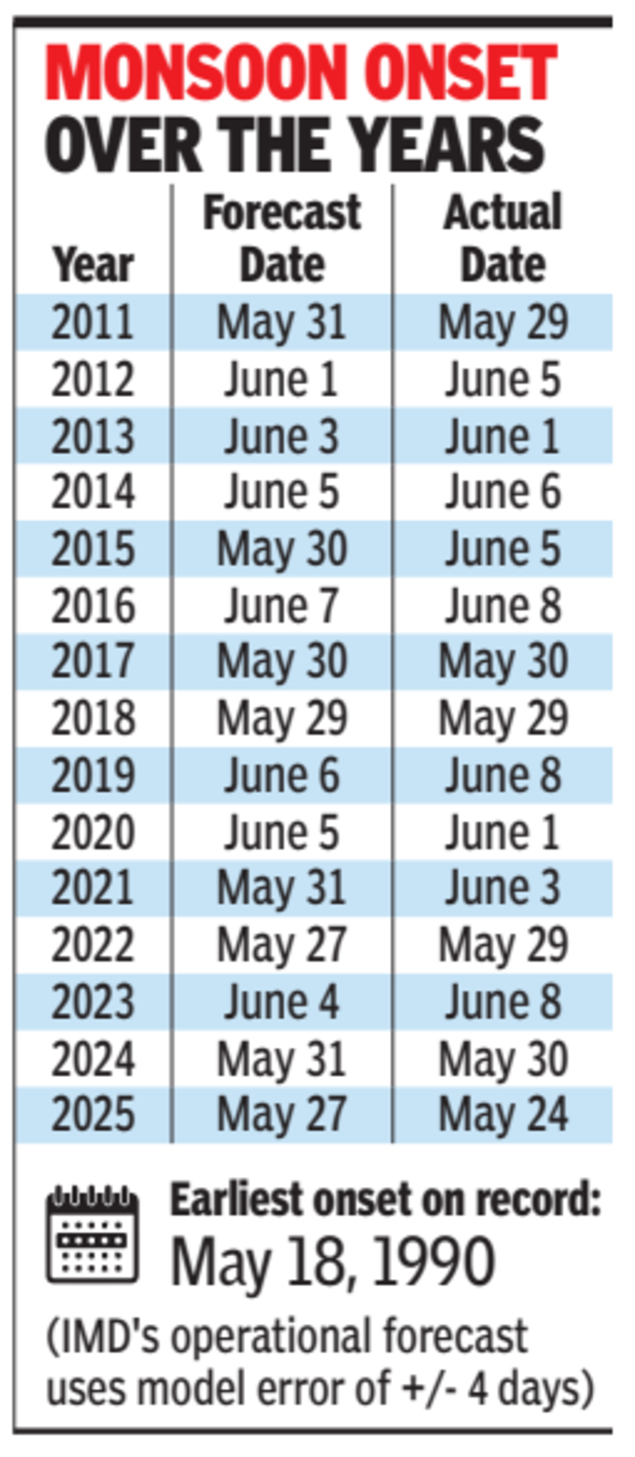
Meanwhile, the IMD on Friday said conditions are favorable for further advance of southwest monsoon into parts of south Bay of Bengal, Andaman Sea and Andaman and Nicobar Islands in the next 24 hours.The IMD has been issuing operational forecasts for the onset date of monsoon over Kerala since 2005, using indigenously developed statistical models with a model error of ±4 days.The six predictors used in the model are: minimum temperature over northwest India, pre-monsoon rainfall peak over the South Peninsula, outgoing long wave radiation (OLR) over the South China Sea, lower tropospheric zonal wind over the equatorial southeast Indian Ocean, outgoing long wave radiation (OLR) over the southwestern Pacific Ocean, and lower tropospheric zonal wind over the equatorial northeast Indian Ocean. Zonal wind.
CBI arrests retired NTA panel professor who set NEET paper
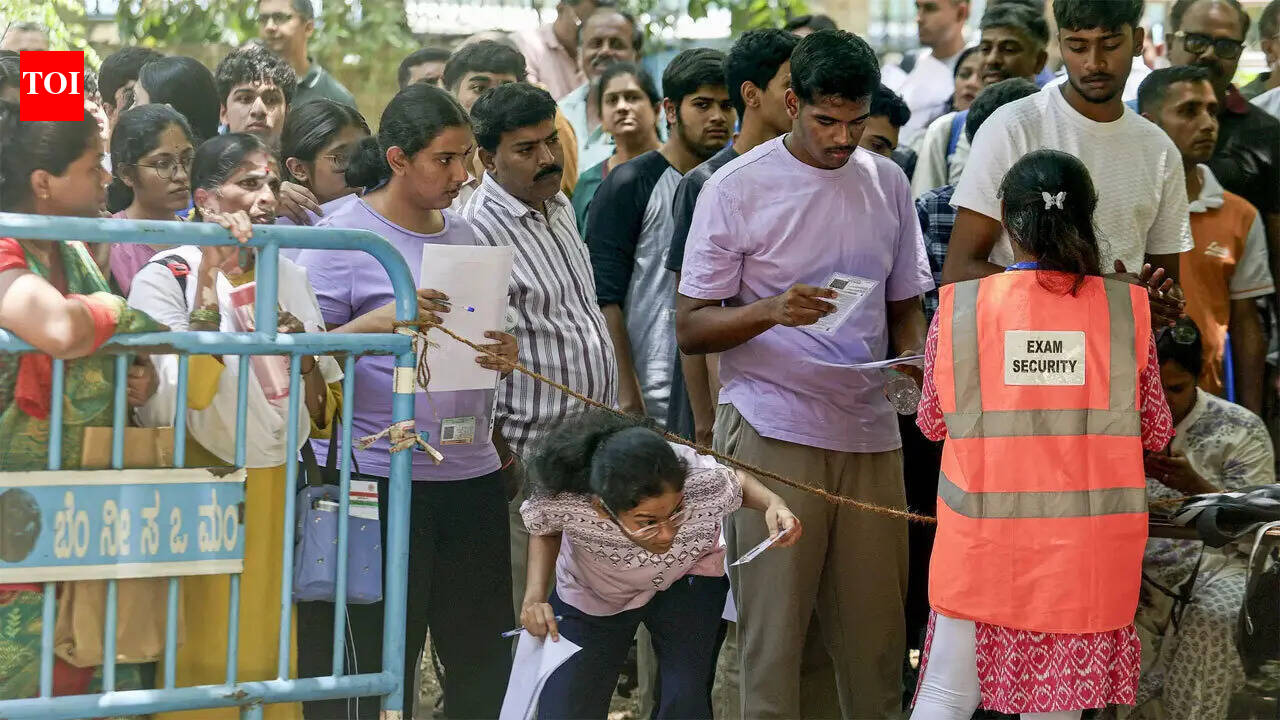
New Delhi/Chhatrapati Sambhajinagar: The CBI on Friday said it has arrested a retired chemistry professor in Latur, whom it has identified as the main accused in the NEET-UG 2026 paper leak case.PV Kulkarni, who spent more than three decades in academia, was associated with the National Testing Agency (NTA) as part of the question paper setting panel. TOI had reported on Friday that the CBI was searching for those who had prepared the questions.Officials claimed that Kulkarni first attempted to sell the newspaper locally, but turned to a wider network after failing to convince buyers of its authenticity. “In the last week of April, Kulkarni, with the help of another accused named Manisha Waghmare, gathered students and conducted special coaching classes for them at his residence in Pune,” a CBI spokesperson said.Kulkarni reportedly set questions with options and correct answers during these special classes. “The questions were handwritten by the students in their notebooks and exactly matched the actual question paper of the examination held on May 3,” the CBI said.CBI sources said that the agency is now interrogating more people related to asking the questions.This leak is different from the leaks that surfaced earlier. The investigation into the first leak revealed people outside the main chain of access who were part of an organized gang and violated the integrity of the exam such as paper distribution at exam centers in the later stages.Coaching institutes have also been brought under the ambit of investigation. The CBI questioned the director of a Latur-based coaching center with units across Maharashtra. Officials conducted searches at his residence, seized his cellphone and issued a notice to the agency’s Pune office for further questioning.As earlier reported by TOI, the CBI has sought detailed information from the NTA about each stakeholder who had access to the question papers before it was sealed: the people who set the questions, the subject experts, and the professors and teachers on the panel who prepared the questions, besides details of the entire paper preparation process.Kulkarni is the eighth arrest in this case. Waghmare was earlier arrested by the CBI along with six others. Officials said Waghmare had received money from around 21 bank accounts before the examination held on May 3. She runs a beauty parlor in Pune and was acting as a mediator for co-accused Dhananjay Lokhande, who is a BAMS graduate and runs a consultancy in Pune.In New Delhi, special CBI judge Ajay Gupta sent Lokhande to six days’ police custody, with the CBI saying it was necessary to identify “the NTA officials involved in the paper leak”.

Inside Sanaullah Khan Mohammed’s failed attempt to gain asylum in the US

Sanaullah Khan Mohammed, an Indian Muslim man who entered the US on a tourist visa in 2016 and then overstayed and then sought asylum, citing persecution in India, was rejected by the US Court of Appeals for the Seventh Circuit after the judges found no merit in his application. He also ruled that Mohammed could not be protected from deportation, as India is a large country and he could be sent back to some other location in India.
Who is Sanaullah Khan Mohammad? ?
According to court documents, Mohammed said his family ran a slaughterhouse business and that created tension. Around May 2016, he claimed that a group “confronted him and his mother, threw stones at them, and then beat them, all the while warning them to close the slaughterhouse”. Mohammed said local police intervened and dispersed the group. Mohammad suffered minor injuries in the attack.About a month later, Mohammed entered the US on a visitor visa, remained there beyond the December 25, 2016 expiration date, and did not apply for asylum until January 28, 2019.USCIS rejected the asylum application because it did not arrive by the deadline. The case went to an immigration judge, who also dismissed the case and said Mohammed demonstrated “neither past persecution nor any meaningful risk of future persecution”. Mohammed appealed for review.The court said it did not have jurisdiction to review the immigration judge’s order that the asylum application was untimely, but on the issue of ‘withholding of removal’ – that he should not be deported to India, the court said it found no reason not to send Mohammed to India.
Court told that local police stopped the attack
Based on Mohammed’s account, the court said that local police had indeed prevented the 2016 attack. And Mohammed could not demonstrate that “the Government of India had authorized the violence”. The bumps, bruises and injuries Mohammed received in the incident do not lead to the conclusion that he faced persecution in India.The court said, “Mohammed’s challenges are even weaker because his family’s local slaughterhouse business that fueled the previous violence is no longer in operation. What’s more, Mohammed may live elsewhere in the much larger country of India.”
2 coaching centers fined for unfair trade practices and misleading advertisements
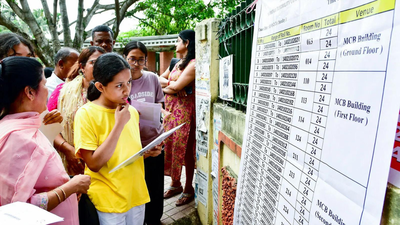
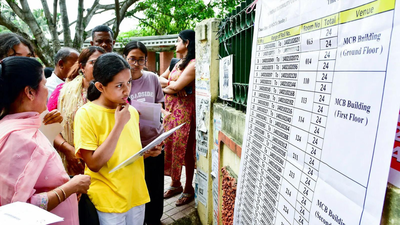
New Delhi: Consumer protection regulator CCPA has imposed a fine of Rs 10 lakh and Rs 5 lakh respectively on Motion Education Pvt Ltd and Career Line Coaching (CLC), Sikar, for publishing misleading advertisements about JEE and NEET results and unfair trade practices.In a statement, the Central Consumer Protection Authority (CCPA) said the advertisements published by both institutions concealed important information about the courses attended by students whose success stories were shown in their promotional materials.Motion Education had advertised a 91.2% NEET qualifying rate and 51% IIT-JEE Advanced pass rate, with details of successful students displayed online. CCPA’s investigation found that most of the selected students had enrolled in ‘I-Eklavya (Online)’ – a course offered free of cost to selected students through a test and interview process. This was not mentioned in any advertisement. The CLC had claimed to have ‘over 1650 CLCians in MBBS, IITs and others’ – a figure which the institute described as cumulative selection since 1996, only to claim during the hearing that it had mentioned 2024 alone.
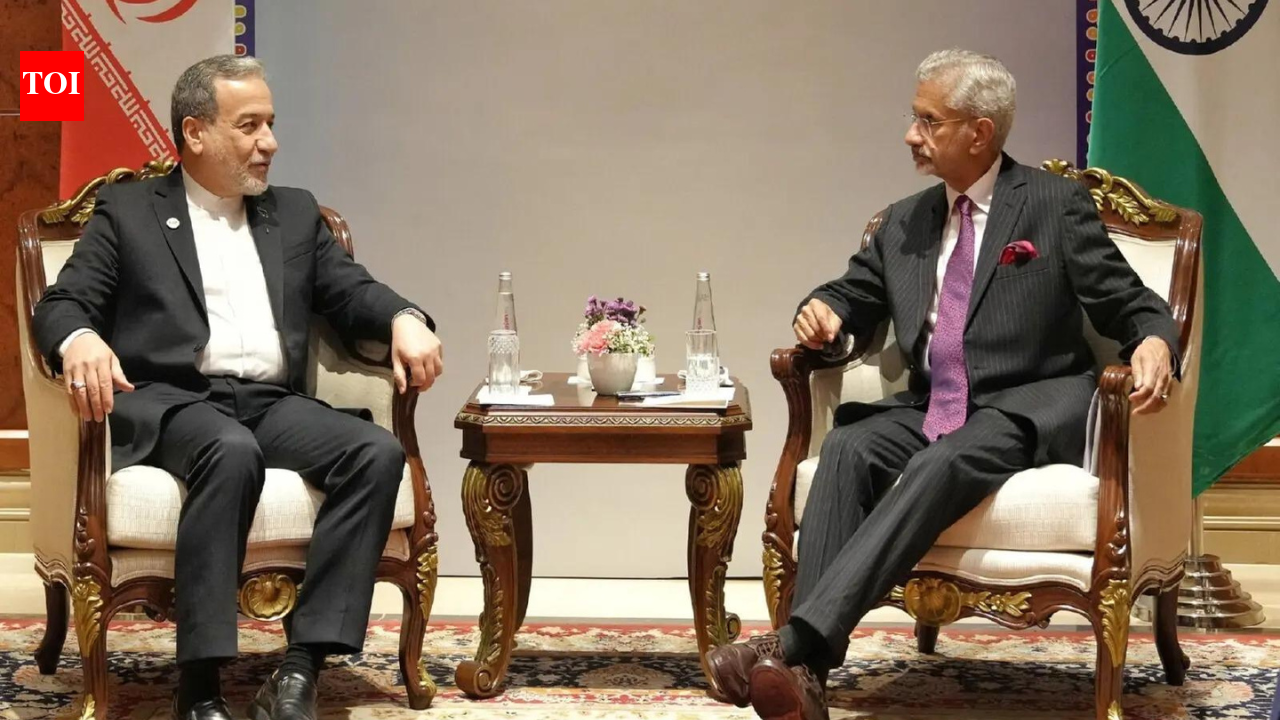
Allies can count on secure commerce, Araghchi said after meeting the foreign minister; Welcomes any positive role of India for peace
Foreign Minister S Jaishankar and his Iranian counterpart Seyyed Abbas Araghchi discussed the Middle East conflict and its implications, including the situation in the Strait of Hormuz, in their first bilateral meeting since the US-Israeli-Iran war began in February. Araghchi later said that his talks with Jaishankar were fruitful, discussing regional developments and clarifying that Iran will always fulfill its “historic duty as protector of security in Hormuz”.Seeking to address India’s concerns over disruption in energy supplies due to the Hormuz blockade, the Iranian minister said, “Iran is a reliable partner of all friendly nations, which can count on the security of commerce.” Iranian officials had said ahead of the BRICS meeting that Tehran would work with friendly countries such as India to facilitate the movement of commercial ships through the strait.Speaking at a press conference later, Araghchi also said India can play a bigger role in the region to help diplomacy and promote peace and security. The External Affairs Minister blamed the US for the economic consequences of the conflict, saying, “India is a friend of almost all the countries in the Persian Gulf, the northern and southern part of this Gulf. Therefore, we appreciate any positive, constructive role played by India in the region.” The Iranian Foreign Minister’s remarks are similar to those of his Russian counterpart Sergei Lavrov, in which he had said that India can contribute to diplomatic efforts for long-term peace. “Pakistan is helping to establish dialogue between the US and Iran to resolve urgent problems. If they look for a long-term mediator between Iran and its Arab friends, this role can be played by India given its vast diplomatic experience,” Lavrov had said. Asked about the situation in the Strait of Hormuz, Araghchi further said that the strait is open and all ships can pass through except ships from countries at war with Iran. “We have allowed many Indian ships to pass. Safe passage of all ships is our policy and in our interest. At the same time, we have a blockade by the US and there is insecurity in the region because of their aggression,” the Iranian minister said. Many Indian LPG tankers are still awaiting approval from Iran, with India diplomatically engaged with Tehran on the issue. It is said that Jaishankar stressed the need for freedom of navigation in the meeting. Araghchi also said that the talks mediated by Pakistan have not failed but added that the situation is difficult. The minister said, “There is still hope. When we met in Islamabad we could not reach any agreement, mainly because of the maximalist stance adopted by the US and their famous behavior of shifting the goalposts. Therefore, we are familiar with those tactics, and we cannot accept anything beyond a fair and balanced agreement.”

120 Burmese python eggs discovered in Florida’s Everglades

Huge nests of Burmese pythons discovered in the Everglades
The nest was reportedly discovered in the Everglades by python hunter Kevin Pavlidis, who shared video of the discovery via his Snakeaholic social media account.The footage shows large white eggs buried inside nesting areas hidden in marshland vegetation. Reportedly, both neighboring nests contained about 120 eggs, suggesting that multiple breeding female pythons were active in the same area.The discovery attracted widespread attention online, with many viewers expressing concern about the rapid spread of invasive snakes in South Florida.
Florida’s python problem
The Burmese python is native to Southeast Asia and is considered one of the most destructive invasive predators in the Everglades. Researchers believe this species established itself in Florida primarily through the exotic pet trade after snakes escaped from captivity or were released into the wild.The warm and humid climate of South Florida allowed the snakes to survive and reproduce rapidly. With very few natural predators in the region, Burmese pythons have spread across large parts of the Everglades during the past two decades.Adult Burmese pythons can grow to over 15 feet long and hunt birds, mammals, and reptiles. Scientists have also documented pythons eating deer and alligators in the wild.
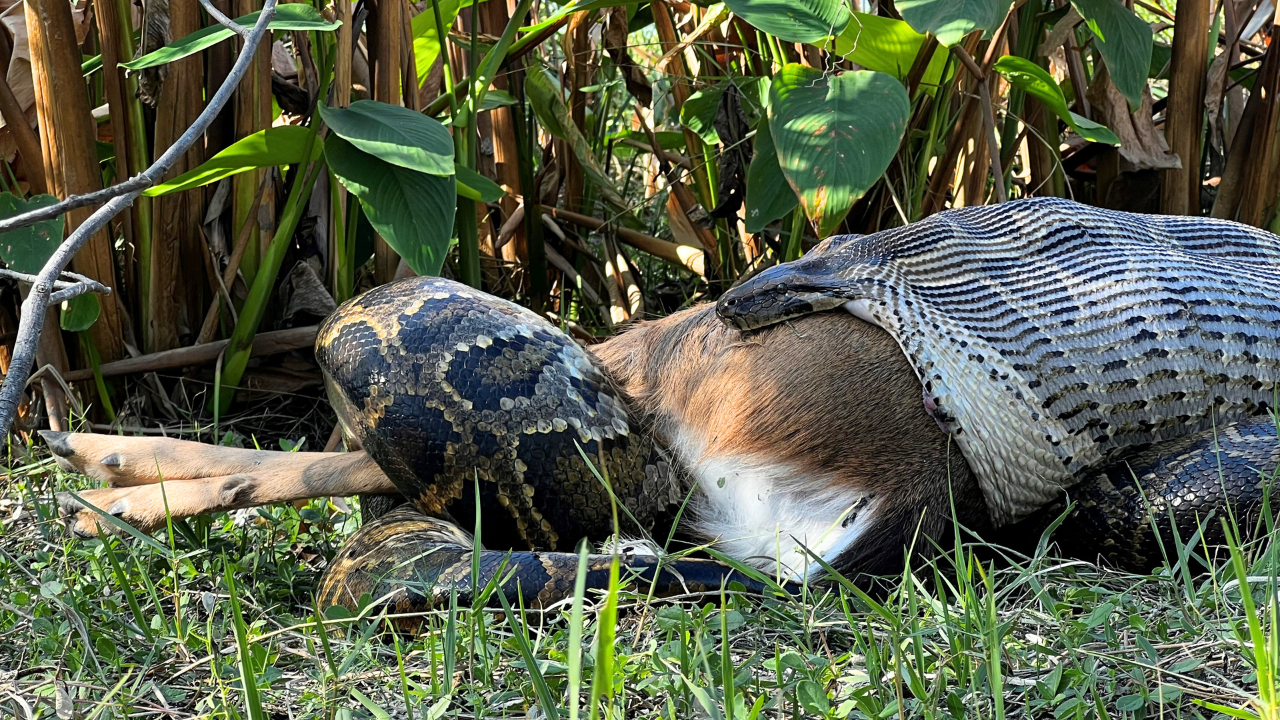
Biologists in Florida found a nearly 15-foot Burmese python eating a full-grown white-tailed deer near Naples in December 2022.
Burmese python’s dramatic impact on wildlife
Wildlife researchers have repeatedly warned that Burmese pythons are seriously harming native animal populations in the Everglades. A widely cited study by the United States Geological Survey linked the spread of pythons to a major decline in mammal sightings throughout the region.According to the study, raccoon sightings declined by 99.3%, opossum sightings by 98.9% and bobcat sightings by 87.5% in some monitored areas after pythons were installed. Marsh rabbits and foxes also became much less common in heavily affected areas.Experts say the loss of native species disrupts the Everglades food chain and weakens one of the most ecologically important wetland systems in the US.
Why is the egg discovery particularly worrying?
Wildlife officials consider python nests particularly important because female Burmese pythons can lay dozens of eggs at a time, with large clutches sometimes reaching as many as 100 eggs.If even a fraction of the approximately 120 eggs discovered survive to hatch, dozens of additional predators could enter the ecosystem.The discovery of neighboring nests also suggests that breeding populations may already be well established in some parts of the Everglades, increasing pressure on native wildlife and making long-term ecosystem recovery more difficult.
Florida’s efforts to control python invasion
Florida wildlife agencies have spent years trying to slow the spread of Burmese pythons through organized removal programs, public reporting systems, and scientific research.The state works with trained contractors and authorized python hunters to capture and remove invasive snakes from the Everglades. Additional incentives are often provided to remove breeding females and nestlings because preventing hatching is considered particularly important.Florida also hosts the annual Florida Python Challenge, a separate public competition that encourages participants to remove invasive snakes from designated areas of the Everglades.Researchers continue to search for better tracking and identification techniques because Burmese pythons are extremely difficult to find in dense wetlands and marshy vegetation.
a long-term environmental challenge
Aside from the shock associated with the nest discovery, scientists say the Burmese python invasion is one of the biggest environmental challenges facing the Everglades.Wetland systems play an important role in water filtration, biodiversity, tourism, and flood protection throughout South Florida. Experts have warned that invasive species introduced by humans could permanently alter ecosystems if populations are not controlled quickly.In the case of Burmese pythons, researchers say continued monitoring, removal programs, and public cooperation will likely be necessary for years to reduce the snakes’ impact on native wildlife and protect the Everglades ecosystem.
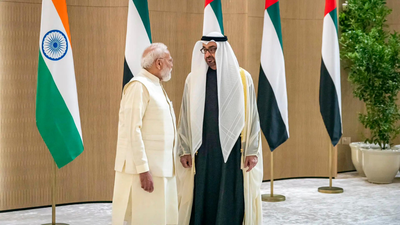
Energy, defense ties get boost as Modi meets UAE President
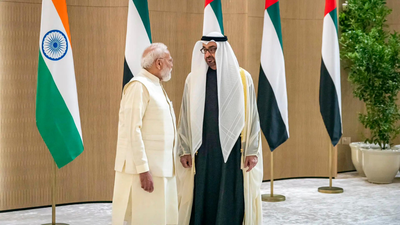
India and the UAE signed 6 MoUs to boost their energy, defense shipping and technology ties and announced $5 billion in investment from the Arab nation to India, as Prime Minister Narendra Modi held bilateral talks with President Mohammed bin Zayed Al Nahyan during a brief stopover in Abu Dhabi on his way to Europe. Modi reiterated India’s strong condemnation of the attacks on the UAE without naming Iran as he said the way the Gulf state was targeted was unacceptable. Offering all possible support for early restoration of peace, the PM said, “India stands shoulder to shoulder with the UAE in all circumstances and will continue to do so in the future.”While one agreement will allow Abu Dhabi National Oil Company (ADNOC) to potentially increase its crude oil storage in India by 30 million barrels, another MoU is expected to facilitate a long-term LPG sales and purchase agreement between the two countries. A framework for strategic defense partnership with a focus on defense industrial cooperation, innovation and advanced technology, training and exercises was also signed. According to an Indian readout, Modi also conveyed India’s clear position in favor of ensuring safe transit passage and unhindered navigation through the Strait of Hormuz, which is vital for sustainable regional peace and stability as well as energy and food security. Modi left for the United Arab Emirates in the morning while the BRICS foreign ministers’ meeting was still underway and amid efforts by the member countries to bridge the gap between Abu Dhabi and Tehran over the West Asia conflict. Due to these differences and Iran blaming Abu Dhabi for the standoff, the meeting ultimately ended without any joint statement. When Modi visited India in January this year, on his gesture the UAE President also welcomed the PM at the airport. UAE’s F16 jets escorted Modi’s plane to the airport. This was Modi’s 8th visit to UAE as President. According to an Indian readout, the leaders welcomed the announcement of $5 billion investment in India by UAE entities. “This includes an investment of $3 billion by Emirates NBD in RBL Bank of India, $1 billion by Abu Dhabi Investment Authority (ADIA) with National Infrastructure and Investment Fund of India (NIIF) in priority infrastructure projects in India and $1 billion by International Holding Company in India’s Summon Capital,” the readout said. Referring to the President as his brother, the PM said in a post on Twitter that his visit to the UAE was brief, yet exceptionally fruitful. “And I am confident that the outcome of this visit will further strengthen the bonds of friendship between us and contribute to achieving development and prosperity,” he said. Two other MoUs were signed for ship repair cooperation, which aims to enhance the capabilities of the Indian maritime workforce and establish India as a hub for skilled shipbuilding and ship repair professionals. Another MoU was to facilitate collaboration to set up supercomputing clusters as part of AI Mission India.