

‘Indecent behaviour’: India condemns disruption of CJI Surya Kant’s UK speech. india news
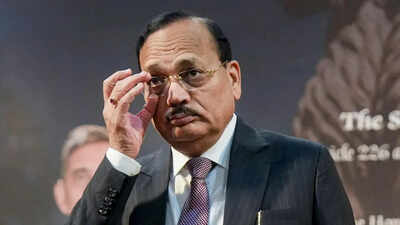
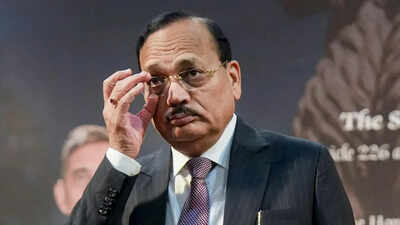
New Delhi: The Indian High Commission in London on Friday condemned the “indecent behavior of the audience” during Chief Justice of India (CJI) Surya Kant’s lecture at Birkbeck College, videos of which surfaced online, showing a participant attempting to raise questions about dissent and democracy in India during the event.“Such unruly audience behavior is unacceptable and inconsistent with the respectful engagement that governs public discussion. Differences of opinion are a natural part of a democratic society. However, they must be expressed in a civil and respectful manner,” the High Commission post said.The statement comes after a clip circulated on social media in which a participant tried to ask questions to the Chief Justice while he was delivering a lecture on artificial intelligence and international law. Organizers intervened and stopped the conversation from continuing, and asked attendees to keep focused on the topic of the event.Speaking at Birkbeck College, University of London, Justice Kant said artificial intelligence has emerged as one of the defining legal and governance challenges of the modern era, the consequences of which will shape the future of democratic societies and international law.During his address, Justice Kant argued that artificial intelligence has moved beyond the realm of theory and is now having a direct impact on public institutions, legal systems and governance structures across the world.He said AI represents one of the greatest challenges facing modern international law and stressed that the way governments and societies respond to the technology will have long-term implications in the coming years.“Technology is neither inherently benevolent nor inherently harmful. Its impact depends on the legal, political, and ethical framework within which society chooses to deploy it. Therefore, the responsibility of law is neither to oppose technological progress nor to surrender unquestioningly to it. Its responsibility is to ensure that technological power remains accountable to constitutional values, democratic legitimacy and human dignity.”The Chief Justice said that AI is already impacting many sectors including governance, commerce, communications, defense and justice system.“Governments now use algorithmic systems to allocate welfare benefits, assess immigration applications, monitor borders, regulate financial systems, and support policing functions. Militaries are increasingly developing autonomous capabilities. There is more than enough access,” he said.Justice Kant also highlighted the growing role of AI in judicial administration, pointing to its use in legal research, case management, translation services, transcription, document organization and identification of precedents.According to the organisers, questions related to India’s democratic record and allegations related to hostility towards dissent were not considered as the session was intended to remain focused on artificial intelligence and its legal implications.One attendee tried to express concerns about the protection of India’s democratic values in the age of AI and described it as hostility towards dissent. However, the organizers stopped the intervention before any discussion could escalate.Addressing the broader implications of emerging technologies, the Chief Justice stressed that AI raises complex questions that extend beyond national boundaries and require coordinated legal responses.“The central challenge before us is to ensure that, in the age of intelligent machines, humanity retains the authorship of the principles by which it is governed. If international law can rise to that challenge, artificial intelligence can become not only a technological revolution, but an opportunity to reaffirm the values that lie at the foundation of democratic civilization,” he underlined.Justice Kant is currently on a six-day visit to the United Kingdom, where he is interacting with legal and academic institutions on issues related to technology, law and global governance.