

Annamalai: CBSE hits back at Annamalai language: Was the former Tamil Nadu chief sending a message to the BJP leadership in Delhi? | india news
New Delhi: East Tamil Nadu BJP Chief K Annamalai, in a rare dissent, has publicly opposed the CBSE’s revised three-language mandate, triggering a fresh political controversy in Tamil Nadu.Annamalai urged the Union Education Ministry to withdraw the CBSE notification making three languages compulsory for Class IX students from the current academic year, saying the sudden move was “a shock to many parents, especially those from Tamil Nadu.“This public disagreement has given rise to more political controversy than linguistic debate, for obvious reasons.And the reason is simple.Over the years, Annamalai has been one of the BJP’s most aggressive defenders of the National Education Policy (NEP) and the three-language formula in Tamil Nadu, repeatedly taking on the former chief minister. mk stalin And Dravida Munnetra Kazhagam (DMK) whenever it accused the Center of trying to “impose Hindi” in the state.This is what has made the recent intervention politically effective.On May 15, CBSE issued a notification to make the third language compulsory for Class IX students from the current academic year, pushing forward the earlier timeline, which was proposed to be implemented from 2029-30.Annamalai objected not to the policy itself, but to its sudden implementation.“This has come as a shock to many parents, especially those in Tamil Nadu,” he wrote onHe also reminded the Center that the previous CBSE notification issued in April had clearly stated that the compulsory requirement of Class 9 would start only from the academic year 2029-30.“I request the Education Ministry to immediately withdraw this notification and honor its previous commitment,” he said.The sharpness of the statement came because just a few weeks ago, Annamalai had welcomed the comprehensive three-language framework for Class VI students, saying it would introduce children to the “diverse literary landscape” of India.This contradiction indicates that the statement may not just be a policy disagreement, but also a deliberate political signal to the BJP leadership in Delhi.
Why does the statement matter?
Language remains the most politically flammable issue in Tamil Nadu.The anti-Hindi movements of the 1960s reshaped the state’s political landscape and helped Dravidian parties establish their decades-long dominance. Even today, any linguistic imposition immediately takes on emotional and political overtones.For decades, parties like the DMK and the All India Anna Dravida Munnetra Kazhagam (AIADMK) have portrayed the BJP as a “North Indian” party attempting to weaken Tamil linguistic identity.The BJP has struggled to break that perception.Annamalai’s political project since entering Tamil Nadu politics has partly been an attempt to localize the BJP’s image – to make it appear less like an external ideological force and more like a party capable of speaking the language of Tamil identity and regional aspiration.
It becomes difficult to strike a balance on issues like NEP and three-language policy.If the BJP aggressively pursues the policy, it risks giving credence to the DMK’s charge of “Hindi imposition”.Annamalai’s latest intervention appears to be an attempt to walk that middle line.Notably, he did not reject multilingual education or the NEP. Instead, he framed the issue around implementation, student pressure, and administrative overreach.This distinction is important politically as it allows them to oppose the Centre’s way of handling the issue without appearing ideologically rebellious.
Perfect timing?
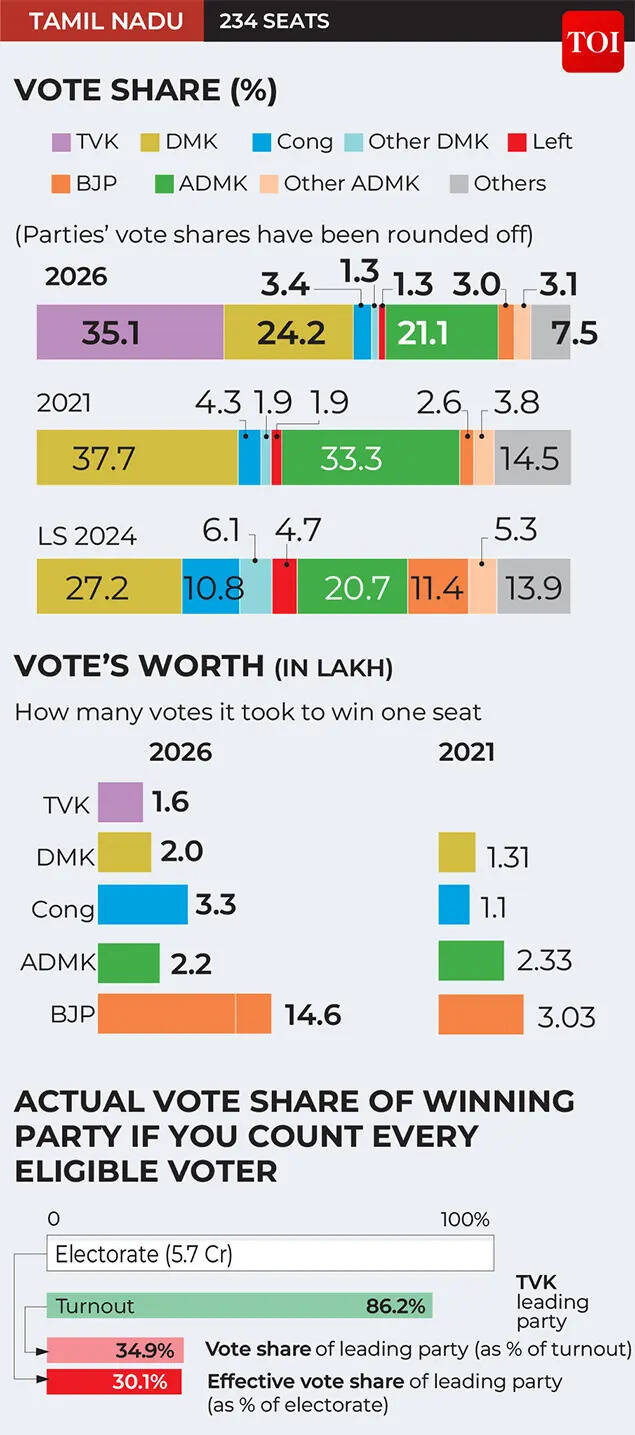
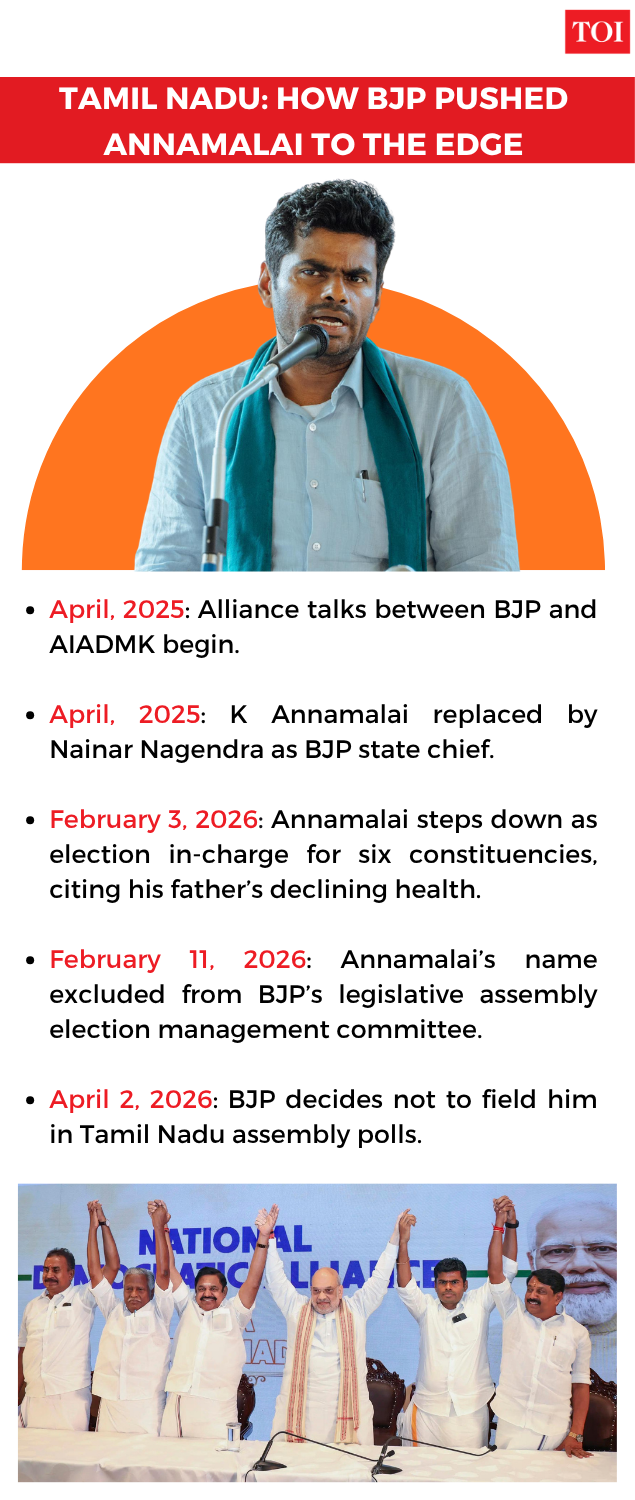
In the case of a firebrand politician, the timing of the disagreement is equally important.The BJP’s poor performance in the 2026 Tamil Nadu Assembly elections has intensified the debate within the party over strategy, leadership and alliances in the state.The BJP won just one seat, while ally AIADMK secured 47 seats.Even before the elections, AIADMK chief Edappadi K Palaniswami had reportedly asked the BJP to sideline Annamalai to form an alliance.Meanwhile, the BJP had removed Annamalai from the post of state president, a decision widely seen as a way to revive ties with the AIADMK.At that time Union Home Minister Amit Shah had said that “Annamalai’s organizational skills will be leveraged within the national framework of the party.”Later BJP also decided not to field Annamalai in the assembly elections. State President Nainar Nagendra had said, “This decision has been taken by the party high command.”Annamalai, on the other hand, had reportedly expressed uneasiness over the BJP coming too close to the AIADMK. According to party insiders, his rationale was that the BJP needed to develop as an independent force in Tamil Nadu rather than permanently function as a junior partner to the Dravidian chiefs.That internal debate did not disappear after the election.In recent times, reports have revealed that the organizational structure and leadership of Tamil Nadu BJP is being reviewed after the disappointing performance of the NDA. It was said that discussions are ongoing in Delhi regarding possible restructuring and future leadership roles.
In that backdrop, Annamalai choosing to speak publicly on a politically sensitive issue like language does not seem accidental.This statement effectively served several purposes.This projected him as a leader who is capable of articulating Tamil Nadu-specific concerns, even if they differ from the immediate position of the Centre.In effect, Annamalai was telling the BJP leadership that Tamil Nadu needed a different political grammar.
a preemptive political move
The intervention may also be aimed at denying the opposition an easy political opening.If the BJP had defended the CBSE notification without qualification, the DMK and actor-politician Vijay’s Tamilaga Vetri Kazhagam would have likely taken advantage of it to revive the BJP’s image of “Hindi imposition”.Language is one of the few issues that has been able to rapidly strengthen anti-BJP sentiment across all sections of society in Tamil Nadu.By criticizing the circular itself, Annamalai effectively blunted that line of attack before it could gain momentum.The contours of his objection also appear to have been carefully crafted to attract urban middle-class families whose children study in CBSE schools – a demographic that the BJP has increasingly targeted in Tamil Nadu.
More regional space within BJP?
Annamalai’s statement may ultimately reflect a larger reality facing the BJP in Tamil Nadu.The party’s national rise has largely been based on message discipline and ideological stability. However, Tamil Nadu has historically resisted centralized political narratives, particularly on language and identity.To propel the BJP forward in the state, its leaders may need space to publicly formulate positions in line with regional sentiments.Annamalai’s dissent shows that at least some within the party believe this.For Annamalai personally, the episode also helps cement the image she has carefully built – that of a Tamil leader first, a BJP leader later.At a time when the future leadership structure of the Tamil Nadu BJP is under discussion, Annamalai’s intervention may serve as a reminder to the party high command that he is one of the few BJP leaders capable of shaping the political narrative in the state and perhaps that is why the leadership should not listen to him.