Why did Trump stop latest strikes on Iran hours before launch?

Why did Trump stop latest strikes on Iran hours before launch?

US President Donald Trump has delayed resuming plans for military strikes on Iran following pressure from Gulf allies and ongoing diplomatic efforts. This came despite him saying that US forces were “fully prepared to launch the operation”.Speaking at the White House on Tuesday, Trump said he had decided to give Tehran “limited time” to reach an acceptable deal before authorizing further attacks. “I’m saying two or three days, maybe Friday, Saturday, Sunday, something, maybe early next week,” CNN quoted Trump as saying.The decision marks the latest reversal in Trump’s approach toward Iran, after he suggested he was close to approving new military action. “They’re loaded to the brim,” Trump said of U.S. warships deployed to the region. “And we were all set to get started.”According to the report, the US military had already prepared a detailed plan for the renewed multi-phase air campaign against Iran, including identified targets and operational phases. Trump reviewed military options with Vice President J.D. Vance, Secretary of State Marco Rubio, CIA Director John Ratcliffe and special envoy Steve Witkoff at his golf club in Virginia after returning from China over the weekend.A person familiar with the discussions said Trump had considered striking additional Iranian targets after becoming frustrated with slow progress in talks, CNN reported.However, as the US came closer to military action, Gulf leaders intervened. Qatar, Saudi Arabia and the United Arab Emirates separately urged Washington to halt the strikes and allow more time through diplomatic channels.Gulf countries fear renewed conflict could provoke Iranian retaliation against critical energy infrastructure and further destabilize the region. Some countries also warned that they could impose tighter restrictions on access to US military bases and airspace if attacks resumed.Trump acknowledged that concerns remain over Iranian retaliation. “They still have some capacity,” he said of Iran’s military capabilities. “Not much, but they have a little.”Saudi Arabia briefly restricted access to US bases and airspace during a prior operation involving the Strait of Hormuz before lifting the ban after Trump suspended the mission.The Gulf countries also pointed to the ongoing Pakistan-led mediation efforts and the importance of the Hajj season as reasons to avoid tensions. A regional official said Gulf leaders presented a “united front” in their appeal for restraint.Trump said those calls ultimately influenced his decision. “I had made the decision. So they called, they heard I had made the decision, and they said, ‘Sir, can you give us a few more days? Because we think they’re fair,'” he said.Despite the temporary pause, military plans remain active. Commanders could launch operations at short notice, and the name of the campaign could be changed from “Operation Epic Fury” to “Operation Sledgehammer”. The proposed name change may also have legal implications. Resuming operations under the new name could potentially reset the 60-day clock under the War Powers Act, which controls congressional approval for military action.Defense Secretary Pete Hegseth previously said the ceasefire declared in April effectively halted that deadline. He said, “With the ceasefire, the clock stops. If it is restarted, it will be the President’s decision.” “That option is always there, and Iran knows it.”While Trump has repeatedly insisted that diplomacy is possible, there has been little public sign that Tehran has softened its position on key disputes, including uranium enrichment and maintaining its stockpile of near-weapons-grade uranium.Vice President J.D. Vance acknowledged that negotiations remain uncertain. “You interact with people, and sometimes you feel like you’re making progress and sometimes you feel like you’re not making progress,” he said. “I think the Iranians want to make a deal.”

Source link

How bees sustain food systems and why their decline should alarm us all

Beyond the honey jar: How bees sustain food systems and why their decline should alarm us all

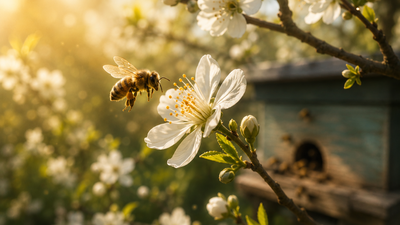
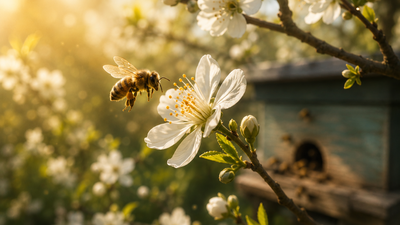
What comes to your mind when you think of bees?These buzzy insects may remind you of a painful childhood sting or the sweet honey they produce. But did you know that apart from honey, with its remarkable antibacterial properties, bees also give us beeswax used in candles, cosmetics, and pharmaceuticals, and propolis, often called “bee glue,” which has strong antimicrobial and anti-inflammatory benefits?But their importance goes far beyond what they produce.Beyond these familiar products, bees have a far more critical role to play.They are among nature’s most efficient and tirelessly laboring pollinators, quietly holding together ecosystems, agriculture, and ultimately, human survival.“In India, people know only two things about bees,” says Pune-based beekeeper and conservationist Amit Godse. “One is that they produce honey, and the second is their sharp sting.”That simple perception, he argues, hides a far more important ecological truth that bees are foundational pollinators, silently sustaining global food systems and biodiversity.Fondly known as Pune’s “Bee Man,” Godse has spent over a decade observing what he describes as a slow but steady ecological decline across the Indian landscape. Speaking to TOI, he emphasizes that while public awareness has improved slightly over the years, it still remains remarkably shallow. “People still don’t connect bees with agriculture or food security,” he says.This limited public understanding coincides with a time when bee populations are under growing biological, chemical, and environmental stress.

Why bees matter more than we realise

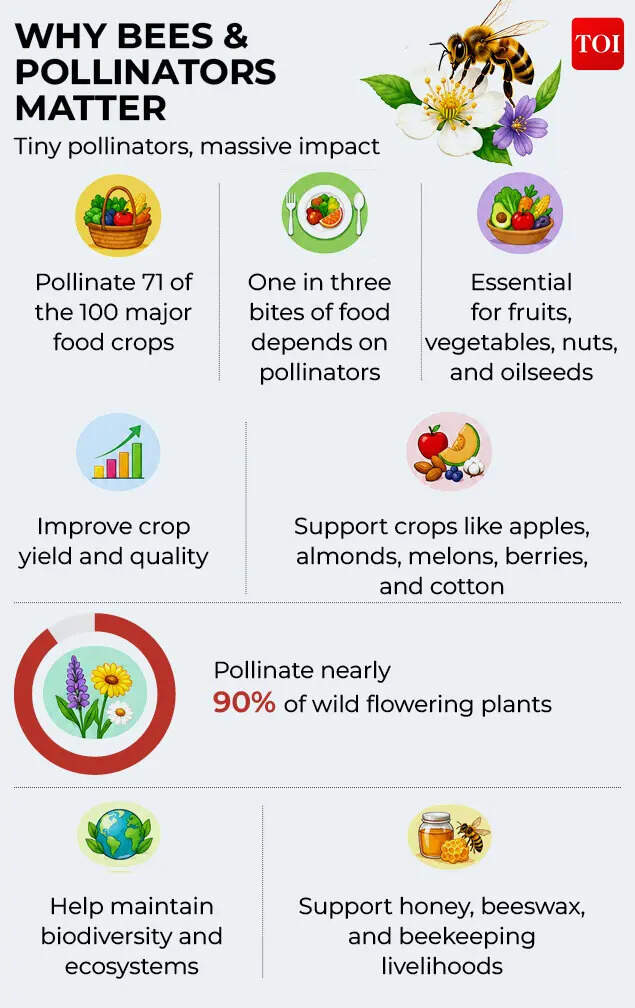
To understand the sheer scale of what is at stake, TOI spoke to Dr. K T Vijayakumar, a leading scientist at the University of Agricultural Sciences (UAS), Bengaluru. He explains that bees are among the most vital contributors to Earth’s baseline ecosystems and the global food supply.About one-third of all human food depends directly or indirectly on animal pollination, and bees do the heavy lifting. They are responsible for pollinating over 70 of the world’s top 100 food crops. When bees visit flowers to collect nectar and pollen for food, they act as the primary, unintentional drivers of plant reproduction.
-

Daily staples and high-value crops including apples, almonds, cucumbers, berries, pumpkins, and even essential beverages like coffee rely heavily on their constant labor. This natural partnership does not just trigger fruiting, it also significantly improves both the final crop yield and the physical quality of the produce.Without this invisible service, Dr Vijayakumar warns, wild plant diversity would rapidly weaken, triggering a devastating chain reaction across the entire food web. Entire ecosystems would become less healthy, less resilient, and deeply unstable.The impact is equally profound on a macroeconomic scale. Insect pollination adds billions of dollars in value to global agriculture each year by boosting the efficiency and value of agricultural outputs without human capital or cost.

Major threats facing bees today

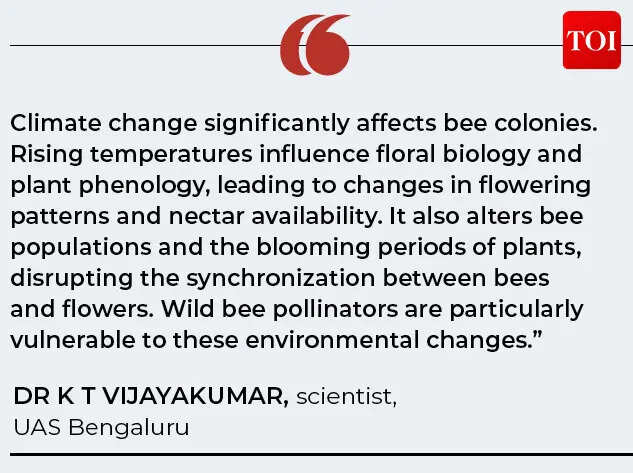
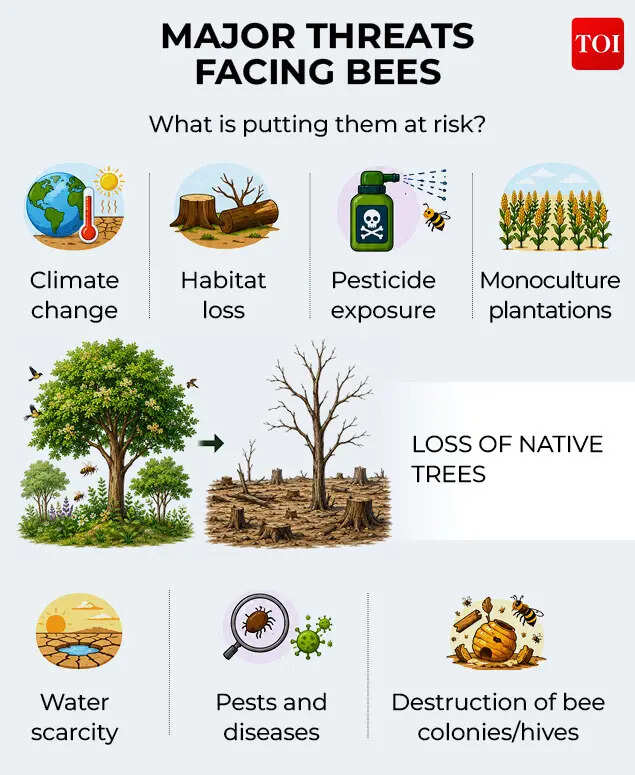
To map out exactly why these vital creatures are struggling to survive, scientists and conservationists point to an interconnected web of modern environmental, biological, and human-made pressures:Climate change and shifting phenology: Dr. Vijayakumar says climate change is significantly affecting bee colonies by disrupting long-standing synchronisation between bees and plants. Rising temperatures are altering plant phenology, shifting flowering times, shortening bloom periods, and reducing nectar availability. Bees, unable to adjust their life cycles quickly, often emerge after peak flowering has passed, leading to poor pollination and food stress.
-

The rise of agricultural monocultures: Amit Godse notes that diverse cropping systems are increasingly being replaced by monocultures. Crops like mustard offer abundant forage for a short period but leave long gaps with no floral resources. Bees require continuous pollen sources and suffer nutritional stress when this is absent, weakening their immunity.Systemic agrochemical poisoning: Neonicotinoids and similar pesticides are a major cause of colony decline. Absorbed into nectar and pollen, they damage bees’ nervous systems, affecting memory, navigation, and flight. Many worker bees fail to return to the hive, contributing to colony collapse.Emerging biological diseases and pests: Bee colonies are also under pressure from diseases and pests, including foulbrood, wax moths, mites, wasps, and the expanding small hive beetle in India. These threats damage colonies, contaminate stores, and can force hive abandonment.Habitat fragmentation and loss of native trees: Urban expansion and deforestation are reducing natural nesting habitats for wild bees. Old canopy trees are disappearing, while replacement plantations like eucalyptus and acacia offer poor nesting and limited forage for native species.The urban “death trap” phenomenon: In cities, discarded sweet liquid waste in plastic and paper cups attracts bees. Once inside, they become trapped and die in large numbers, turning urban spaces into accidental hazards for pollinators.Human fear and defensive eradication: Limited awareness leads to hostility toward bees. Instead of safe relocation, colonies found in homes or public spaces are often destroyed using chemicals or fire, causing avoidable mass deaths.
-

The overlooked bee species

When the average citizen visualizes a bee, they almost always picture a managed hive of European honeybees (Apis mellifera) or the native Indian honeybee (Apis cerana indica). However, scientists emphasize that there are over 20,000 bee species globally, comprising a vast, hidden tapestry of wild and solitary pollinators that look and behave nothing like domestic hive bees. These include: Bumblebees: Large, robust, and heavily furred, these bees are capable of a unique physical mechanism called “buzz pollination.” By vibrating their flight muscles at a specific frequency, they can dislodge firmly trapped pollen from deep-throated wild flowers and greenhouse crops like tomatoes.Carpenter Bees: Carpenter bees belong to the genus Xylocopa in the subfamily Xylocopinae, which includes around 500 species across 31 subgenera. The common name comes from their nesting behavior, as most species burrow into hard plant materials such as dead wood or bamboo to construct individual nests.Stingless bees (tribe Meliponini) are ancient, highly social insects widely kept in tropical and subtropical regions for specialized pollination and their prized, medicinal pot-honey. Solitary Bees: Accounting for the vast majority of all wild plant reproduction, these bees do not form communal colonies, live in hives, or answer to a queen. Every single female is a fertile queen who constructs an independent nest in sandy soil or hollow stems, quietly maintaining the plant diversity of their local micro-climates.Dr. Vijayakumar notes that these wild, unmanaged pollinators are by far the most vulnerable to human disruption. Unlike commercial honeybees, which receive human intervention, supplementary feeding, and shelter from beekeepers during lean seasons, wild bees depend entirely on undisturbed natural habitats.

What is Colony Collapse Disorder?

In recent decades, localized population drops have escalated into a structural, systemic failure known as Colony Collapse Disorder (CCD). First reported in the United States in 2006, CCD is a devastating phenomenon marked by the sudden, clean disappearance of an entire hive’s worker bee population. Mysteriously, they leave behind an intact queen, the immature brood, and plentiful food reserves, effectively rendering the hive a ghost town incapable of functioning.A 2025 study titled Buzzing into silence: A geographical analysis of Colony Collapse Disorder published in the International Journal of Ecology and Environmental Sciences by researchers Vijaylaxmi and Dr. H. N. Koli, emphasizes that CCD is not merely a freak biological anomaly. Instead, it is a complex socio-ecological crisis heavily shaped by regional agricultural policies, rapid land-use changes, and extreme chemical dependencies.According to the global synthesis of environmental data presented in their research, the primary drivers pushing bee colonies into silence are divided by distinct impact levels: neonicotinoid pesticides lead the crisis at an estimated 35%, followed by varroa mites at 20%, habitat loss and monocultures at 15%, climate variability at 15%, and the remaining share comprised of localized pathogens and urban pollution.

“Bees were everywhere, now they are disappearing”

This ecological decline is not an abstract statistical model; it is an observable reality on the ground. “Twenty years ago when I traveled to farms, you used to see bees everywhere,” Amit Godse recalls. “Today, the pollination is so down. It is difficult to find a bee on the farm, and it is disappearing even in the forest areas. Bees are not safe anywhere now, whether you go to a farm, a forest, or a city.”The empirical findings from Vijaylaxmi and Dr. Koli’s 2025 study confirm this worrying decline in India’s pollinator infrastructure. Over a 13-year trailing period, India’s total number of estimated active bee colonies has plummeted by nearly 40 per cent.In 2010, the nation possessed 1.50 million active colonies. This fell to 1.30 million in 2015, representing a 13.3% drop. The annual decline rate peaked significantly around 2020 with a massive 19.2% single-period loss, a window characterized by extreme regional climate anomalies and heavily intensified chemical inputs. By 2023, the number dwindled further to 0.92 million colonies, reflecting a persistent downward trajectory.

Uneven decline across India: Agrochemical density vs. resilience

The 2025 geographical analysis shows a clear link between pesticide intensity and colony loss, with high-input agricultural regions suffering significantly higher bee declines than diversified systems.Punjab (1.33 kg/ha pesticide use) reports about 25% hive loss, driven by intensive wheat and cotton cultivation. Maharashtra (1.18 kg/ha) records around 21% loss in horticulture and cash-crop zones. Rajasthan (0.72 kg/ha) shows a comparatively lower 15% loss across mustard and bajra regions.In contrast, states with lower chemical use and more diverse cropping patterns demonstrate greater resilience. Overall, higher pesticide intensity and monocultures consistently correspond to higher bee losses.

Urban vs rural: A shifting ecological paradox

This widespread urban hostility has created a bizarre and ironic ecological paradox. Godse reveals that there is a complex divide between urban and rural settings, and bee populations are increasingly being observed nesting in cities as compared to certain heavily degraded farmlands or rural forest areas.Rural ecosystems across India have undergone profound, negative ecological transformations. “Earlier, water was available throughout the year in forests and rivers,” Godse explains. “Now streams are drying up, groundwater levels are falling, and flowering plant diversity is disappearing.”Paradoxically, urban areas, despite their concrete density, often feature a continuous patchwork of home gardens, public parks, and ornamental flowering trees that offer a steady, year-round supply of nectar and water. However, this accidental urban sanctuary remains highly dangerous for bees due to human fear, resulting in frequent colony destruction driven by a systemic lack of public awareness.The field observations logged from the urban “death trap” studies, where up to 48 bees die every 10 minutes at high-traffic sugary waste disposal sites, prove that cities are a double-edged sword for the insects.

Path forward: What farmers and citizens must do

The crisis facing India’s pollinators is severe, but experts agree it is entirely reversible through deliberate behavioral, technological, and systemic adjustments. Vijaylaxmi and Dr. Koli advocate for a shift away from uniform national policies toward region-specific, targeted agricultural strategies.
-

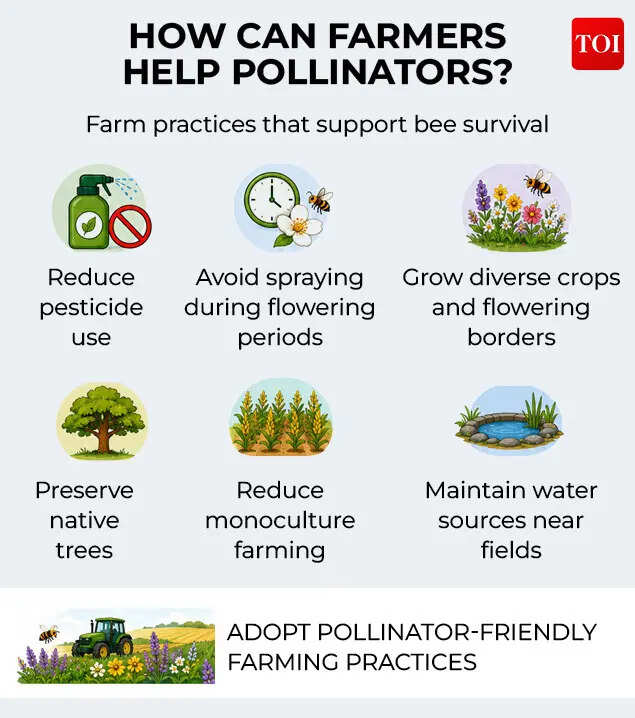
For the agricultural sector:

  • Implement Integrated Pest Management (IPM): Transition away from chemical-heavy reliance, adopt biological pest controls, and reduce dependence on bee-toxic neonicotinoid variants, mirroring successful international stabilization frameworks.
  • Establish dedicated floral corridors: Farmers must reject absolute monocultures by planting different, nutrition-diverse crops and maintaining wild floral boundaries to ensure bees have a continuous, year-round supply of forage between main harvests.
  • Practice smart spraying timing: Training smallholders to avoid applying any necessary chemical treatments during peak daylight foraging hours will minimize active chemical contact with visiting colonies.

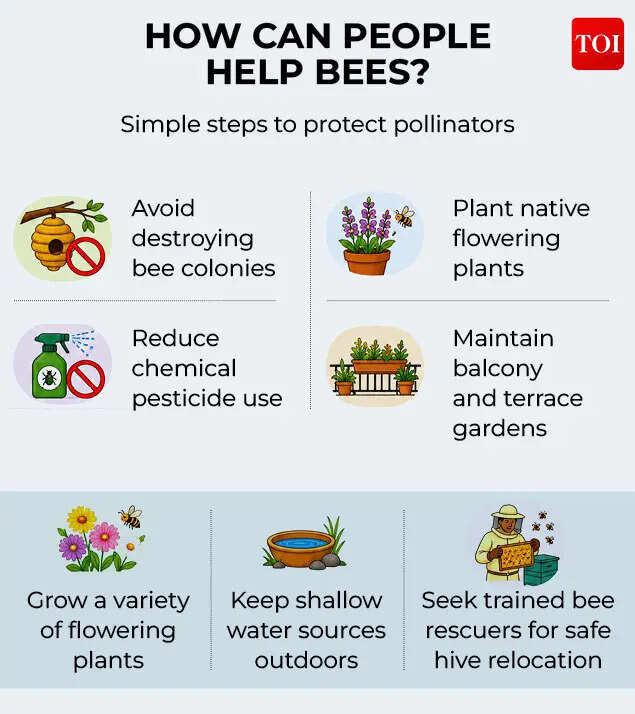
For urban citizens:

  • Halt destructive eradication: Communities must completely ban the practice of using pest control chemicals or fire to remove urban bee colonies, opting instead to contact trained conservation groups to safely relocate hives discovered in residential zones.
  • Manage sugary waste: Ordinary citizens can actively help by rinsing and crushing disposable sweet beverage cups before disposal, removing the “death trap” effect from roadside stalls.
  • Cultivate native flora: Transform balconies, terraces, and community public parks into safe foraging havens by planting a diverse array of native flowering plants.
-

As World Bee Day draws global attention to the plight of pollinators, the message from India’s scientific and conservation communities is clear, simple, and incredibly urgent.As Amit Godse succinctly puts it, “Bees are our friends, not enemies.

-

Bees are not aggressive pests or “enemies” to be feared, nor are they simply insects that produce honey. These hard-working architects are key pollinators that support food production, agricultural productivity, and ecosystem stability. Their survival is essential for global food security and food chain dynamics, as well as for maintaining crop yields, biodiversity, and overall ecological balance. Greater public awareness and reduced human-induced threats are crucial to their conservation.


Source link

Vaibhav Suryavanshi is creating ‘Gayle-level fear’, record of 59-sixes close, says Pathan

Vaibhav Suryavanshi is creating 'Gayle-level fear', record of 59-sixes close, says Pathan
Vaibhav Suryavanshi (Photo Credit: IPL)

Former Indian all-rounder Irfan Pathan He heaped praise on teenage sensation Vaibhav Suryavanshi, saying he is instilling the same fear among young bowlers as the great T20 powerhouse. chris gayle Did it once during his prime years. Pathan also believes that Suryavanshi is now actually threatening Gayle’s long-standing IPL record of 59 sixes in a season.Rajasthan Royals The 15-year-old prodigy kept their IPL 2026 playoff hopes alive with a thrilling seven-wicket win over Lucknow Super Giants at the Sawai Mansingh Stadium thanks to another breathtaking innings from the 15-year-old prodigy. Chasing a tough target of 221, Suryavanshi scored 93 runs in just 38 balls at an astonishing strike rate of 244.74, which included seven fours and 10 skyscraper sixes.This explosive innings also helped him create history as the first Indian batsman to hit 50 sixes in a single IPL season.Earlier in the evening, LSG had posted a mammoth score of 220/5 after a strong opening partnership between Mitchell Marsh and Josh Inglis. Marsh scored 96 runs in 57 balls, while Inglis scored 60 runs in just 29 balls. Yashraj Punia emerged as the pick of the RR bowlers with figures of 2/35.During the chase, Yashasvi Jaiswal provided the early pace while Suryavanshi started cautiously, scoring only five runs from his first 10 balls. But once he settled in, Kishore completely took over the contest, scoring 24 runs in one over against Akash Singh and scoring a brilliant half-century in 23 balls.Speaking after the match, Pathan highlighted Suryavanshi’s maturity and improved range in his batting as the most impressive aspect of his innings.“It was incredible. The maturity he showed was the highlight for me. Whenever we watch Vaibhav Suryavanshi we always say he is a very good leg-side player, but the way he played on the off-side in this game was brilliant,” Pathan said on Geostar.“He has very good control over his back-lift. He was driving over cover and also playing upper-cuts over third man. It is very difficult to stop him,” he said.“In his first 10 balls, he was batting at a strike rate of less than 100 and by the end of the innings, he had scored 93 runs off just 38 balls,” Pathan said.After this, the former Indian all-rounder compared him with Chris Gayle and said that the bowlers have started feeling the same fear against Suryavanshi that they once felt against the West Indies icon.“With 53 sixes, he is actually going past Chris Gayle’s record of 59 sixes, which has stood since 2012. As bowlers, we were always scared of facing Chris Gayle. Vaibhav Suryavanshi is instilling the same fear, and Gayle’s record is definitely in danger,” Pathan concluded.

Source link

1,700-year-old Roman tombs reveal that coffins sealed for centuries contained dye worth more than gold

1,700-year-old Roman tombs reveal that coffins sealed for centuries contained dye worth more than gold

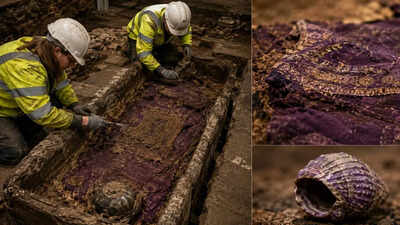
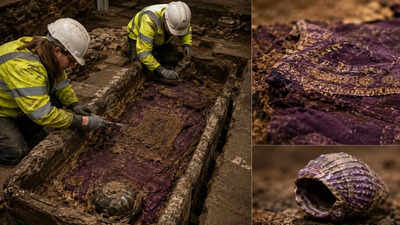
Archaeologists studying ancient Roman tombs in England have revealed a discovery that is changing what experts know about wealth and burial traditions in Roman Britain. While investigating an infant burial in Roman York, researchers identified traces of Tyrian purple, one of the rarest and most expensive dyes in the ancient world. As reported in Bioscience, the remarkable discovery was hidden inside buried remains approximately 1,700 years old. Researchers also discovered delicate gold thread woven into pieces of cloth, suggesting that the children buried there belonged to families of extremely high social status. Experts say the discovery is especially important because ancient textiles rarely survive long enough to be studied. In this case, it appears that unusual burial conditions have preserved small traces of fabric and dye beneath York’s soil for centuries.

Ancient Roman burials reveal rare dye worth more than gold

The discovery was made during research conducted on two Roman-era burials dated to the late 3rd or early 4th century, one burial contained a child believed to be about two years old, placed inside a stone coffin with two adults. In the second burial an infant, only a few months old, was placed inside a lead coffin.Researchers at the University of York examined preserved material from the tombs and identified traces of luxury textiles that once covered the bodies. According to archaeologists, the clothes were decorated with gold thread and dyed using Tyrian purple, a color strongly associated with wealth, power, and royal authority in the Roman Empire.Project director Maureen Carroll said this is the first confirmed evidence of Tyrian purple discovered in Roman York. Researchers reportedly did not expect such rare material to survive inside the tombs.

What made Tyrian Purple more valuable than gold?

Tyrian purple was one of the most prized colors in the ancient world. This color was primarily prepared using Murex sea snails collected near the ancient Phoenician city of Tyre, located in present-day Lebanon.The process of making the dye was extremely difficult and time consuming. Thousands of sea snails had to be crushed to produce very small quantities of the pigment. Since production required immense effort and resources, the dye became incredibly expensive. Historians say that during certain periods of Roman history, Tyrian purple was worth several times more than gold by weight.As a result, purple robes became a symbol of elite status throughout the Roman Empire. Emperors, nobles, and wealthy officials often wore purple to display their power and importance. Experts believe that the discovery of Tyrian purple in Roman York shows that the families associated with these burials were among the wealthiest people living in Britain at the time.

How gypsum helped preserve rare purple textiles for 1,700 years

Ancient textiles are rarely preserved because the fabrics usually decay quickly underground. However, archaeologists believe that an unusual gypsum burial method in these tombs helped preserve the remains for centuries.Liquid gypsum was poured around bodies during burial ceremonies. Over time, the material hardened into a protective covering that preserved the marks and microscopic marks of the fabric. In some areas, a light purple color can still be seen on the surface of the gypsum during examination. Many traces of the dye were invisible to the naked eye and could only be detected after scientific testing. Research specialist Jennifer Wakefield led the laboratory analysis using liquid chromatography-tandem mass spectrometry, also known as LC-MS/MS. Testing confirmed that the pigment found inside the tombs was genuine Tyrian purple, and not another red or purple dye sometimes used in Roman textiles. The researchers described the results as surprising and extremely important for the study of Roman Britain.

Source link

PM Modi, Donald Trump may face each other at the G7 summit in France next month

PM Modi, Donald Trump may face each other at the G7 summit in France next month

New Delhi: Prime Minister Narendra Modi and US President donald trump Expected to face each other in France next month g7 summit.The White House told news agency AFP that Trump would visit France despite tensions between Washington and its allies over issues ranging from Iran to tariffs.The summit, to be held from June 15 to 17 in Evian-les-Bains in southeastern France, is expected to cover issues including artificial intelligence, trade, critical minerals, immigration and global security.Reducing regulatory barriers and increasing energy production, especially fossil fuels, are also likely to be discussed. Iran is expected to feature prominently in comprehensive talks amid ongoing tensions in West Asia.Trump has repeatedly criticized NATO allies, including Britain, France, Germany and Italy, accusing them of failing to provide adequate support to Washington during the ongoing conflict with Iran.Strategic tensions have also prompted a change in rhetoric from major European capitals. German Chancellor Friedrich Merz recently reaffirmed the importance of trans-Atlantic relations, calling the United States “Germany’s most important partner in the North Atlantic alliance,” days after criticizing Trump’s handling of the Middle East conflict.Trump’s attendance at the summit, scheduled for the meeting of the Group of Seven major economies in the French Alpine resort town, was not previously confirmed.Meanwhile, French President Emmanuel Macron had extended the invitation during his visit to India in February PM Modi. Although India is not a permanent member of the G7, it regularly participates in the annual summit as a special invitee.The last meeting of PM Modi and Trump took place in February after returning to the Oval Office in Washington.In the high-profile meeting held against the backdrop of tariff tensions, Trump described Modi as a “great friend” while the two leaders pledged to double India-US trade to $500 billion by 2030.The expected meeting in France will be closely watched for signals on trade talks, energy cooperation and broader strategic alignment between New Delhi and Washington amid rising global geopolitical tensions.

Source link

What to do and what not to do during this month

Adhik Maas 2026: Do's and Don'ts during this month

Adhik Maas is also known as Purushottam Maas. This month is one of the most sacred months according to the Hindu calendar. This month is dedicated to the worship of Lord Vishnu. This entire month is considered highly auspicious for spiritual growth, charity, devotion and self-discipline. It is considered auspicious for performing various spiritual and religious activities. Purushottam month started from 17th May and it will end on 15th June, 2026 so one should follow some guidelines which we are going to mention below. Let’s see the do’s and don’ts given below:

Here are the following do’s and don’ts to follow during Purushottam month:

follow spiritual activities

This month is extremely holy and sacred. People perform various religious and spiritual activities ranging from lighting lamps, praying, meditating and chanting mantras to reciting holy scriptures.

keep fast

People can observe fast on any special day to please Lord Vishnu. Thursday is dedicated to Lord Vishnu, hence one must worship him on this special day.

chant mantras

During this month, one should chant various mantras of Lord Vishnu, Lord Rama and Lord Krishna to please them as they bless the devotees with the fulfillment of their desired wishes. This is going to be a powerful ritual that everyone should follow during this month.

read any scripture

Devotees are advised to read any holy scriptures like Ramcharitmanas and Bhagavad Geeta as these scriptures will help you to connect with God and you will be able to learn a lot of things through it.

Recite Stotra/Kavacham

You can recite Shri Hari Stotra, Narayan Kavach and Vishnu Sahasranama as reciting them during this Purushottam month can be beneficial. With this, all your desired wishes will be fulfilled.

don’t drink alcohol

As we know that Purushottam month is dedicated to Lord Vishnu so the entire month is considered extremely sacred and you need to stay away from alcohol.

Avoid non-vegetarian food

Devotees should avoid eating non-vegetarian food as it will create hindrance if you are looking for spiritual growth. Pure vegetarian and satvik food is preferred as it will make you feel calm and comfortable while following spiritual activities.

Avoid anger and negative speech

In this month you should avoid using negative words, jealousy, hatred and greed. There are five bad elements in all of us that we should try to improve and Purushottam month is the most important month to follow this.

Avoid auspicious events

Since this month is also known as Adhik Maas, organizing auspicious events like marriage, engagement, roka, housewarming ceremony, naming ceremony, buying property and starting new business ventures should be avoided.

Source link

Riyan Parag urges IPL commentators to ‘talk about cricket’

'We're human too, we make mistakes': Riyan Parag urges IPL commentators to 'talk about cricket'

New Delhi: Riyan Parag launched a concerted defense of the players after Rajasthan Royals‘The seven-wicket win over Lucknow Super Giants in Jaipur urges commentators and experts to stop personal criticism and focus on the game.The RR captain, who missed the match due to a hamstring problem and remained among the impact substitutes, said players often face unfair judgment from outside despite preparing for several days for every game. “We perform as per the expectations of the audience. So I think we all should love cricket and look at it the same way. The players are working very hard,” Parag said after the win. “It is very easy to say, if a team is all out for 75 or 80 runs, they do not know how to play or do not have the mentality to play. But there is 3-4 days of preparation before that match to ensure how we can score 200-250. But sometimes this does not happen.‘Commentators should talk about cricket’Parag, who has often been in the headlines this season for reasons beyond his performances, including an off-field controversy, said criticism crosses the line when it becomes personal.He said in the post-match press conference, “We are also human beings and we also make mistakes. So, I think the more that is coming out, especially the commentators, their voices are reaching the people. I would request them to love cricket. Talk about cricket.”The 24-year-old player, who was recently named vice-captain of the India A team for the Sri Lanka tri-series, said the game deserves more respect from those who shape public opinion.“The game, which is the most important game in the country, and the one in which we are the best, should be treated with some respect. We should only talk about cricket.” We shouldn’t be talking about anything else,” he said.Parag said that he has learned to control external noise.Parag said, “In the last four years, I have understood one thing – no matter what I do, there will be conversations. I have also understood that whatever conversations are happening, it should not affect my game, my form or my mentality because keyboard warriors are outsiders.”

Riyan Parag Jai Ho Vaibhav Suryavanshi

Parag also gave special praise to 15-year-old opening batsman Vaibhav Suryavanshi, who scored 93 runs in 38 balls to chase down the target of 221 runs.“I think that was his best innings,” Parag said. “When he was on 5 at 10 or 11, there were always two ways to go. But he took his time. That first big shot from Mayank Yadav over cover gave me the satisfaction that he may be short, but he has a great understanding of the game.”

Source link

Can people be allergic to water? Scientists say this rare condition makes it possible

Can people be allergic to water? Scientists say this rare condition makes it possible

For most people, water is harmless, even comfortable. It cools the body on hot days, washes away dirt and makes up about 60 percent of the human body itself. But for a small number of people around the world, contact with water can cause painful, itchy hives within minutes. The condition known as aquagenic urticaria is so rare that only a limited number of cases have been formally documented in the medical literature. Researchers say patients may react to rain, showers, swimming pools and, in some cases, even their own sweat. Although scientists still do not fully understand this disorder, decades of medical studies confirm that this rare condition is real.

What do scientists know about water allergies?

This condition was first described in 1964 by researcher F. Shelley and W. Rawnsley, who documented patients developing hives after exposure to water. Since then, dermatologists and immunologists have been trying to understand why this happens. Scientists believe that people are not actually allergic to water itself. Instead, water can interact with substances in the outer layer of the skin, causing immune cells called mast cells to release histamine, the chemical responsible for itching and inflammation.A 1981 study by researcher RG Sibbald and colleagues found evidence of histamine release during exposure to water, lending support to the theory that the condition is associated with an abnormal immune response rather than simple skin irritation.

Symptoms may appear within minutes

People suffering from aquagenic hives usually develop small raised lesions and intense itching soon after water touches the skin. The reaction usually appears within 20 to 30 minutes and may last for an hour or more. The longer the exposure, the more severe the symptoms may become.Doctors say that even routine activities can become difficult. If sweating causes a flare-up, patients may need to take shorter baths, avoid swimming, or limit exercise. Interestingly, most people with this condition can still drink water normally because the reaction occurs through skin contact rather than through the digestive tract.Because the disorder is so rare, diagnosis can take time. Doctors often rule out more common causes of hives before considering aquagenic hives. The standard diagnostic method is called a water provocation test, where a cloth soaked in room temperature water is placed on the skin for about 20 minutes to see if hives develop.Researchers Robert Rothbaum and Gene S. Medical reviews, including McGee’s 2016 analysis, have highlighted how difficult the condition can be to recognize as many physicians may never encounter a case during their careers.

Is there any treatment?

There is currently no cure for aquagenic hives, but treatment can help control symptoms. Doctors usually prescribe antihistamines, which block the release of histamine in the body. Some patients with severe symptoms have also responded to therapies such as omalizumab, a drug commonly used for asthma and chronic allergic conditions.A 2022 systematic review by researcher Chuda Rujitharanawong and colleagues found that antihistamines remain the primary treatment option, although researchers are still searching for more effective treatments.

A mystery scientists still can’t fully explain

Despite decades of study, scientists still don’t know exactly why some people develop aquagenic hives. Researchers are investigating whether a substance hidden in the skin activates the immune system by reacting with water. For now, the condition remains one of medicine’s strangest documented disorders, a rare example of how the body can sometimes react to even the most essential substance for life.

Source link

TVK advocates unity amid tension in alliance over AIADMK rebels

'Wants to work like a family': TVK pitches for unity amid tensions in alliance over AIADMK rebels

New Delhi: Tamil Nadu minister Adhav Arjun on Wednesday said Chief Minister Vijay wants his cabinet to “work like a family” as cracks appear in the alliance over the possibility of including rebel AIADMK MLAs in the government.Speaking to reporters, Arjun said that Vijay wanted the parties supporting the government to get representation in the cabinet.“The CM wants the cabinet to work like a family. He wants the supporting parties to get representation in the cabinet. The DMK and AIADMK attempted to form an alliance which went against the people’s decision,” the minister said.Read this also ‘I think they will not go to that extent’: Shanmugam warns CPM to reconsider support if TVC inducts AIADMK rebels into cabinet.“During the elections, DMK said that AIADMK is under the control of BJP, but later it forgot its ideology and negotiated an alliance with AIADMK. Congress and Left parties united on one front to protect the constitutional system. We will travel together with AIADMK in the spirit of friendship.The comments come a day after CPM said it would reconsider its support to the Vijay-led government if it accommodates the rebel AIADMK faction in the cabinet.Read this also 2 Congress MLAs will join Vijay government, currently no AIADMK rebelAddressing a press conference, CPM leader Shanmugam said the basis for supporting the TVK was to stop the imposition of President’s rule and prevent “backdoor entry into BJP rule”.Shanmugam said the purpose of this arrangement is to ensure governance by a party elected by the people. However, he said the inclusion of rebel AIADMK members in the Council of Ministers would be against the party’s stand on mandate and clean governance.He said, “No party got the majority and TVK emerged as the largest party, and hence only they had the scope to form the government. With the idea of ​​facilitating governance by a party elected by the people, the Left parties and the VCK extended outside support to the TVK, enabling it to form the government.”“I think the TVK will not go to that extent (of including the AIADMK rebel group in the cabinet). In case the TVK takes such a stand, the CPI(M) will reconsider its support to the TVK,” he said.TVK had passed the floor test in the Assembly on May 13 with the support of AIADMK rebels, expelled AMMK MLA Kamaraj, Left parties, VCK and IUML.

Source link

Check steps to download hall ticket here

IGNOU June TEE Admit Card 2026 Expected to Release Soon at ignou.ac.in: Check Steps to Download Hall Ticket Here
IGNOU June 2026 June Admit Card 2026

Indira Gandhi National Open University (IGNOU) will start the June 2026 Term End Examination (TEE) from June 1, 2026. Lakhs of students across the country are preparing to appear for the examination. It is expected that the university will release the admit card soon on the official website ignou.ac.in. The university will conduct the examinations for students enrolled in Open and Distance Learning (ODL) and Online Programs (IoP) by July 21, 2026. Students appearing for the examination will soon be able to download their hall tickets through the official IGNOU Samarth portal.

IGNOU Admit Card 2026: Details Mentioned on Hall Ticket

IGNOU June 2026 TEE Hall Ticket will contain many important details related to the exam, and students are advised to verify all the information carefully after downloading the admit card. The hall ticket will contain the candidate’s name, enrollment number, program name, exam date, exam timings, exam center details and important exam-day instructions. Students are instructed to immediately report any discrepancy or error in the details of the admit card to the university authorities before the commencement of the examination.

IGNOU Admit Card 2026: Steps to download hall ticket

Students appearing for June 2026 Term End Examination can follow these steps to download their IGNOU Hall Ticket:

  • Visit the official IGNOU Samarth portal, ignou.samarth.edu.in.
  • Click on the link “IGNOU June 2026 TEE Hall Ticket” available on the homepage.
  • Enter your Username and Password to Login.
  • Select your enrollment number and program details.
  • Hall ticket will appear on the screen.
  • Download the admit card and take a printout of it for future use.

Candidates will be able to check IGNOU Admit Card 2026 from the official website by clicking on the link given here.Candidates are advised to stay tuned to the official website to get complete information on IGNOU Admit Card 2026.

Source link